Tag Archives: French

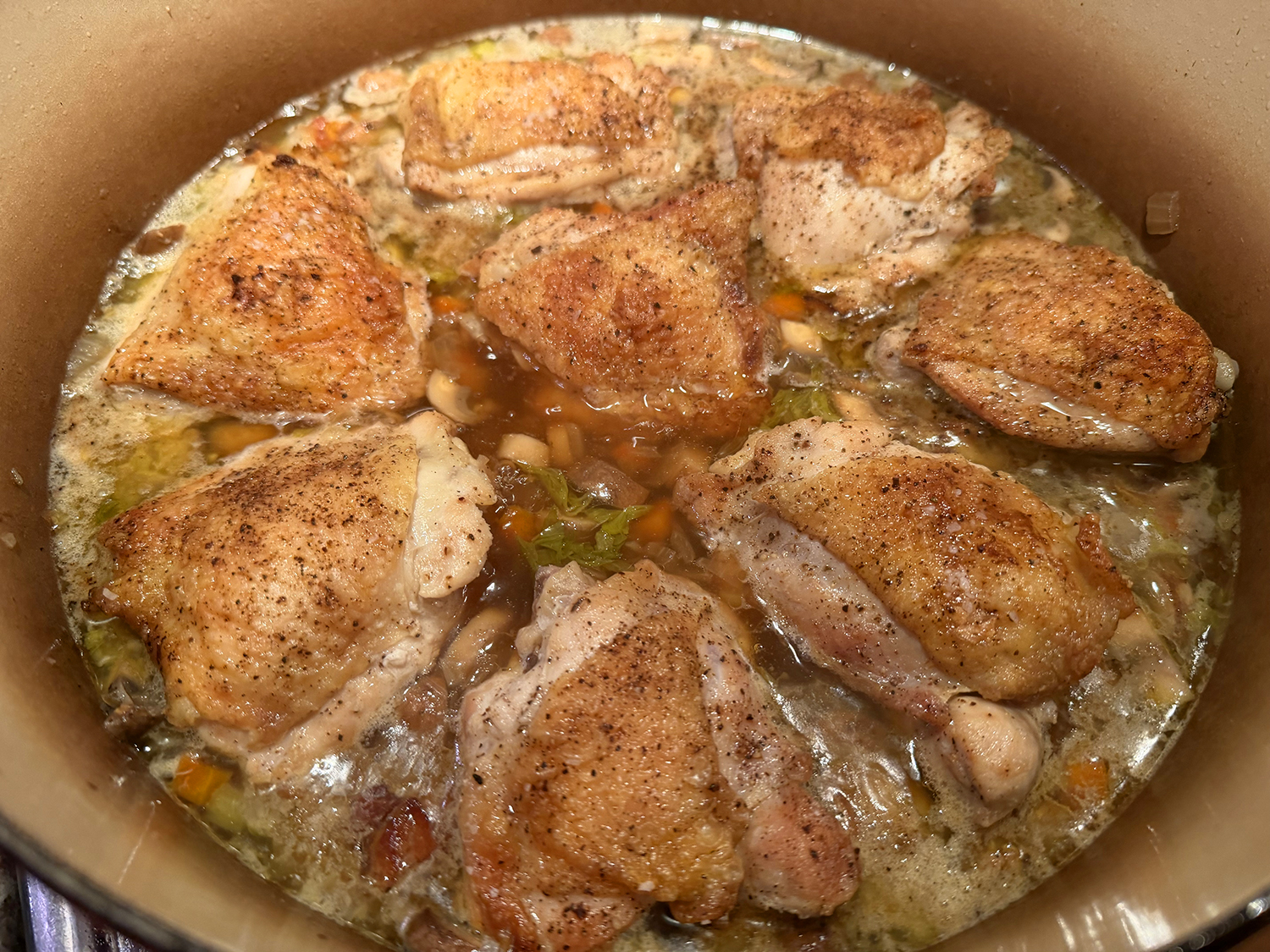
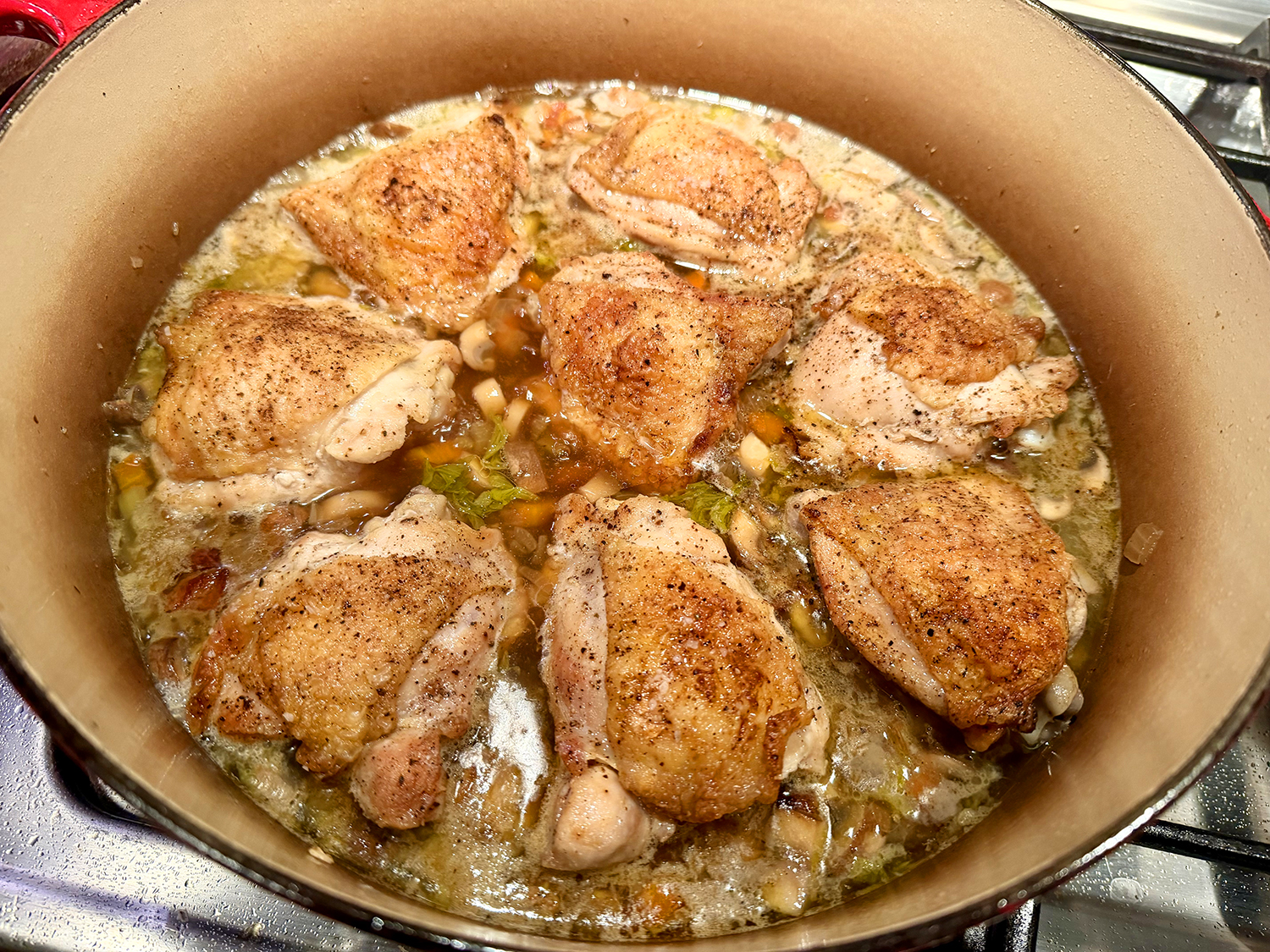
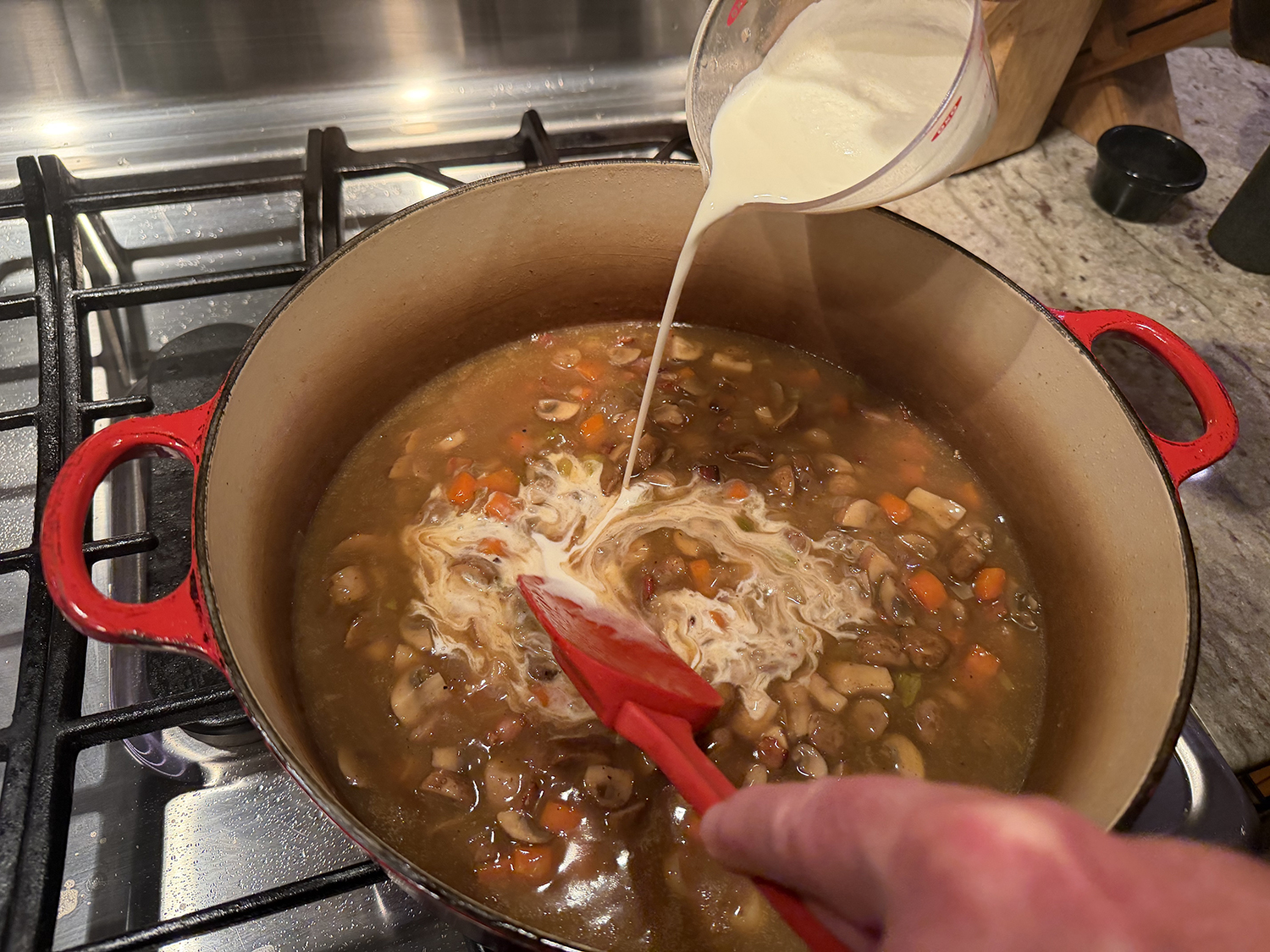
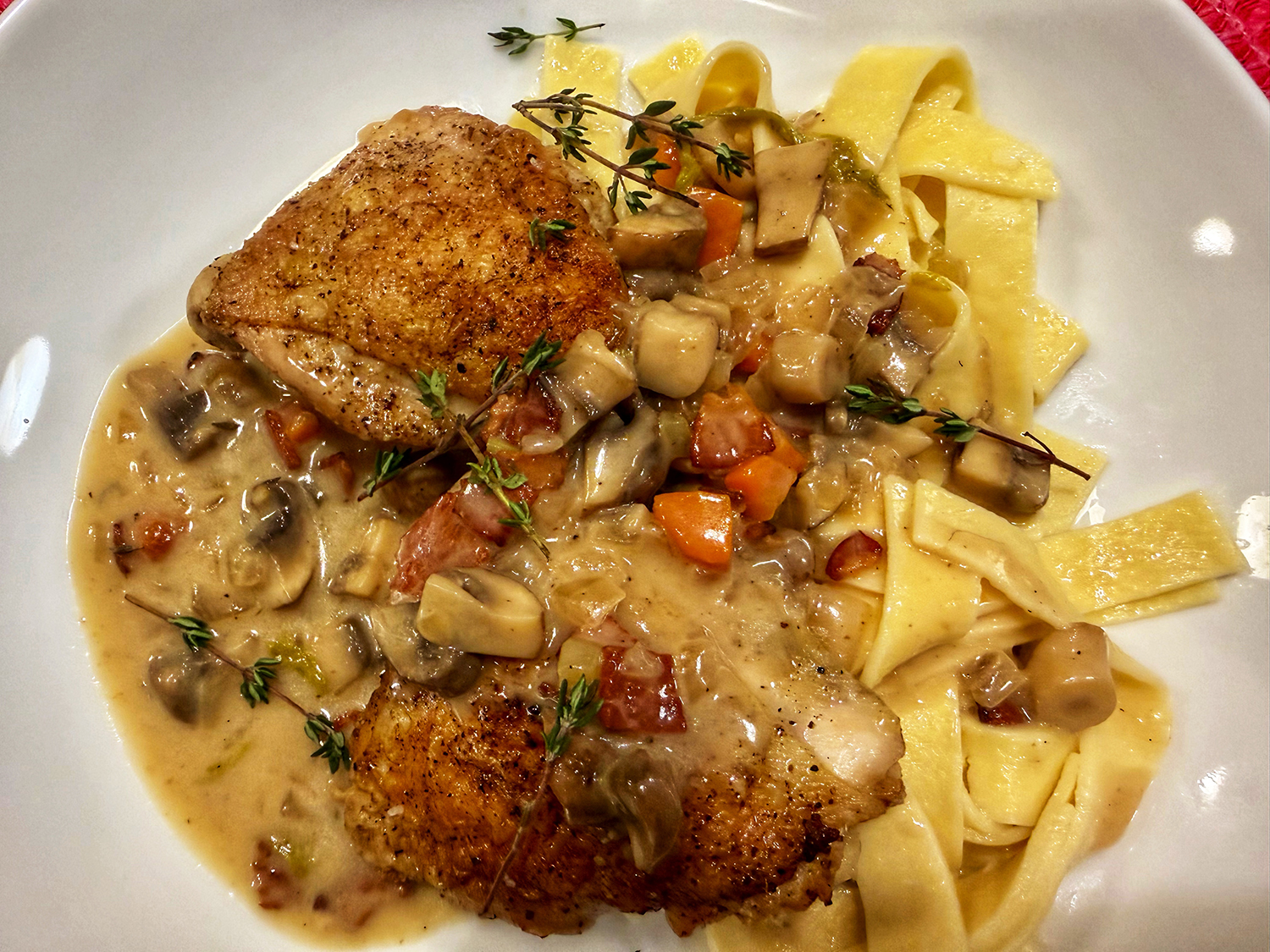
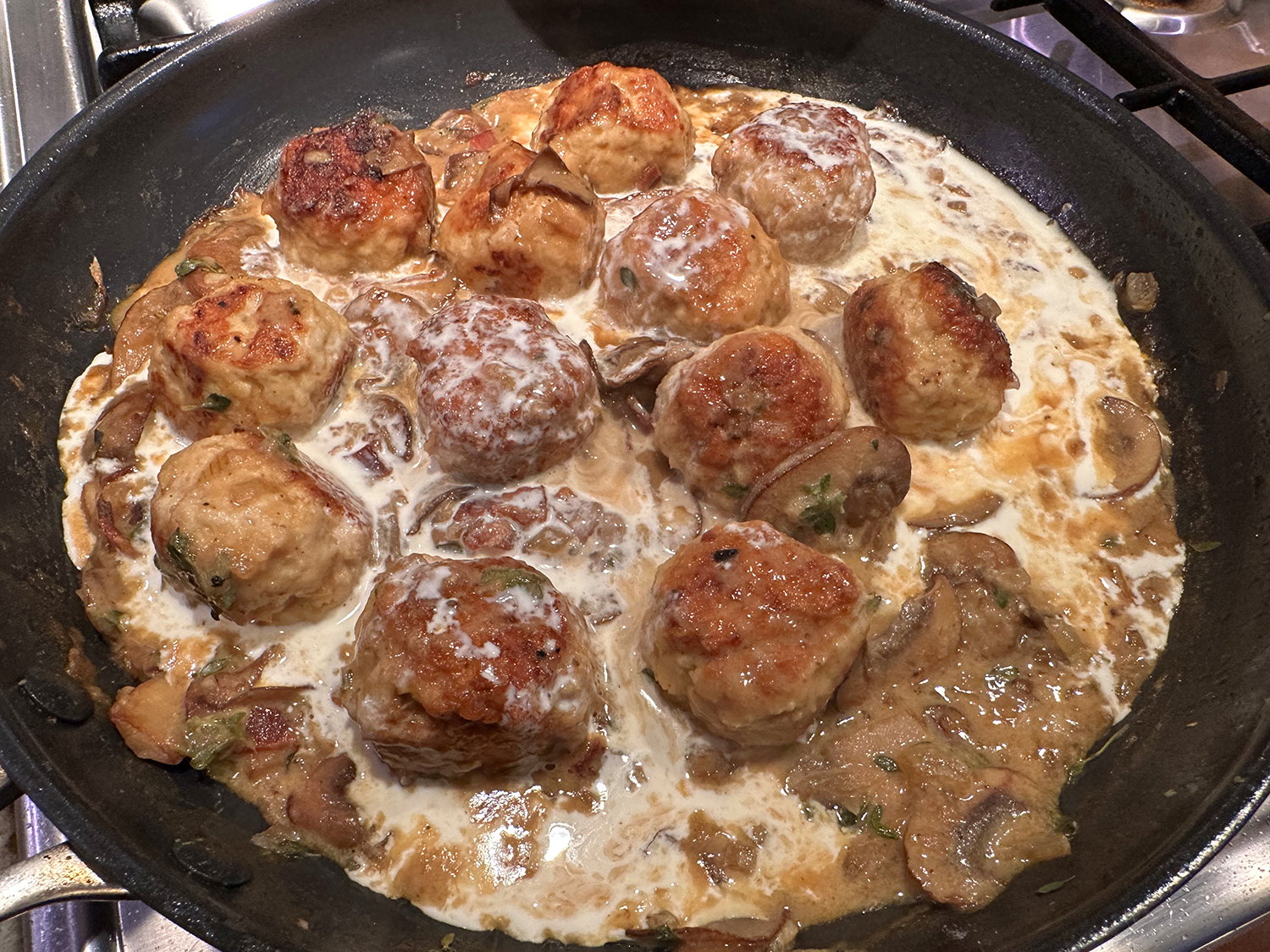
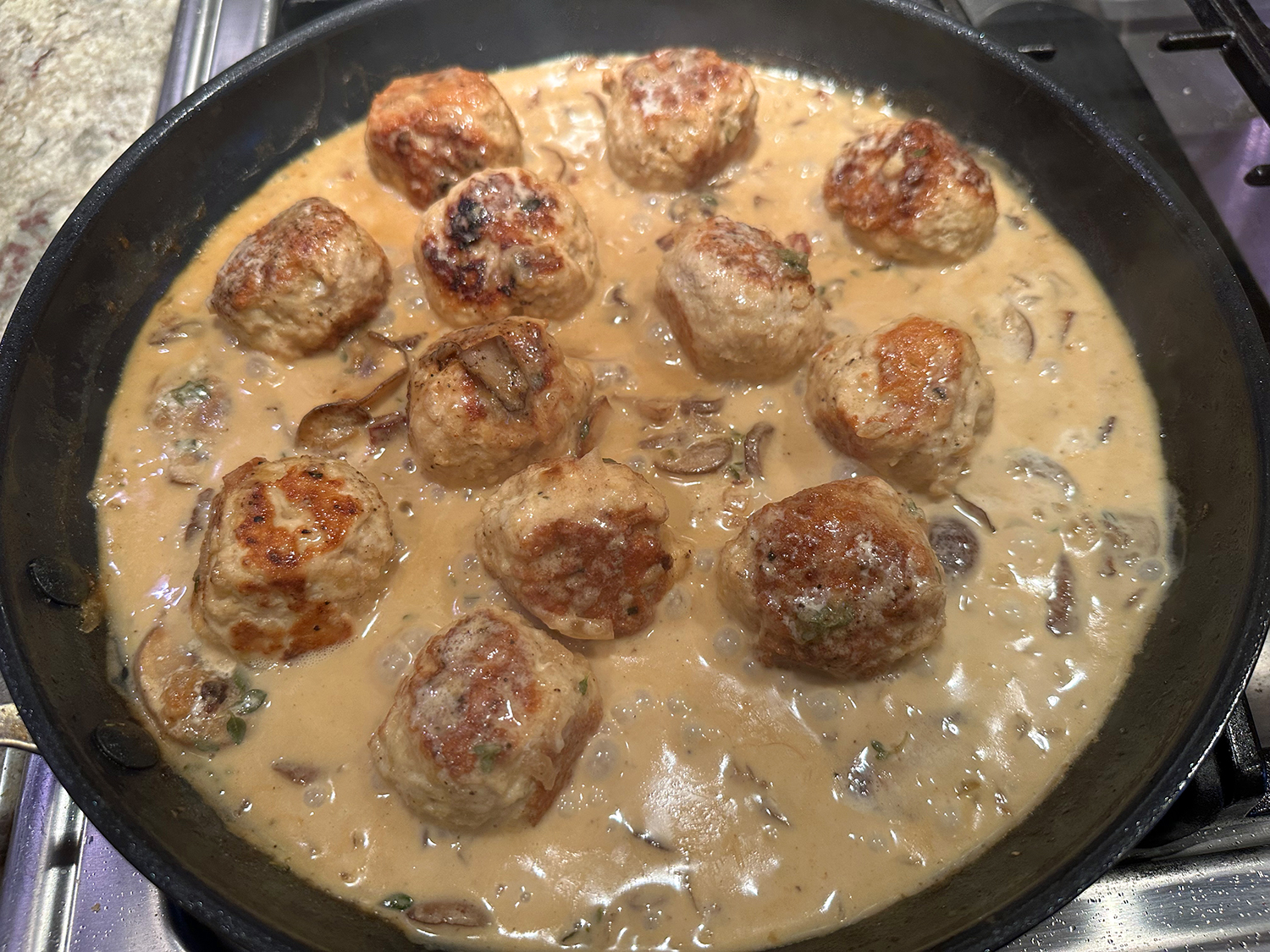
Coq Au Vin Meatballs

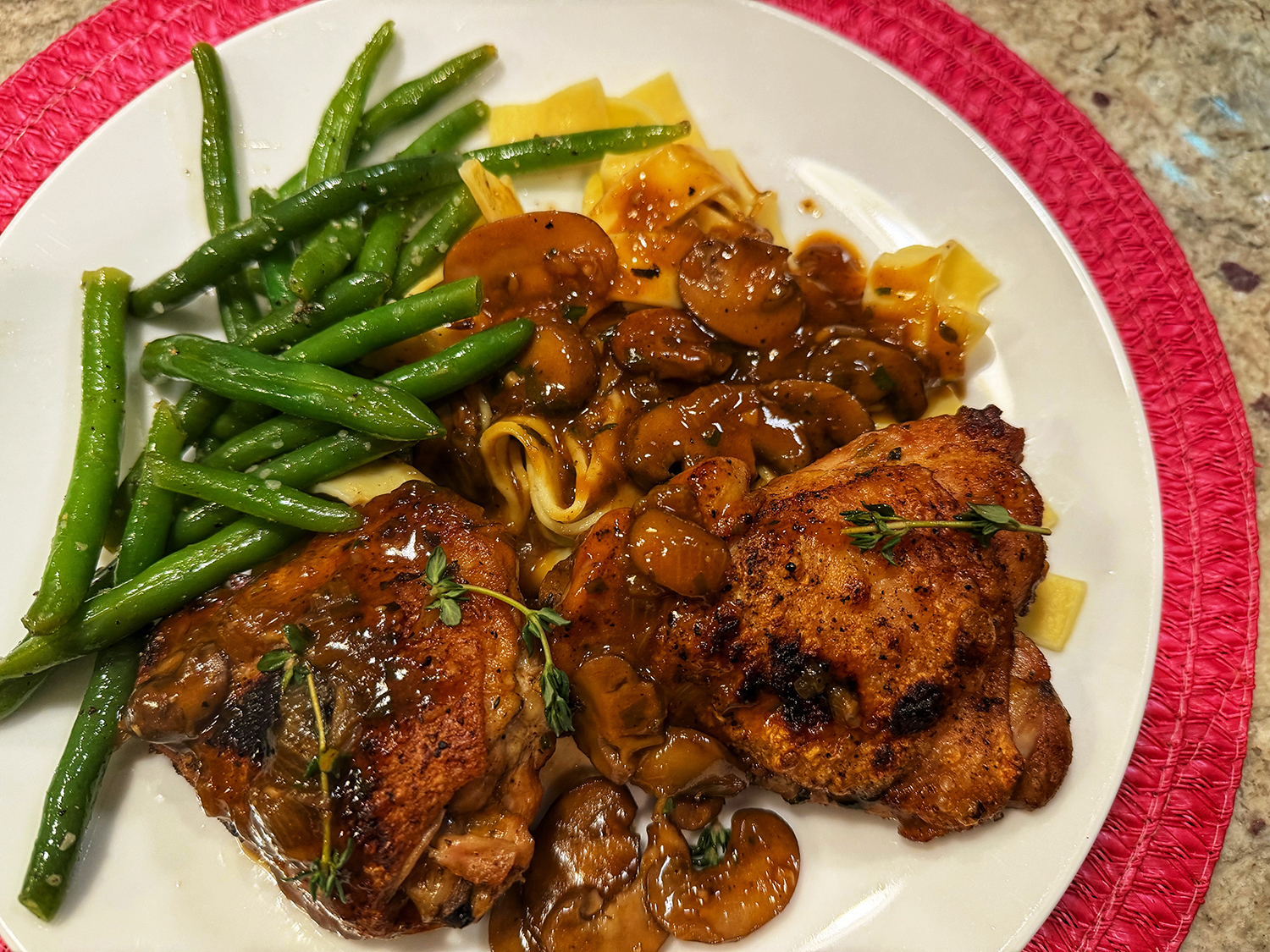
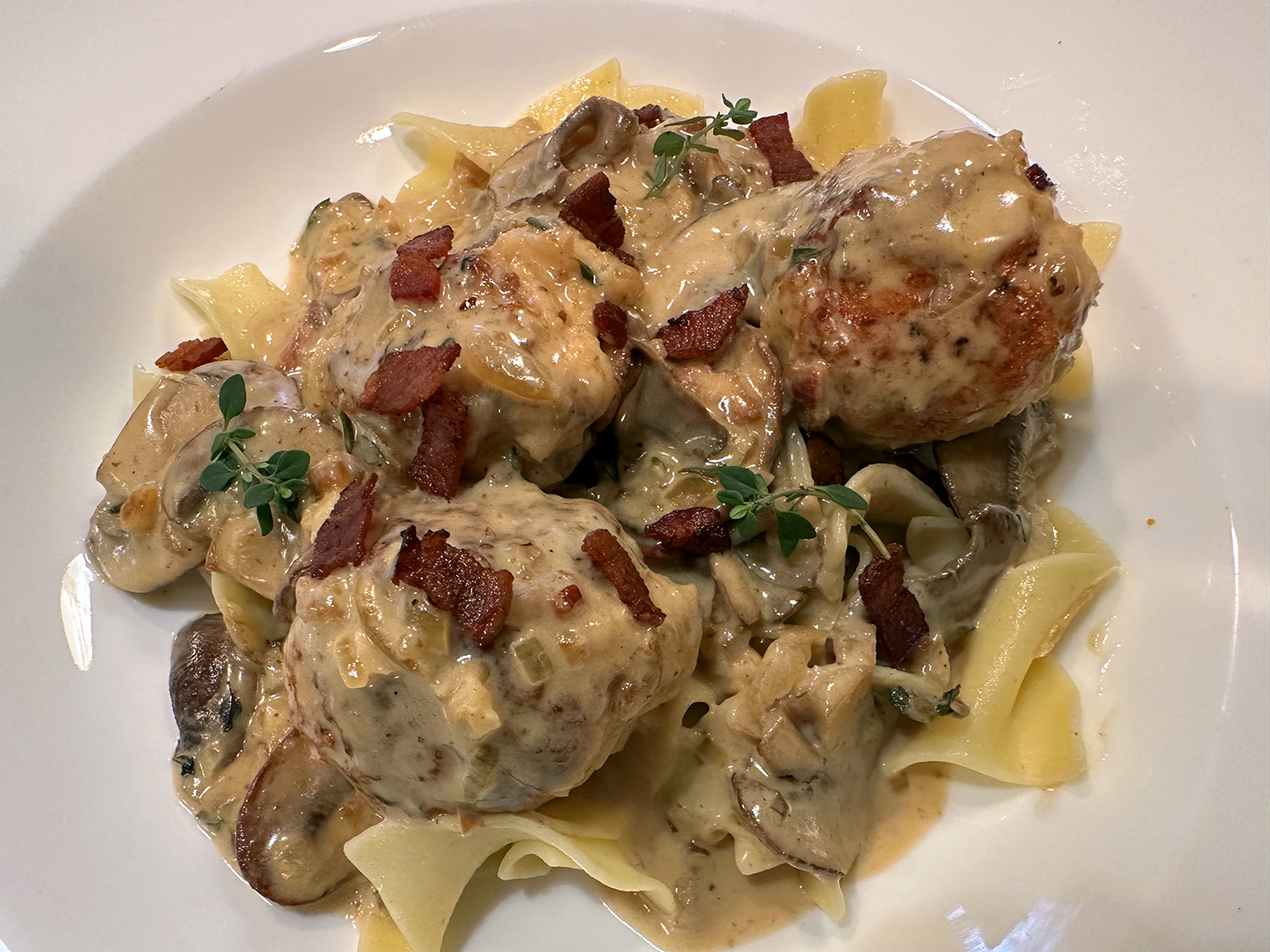
From Food & Wine, this riff on Coq au Vin, a classic French dish of chicken braised in a red wine stew, swaps out the chicken for ground turkey, leans on white wine, and transforms the dish into a semi-quick weeknight dinner. Tender turkey meatballs are browned and then finished in a simple and lightly acidic pan sauce speckled with earthy mushrooms and smoky bacon.

When making these meatballs, you can substitute ground chicken for ground turkey. Be sure to source ground chicken that is a mix of white and dark meat, not just ground chicken breast, which is very lean and will result in dry meatballs. Keep the meatballs chilled until you are ready to cook to help them hold their shape.

*Our meatballs ended up being quite dense, probably because they were too lean at 99%. So, just as you should not purchase all white chicken meat, buy ground turkey that’s no more than 93% lean, and try not to overwork them when creating the balls. We also suggest that after you place the meatballs back into the skillet with the sauce that you partially cover the pan. This should ensure the sauce won’t reduce too much and the meatballs will get to temperature quicker and stay more moist.

The original recipe indicates it feeds four, three 1 1/2-inch meatballs per guest. We had our doubts, thinking so few meatballs per person would be a bit on the shy side. However, served over noodles or pasta, it was quite filling (we also paired with a side salad). Meatballs can be prepared through Step 1 up to one day in advance. Proceed with the recipe as directed when ready to cook.

Coq Au Vin Meatballs

  • Servings: 4
  • Difficulty: easy
  • Print

Ingredients

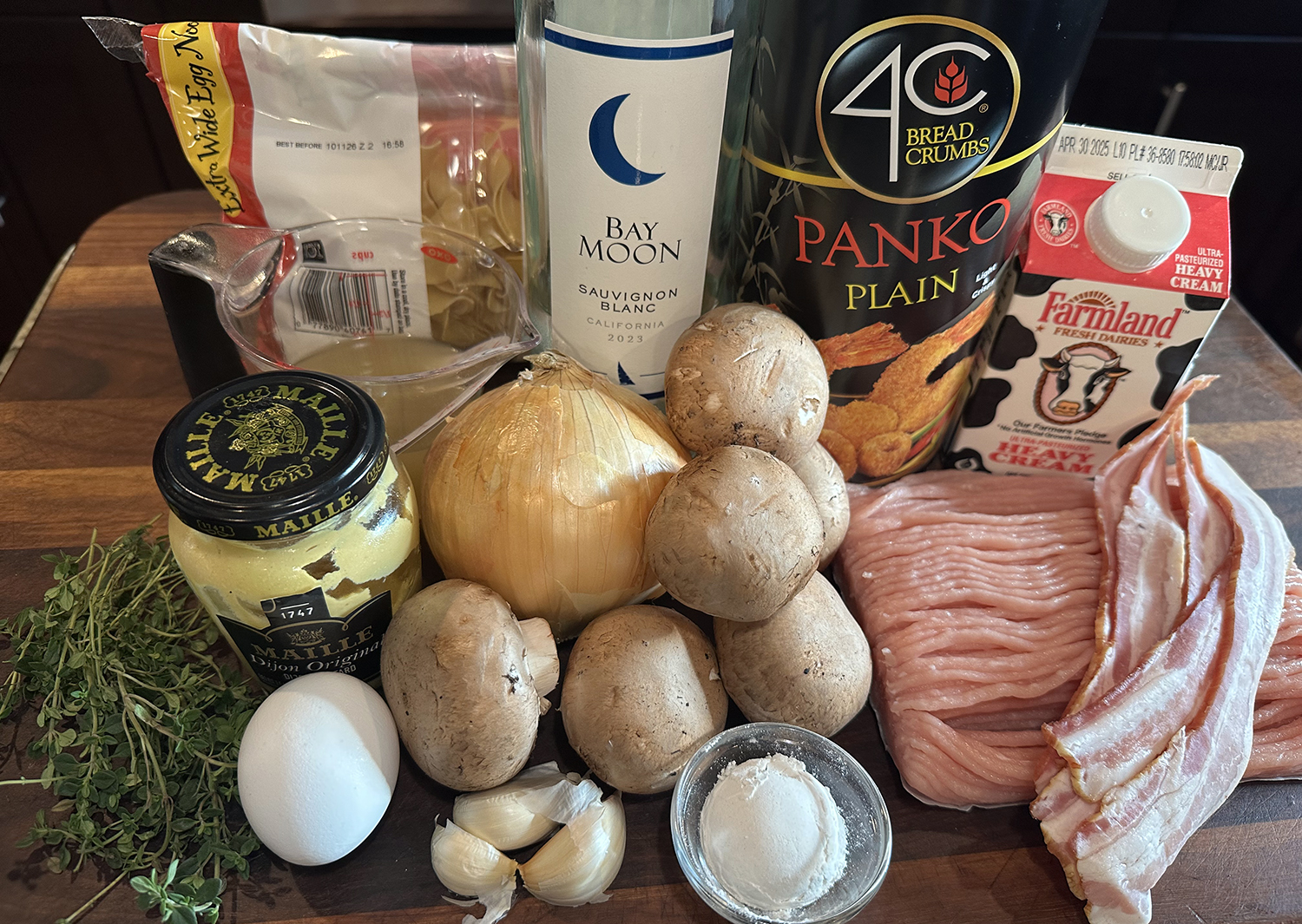
  • 1 lb. lean ground turkey (see above*)
  • 1 large egg, beaten
  • 1/3 cup panko
  • 1 tsp. kosher salt, plus more to taste
  • 1 Tbsp. minced garlic, divided
  • 1/2 tsp. black pepper, divided
  • 4 thick-cut bacon slices, chopped
  • 8 oz. cremini mushrooms, sliced
  • 1 small yellow onion, finely chopped
  • 1/2 cup plus 2 Tbsp.  chicken broth, divided
  • 1 Tbsp.  all-purpose flour
  • 1 cup (8 oz.) dry white wine
  • 2 Tbsp.  Dijon mustard
  • 1 Tbsp.  fresh thyme leaves, plus more for garnish
  • 1/2 cup heavy cream

Directions

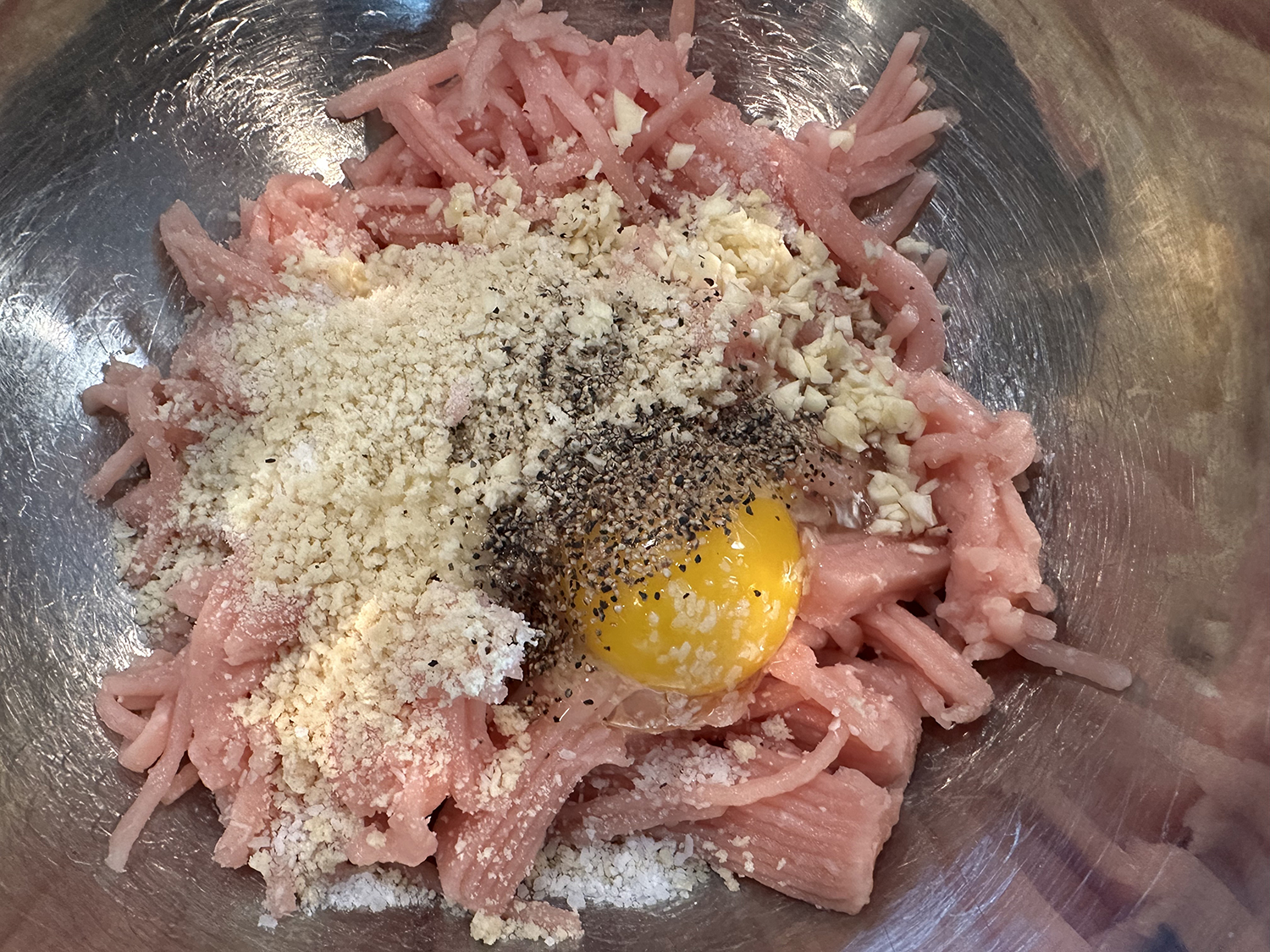
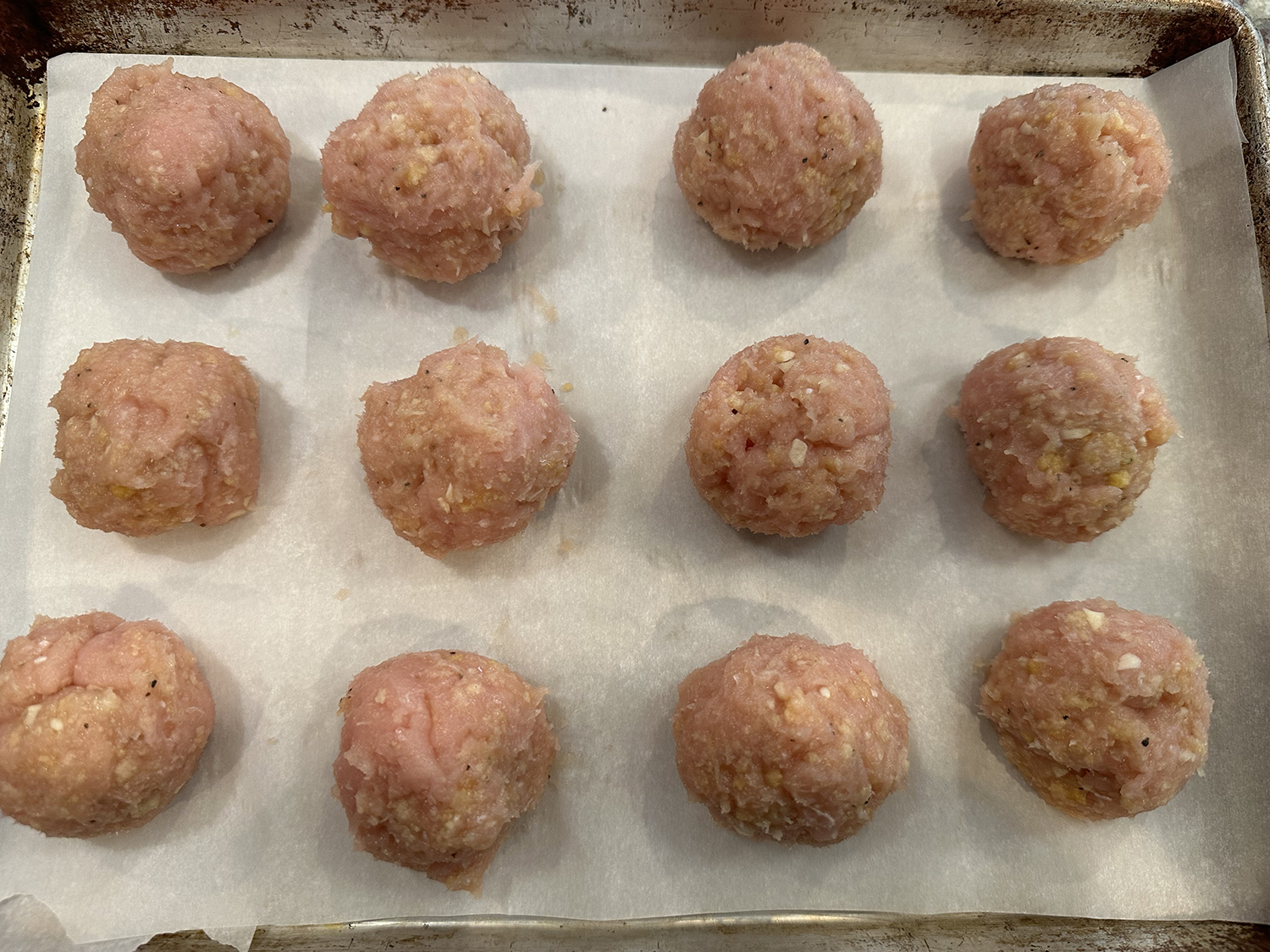
  1. Stir together ground turkey, egg, panko, salt, 1 teaspoon garlic, and 1/4 teaspoon pepper in a medium bowl until evenly combined. Shape mixture into 12 (about 1 1/2-inch) meatballs; transfer to a parchment paper–lined baking sheet. Cover and refrigerate until ready to cook.
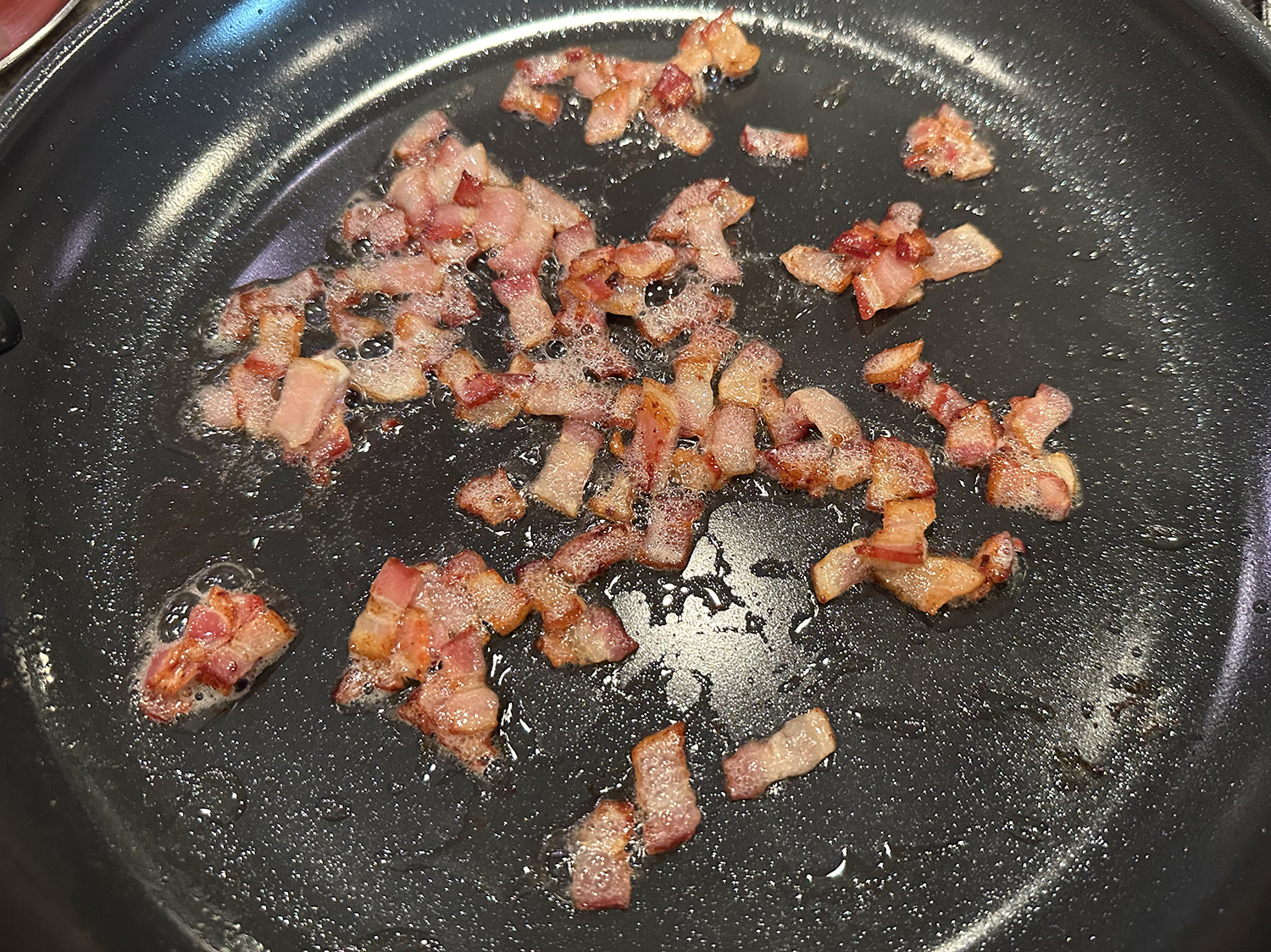
  2. Cook bacon in a large skillet over medium-high, stirring often, until crisp and rendered, about 8 minutes. Transfer bacon to a paper towel–lined plate using a slotted spoon. Reserve 1/4 cup drippings in skillet; discard remaining drippings, or reserve for another use.
  3. Return skillet with drippings to medium-high. Cook meatballs, turning occasionally, until browned on all sides, about 6 minutes. Transfer meatballs to a plate, and set aside.
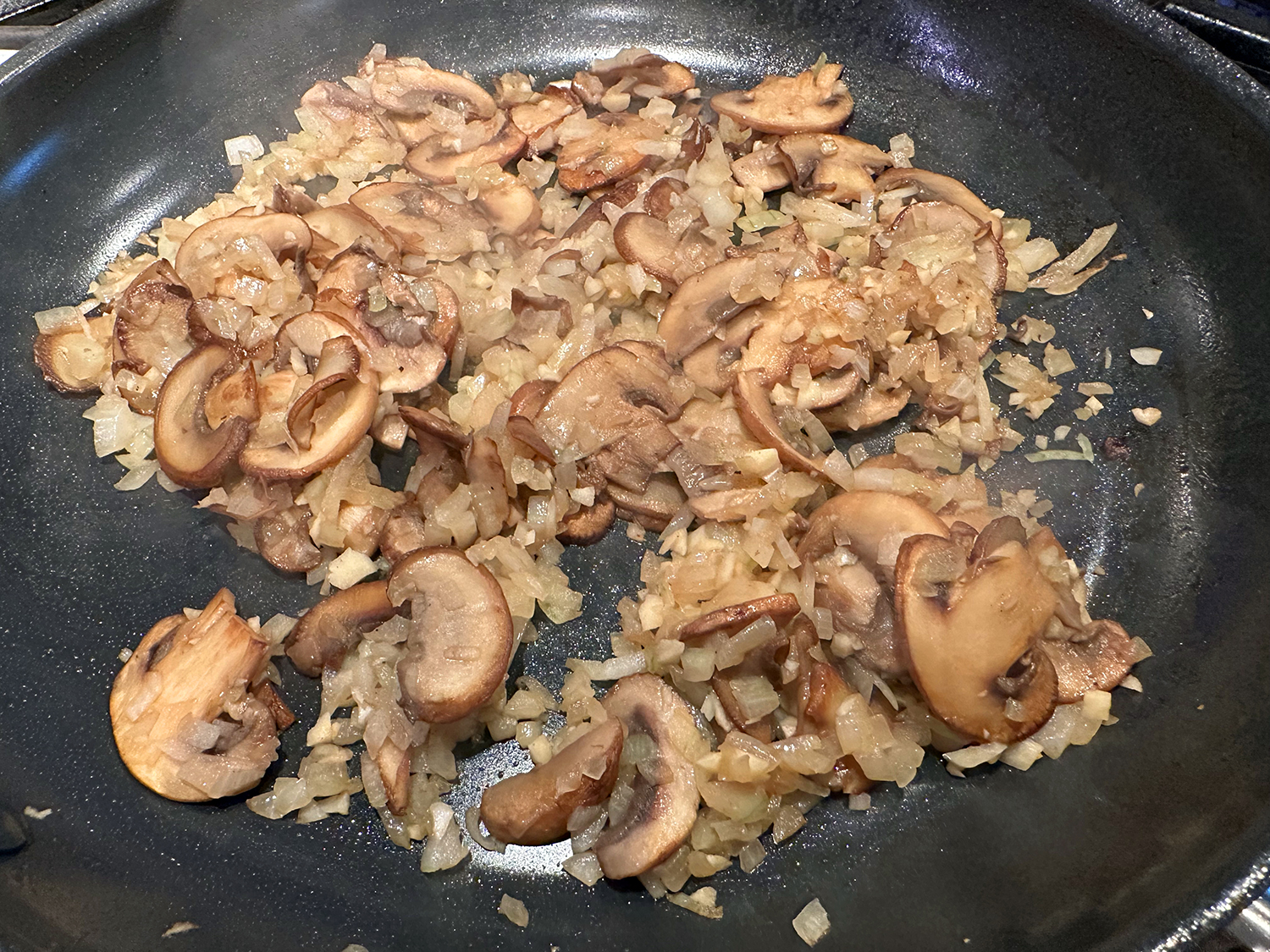
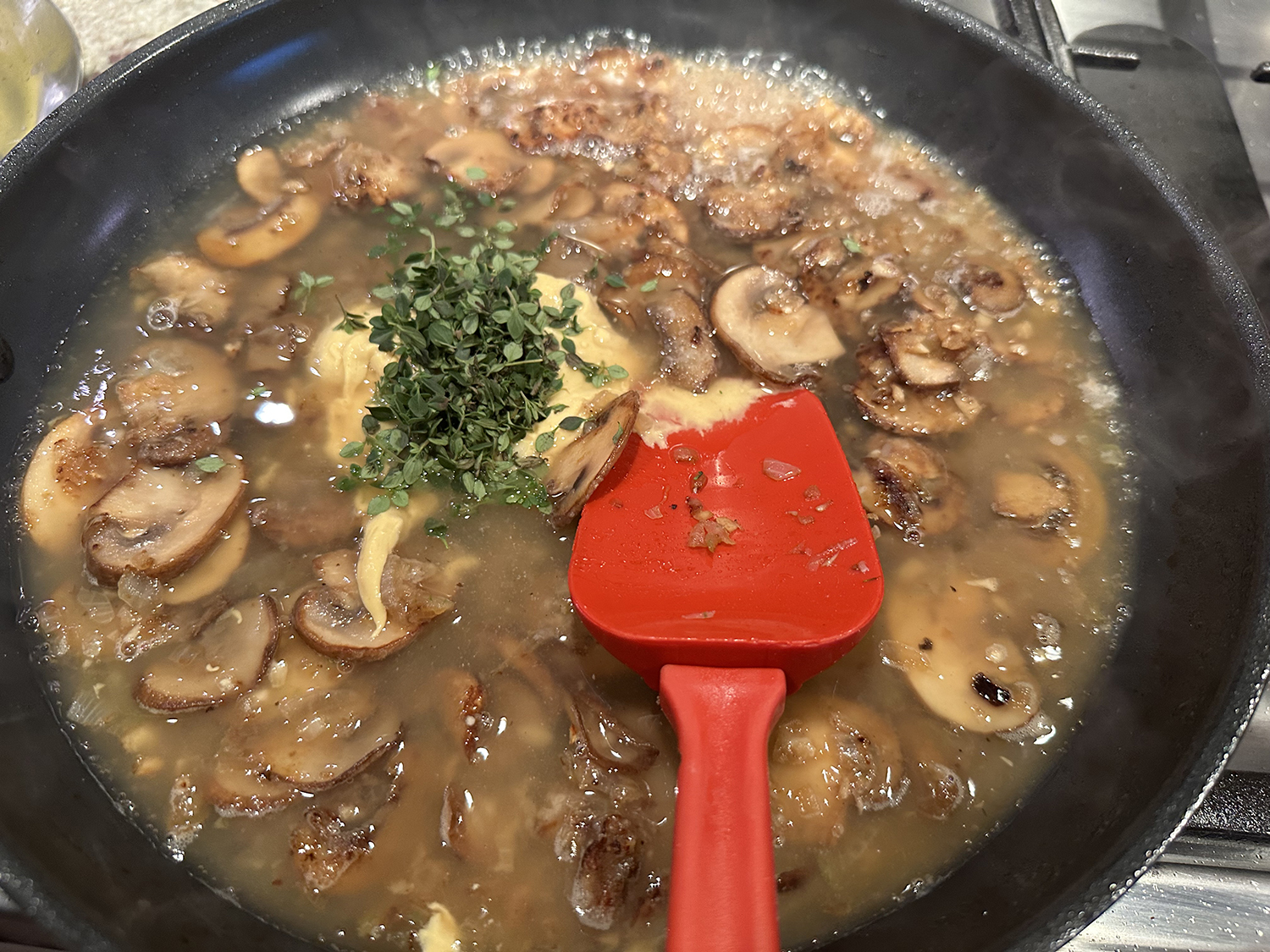
  4. Add mushrooms to skillet with drippings, and cook over medium-high, undisturbed, until browned on 1 side, about 3 minutes; stir and cook 2 more minutes. Add onion, 2 tablespoons broth, and remaining 2 teaspoons garlic. Cook, scraping up browned bits from the bottom of the skillet, until onion is just tender, about 3 minutes. Add flour; cook, stirring constantly, for 1 minute. Add wine, mustard, thyme, and remaining 1/2 cup broth; bring to a boil over medium-high.
  5. Add meatballs and half of reserved bacon to skillet; simmer over medium-low, partially cover and turn meatballs occasionally, until a thermometer inserted into meatballs registers 165°F and sauce is thickened, 8 to 10 minutes. Stir in cream and remaining 1/4 teaspoon pepper. Season to taste with salt. Sprinkle with remaining bacon, and garnish with additional thyme leaves.

http://www.lynnandruss.com
Original recipe from Anna Theoktisto for Food & Wine

Cheesy French Onion Garlic Bread

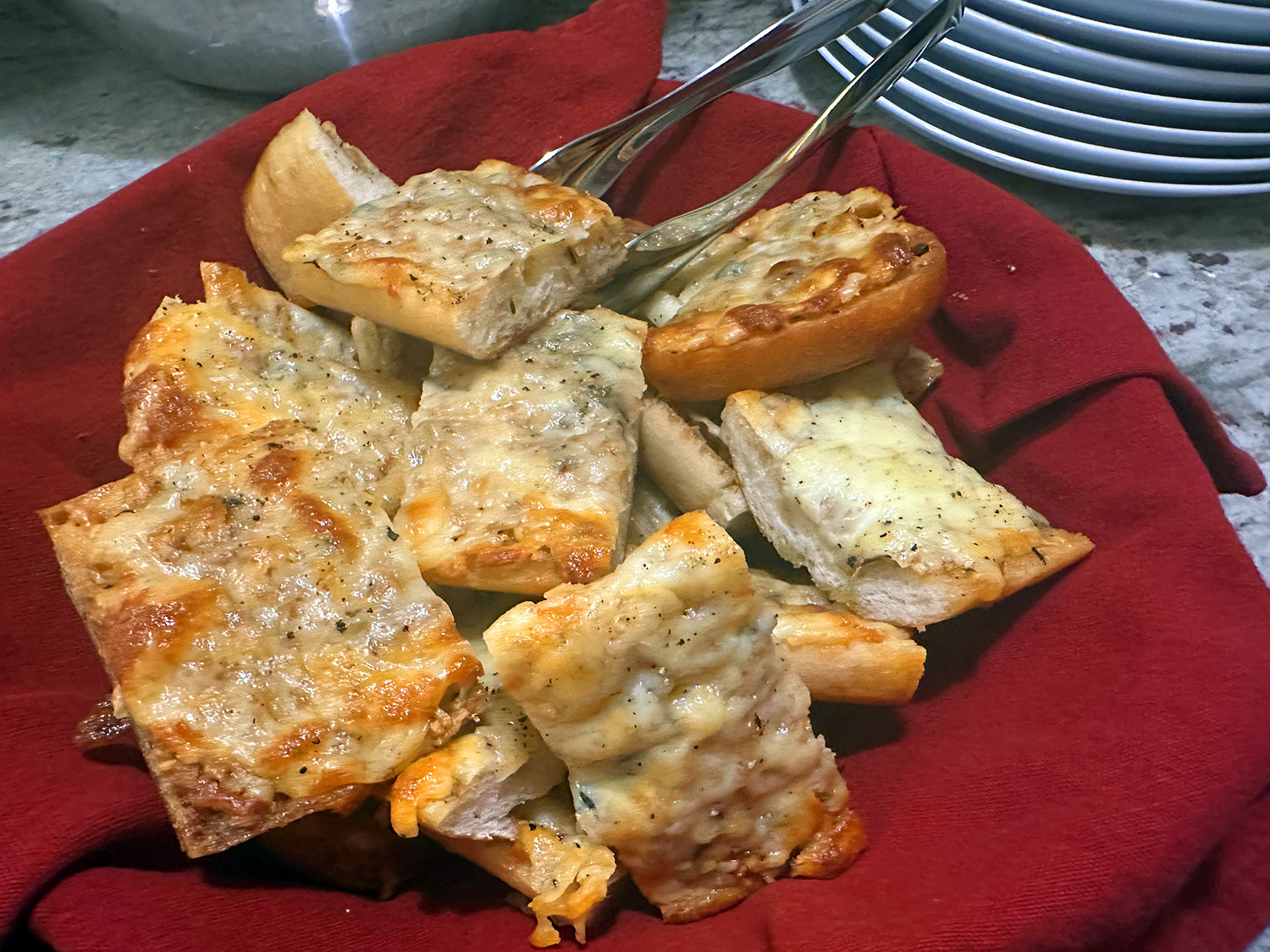
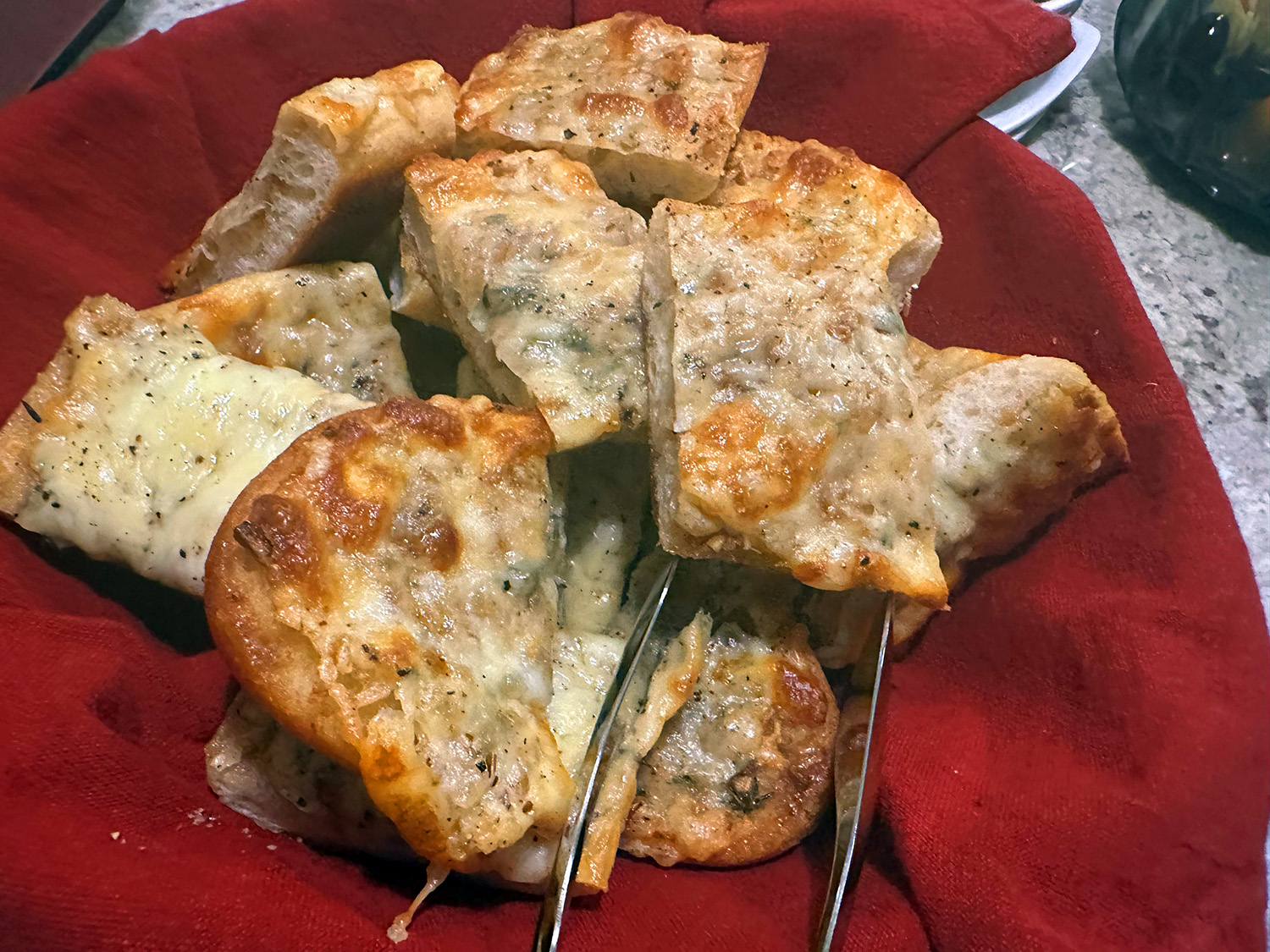
Love garlic bread? Well, this cheesy French onion garlic bread is the best of both worlds, combining garlic bread and French onion soup, with none of the hassle. With just a few ingredients and a little help from the grocery store, you’ll have a delicious twist on garlic bread in no time. A great addition to most dinner parties.

Here, I use a packet of onion soup mix and some butter to season the bread. Topping it with gooey mozzarella, Gruyère, fresh thyme, and black pepper achieves that signature French onion soup flavor. The bread crisps up in the oven to become a buttery, cheesy delight. It’s the ideal companion to any pasta dish — or perhaps a great midday snack. No matter what you pair it with, it’s one of the best complements to any meal.

While the original recipe didn’t say to, we found it’s best to let the butter/onion soup mix sit at room temperature so that the dried bits of onion hydrate some.

Make ahead: The butter mixture can be made up to two days ahead and refrigerated in an airtight container. Let sit at room temperature until softened before using.

Storage: Leftover bread can be refrigerated in an airtight container for up to four days. Reheat in a 350ºF oven until warmed through, about 8 minutes.

Cheesy French Onion Garlic Bread

  • Servings: 8-10
  • Difficulty: easy
  • Print

Ingredients

For the Butter

  • 9 Tbsp. unsalted butter, at room temperature
  • 3 Tbsp. mayonnaise
  • 1 1-oz. packet of dried onion soup mix, such as Lipton’s
  • 3 cloves garlic, minced

For the Bread

  • 1 12-oz. loaf French or Italian bread
  • 4 1/2 oz. low-moisture mozzarella cheese, shredded
  • 4 1/2 oz. Gruyère cheese, shredded
  • 1 Tbsp. fresh thyme leaves from about 5 sprigs, plus more for garnish
  • Freshly ground black pepper

Directions

  1. Make the butter: Stir and smash room-temperature unsalted butter, mayonnaise, onion soup mix, and minced garlic cloves together with a flexible spatula in a small bowl until combined. Let sit for about 30 minutes to ensure the dried onion bits hydrate.
  2. Assemble the bread: Heat the oven to 375ºF. Line a baking sheet with parchment paper or aluminum foil.
  3. Use a serrated knife to split 1 loaf French bread in half. Place cut side up on the baking sheet. Spread the butter mixture evenly onto the bread.
  4. Sprinkle evenly with shredded mozzarella cheese, shredded Gruyère cheese, fresh thyme leaves, and liberally season with black pepper.
  5. Bake, rotating halfway through, until the cheese is melted and the top is browned in spots, about 15 minutes total. Let cool for at least 10 minutes. Garnish with more fresh thyme leaves if desired and cut crosswise into pieces.

http://www.lynnandruss.com

Recipe by Janette Zepeda for The Kitchn.com
Chicken Gratin

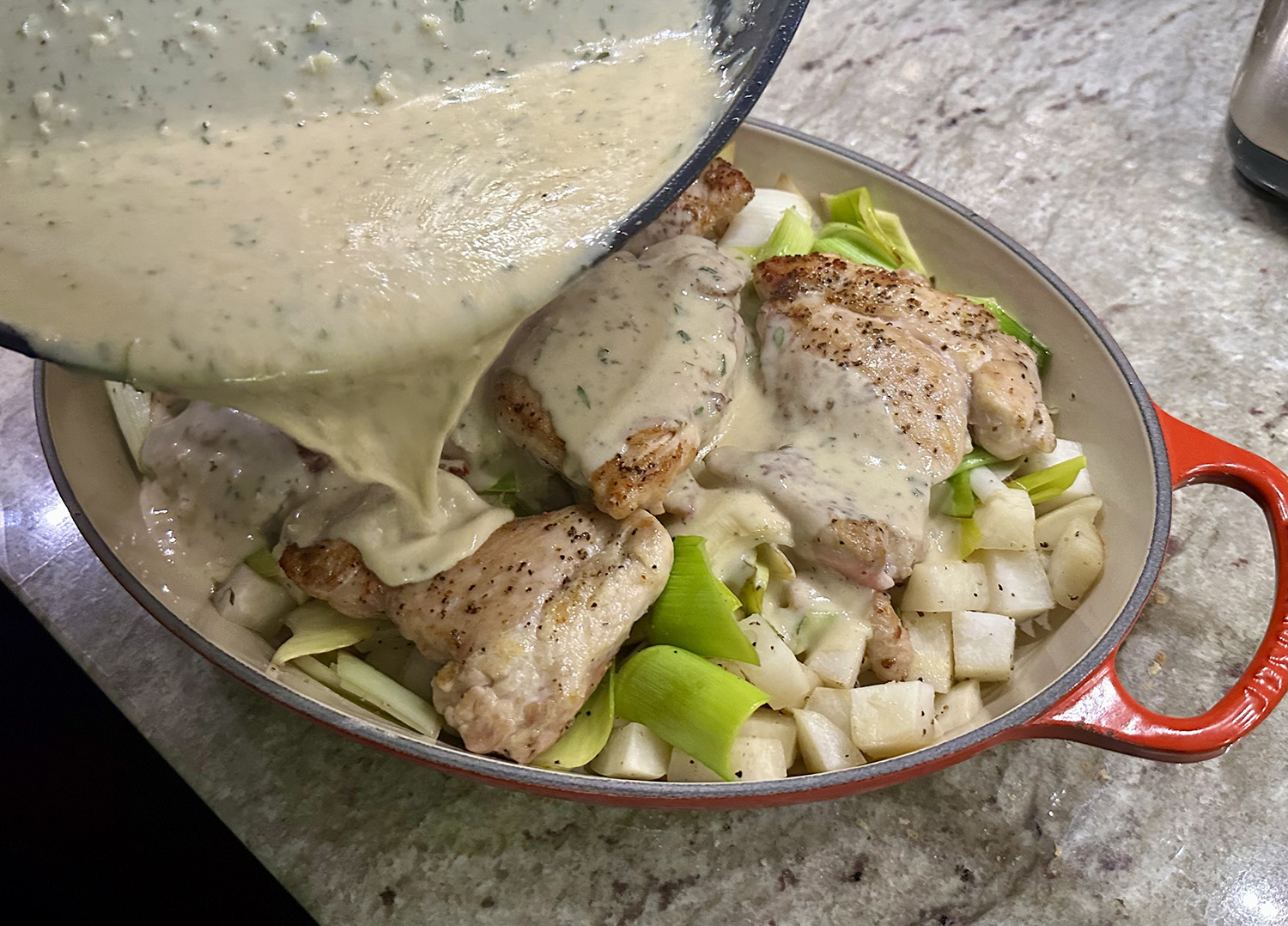
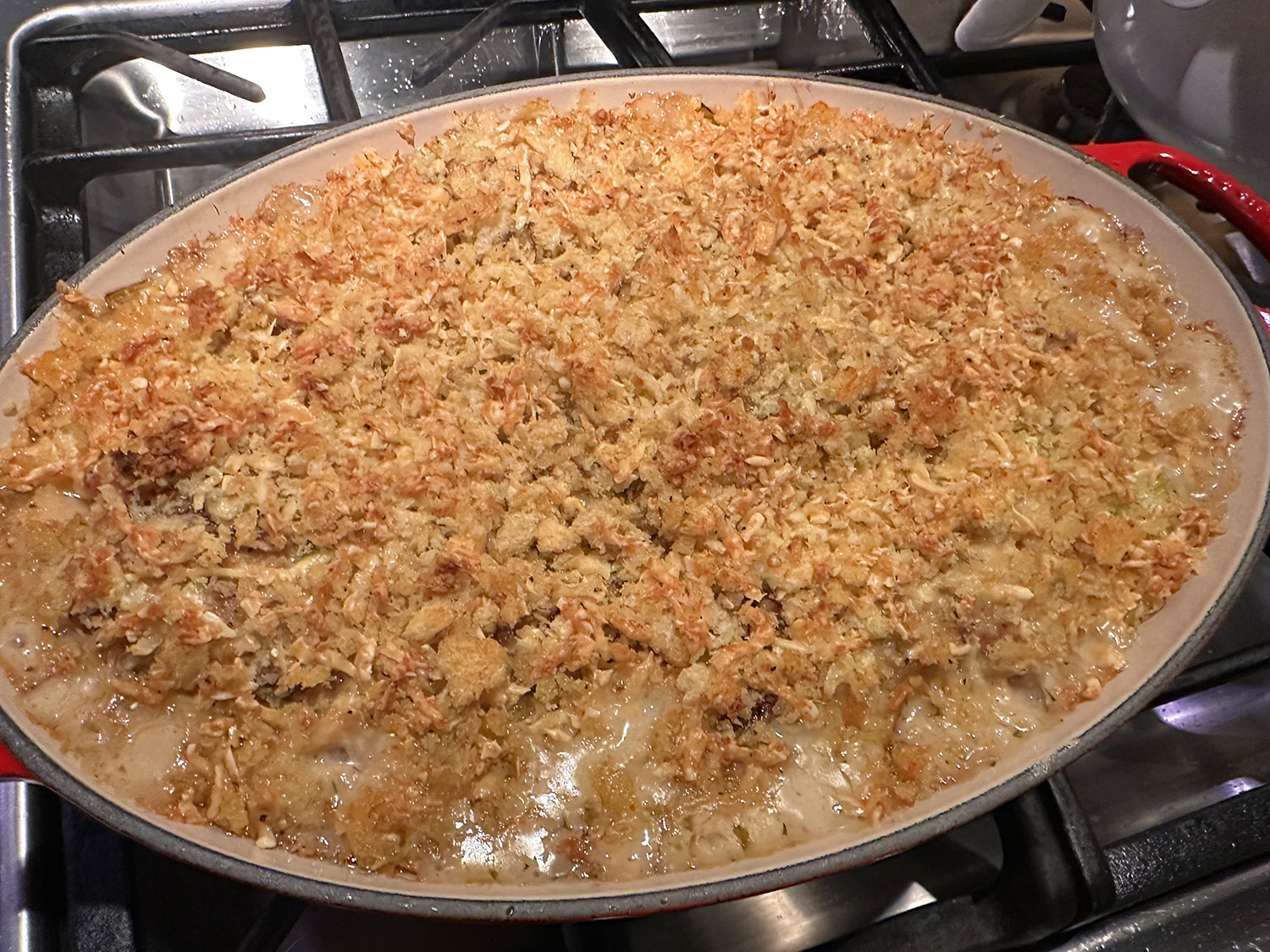
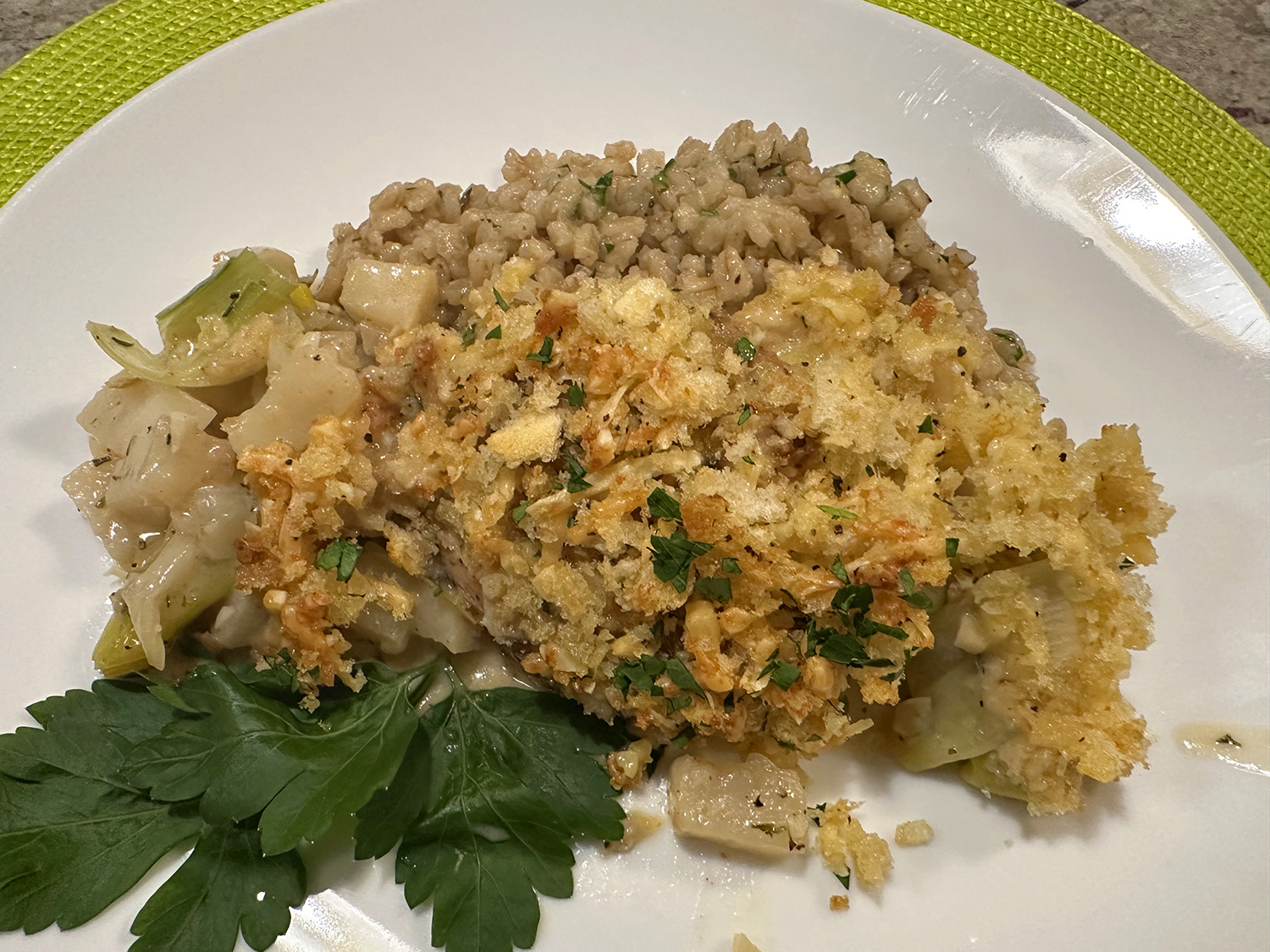
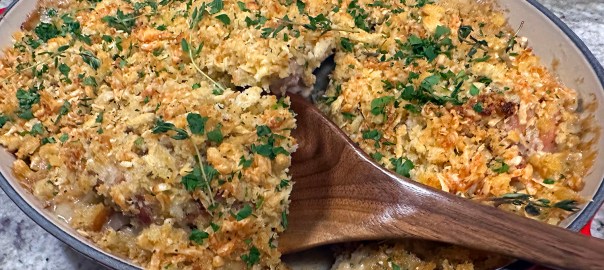
This decadent, company-worthy casserole, features tender chicken thighs and melted turnips and leeks bathed in a creamy gratin sauce reminiscent of fondue and topped with garlicky breadcrumbs. Sherry and Cognac join forces to cut through the richness of the gratin while adding a touch of nuttiness.

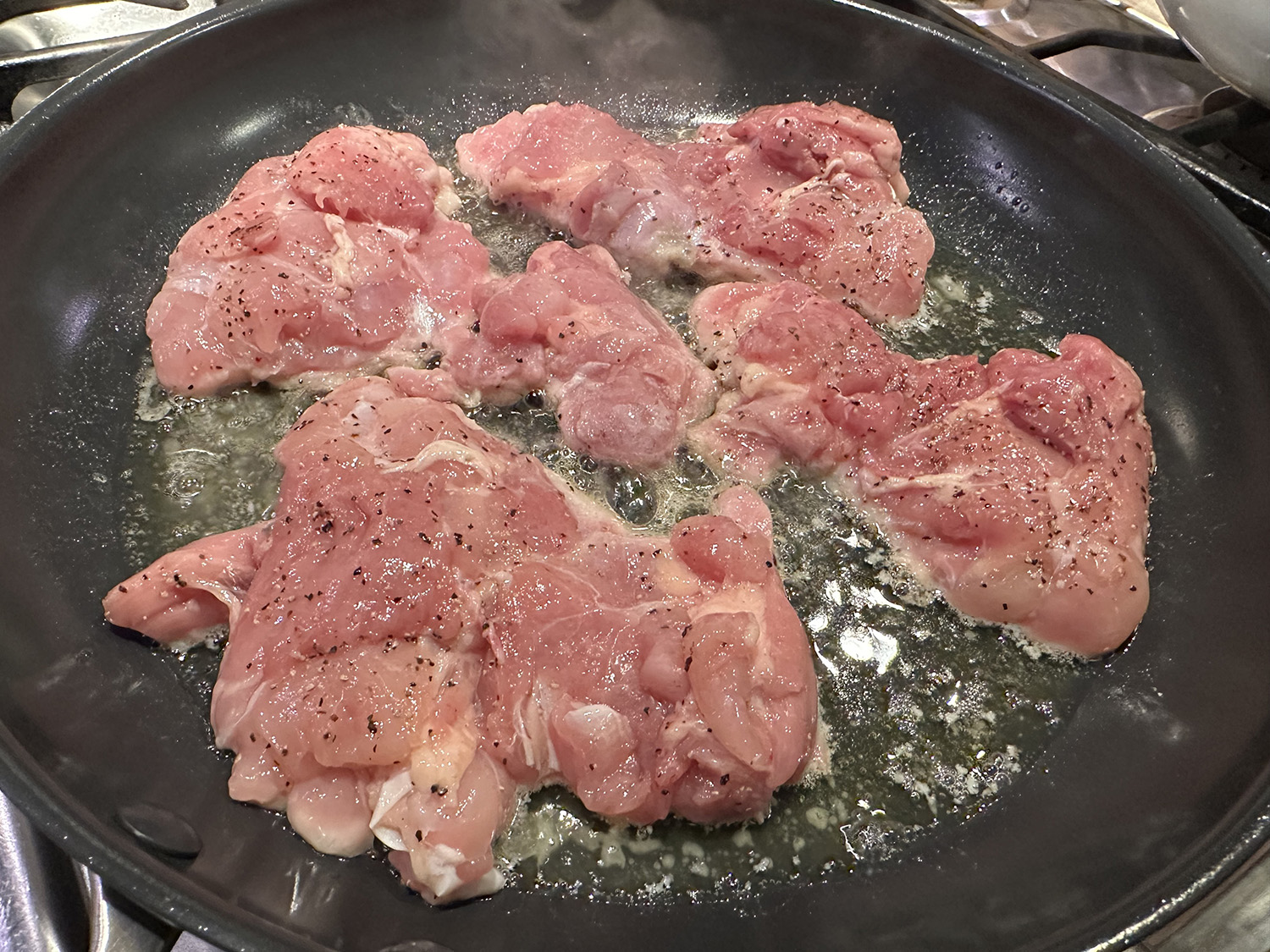
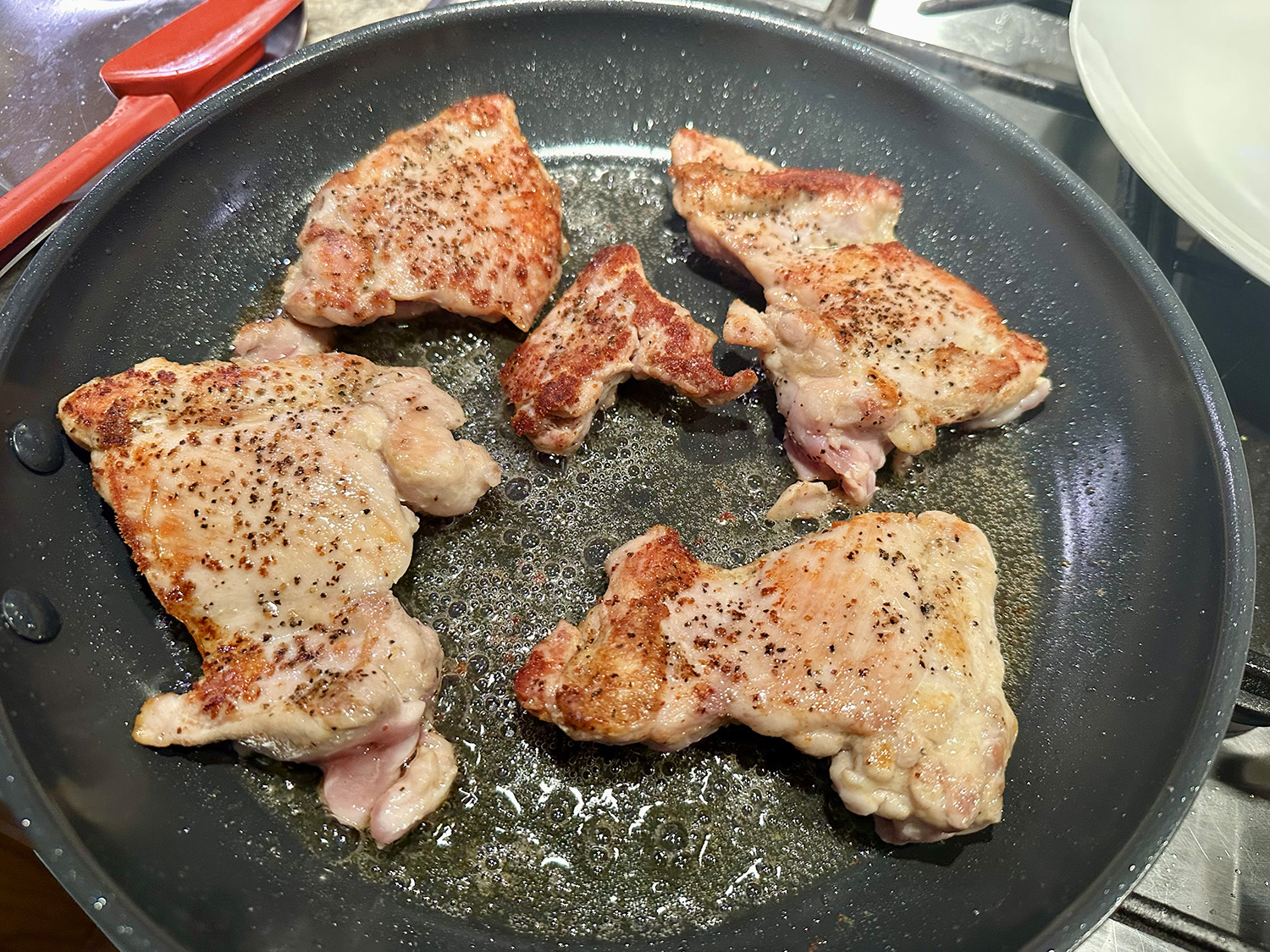
Allow the flavorful browned bits to build in the skillet as the chicken sears — these golden nuggets are key to building the foundation of the cheese-laden sauce. (If necessary, brown the chicken pieces in two batches so that they brown instead of steam.)

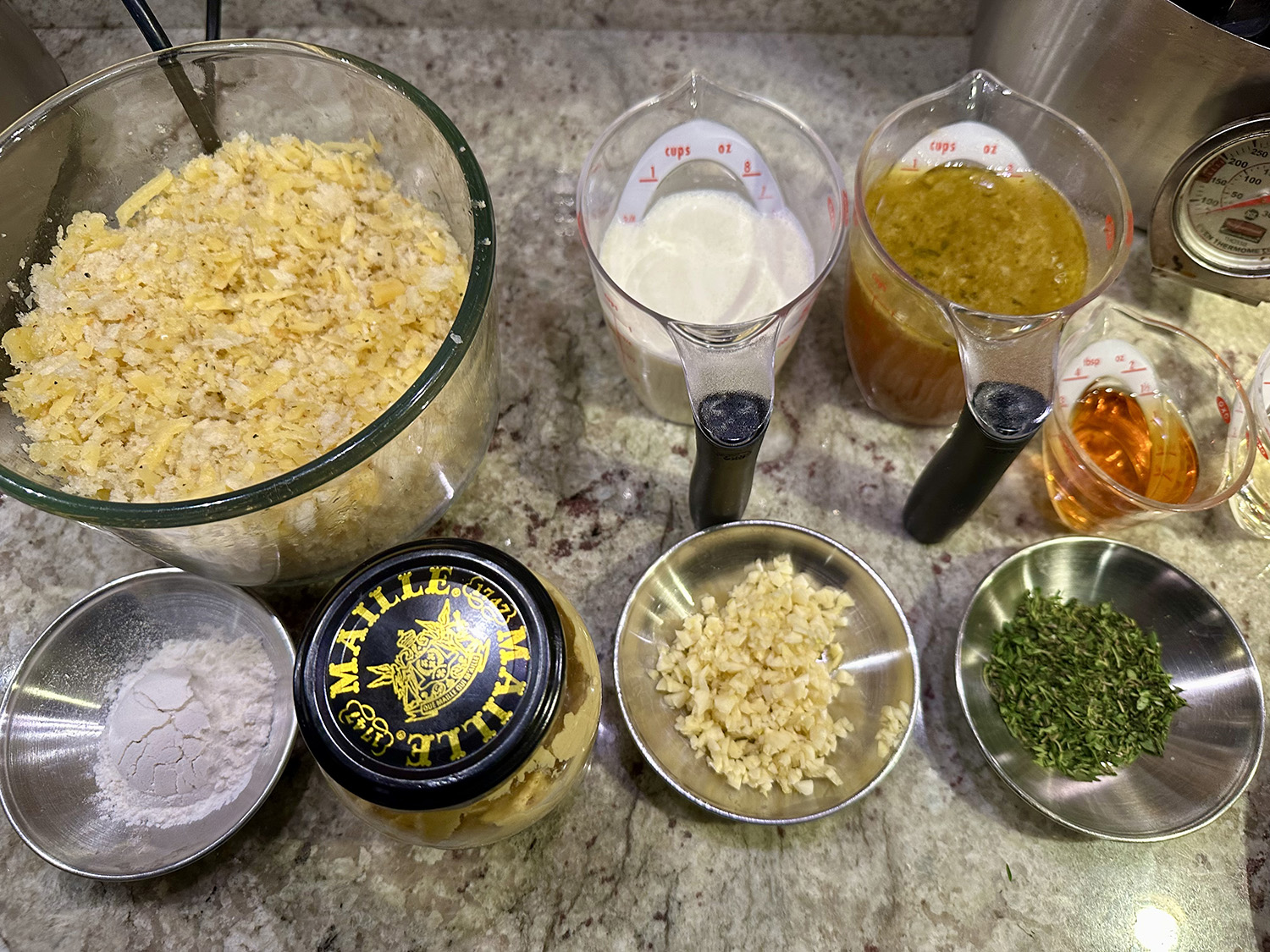
For a more funky and pungent flavor, try Gruyère cheese. For a more mild, buttery, and nutty flavor, opt for aged Gouda. The topping of breadcrumbs helps to provide a pleasantly crunchy contrast to the soft, creamy chicken gratin. Tossing the breadcrumbs with olive oil, garlic, salt, and pepper before baking infuses them with extra flavor.

A few things we did differently was incorporate 3 leeks instead of two, use a bit more cheese, and mixed in the cheese with the breadcrumb mixture (that was actually a mistake, but we liked the result!).

We served ours with a Herbed Barley Pilaf. But upon consideration, it was a rather heavy side dish for the gratin, so a green vegetable or side salad might be a better match.

Chicken Gratin

  • Servings: 6
  • Difficulty: moderately easy
  • Print

Ingredients

  • 8 small boneless, skinless chicken thighs (about 2 1/4 lbs.)
  • 1 3/4 tsp. kosher salt, plus more to taste
  • 1 1/4 tsp. black pepper, divided
  • 5 Tbsp. unsalted butter, divided
  • 2 medium (about 12-oz.) leeks, thoroughly washed, light green and white parts of leeks cut in half lengthwise, and sliced diagonally into 1 1/2-inch pieces
  • 5 garlic cloves, 4 finely chopped and 1 grated
  • 1 1/4 pounds turnips (about 3 medium turnips), peeled and cut into 1/2-inch pieces
  • 2 Tbsp. all-purpose flour
  • 1 cup chicken stock 
  • 3 Tbsp. (1 1/2 oz.) Cognac
  • 2 Tbsp. (1 oz.) dry sherry
  • 3/4 cup heavy cream
  • 1 Tbsp. Dijon mustard
  • 1 1/2 tsp. finely chopped fresh thyme, plus thyme sprigs for garnish
  • 1/2 tsp. ground nutmeg
  • 5 oz. Gruyère or aged Gouda cheese, grated (about 1 1/4 cups)
  • 3 Tbsp. olive oil
  • 1 1/2 cups fresh breadcrumbs (from 1 small French bread loaf)

Directions

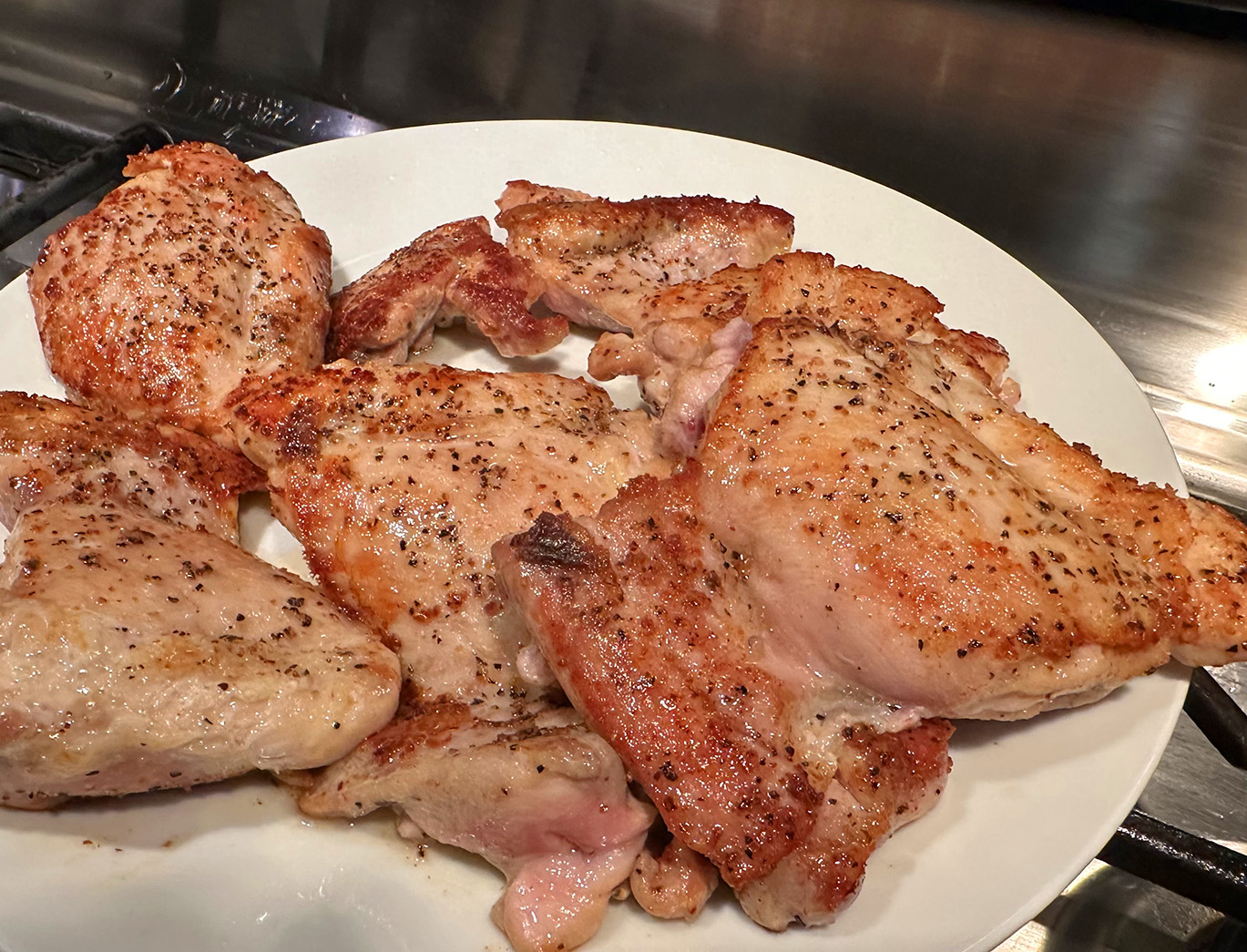
  1. Pat chicken dry with paper towels. Sprinkle evenly with 1 teaspoon salt and 1/2 teaspoon pepper. Heat 3 tablespoons butter in a large skillet over medium until foamy. Working in batches, if needed, cook chicken, undisturbed, until well browned, about 10 minutes, adjusting heat as needed to prevent browned bits in skillet from burning. Flip chicken; cook until no longer pink on the outside, about 1 minute. (You may to do this in two batches.) Transfer chicken to a plate, and set aside. Remove skillet from heat; do not wipe clean. Preheat oven to 375°F.
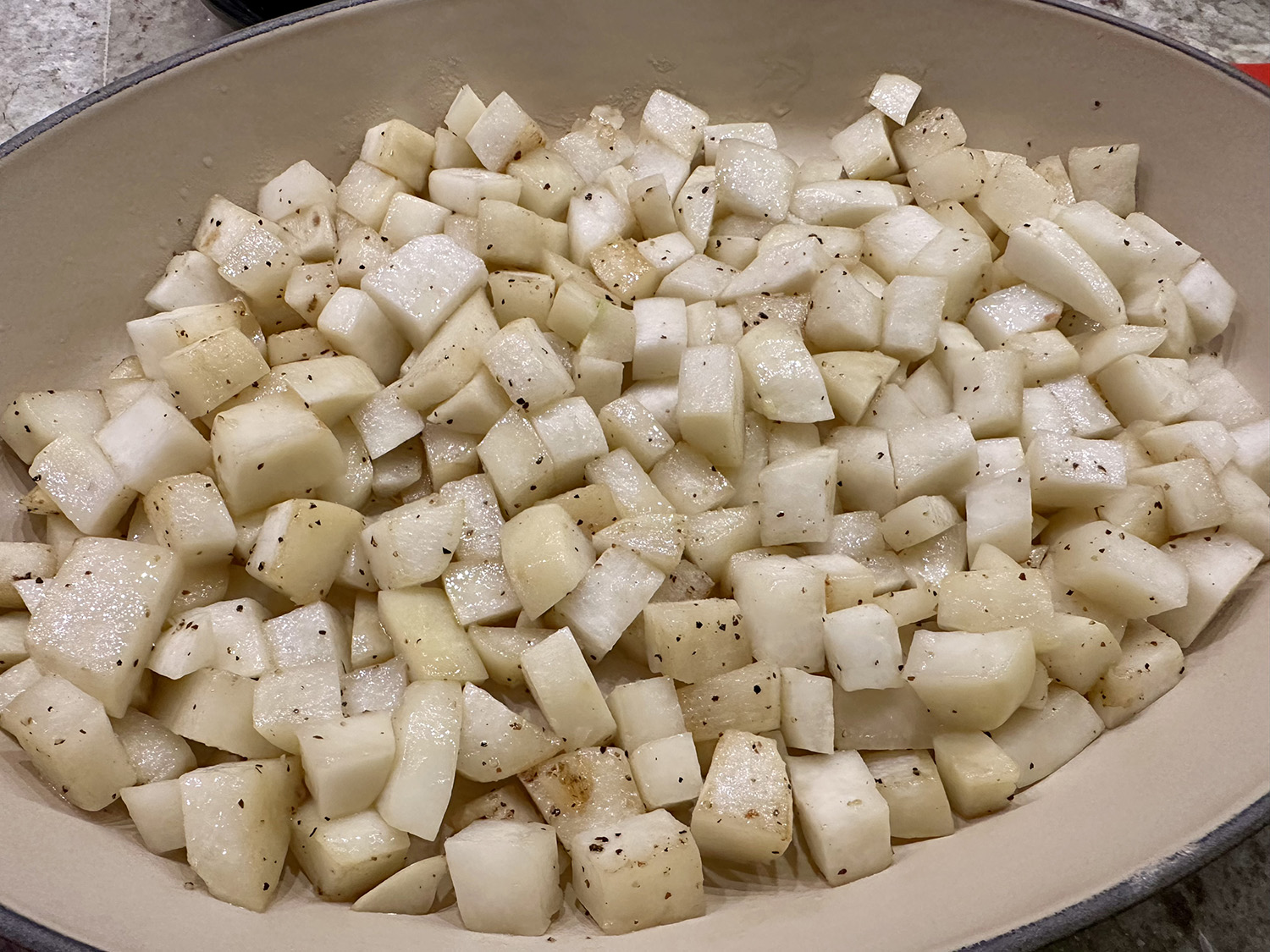
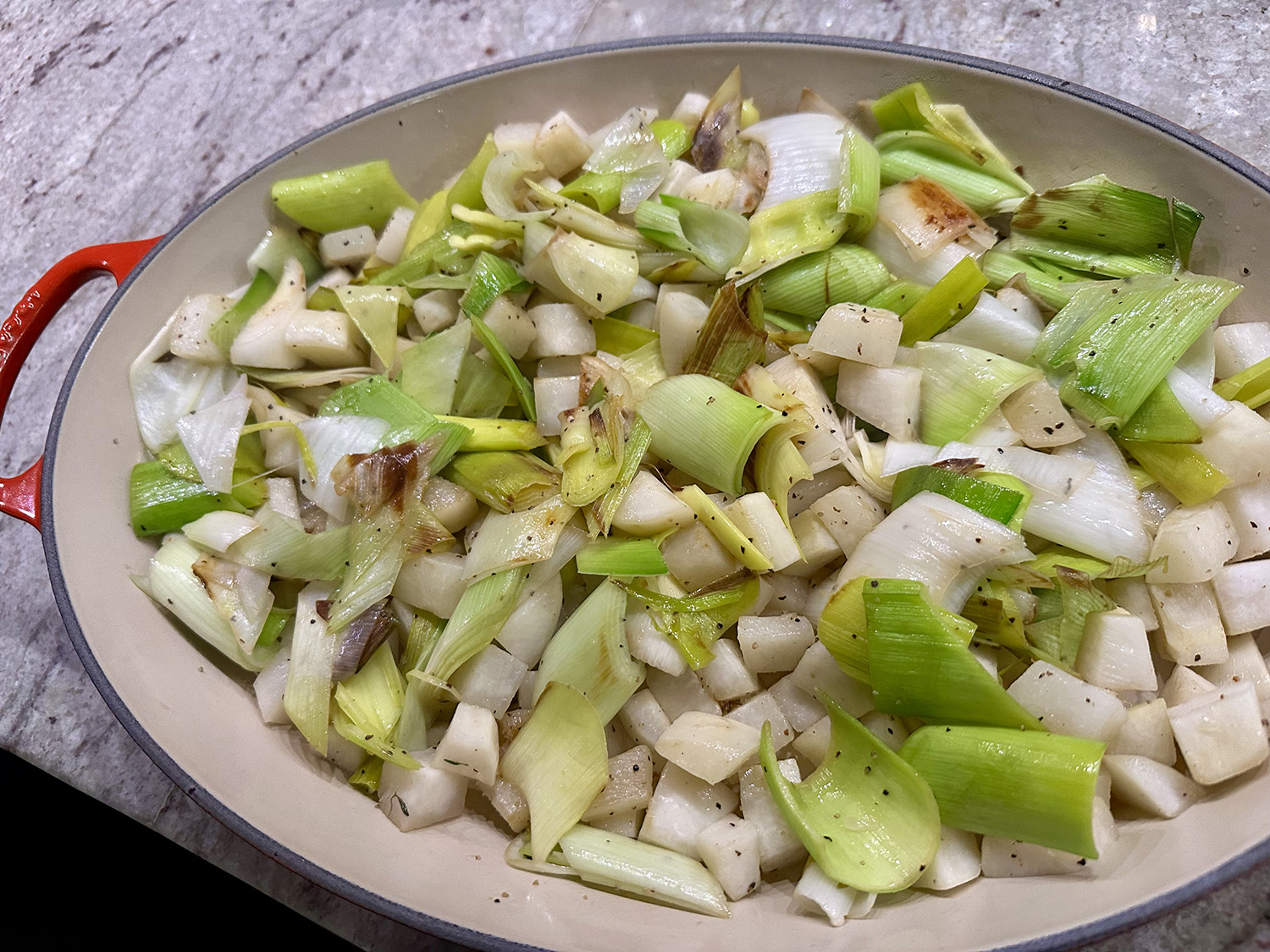
  2. Increase heat to medium-high under skillet. Add turnips, and sprinkle with 1/4 teaspoon salt and 1/4 teaspoon pepper. Cook, stirring occasionally, until turnip edges are browned, 4 to 5 minutes. Transfer turnips to a large (2 1/2- to 3-quart) baking dish; set aside. Reduce heat to medium.
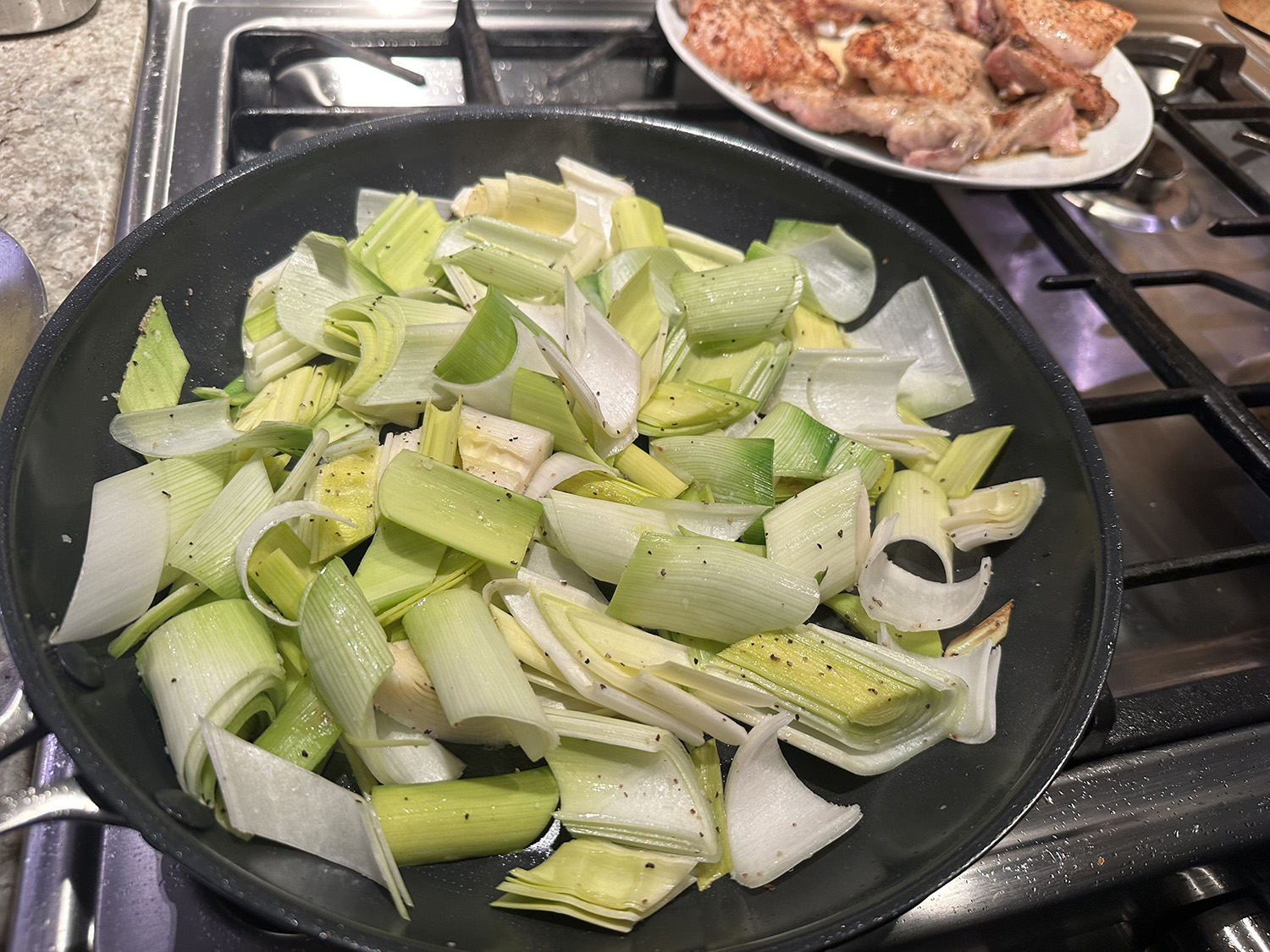
  3. Add leeks to the skillet and sprinkle with 1/4 teaspoon salt and 1/4 teaspoon pepper. Cook over medium, stirring often, until softened, about 3 minutes. Transfer the leeks to the baking dish with turnips. Do not wipe the skillet clean.
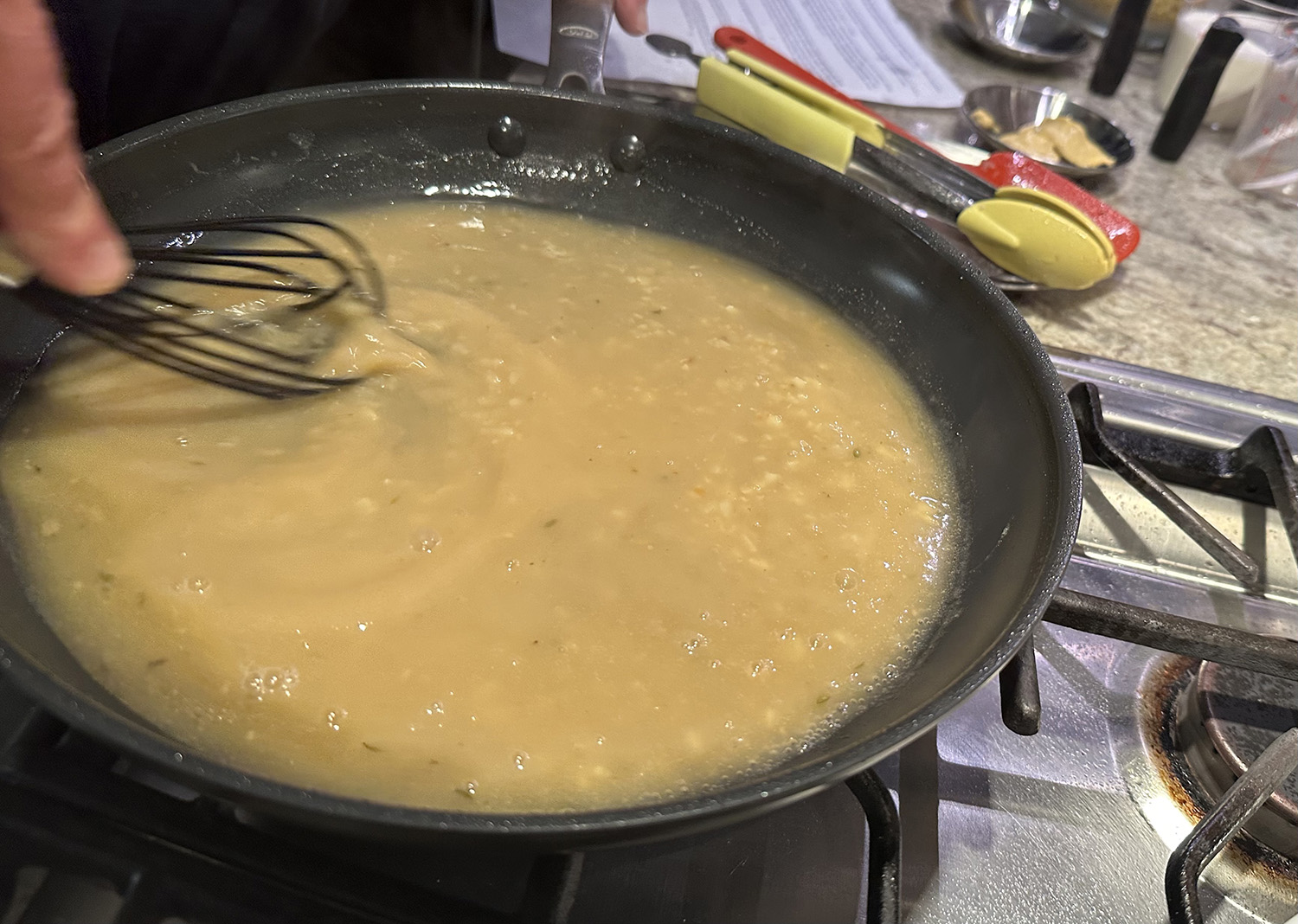
  4. Add remaining 2 tablespoons butter to skillet and melt over medium. Add finely chopped garlic; cook, stirring constantly, until fragrant, about 30 seconds. Add flour; cook, stirring constantly, 1 minute. Stir in chicken stock, Cognac, and sherry. Bring to a simmer over medium, and stir using a wooden spoon to scrape up browned bits from the bottom of the skillet. Stir in cream, mustard, chopped thyme, and nutmeg; simmer over medium, stirring occasionally, until sauce is slightly thickened, 2 to 3 minutes. Remove from heat. Season with additional salt to taste.
  5. Arrange chicken thighs over turnip-and-leek mixture in the baking dish. Pour sauce evenly over the mixture; sprinkle with cheese.
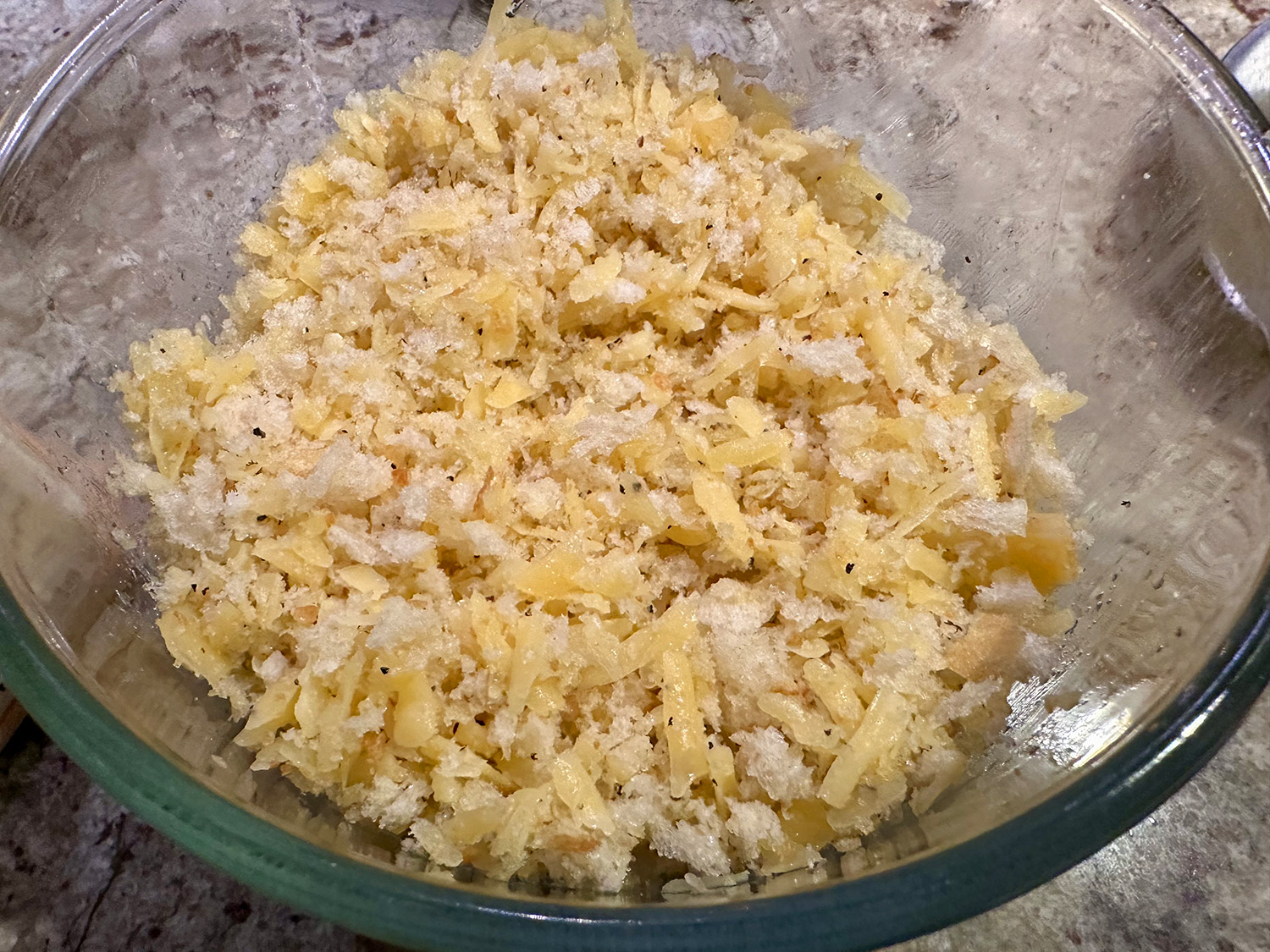
  6. Place the grated garlic clove in a medium bowl. Stir in oil. Add breadcrumbs, remaining 1/4 teaspoon salt, and remaining 1/4 teaspoon pepper; toss to combine. Sprinkle evenly over chicken mixture.
  7. Bake in preheated oven, uncovered, until breadcrumbs turn dark amber brown, sauce bubbles in the center, and a thermometer inserted in the thickest portion of chicken registers at least 165°F, 30 to 40 minutes. Remove from oven, and let cool 5 minutes. Garnish with thyme sprigs, and serve.

http://www.lynnandruss.com
Adapted from a recipe by Amy Thielen for Food & Wine

Sheet-Pan Roasted Salmon Niçoise Salad

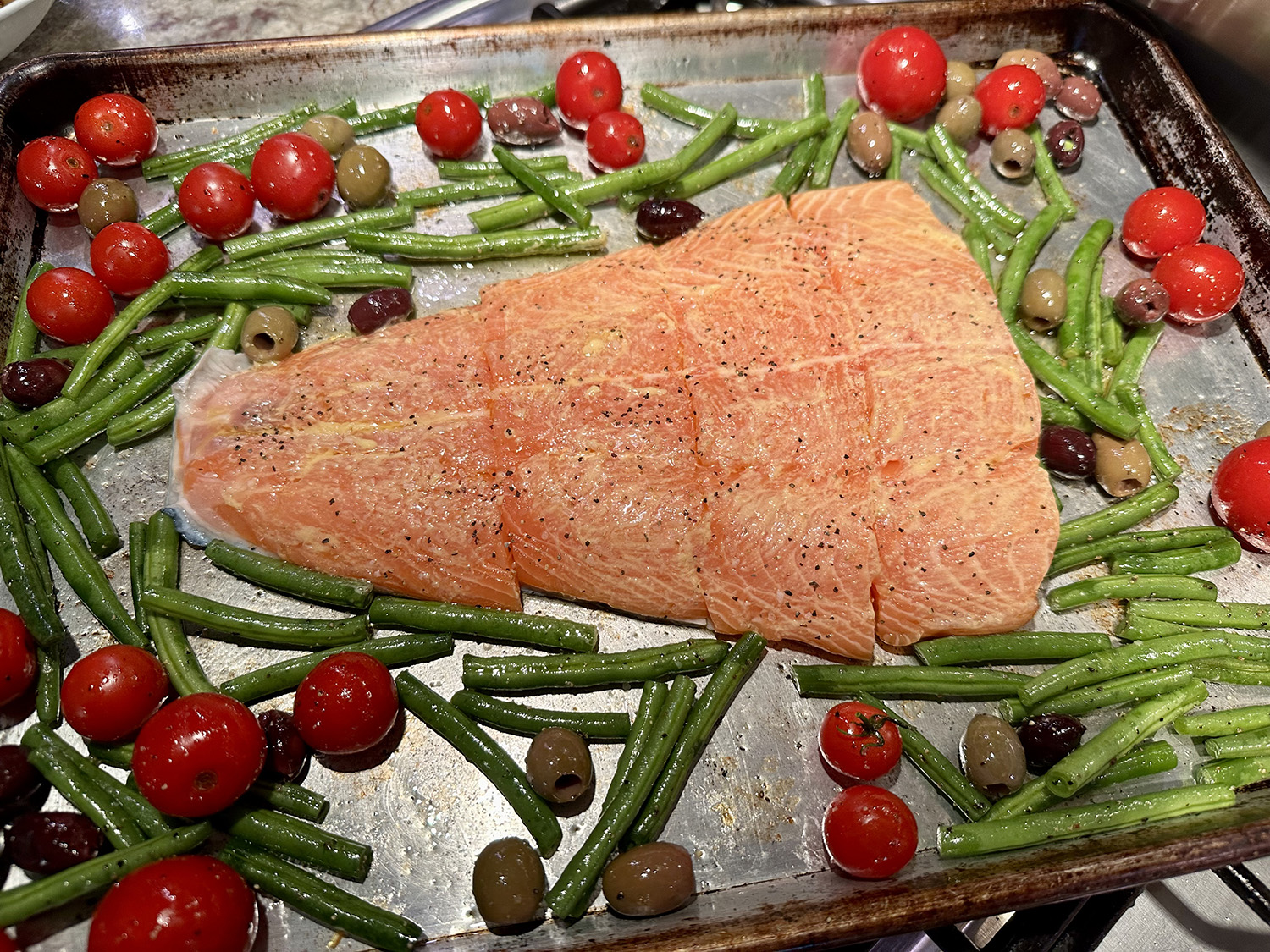
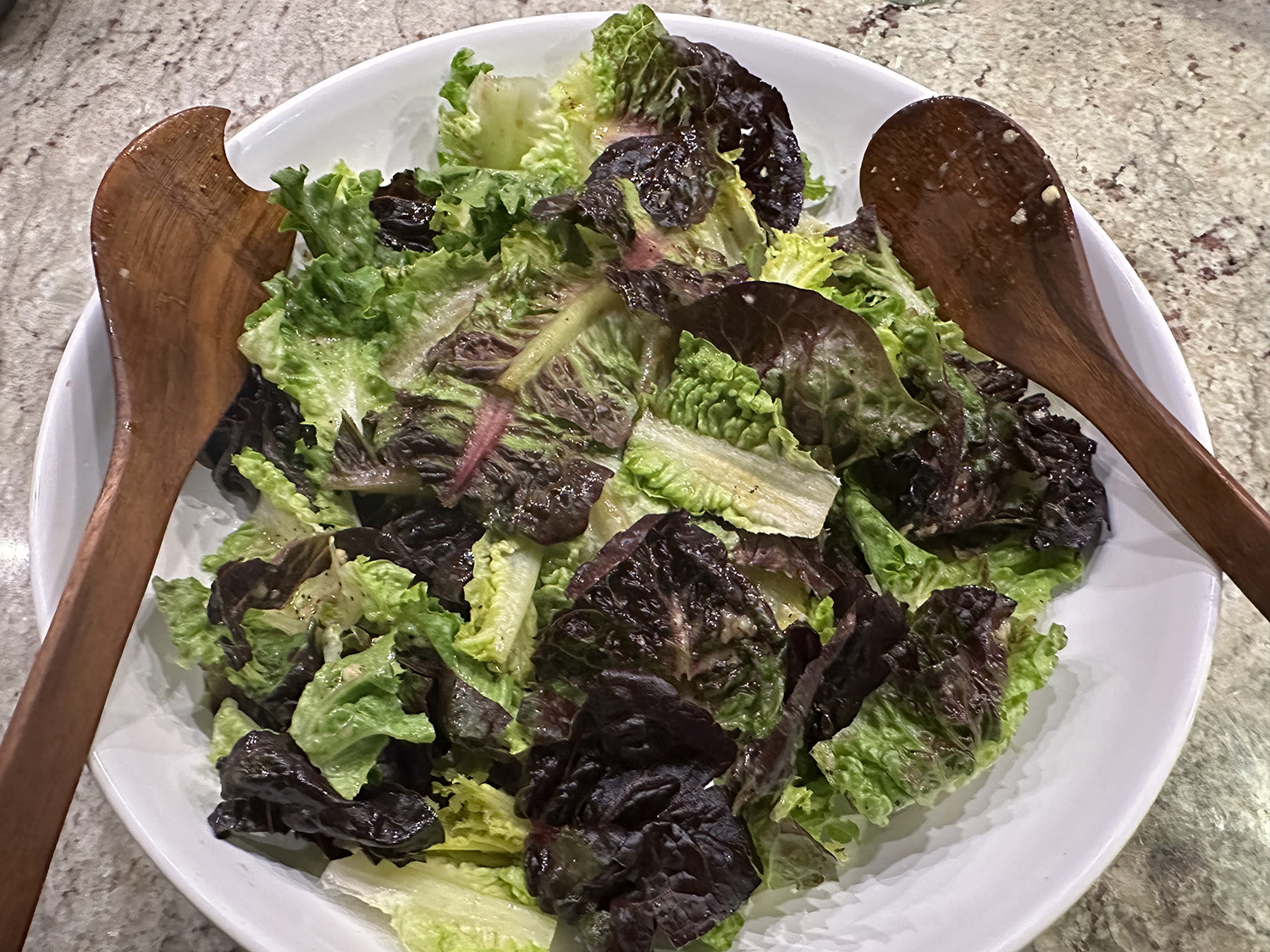
Here, the classic French salad becomes an elegant dinner, with mustard-glazed salmon in place of tuna, roasted vegetables and slightly jammy eggs served over a jumble of salad greens tossed with a red-wine vinaigrette.

Roasting the vegetables, rather than serving some steamed and some raw as you would for a traditional Niçoise, gives this dish great texture and a delicious contrast of temperatures. The vegetables and salmon are roasted on a single sheet pan — fit for company and easy enough for a weeknight.

It’s best to buy 4 uniform fillets of salmon so that they all cook at the same rate. Our piece was thick on one end thinner at the tail, which just meant two of the sections were more done than the other two. You could add the smaller sections to the pan 5 minutes after the others have started to roast if you want them less well-done.

Regarding the comments of several other reviewers, I lessened the amount of olive oil overall, down to about 6 tablespoons, which seemed perfect in the end. And/or you may also choose to double the Dijon-olive oil glaze for the salmon.

Sheet-Pan Roasted Salmon Niçoise Salad

  • Servings: 4
  • Difficulty: easy
  • Print

Ingredients

  • 1 lb. baby Yukon Gold potatoes, halved
  • 8* Tbsp. extra-virgin olive oil
  • 2 tsp. kosher salt, plus more to taste
  • 1¼ tsp. black pepper
  • 2 large eggs
  • 2 Tbsp. red-wine vinegar
  • 2 tsp. Dijon mustard
  • 1 tsp. minced garlic (about 1 clove)
  • 1 anchovy fillet, minced (optional)
  • 6 oz. haricots verts or green beans, trimmed
  • 1½ cups cherry tomatoes
  • ½ cup pitted olives, preferably Niçoise or Kalamata
  • 4 6-oz. center-cut, skin-on salmon fillets
  • 5 oz. tender salad greens, like baby red and green leaf lettuce

Directions

  1. Heat the oven to 400 degrees and place a rack near the top of the oven.
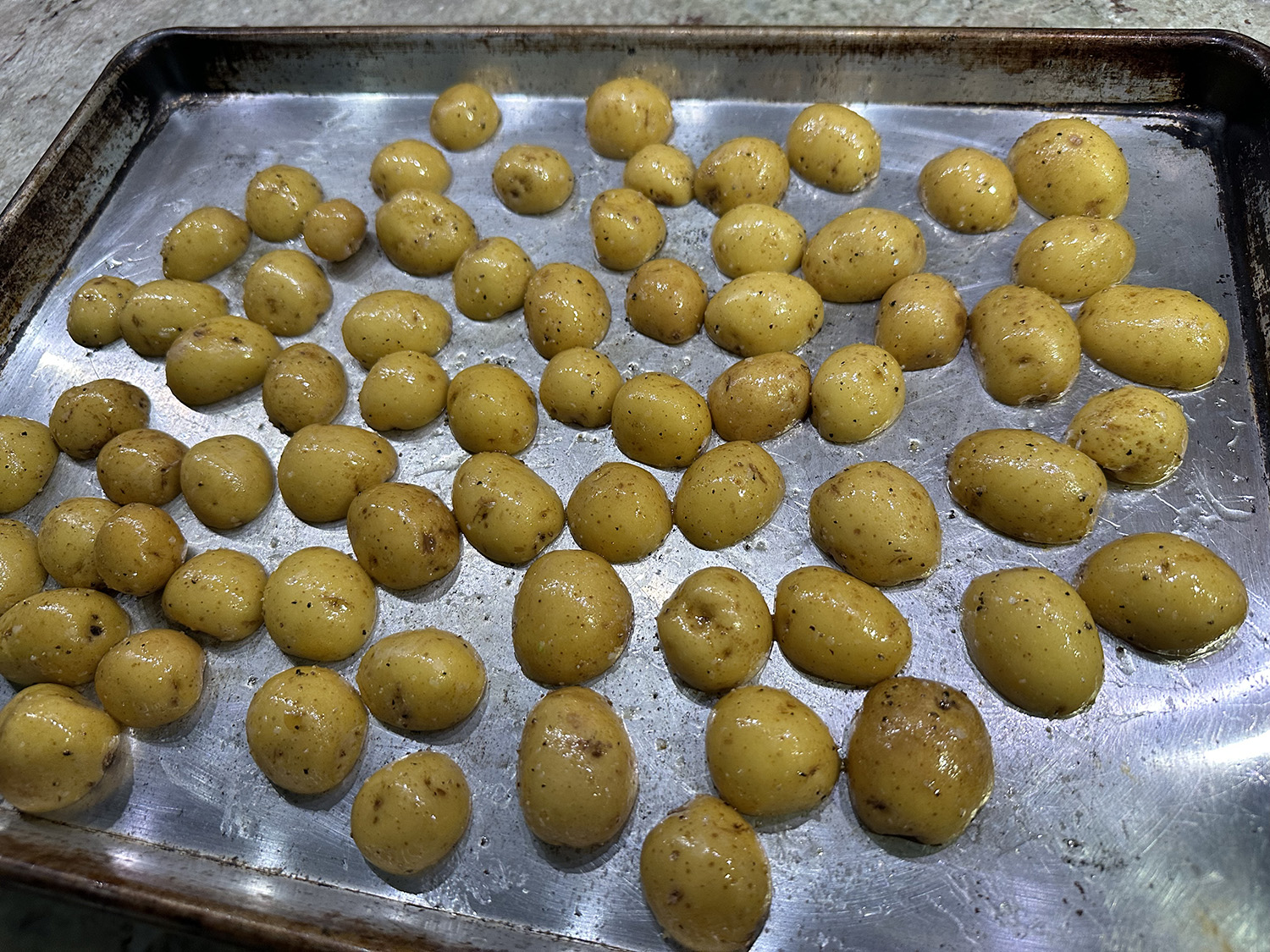
  2. Place the potatoes in a large bowl, add 1 tablespoon olive oil, ½ teaspoon salt and ½ teaspoon pepper and toss. Arrange the potatoes on a sheet pan so the cut sides are facing down and roast for 20 minutes. Afterward, if they are completely cooked through and browned on the cut sides, remove to a plate for later.
  3. While the potatoes roast, fill a medium saucepan with water and bring to a boil. Add the eggs and cook over medium heat for exactly 6 minutes. Remove the eggs, and when they are cool enough to handle, peel and quarter them.
  4. Make the dressing: In a small bowl, whisk together the vinegar, 1 teaspoon Dijon mustard, the garlic, anchovy (if using), ½ teaspoon salt and ½ teaspoon pepper. Slowly whisk in 4* (or less) tablespoons of olive oil and set aside.
  5. Add the haricots verts, tomatoes and olives to the same bowl that the potatoes were in, and toss with 2 tablespoons olive oil and ½ teaspoon salt. Using tongs, toss well, then move the vegetables to the sides to create space in the center of the sheet pan. Pat the salmon fillets dry with a paper towel and place them, skin-side down, in the center of the sheet pan.
  6. Brush fillets with remaining 1 tablespoon olive oil and 1 teaspoon Dijon mustard, and sprinkle with ½ teaspoon salt and ¼ teaspoon pepper. Roast on the top rack in the oven for 10 minutes. Add the cooked potatoes back onto the sheet pan. Turn the broiler to high and broil for 2 to 3 minutes to lightly brown the salmon. (If you don’t have a broiler, roast salmon for an additional 2 to 3 minutes instead.) The salmon should flake easily and be just cooked in the center.
  7. Add the greens to a large bowl with the dressing, and toss gently. Place the salmon fillets in the middle of the platter, then arrange the roasted vegetables and eggs around them. Sprinkle with salt and serve.

http://www.lynnandruss.com

Recipe by Lidey Heuck for NYTimes Cooking

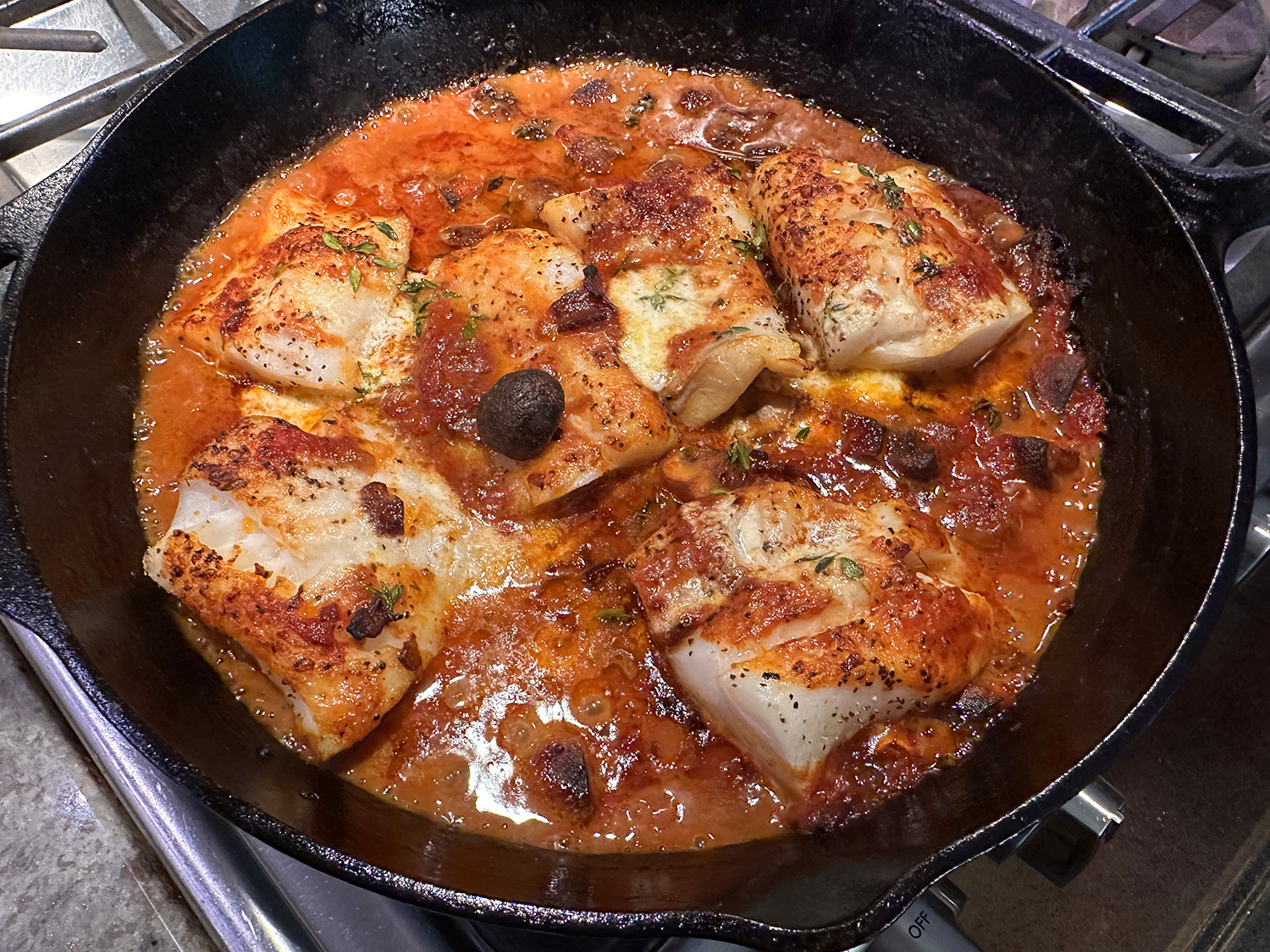
Creamy Fish With Mushrooms and Bacon

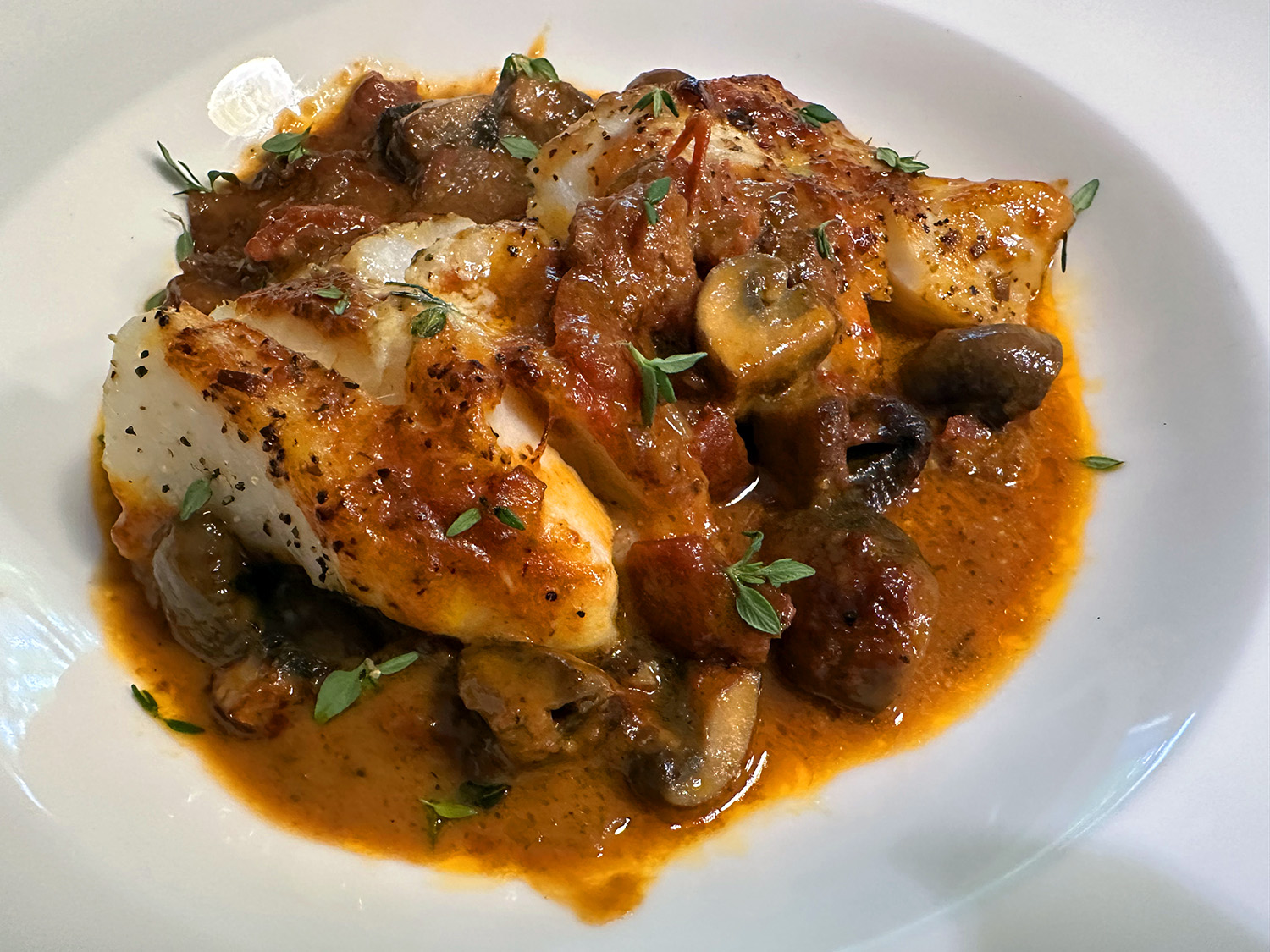
OMG, we were astounded by how delicious this turned out! The delightful fish recipe was inspired by one from the chef Hugue Dufour of M. Wells restaurant in Long Island City, Queens. It’s based on the classic French preparation called bonne femme, which refers to simple, homey dishes often containing wine, mushrooms and cream… which this was.

Here, bacon and tomatoes are added to the sauce, giving it brawny depth and brightness. You can use any kind of mild, white-fleshed fish you like. Just watch it carefully so the fillets don’t overcook under the broiler. While there are many good choices of flaky white fish, cod seems to be the most economical, so that is what we used.

I’ve often wondered what the difference in terminology for “filet” versus “fillet” in recipes really means. Basically they are interchangeable. Filet is predominantly used in American (US) English (en-US), while fillet is predominantly used in British English. Fillet can be used as a noun or a verb. As a noun, fillet is a boneless piece of meat/fish. Many people eat fish fillets, for instance. As a verb, fillet means to remove meat/fish from the bone. Today, fillet is used much more frequently than filet. Don’t get too hung up on which version to use.

Creamy Fish With Mushrooms and Bacon

  • Servings: 4-6
  • Difficulty: easy
  • Print

Ingredients

  • 4 oz. bacon (4 to 8 slices, depending on thickness), diced
  • 8 oz. cremini or white mushrooms, stems discarded and caps halved or quartered
  • 1 large shallot, diced
  • 1 cup canned peeled whole tomatoes
  • ¼ cup white wine
  • 1 cup vegetable or chicken stock
  • ¼ tsp. fine sea salt, plus more for fish and to taste
  • ¼ tsp. finely ground black pepper, plus more for fish
  • 5 Tbsp. crème fraîche or heavy cream
  • 5 thyme sprigs, plus ½ tsp. thyme leaves, more for garnish
  • 4 to 6 fillets black sea bass, fluke, tilefish, hake or other white fish (1¼ to 1½ lbs.), skin removed
  • Baguette slices or buttered toast, for serving

Directions

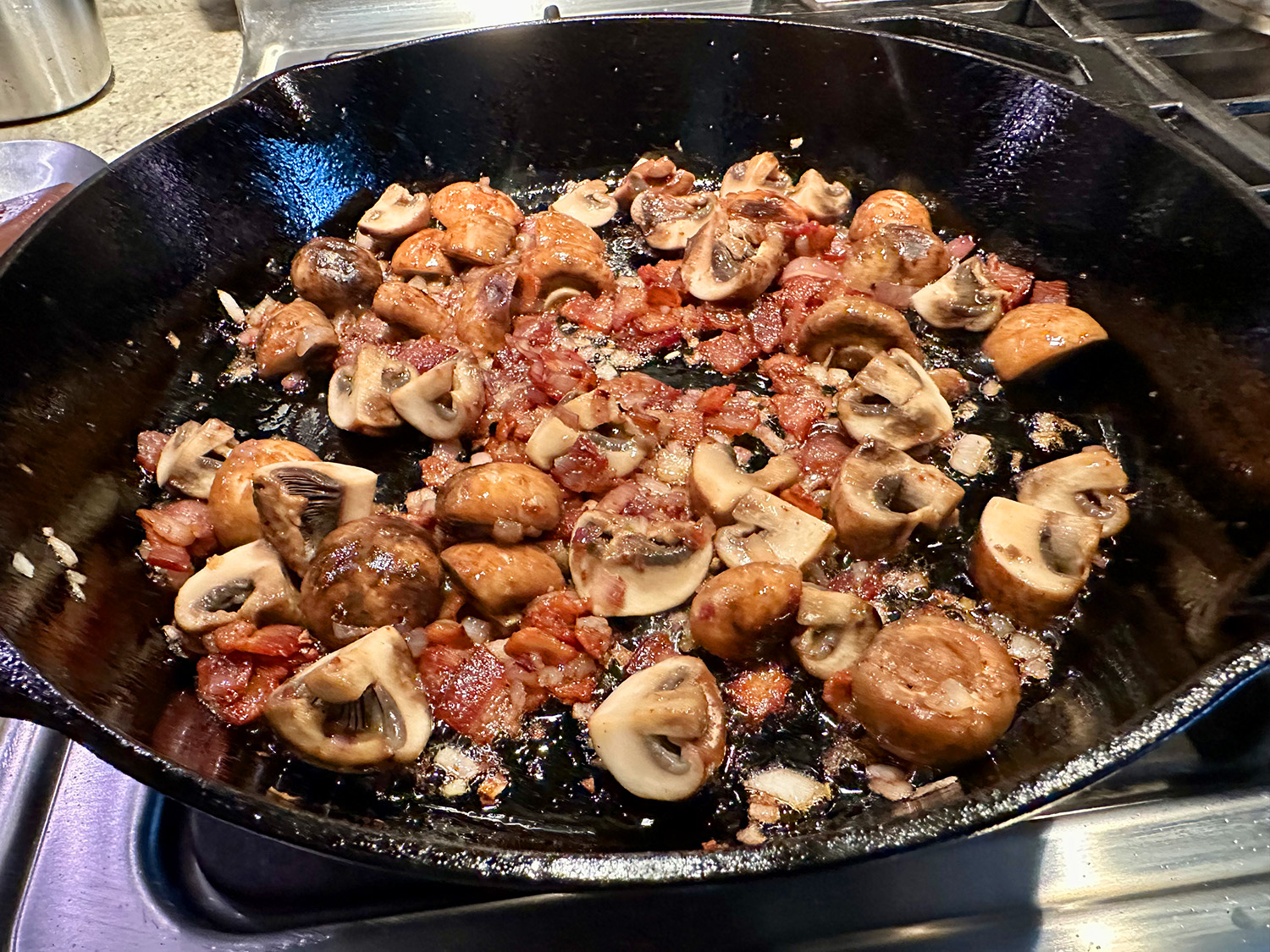
  1. In a large oven-safe skillet over medium-high heat, cook the bacon until crisp and brown, about 5 minutes. Add mushrooms and shallot, and cook until tender and deeply golden, 5 to 8 minutes.
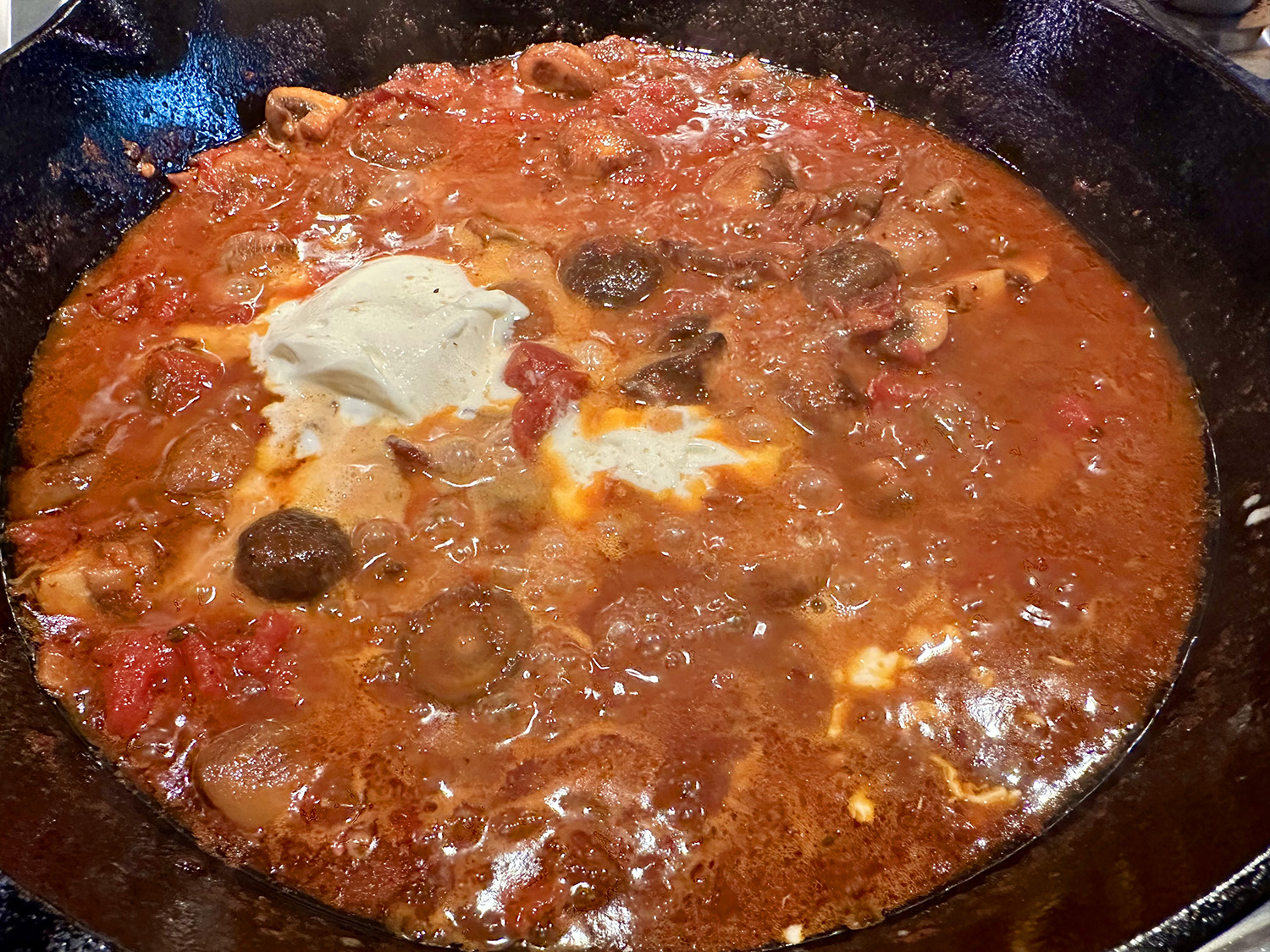
  2. Use your hands to crush the tomatoes or a knife to roughly chop them. Deglaze the skillet with the crushed tomatoes and their liquid, along with the wine and vegetable stock. Add the salt and pepper. Bring to a strong simmer and cook until the sauce has thickened, about 10 minutes. Taste and add more salt if needed.
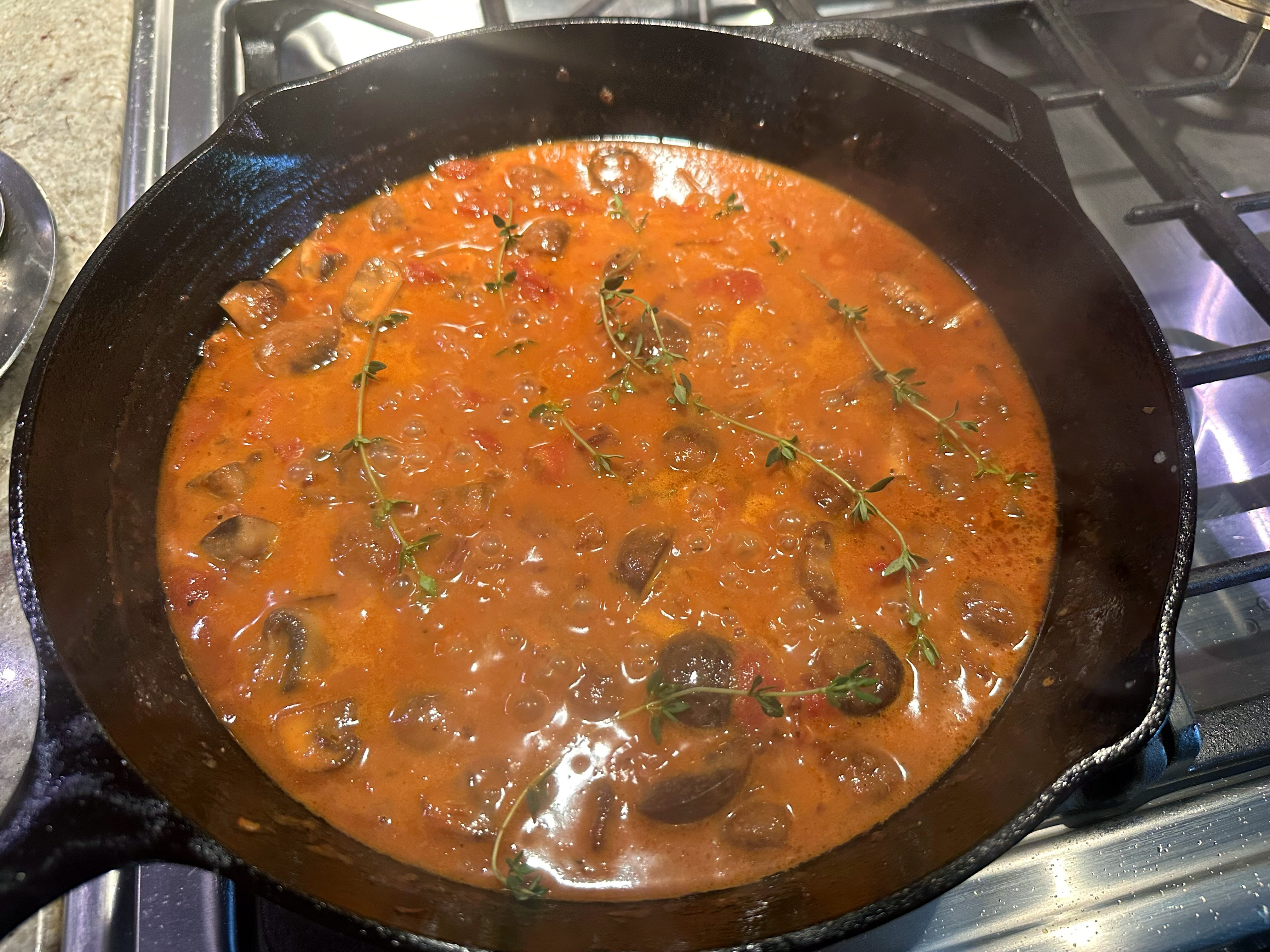
  3. Whisk in 4 tablespoons crème fraîche or cream, then add thyme sprigs. Simmer for 2 to 3 more minutes or until the sauce has reduced slightly.
  4. While the sauce reduces, generously season the fillets on both sides with salt and pepper. Heat broiler on high with a rack placed 6 inches from the heat source.
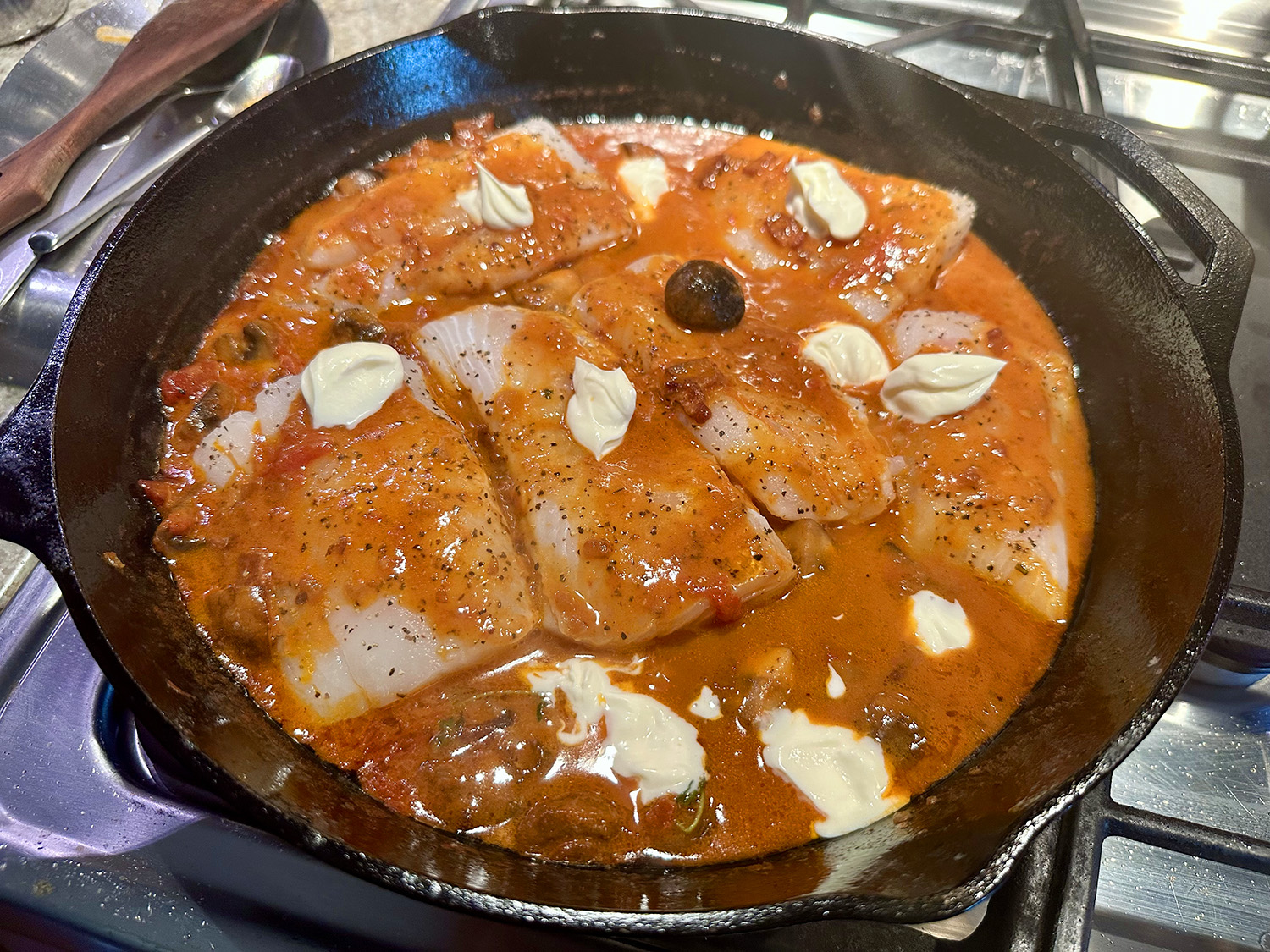
  5. Place the thicker fillets toward the edge of the skillet on top of the sauce and place the thinner fillets toward the center. Some overlapping is fine. Use a spoon to scoop some of the mushroom mixture over the fillets and dollop the remaining 1 tablespoon of crème fraîche evenly over the skillet. Sprinkle with thyme leaves.
  6. Broil for 2 to 5 minutes for thin fillets and 6 to 10 for thick ones, or until the sauce is bubbling and the fillets are just cooked through. Serve garnished with thyme leaves in shallow bowls with baguette slices or buttered toast for dipping.

http://www.lynnandruss.com

Recipe by Melissa Clark for NYTimes Cooking

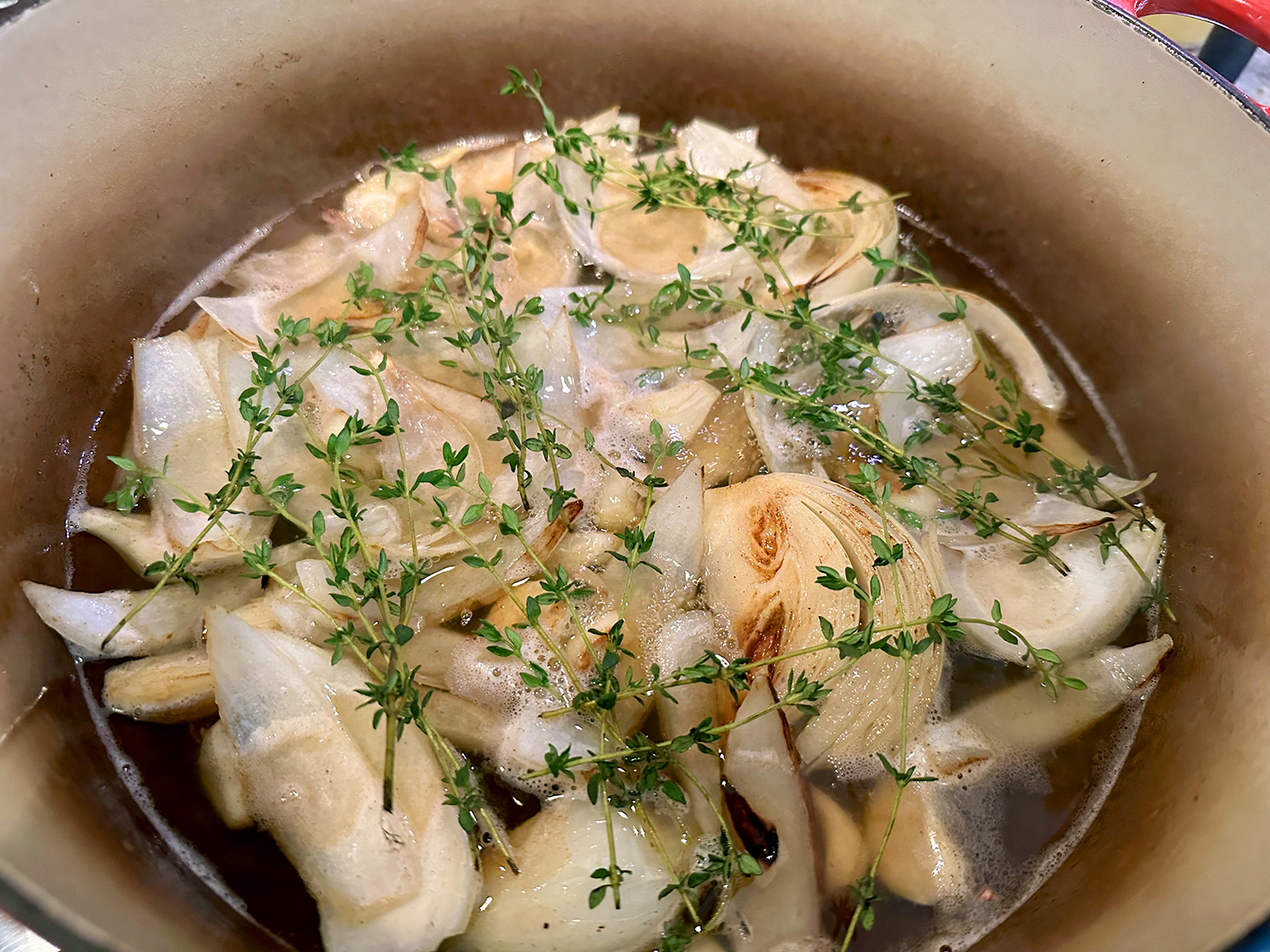
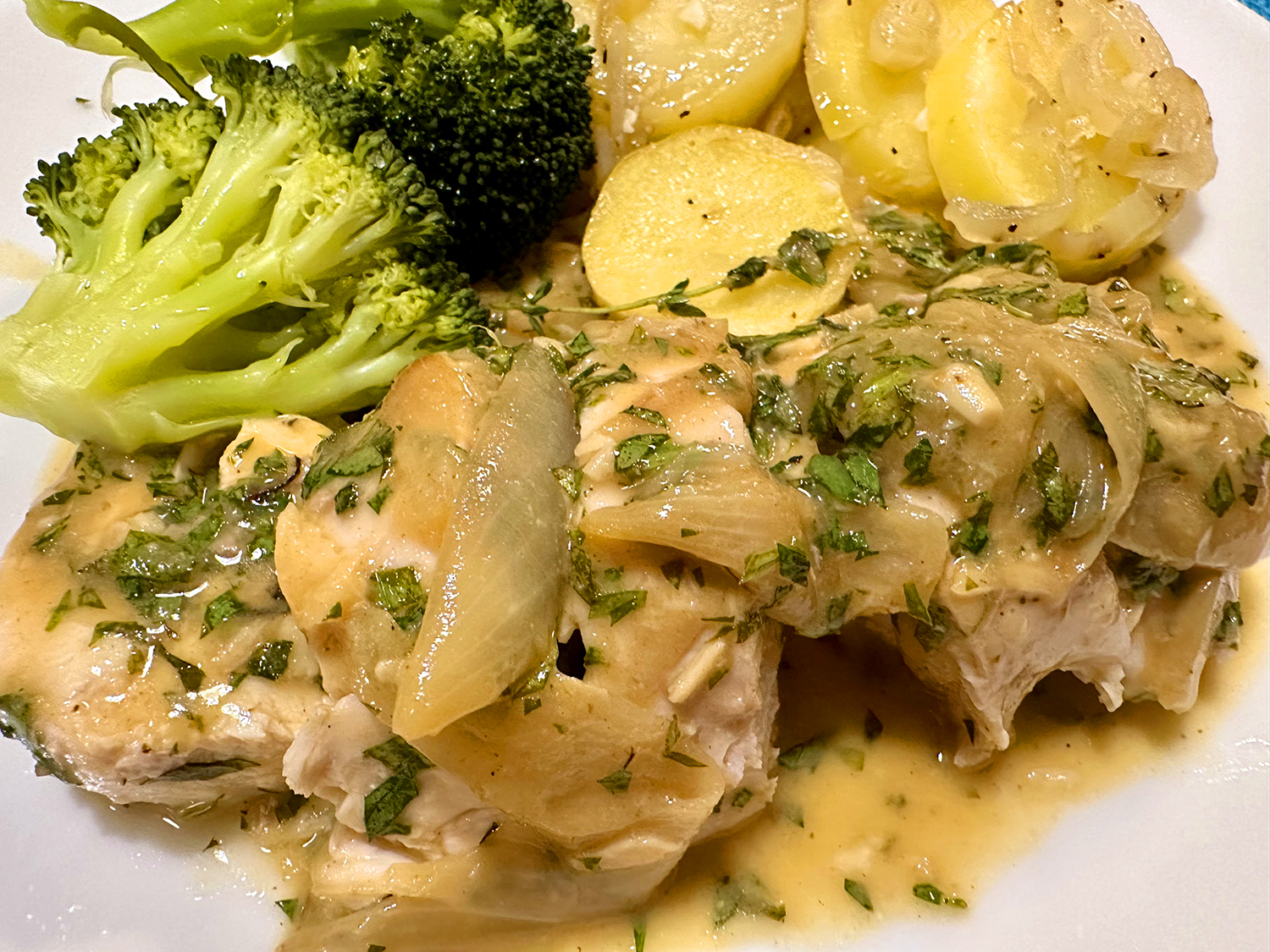
Chicken En Cocotte

With very little prep involved in this Chicken En Cocotte—or in a pot—and most of the cooking being hands-off, you should get this tasty recipe on your short list. You will not get crispy skin from this method, in fact it gets discarded, but you will end up with super-moist poultry meat. We oooohed and aaaahhhed all the way through dinner.

Cooking the chicken breast side down allows the delicate white meat to gently poach in the wine while the legs bake up above, a technique that helps equalize the cooking of the white meat (done at 160°F) and dark meat (done between 175°F to 180°F). Allowing the chicken to rest breast side up after prevents the white meat from overcooking.

The sauce was just amazing, we even spooned it over our side dish of Spanish Potatoes in Olive Oil, a perfect companion to the chicken because they both share several ingredients: white wine, garlic, onion and thyme.

NOTE: Don’t use a Dutch oven smaller than 7 quarts or a chicken larger than 4½ pounds. If the bird fits too snugly, there won’t be enough space for heat to circulate, hindering even cooking.

Chicken En Cocotte

  • Servings: 4
  • Difficulty: easy
  • Print

Ingredients

  • 5 Tbsp. salted butter, divided
  • 1 large yellow onion, cut into 8 wedges
  • 8 medium garlic cloves, peeled and halved
  • 1 1/2 cups dry white wine
  • 10 thyme sprigs
  • 1 4- to 4½-lb. whole chicken, wings tucked and legs tied
  • Kosher salt and ground black pepper
  • 3 Tbsp. lemon juice
  • 2 Tbsp. dijon mustard
  • 1/2 cup finely chopped fresh tarragon leaves

Directions

  1. Heat the oven to 400°F with a rack in the lower-middle position. In a large Dutch oven over medium, melt 1 tablespoon of the butter. When the foaming subsides, add the onion and garlic and cook until lightly browned, about 5 minutes. Pour in the wine and bring to a simmer. Lay the thyme sprigs on the onion mixture.
  2. Using paper towels, pat the chicken dry then season with salt and pepper. Set the chicken breast side down over the thyme and onions. Cover and bake until the thickest part of the breast reaches 160°F and the thighs reach 175°F to 180°F, 55 to 65 minutes. Using tongs inserted into the cavity of the chicken, carefully transfer it to a large baking dish, turning it breast side up. Let rest for at least 15 minutes.
  3. Meanwhile, remove and discard the thyme sprigs. Tilt the pot to pool the liquid to one side and use a wide spoon to skim and discard the fat. Bring to a simmer over medium and cook until thickened and reduced to about 1 cup (with solids), about 5 minutes. Off heat, whisk in the remaining 4 tablespoons butter, the lemon juice and mustard. Taste and season with salt and pepper.
  4. Remove the legs from the chicken by cutting through the hip joints. Remove and discard the skin from the legs, then separate the thighs from the drumsticks. Remove the breast meat from the bone, remove and discard the skin, then cut each crosswise into thin slices. Arrange the chicken on a platter. Transfer the sauce to a bowl, stir in the tarragon and serve with the chicken.

http://www.lynnandruss.com

Recipe from Milk Street

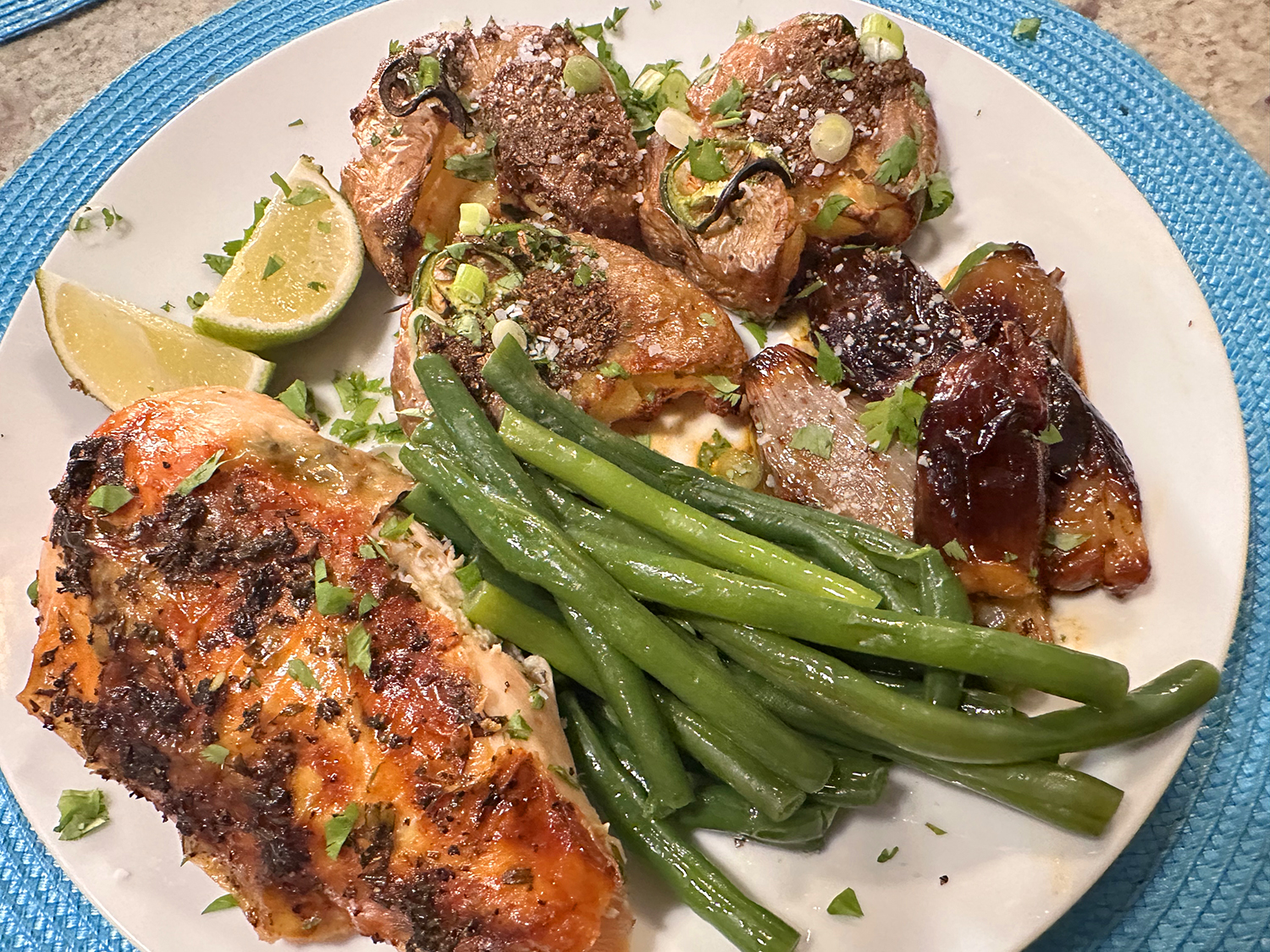
Roast Tarragon-Cognac Chicken

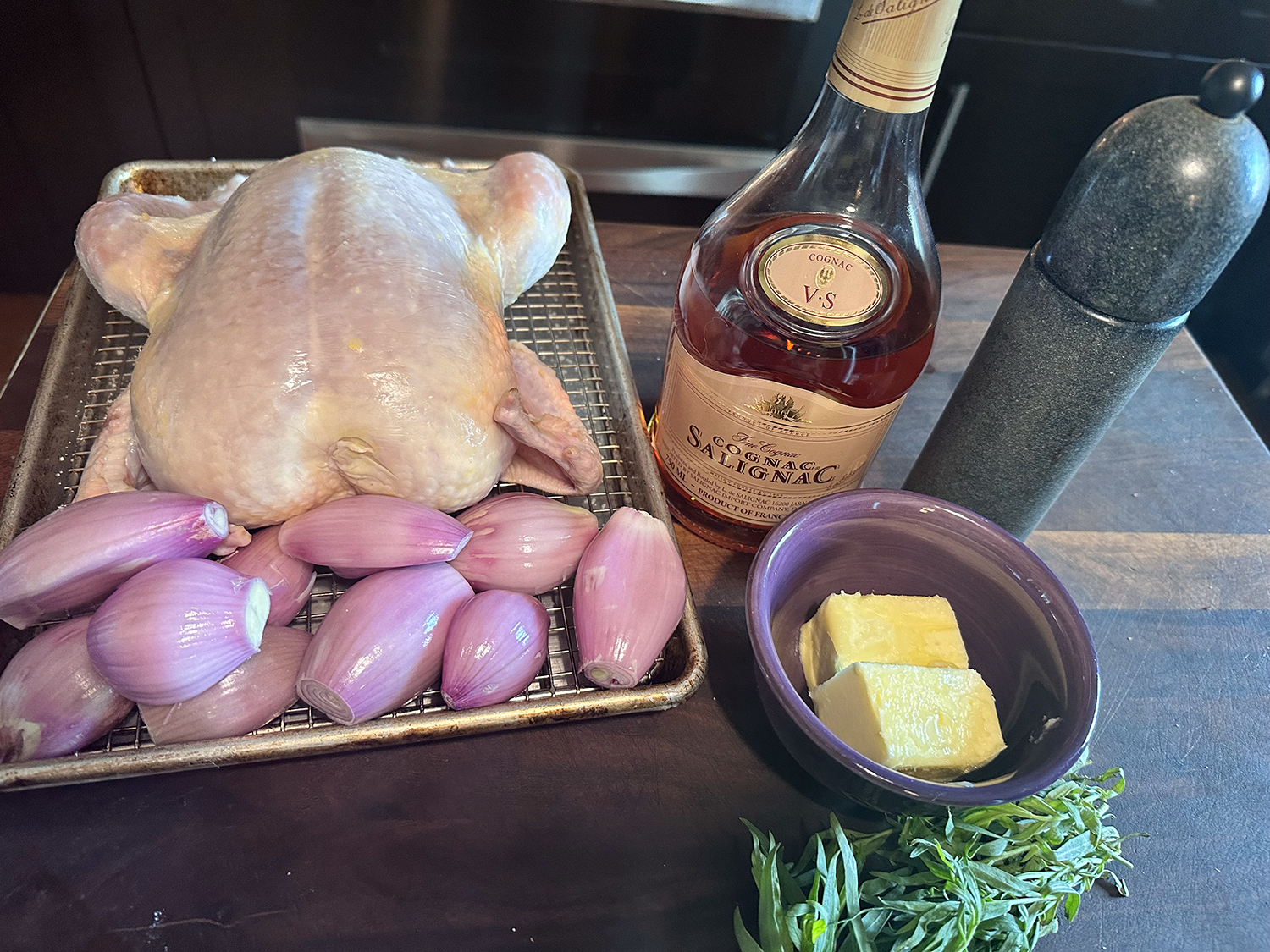
Chef/author Melissa Clark tell us “The sophisticated, French flavors of brandy, butter and tarragon season this golden-skinned roast chicken, adding panache to what is otherwise an easy and straightforward recipe.”

Nothing like a fabulous meal using a limited number of ingredients. We decided to include about a dozen shallots to surround the poultry and add the beloved allium flavor. As they roast with the chicken, the shallots become all soft and jammy.

Serving the chicken with mashed potatoes or polenta, provide a soft bed to absorb all the heady, buttery juices. But we were jonesing to try the “Gunpowder Potatoes” in this case. If you choose the mashed potatoes idea, go ahead and make a flavorful pan sauce, especially if you add those shallots.

Oh, and if you’re not a tarragon fan, fresh thyme makes an excellent, milder substitute.

Roast Tarragon-Cognac Chicken

  • Servings: 4
  • Difficulty: easy
  • Print

Ingredients

  • 1 4-lb. whole chicken
  • 10-12 shallots, trimmed and peeled
  • 2 tsp. coarse gray sea salt or 2½ teaspoons kosher salt (such as Diamond Crystal)
  • 6 Tbsp. unsalted butter, softened
  • 1 bunch fresh tarragon, leaves and tender stems coarsely chopped (about ¾ cup)
  • 2 Tbsp.s Cognac
  • 1 tsp. freshly ground black pepper

Directions

  1. Pat the chicken dry and salt the bird inside and out. Transfer to a plate or baking dish, preferably on a rack, and refrigerate uncovered for at least 1 hour or overnight. (Ours was in the fridge for 4 hours.)
  2. When ready to cook the chicken, heat the oven to 400 degrees.
  3. In a small bowl, combine butter, tarragon, 1 tablespoon Cognac and the pepper. Rub mixture inside the chicken cavity and over and under the chicken skin.
  4. Place chicken on a rimmed sheet pan or in a large, ovenproof skillet. Roast, breast side up, until the skin is golden and crisp, and the juices run clear when you insert a fork in the thickest part of the thigh (165 degrees), about 1 hour.
  5. Turn off the oven — don’t skip this step, or the Cognac may overheat and catch fire — and transfer the pan with the chicken to the stovetop. Pour the remaining 1 tablespoon Cognac over the bird and baste with some of the buttery pan juices. Immediately return the chicken to the turned-off oven and let rest there for 10 minutes before carving and serving.

http://www.lynnandruss.com

Adapted from a recipe by Melissa Clark for NYTimes Cooking

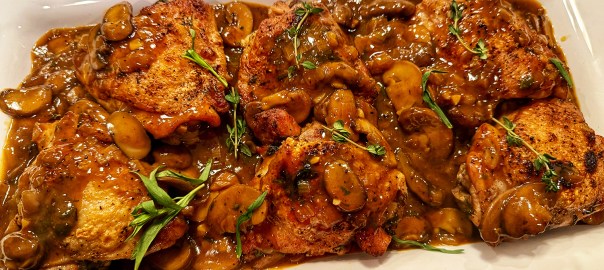
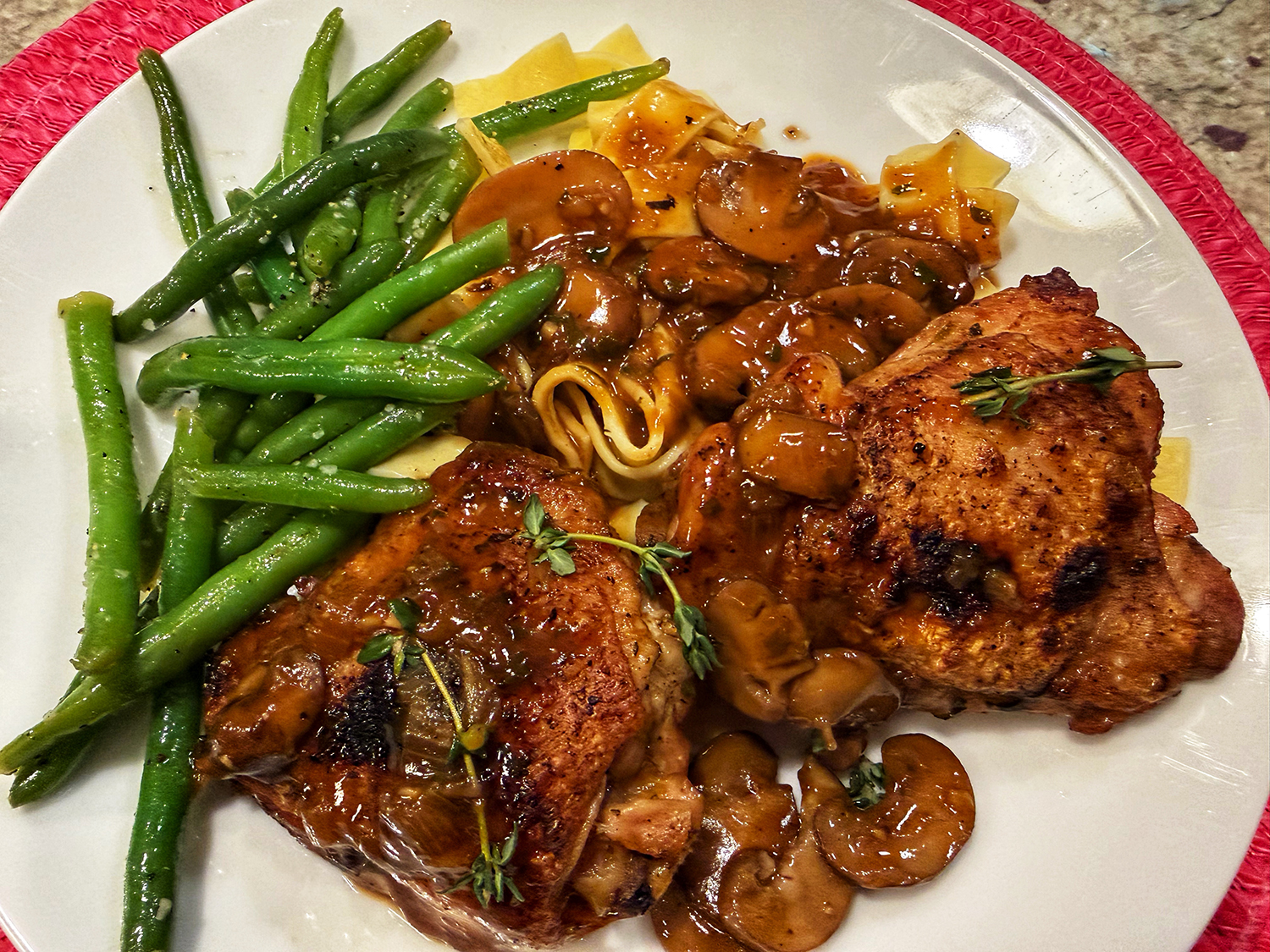
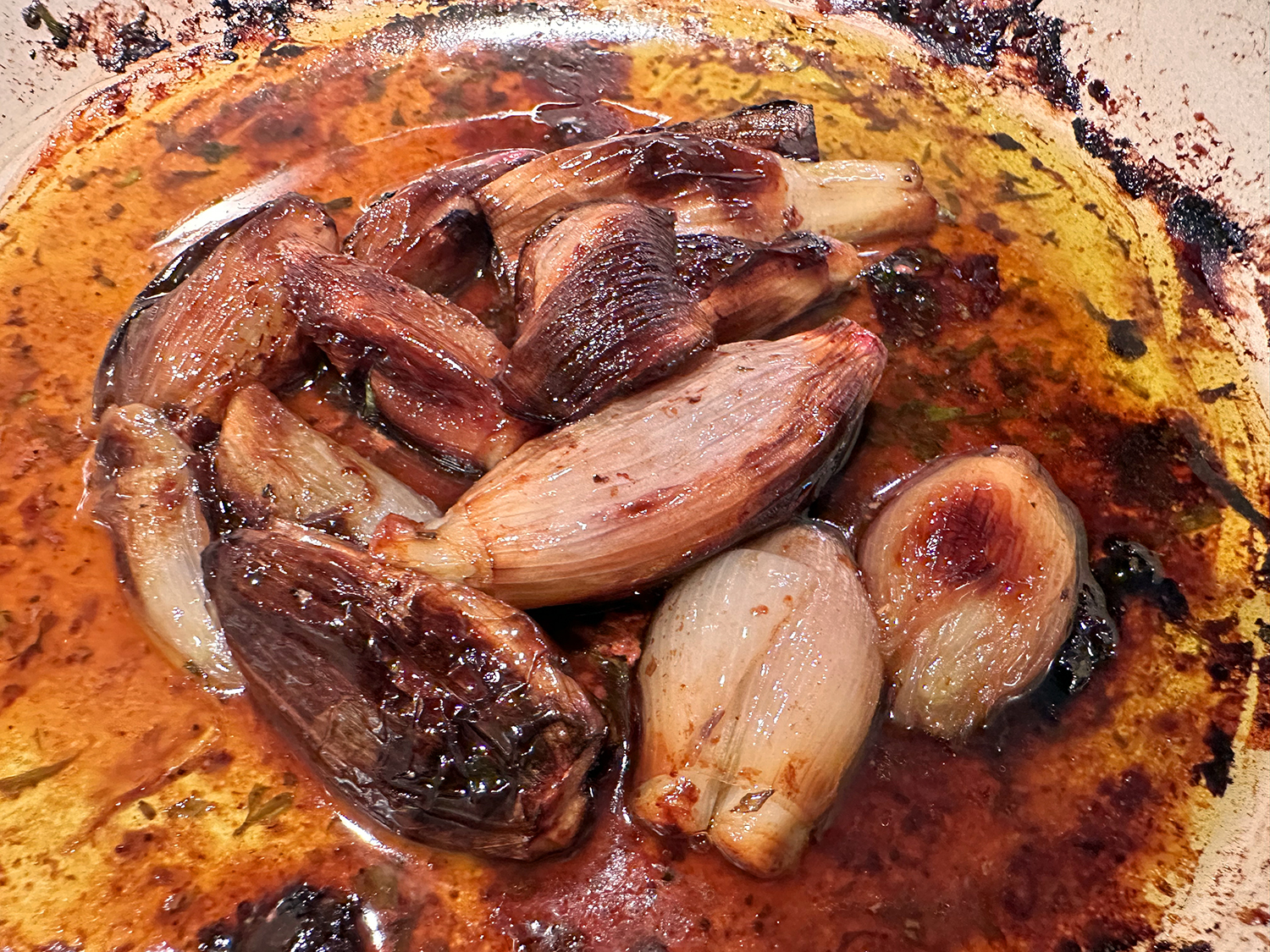
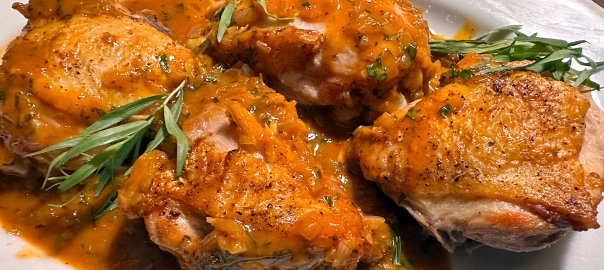
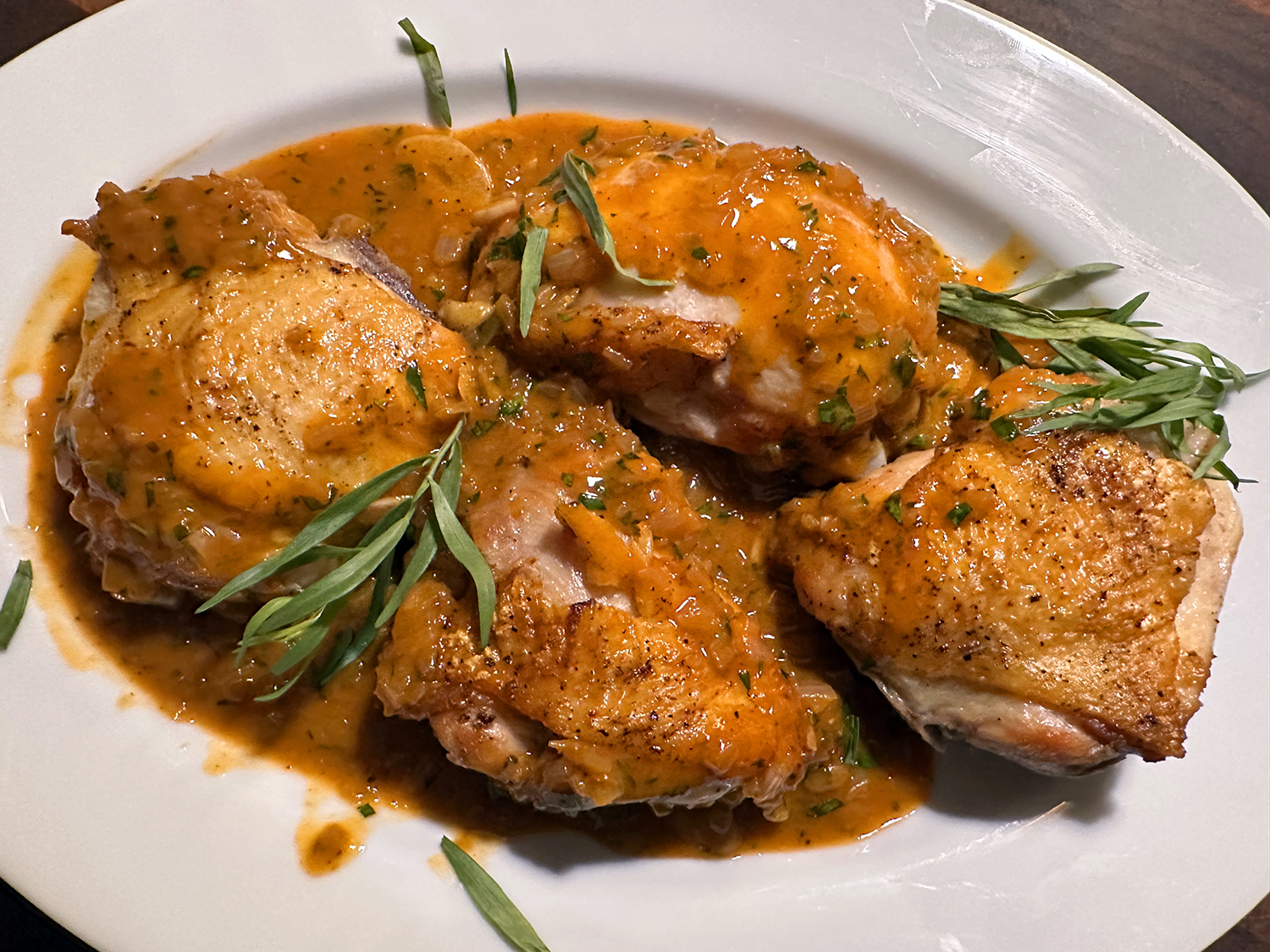
Poulet au Vinaigre

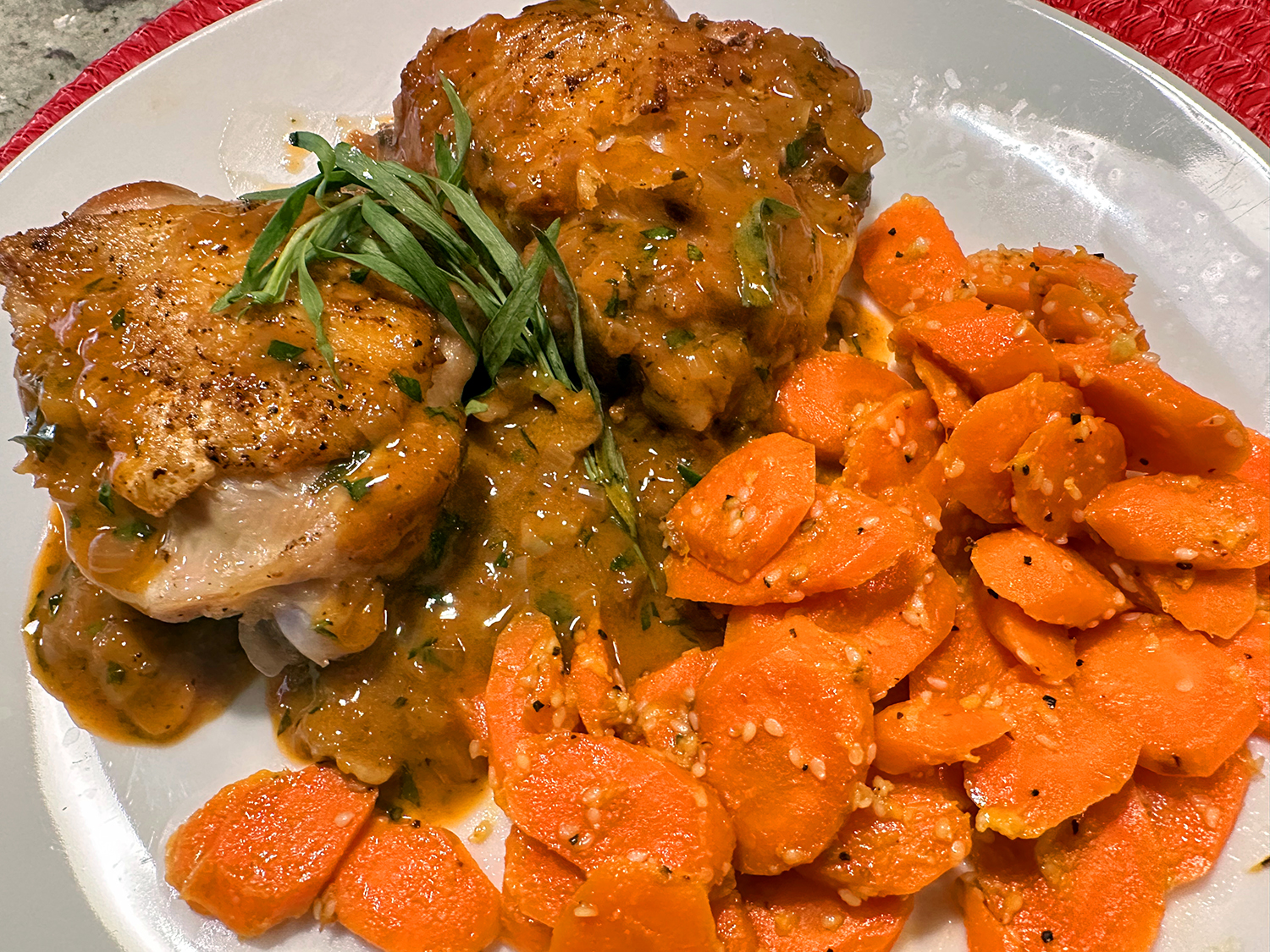
This classic Lyonnaise dish calls for using just chicken thighs rather than the usual combination of light and dark meat to ensure that all the meat cooks at the same rate. It hails from America’s Test Kitchen and we were excited to try the recipe.

The chicken thighs are browned to develop flavor and then braised in a flavorful mix of chicken broth (preferably homemade), white wine, and red wine vinegar until it reaches 195 degrees and is meltingly tender and juicy.

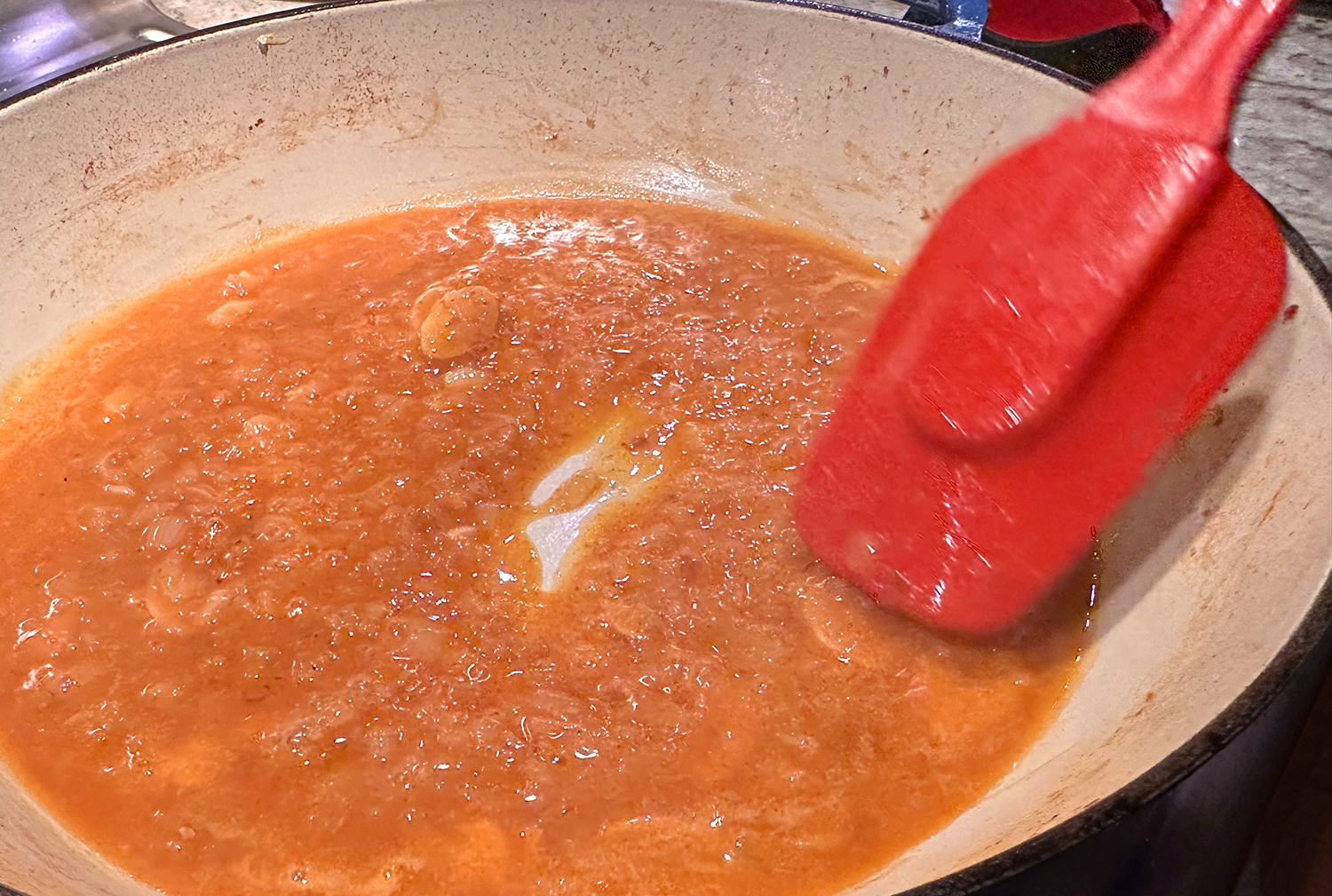
To finish the sauce, fortify the braising liquid with tomato paste and reduce it to a luxurious, lightly thickened consistency before adding minced fresh tarragon. The sauce is typically finished with heavy cream, but this version whisks in a couple tablespoons of butter instead to help preserve the vibrancy of the luscious sauce. 

We initially loved the fact that it was a recipe for two. But after dining on the amazing dish, we almost wished we did have leftovers. The sauce alone is so incredibly tasty, you’ll want to lick your plate clean! Our entree was paired with Miso-Orange Glazed Carrots.

NOTE: Use an inexpensive dry white wine here or substitute dry vermouth. Fresh tarragon is traditional for poulet au vinaigre, but parsley can be substituted, if desired.

Poulet au Vinaigre

  • Servings: 2
  • Difficulty: easy
  • Print

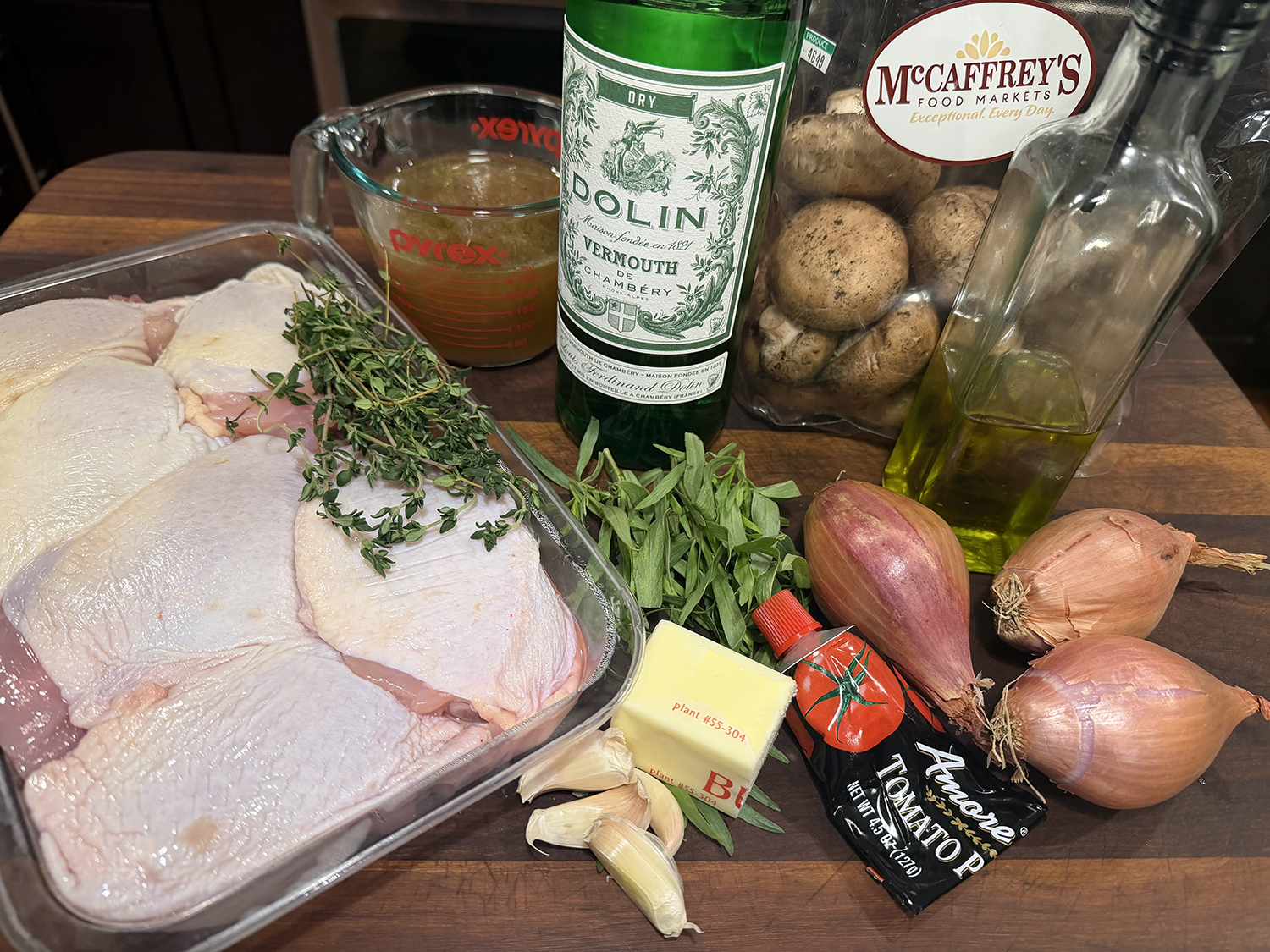
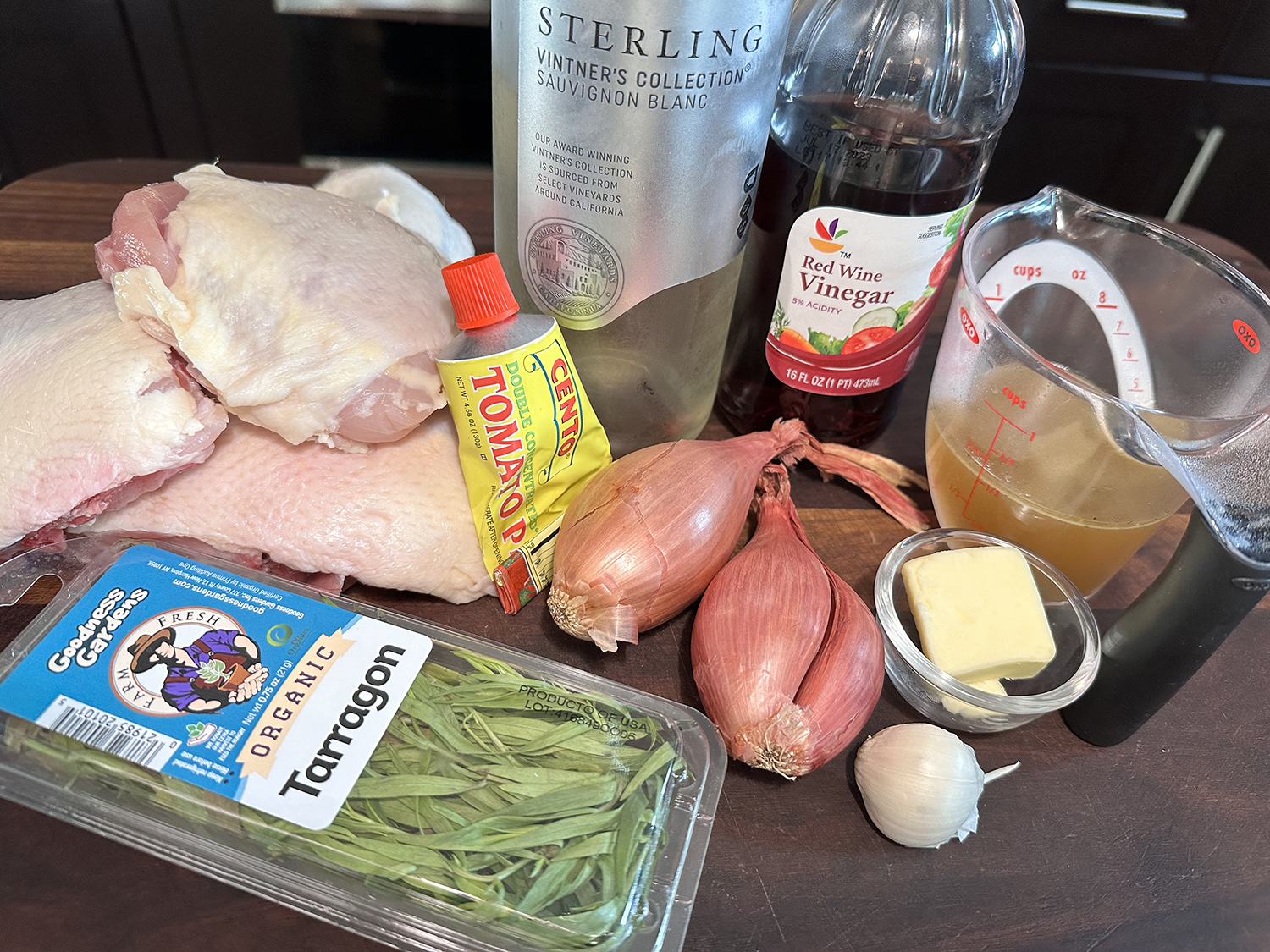
Ingredients

  • 4 (5- to 7-oz.) bone-in chicken thighs, trimmed
  • ½ tsp. table salt
  • ¼ tsp. pepper
  • 1 ½ tsp. vegetable oil
  • 2 Tbsp. minced shallot, or more (we doubled it to 1⁄4 cup)
  • 1 garlic clove, sliced thin
  • ½ cup chicken broth, preferably homemade
  • ½ cup dry white wine
  • 2 ½Tbsp. red wine vinegar, plus extra for seasoning
  • 1 ½ tsp. tomato paste
  • 1 Tbsp. unsalted butter, chilled
  • 1 ½ tsp. minced fresh tarragon

Directions

  1. Adjust oven rack to lower-middle position and heat oven to 325 degrees.
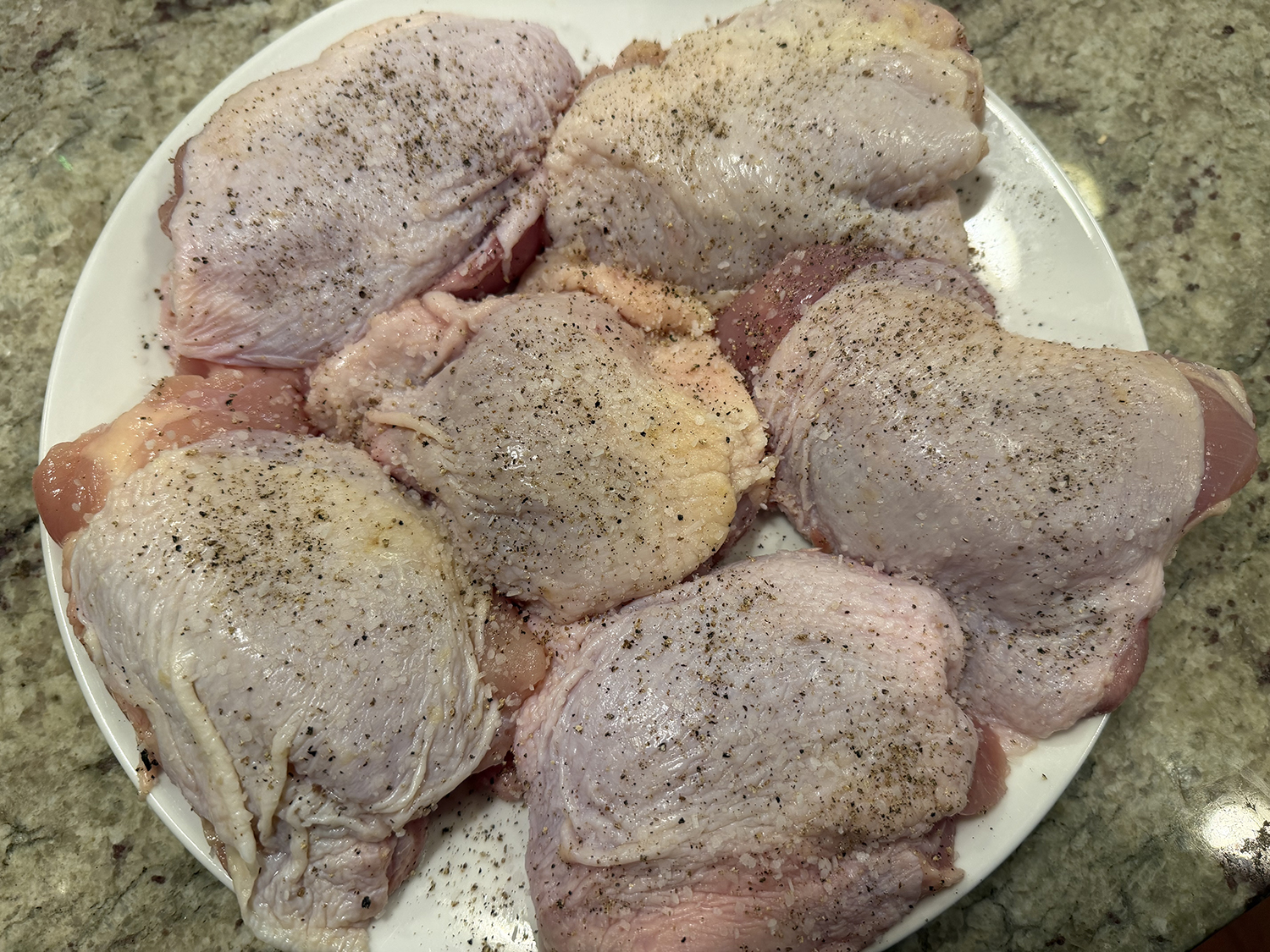
  2. Pat chicken dry with paper towels and sprinkle both sides with salt and pepper. Heat oil in 10-inch oven-safe skillet over medium heat until shimmering.
  3. Add chicken, skin side down, and cook, without moving it, until well browned, about 8 minutes. Using tongs, flip chicken and brown on second side, about 3 minutes. Transfer chicken to large plate.
  4.  Pour off all but 1 tablespoon fat from skillet. Add shallot and garlic and cook, stirring frequently, until garlic is golden brown, about 1½ minutes.
  5. Add broth, wine, and vinegar; bring to simmer, scraping up any browned bits. Return chicken to skillet, skin side up (skin will be above surface of liquid).
  6. Transfer skillet to oven and bake, uncovered, until chicken registers 195 degrees, 35 to 40 minutes. Using tongs, transfer chicken to clean serving platter and tent with aluminum foil.
  7. Place skillet over high heat. Whisk tomato paste into liquid and bring to boil. Cook, occasionally scraping side of skillet to incorporate fond, until sauce is thickened and reduced to ⅔ cup, 5 to 7 minutes.
  8. Off heat, whisk in butter and tarragon. Season with salt, pepper, and up to ½ teaspoon extra vinegar (added ⅛ teaspoon at a time) to taste. Pour sauce around chicken and serve.

http://www.lynnandruss.com

Original recipe from America’s test Kitchen

Lazy Chicken-and-Sausage Cassoulet

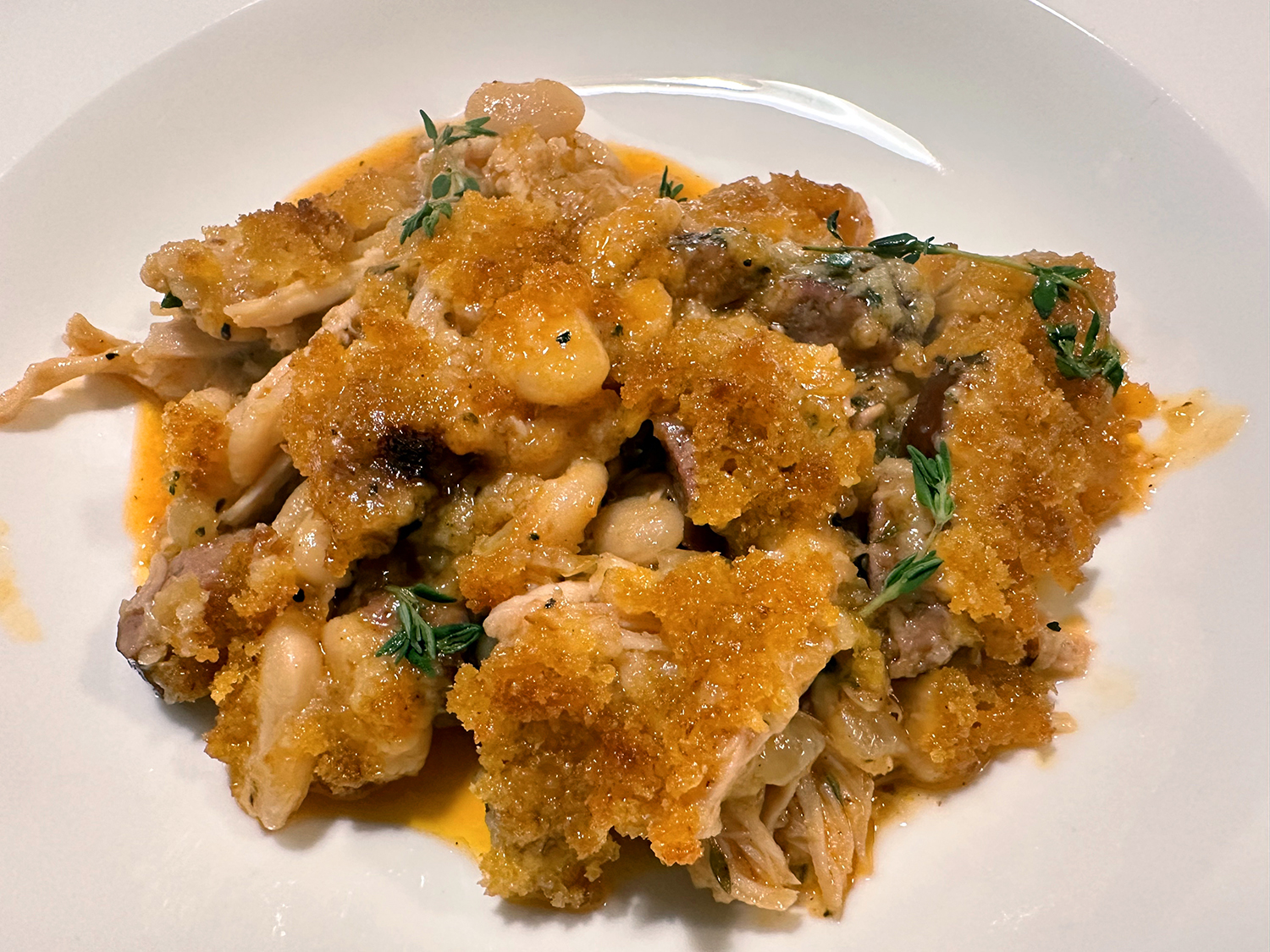
Cassoulet, a hearty slow-simmered stew of sausage, confit (typically duck), pork, and white beans, is one of the great hallmarks of French country cuisine. The best versions are cooked for hours until the beans and meat meld into a dish of luxuriant, velvety richness. As chef-author Molly Stevens says “There is no single best cassoulet, and, perhaps more importantly, feel free to adapt this rustic dish to suit your own appetite and cooking routines.”

Typically, a traditional French cassoulet should be cooked, then cooled, preferably overnight, then cooked and cooled again — at least three times. Multiple slow simmerings allow the beans to absorb the rich flavors of the sausage and duck confit until they become velvety and plush while still maintaining their shape and integrity. Ideally, it is made over the course of four days, but not here.

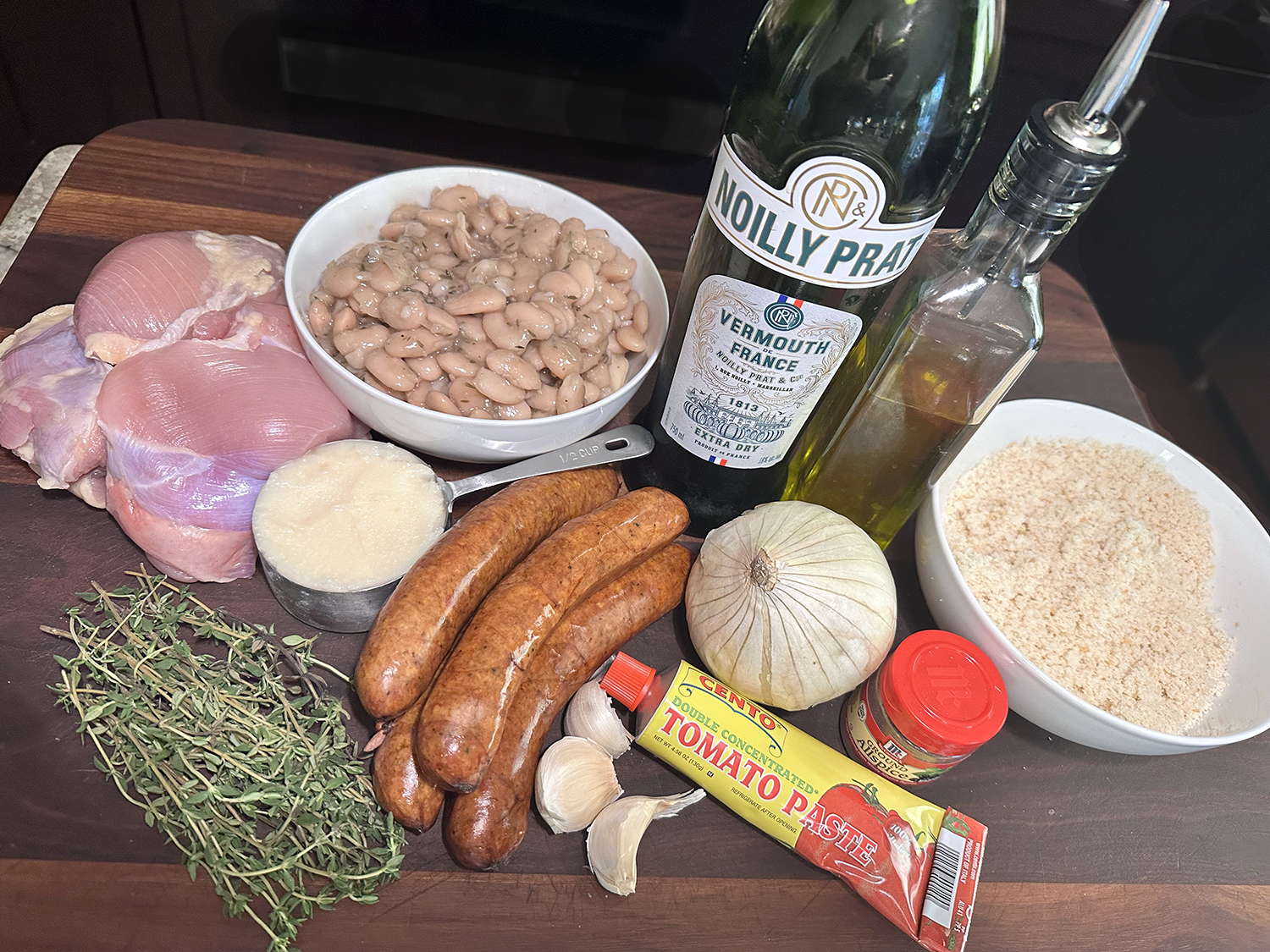
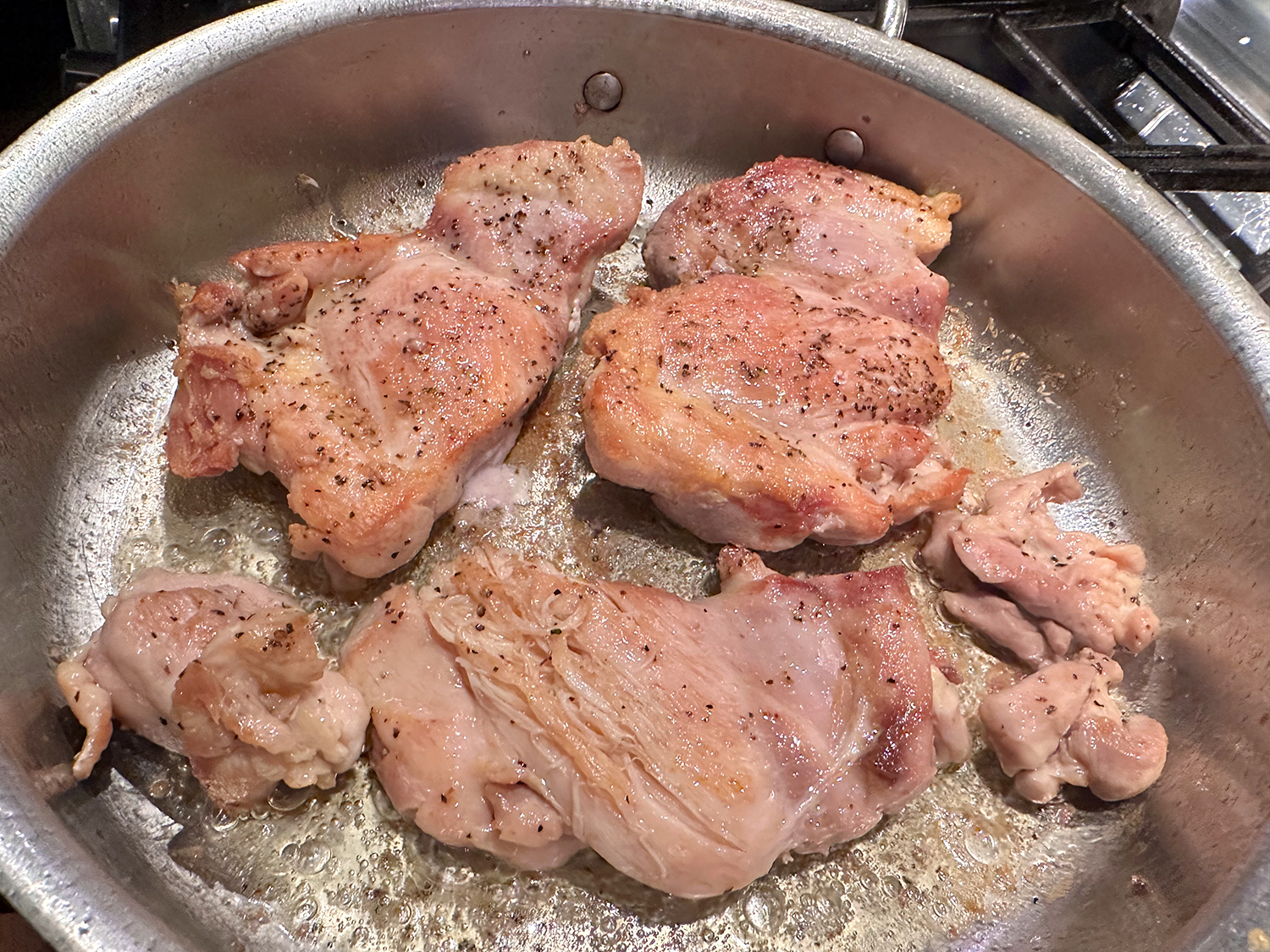
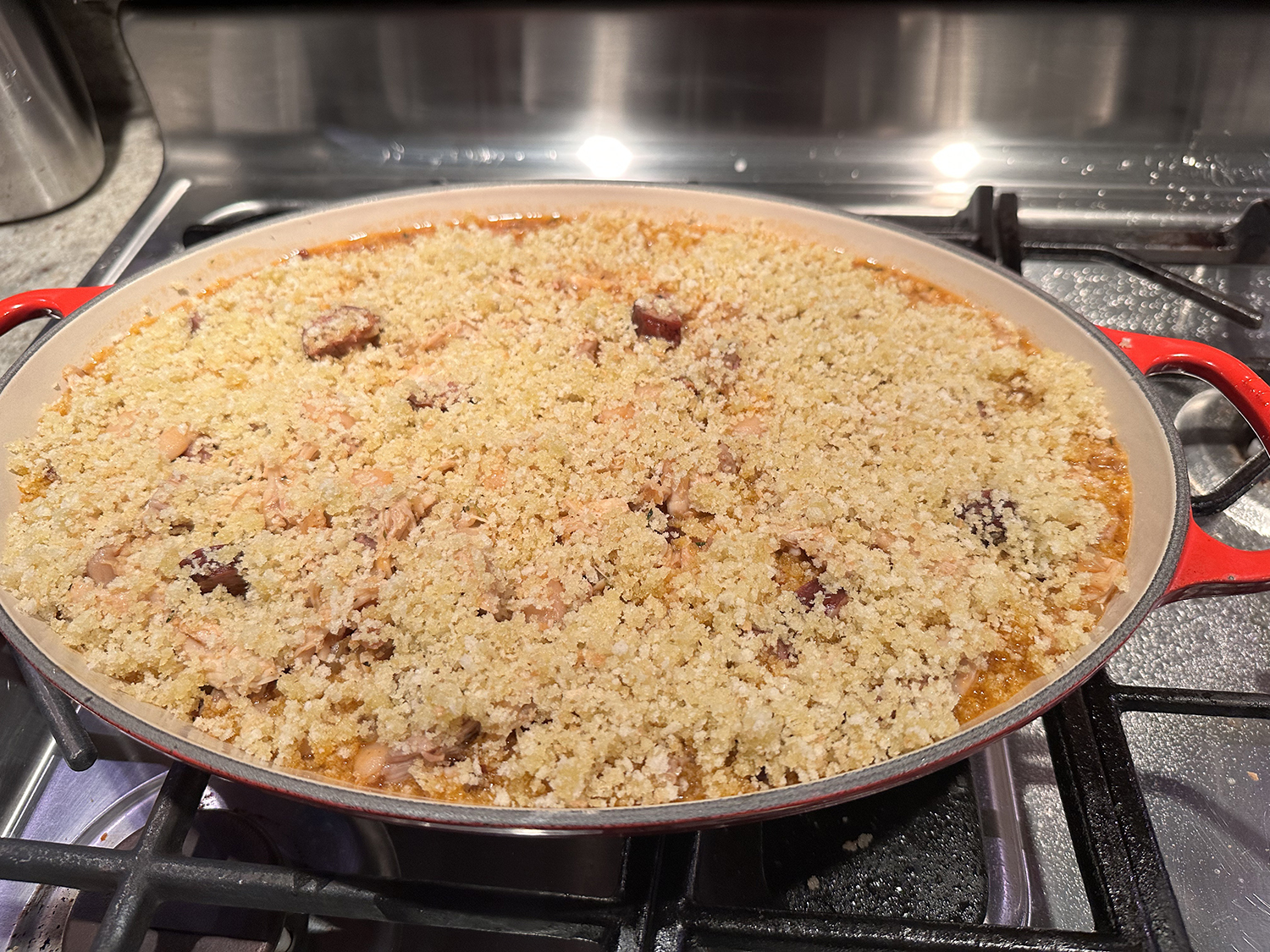
This “lazy” version remains the simplest: one that you can get on the dinner table in about an hour. Start with boneless, skinless chicken thighs (unless you have leftover roast chicken, which works great, too). If you have duck fat on hand, which we did, use it to sauté the chicken for an extra flavor boost (and because that’s the fat most used in southwest France), but any neutral-tasting oil will do. Either way, the chicken should be tender, cooked through, and well-seasoned.

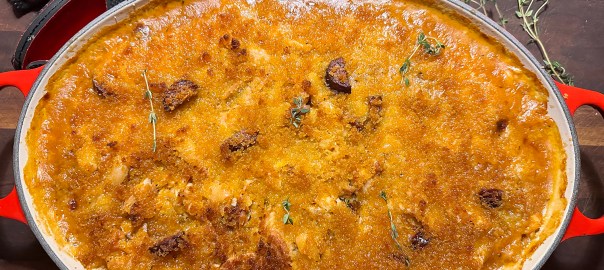
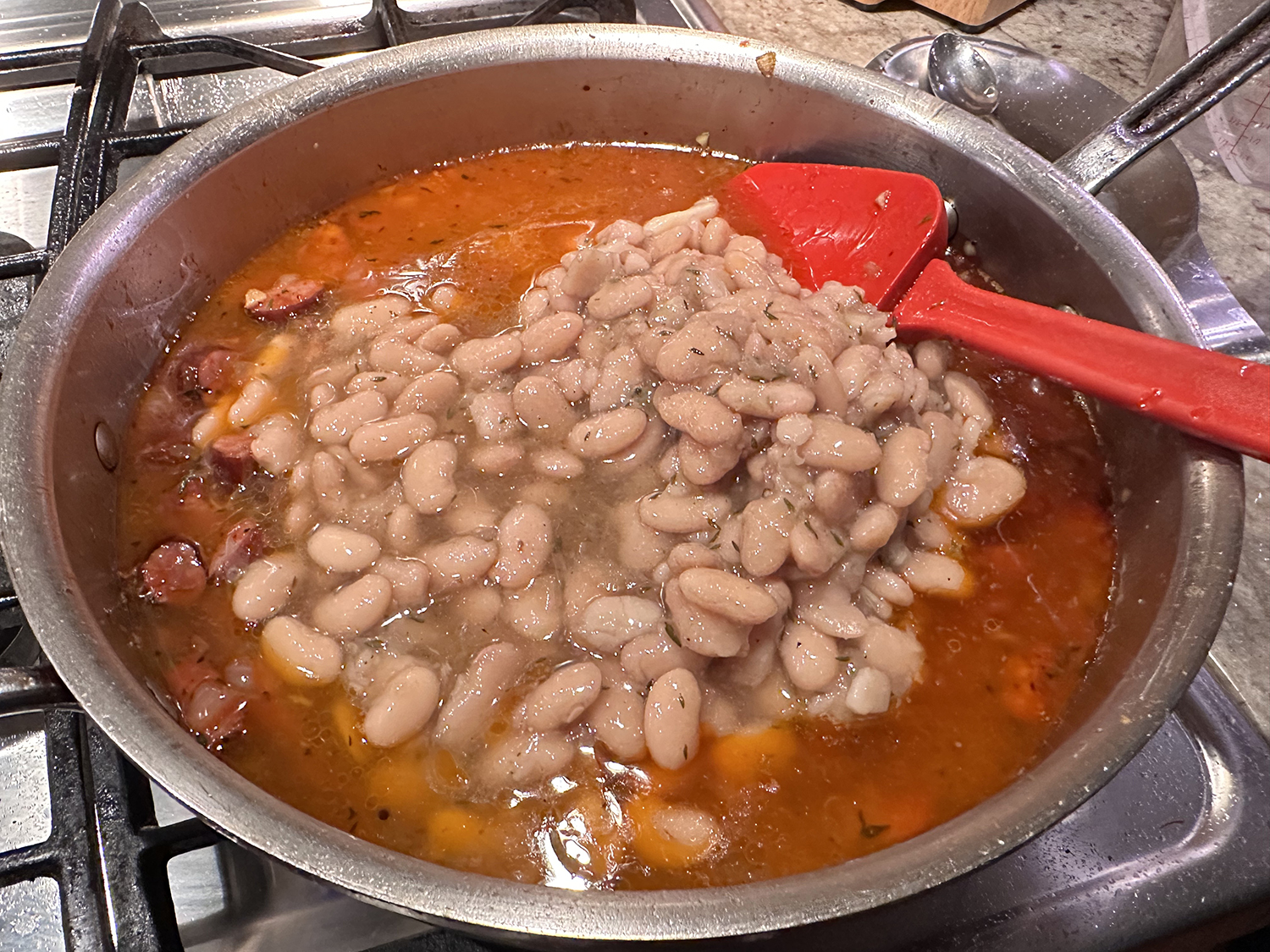
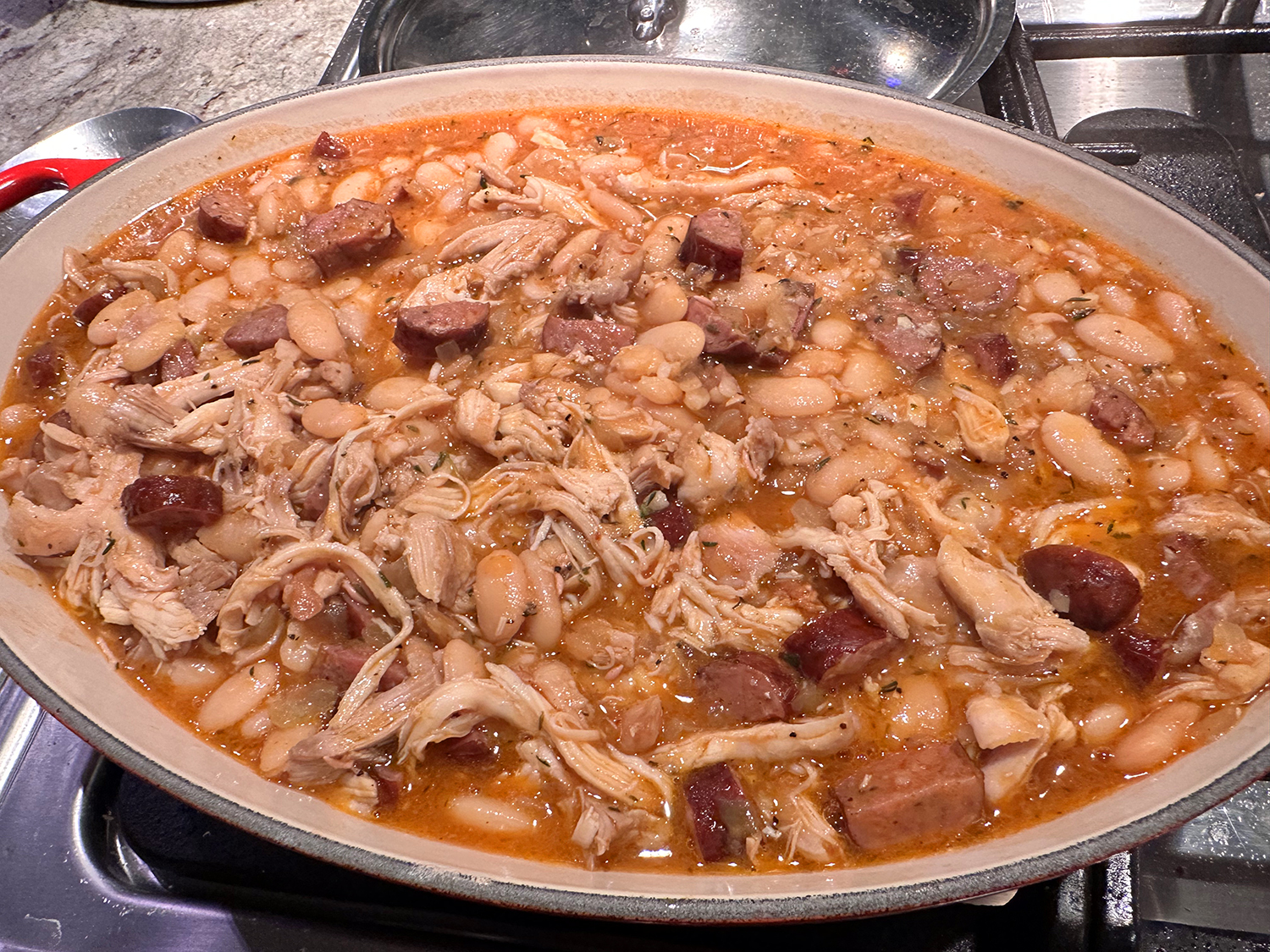
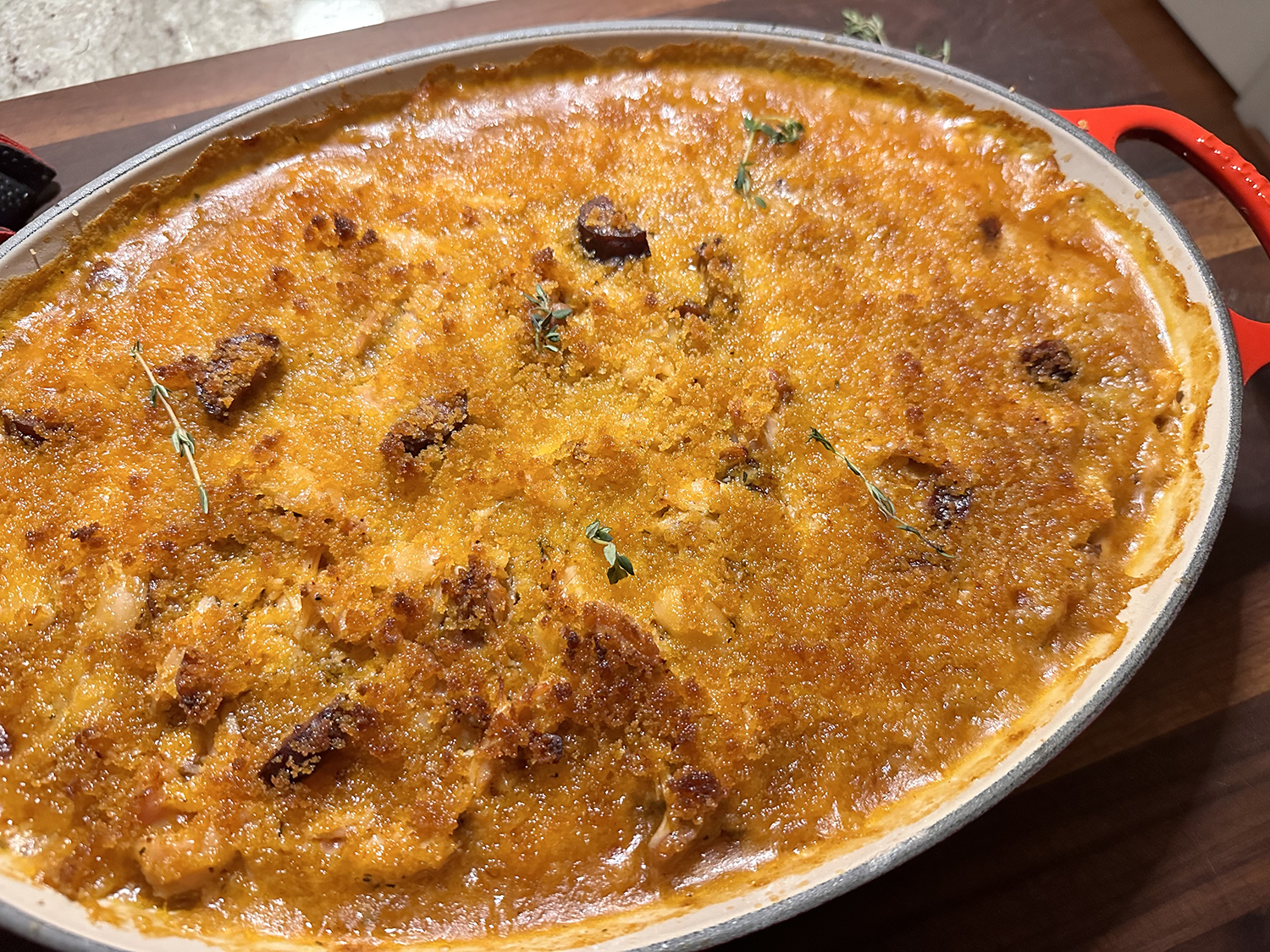
Then it’s a matter of sautéing an onion, a healthy amount of garlic, and a heap of smoked sausage to create a flavor base that will carry through the entire dish. A bit of tomato paste ups the umami quotient, and a splash of white wine contributes just enough acid to balance the richness. From there, everything gets gently folded together with cooked white beans (canned or home-cooked), spread in a shallow dish (either a gratin or a heavy skillet), topped with breadcrumbs, and baked until bubbling hot on the inside and crunchy-golden on top. Unbelievably decadent and delicious!

Make Ahead: The dish may be prepared through step 5, covered, and stored in the refrigerator up to 1 day ahead.

FYI, we doubled the andouille sausage because we only had about half the amount of chicken thighs.

Lazy Chicken-and-Sausage Cassoulet

  • Servings: 4
  • Difficulty: easy
  • Print

Ingredients

  • 2 lbs. boneless, skinless chicken thighs, patted dry
  • 1 3/4 tsp. kosher salt, divided
  • 1 tsp. black pepper, divided
  • 1/2 cup olive oil or canola oil, divided
  • 1 medium-size yellow onion, chopped
  • 6 oz. smoked sausage, such as andouille or kielbasa, halved lengthwise and cut crosswise into 1/2-inch pieces
  • 3 garlic cloves, minced
  • 1 Tbsp. chopped fresh thyme, plus more for garnish
  • 1/8 tsp. ground allspice
  • 1/4 cup dry white wine
  • 2 Tbsp. tomato paste
  • 2 15-oz. cans white beans, such as Great Northern or cannellini, drained and rinsed
  • 1 cup chicken stock, preferably homemade
  • 1 1/2 cups fresh breadcrumbs

Directions

  1. Preheat oven to 375°F. Season chicken thighs with 1 teaspoon salt and 1/2 teaspoon pepper. Heat 2 tablespoons oil in a large skillet over medium-high. Add chicken thighs, smooth side down. Cook, undisturbed, adjusting heat as necessary so thighs cook evenly without scorching, until edges turn opaque and bottoms are nicely browned, about 6 minutes. Flip and cook until internal temperature reaches 165°F, 4 to 5 minutes. Set aside on a plate. Do not wipe skillet clean.
  2. Return skillet and any drippings to medium heat. Add 1 tablespoon oil, onion, and sausage. Cook, stirring often, until onion is tender and light golden, about 6 minutes.
  3. Add garlic, thyme, allspice, remaining 3/4 teaspoon salt, and remaining 1/2 teaspoon pepper. Cook, stirring often, until heated through and fragrant, about 2 minutes.
  4. Add wine and tomato paste, and stir to combine. Bring to a simmer; cook, stirring often, 1 to 2 minutes. Add beans, stock, and 2 tablespoons oil; bring to a simmer.
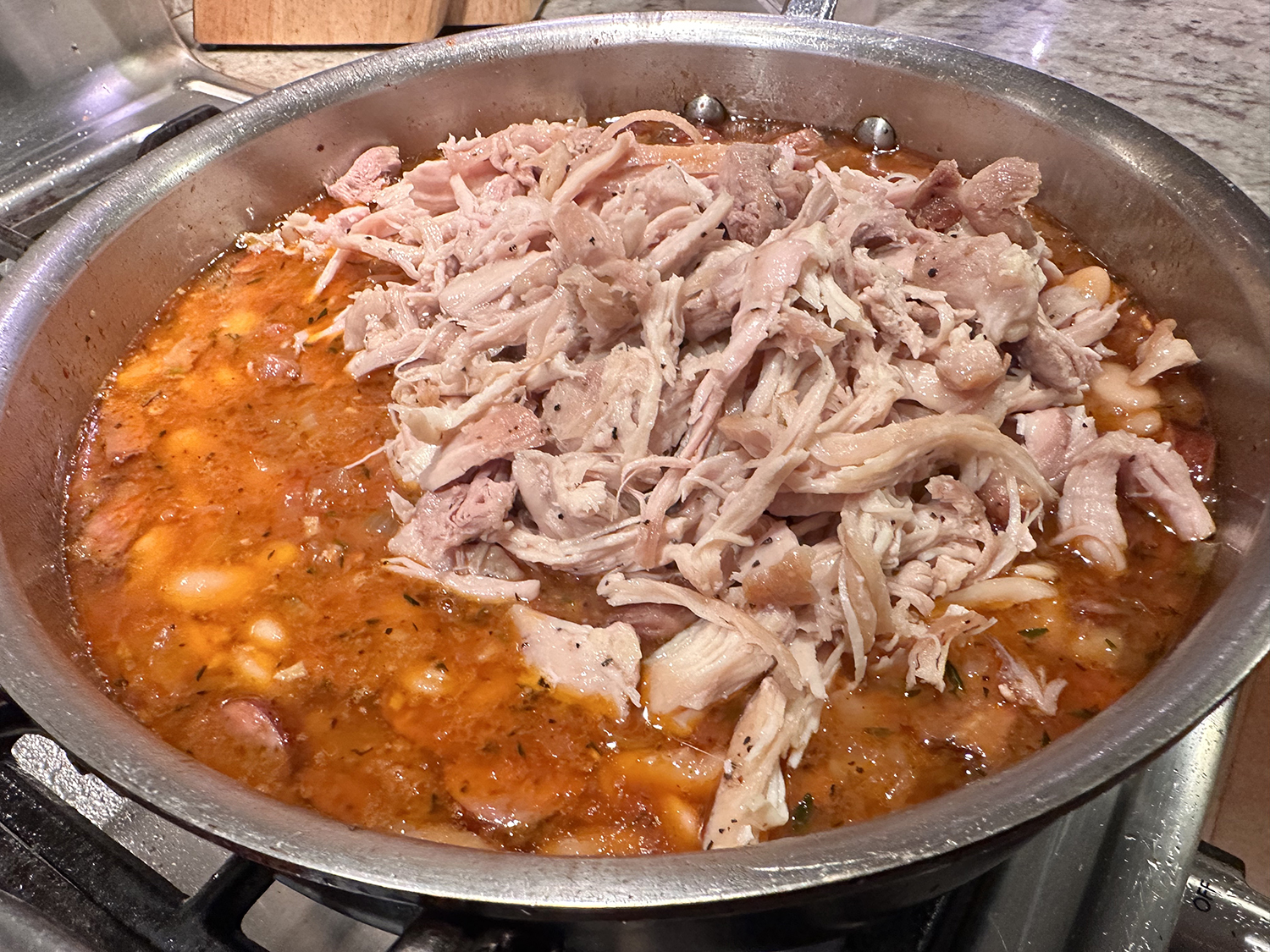
  5. Shred chicken into bite-size pieces; add to onion mixture along with any drippings that have accumulated on the plate. Transfer to an 8- x 11-inch baking dish. Spread into an even layer. (If cooking later, cover the dish with foil and refrigerate until ready to bake.)
  6. Toss breadcrumbs with remaining 3 tablespoons oil in a large bowl. Scatter breadcrumbs over bean mixture.
  7. Bake in preheated oven until heated through, top is browned, and sides are bubbly, about 20 minutes. (If baking from refrigerated, bake an additional 5 to 10 additional minutes.)
  8. Remove from oven and let rest for about 10 minutes. Serve.

http://www.lynnandruss.com

Recipe by Molly Stevens for Food & Wine

Steak Au Poivre

Bringing back a classic. Want to impress your significant other with an impossibly fancy-sounding dish that really isn’t all that complicated? Then Steak Au Poivre (pronounced oh-pwav) is your guy, …er recipe. Even though we made it for our Valentine’s dinner, you can make it for any special occasion, or just because.

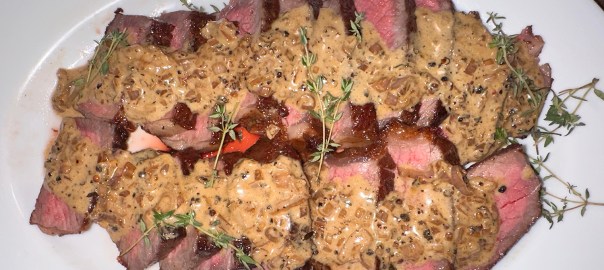
Steak au poivre sounds as if it would be difficult, but it is actually quite simple to prepare, and makes an easy and elegant (perhaps somewhat pricy) meal. Essentially it is a sautéed steak, with a quick pan sauce. This version made with black peppercorns tastes bright but not overpoweringly peppery or boozy.

Although the classic cut of beef for this dish is filet mignon, other cuts of boneless steak can be prepared au poivre, including boneless ribeye, strip steak (our choice), or sirloin. Just remember, a bad or tough steak will still be tough, so select a decent piece of beef with good marbling. It’s best if you season the raw steaks with salt and pepper then place them on a rack without covering in the fridge for 8 up to 24 hours. Take them out of refrigerator 1 hour before cooking.

Because pepper is such an important part of the dish (at least one teaspoon of whole peppercorns per steak), it’s applaudable to splurge on high quality peppercorns. Crush the peppercorns with a light hand. They should be “just-cracked” into big pieces, so it’s best to use a mallet, or mortar and pestle, but not a pepper grinder. The au poivre sauce is made from pan drippings, liquor, and cream.

Steak Au Poivre

  • Servings: 4
  • Difficulty: easy
  • Print

Ingredients

  • 2 1½”-thick New York strip steaks (about 1½ lb. total)
  • Kosher salt, freshly ground pepper
  • 1 Tbsp. whole black peppercorns
  • 2 Tbsp. vegetable oil
  • 4 Garlic cloves, 2 smashed, 2 thinly sliced
  • 3 Sprigs thyme
  • 3 Tbsp. unsalted butter, divided
  • 1 Large shallot, finely chopped
  • ⅓ cup cognac, dry sherry, or brandy
  • ½ cup heavy cream
  • Flaky sea salt

Directions

  1. Pat steaks dry with paper towels. Season all over with kosher salt and a generous amount of ground pepper. Let sit 15–30 minutes.
  2. Coarsely crush peppercorns with a mortar and pestle or place in a resealable plastic bag and crush with a small saucepan (they should be a lot coarser than ground pepper).
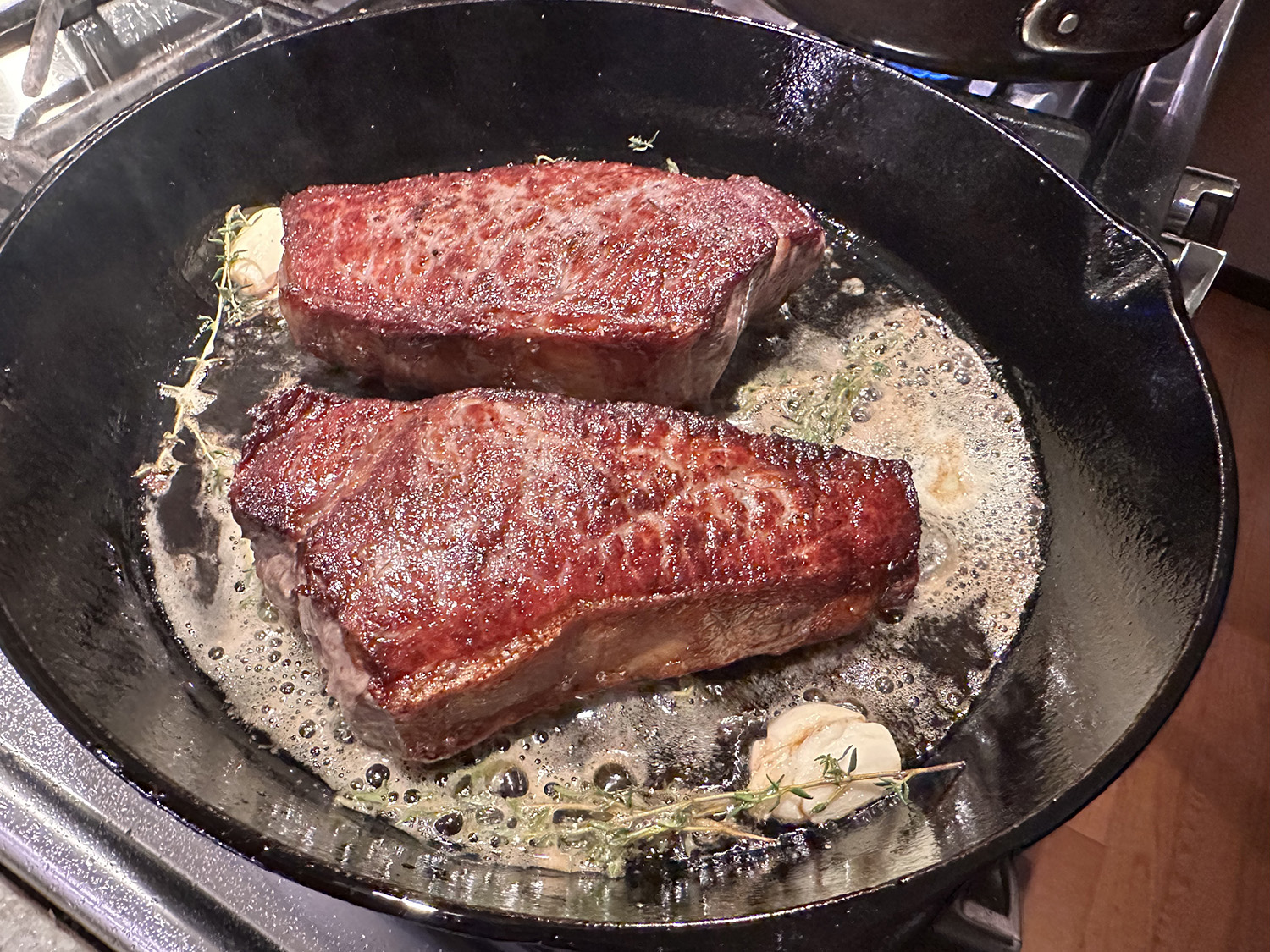
  3. Heat oil in a large skillet, preferably cast iron, over medium-high. Cook steaks, undisturbed, until a deep golden brown crust forms underneath, about 3 minutes. Turn over and cook on second side until golden brown, about 3 minutes. If the steaks have a fat cap, stand them on their sides with tongs and cook until browned, about 3 minutes.
  4. Reduce heat to medium-low. Add smashed garlic cloves, thyme sprigs, and 1 Tbsp. butter to the pan. Cook, basting steak continuously, until an instant-read thermometer inserted into the thickest part of each steak registers 120°, about 2 minutes. Transfer steaks to a cutting board and let rest 10 minutes.
  5. Meanwhile, combine shallot, sliced garlic, crushed peppercorns, and remaining 2 Tbsp. butter in skillet and cook, stirring often, until shallot and garlic are softened but not browned, about 5 minutes.
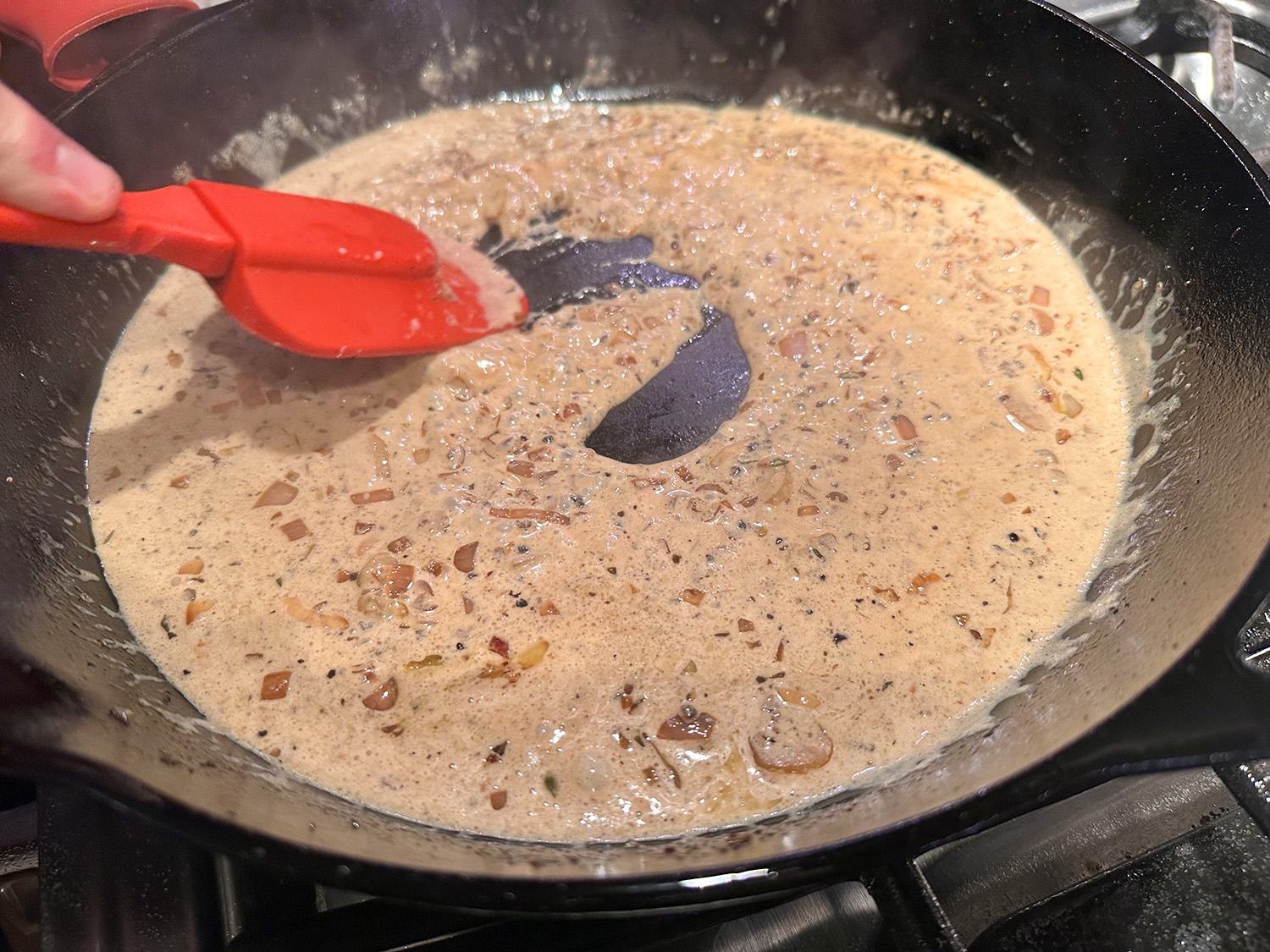
  6. Remove from heat and add cognac to pan. Set over medium heat and cook until cognac is mostly evaporated and spoon leaves streaks in skillet while stirring, 1–2 minutes. Add cream, bring to a simmer, and cook until sauce coats spoon, about 1 minute. Season with kosher salt.
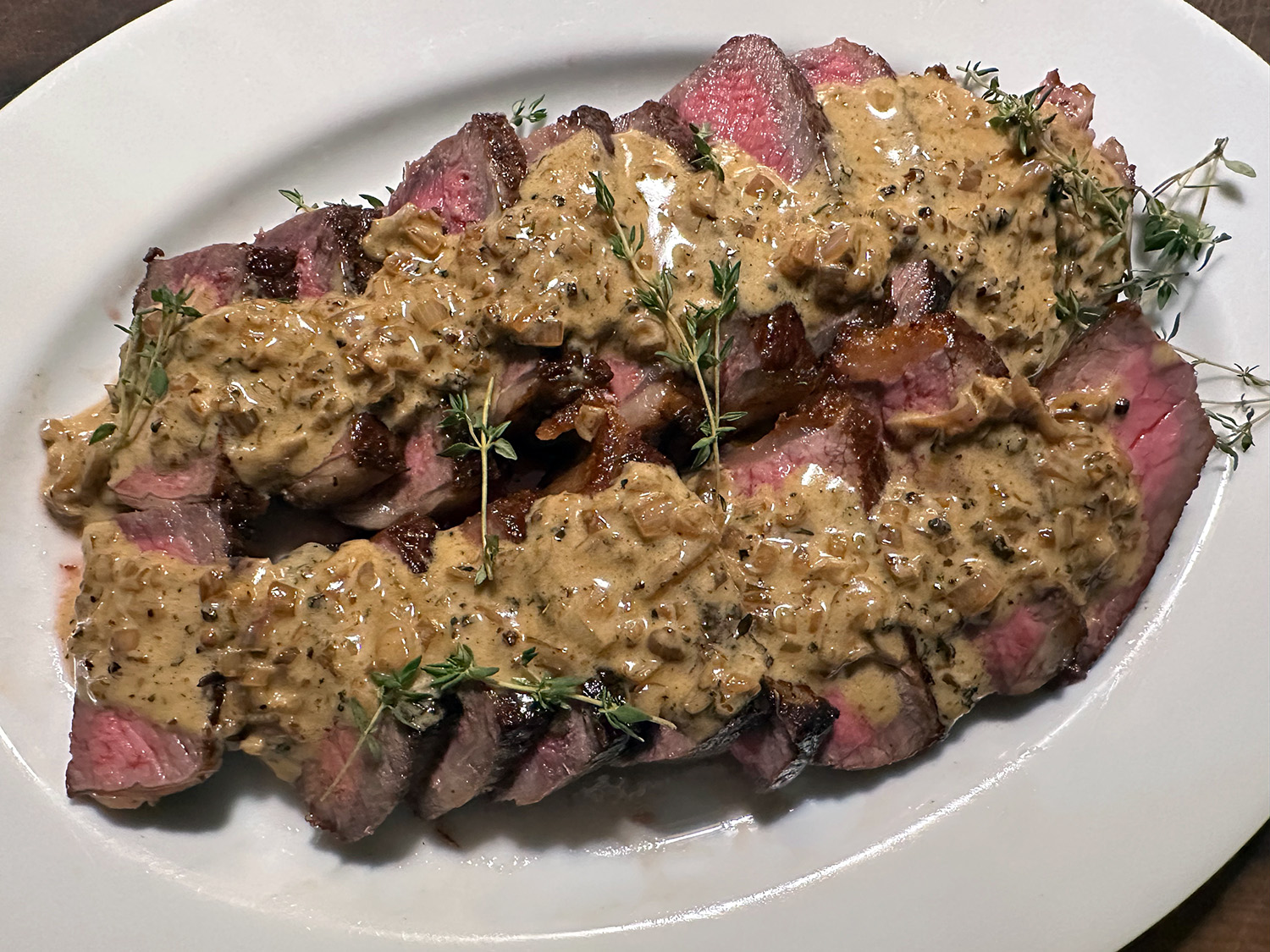
  7. Slice steaks against the grain and transfer to a platter. Pour any juices from cutting board back into skillet and stir into sauce. Spoon sauce generously over steak; sprinkle with sea salt. 

http://www.lynnandruss.com

Adapted from recipe in “Cook This Bookby Molly Baz