Category Archives: Uncategorized

Haitian Chicken in Sauce (Poul Nan Sos)

For this ultra-flavorful dish, the chicken is marinated overnight with onions, garlic, thyme, chiles, and citrus before it’s stewed with loads of bell peppers. The meltingly tender puddle of bell peppers collapses into a nest of lusciousness as they simmer under the chicken pieces.

According to Chef/Author Gregory Gourdet “The meat is marinated overnight with onions, garlic, thyme, and chiles along with citrus, which is rubbed forcefully onto the chicken to access the fragrant oils. After the meat takes on all that flavor, it’s stewed with the marinade and loads of bell peppers for a satisfying, thrilling stew.”

About the hot pepper choice: The heat level of any given pepper can vary widely, but Scotch bonnet and habanero peppers both generally register between 100,000 and 350,000 Scoville units. Scotch bonnets, which tend to be sweeter and have distinct citrus notes, are the traditional choice for Haitian chicken stew, but the closely related habanero makes a fine substitution. In the end, there was barely any heat from these peppers, but they added a nice subtle nuance of flavor.

While this dish isn’t particularly difficult or time-consuming to prepare, the chicken does require a long marination, so you’ll need to plan ahead. Allow anywhere from 12 to 48 hours for the chicken to absorb all those flavors in the fridge. When it comes time to cook the meat, be sure to reserve both the marinade’s liquid and solids, which will be incorporated back in later.

You definitely need a bed of rice or something to help soak up all of the liquid (we served with a side of rice and beans). In fact, it may be wise to reduce the amount of chicken broth from 2 cups down to 1 cup, which is indicated below*. After all, more liquid comes from the marinade, and moisture that comes from the peppers and chicken.

So unbelievably good!!

Haitian Chicken in Sauce (Poul Nan Sos)

  • Servings: 4-6
  • Difficulty: easy
  • Print

Ingredients

Marinade

  • 3 lbs. bone-in chicken thighs (drumsticks optional), patted dry (we used all thighs)
  • 3 Tbsp. kosher salt
  • 1 juicy orange, halved
  • 1 juicy lime, halved
  • 1 juicy lemon, halved
  • 2 medium yellow onions, halved and thinly sliced
  • 8 garlic cloves, sliced
  • 2 Scotch bonnet or habanero chiles, cut in half and sliced thin
  • 1/4 cup fresh thyme leaves

Stew

  • 1/3 cup extra-virgin olive oil
  • 1/2 cup tomato paste
  • 1 Tbsp kosher salt
  • 2 red bell peppers, seeded and deveined, cut into long, thin slices
  • 2 yellow bell peppers, seeded and deveined, cut into long, thin slices
  • 1 cup chicken stock*, salted homemade or store-bought
  • Small handful roughly chopped parsley sprigs, for serving

Directions

  1. Put the chicken pieces in a large bowl and season with the salt. Squeeze the citrus halves over the chicken, then spend a minute or so rubbing the cut sides of the citrus against the chicken. Add the onions, garlic, chile, and thyme and toss well, rubbing the chicken as you do. Cover and marinate in the fridge for at least 12 hours or up to 48 hours. (We marinated 27 hours.)
  2. Preheat the oven to 375°F. Remove the chicken from the marinade, guiding any stuck-on aromatics back into the bowl. Set a strainer over a small mixing bowl. Pour the marinade through the strainer, reserving the solids and liquid. Pat the chicken very dry with paper towels.
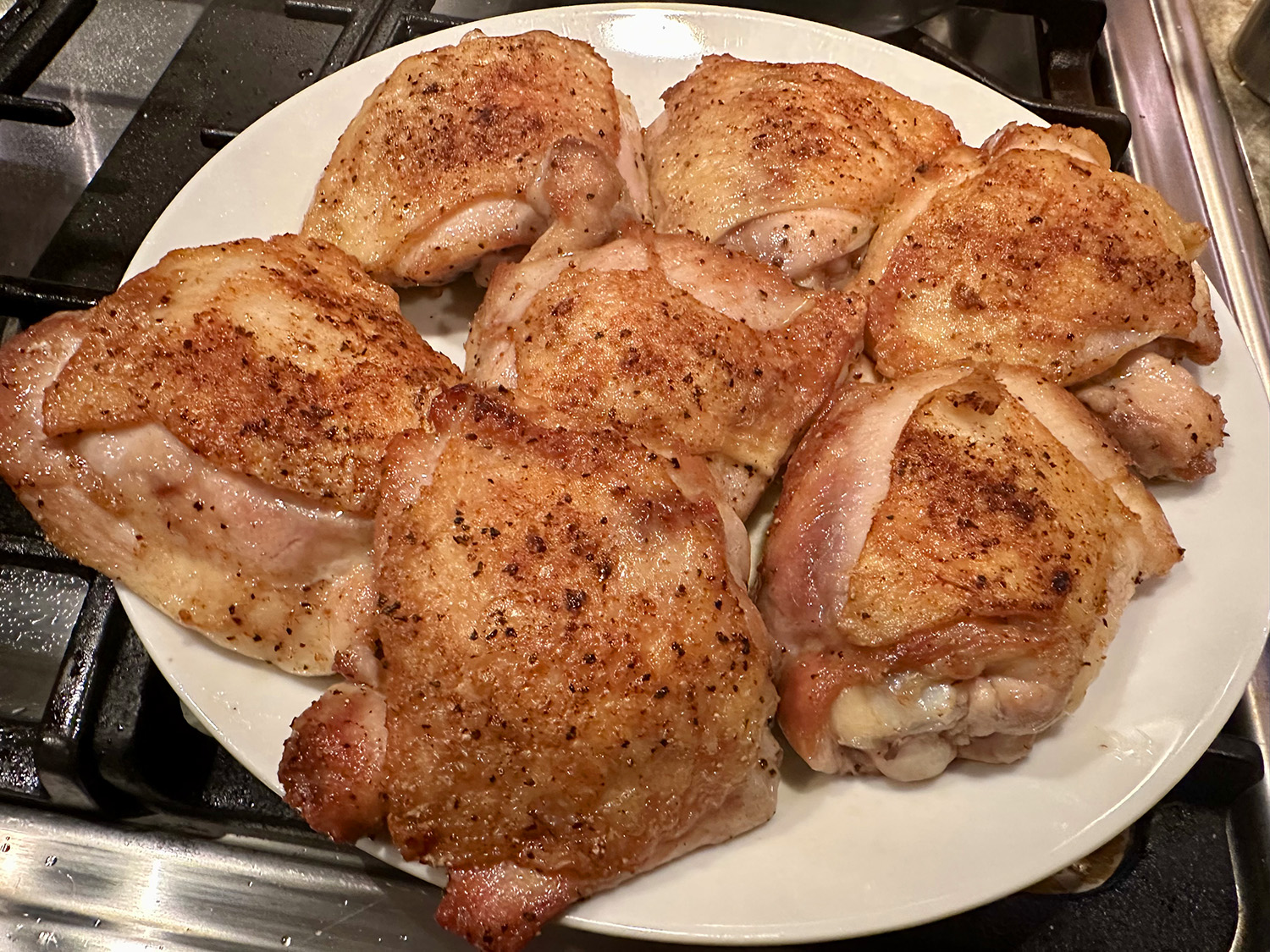
  3. Heat the oil in a wide, heavy ovenproof pot (such as a 3 1/2-quart braiser) over medium-high heat just until shimmery. Cook the chicken, skin-side down, occasionally turning the drumsticks but not the thighs, until the skin is deep brown, about 8 minutes. (It may take two batches so that the chicken browns instead of steams.) Transfer the chicken pieces to a plate.
  4. Reduce the heat to medium-low, add the tomato paste and salt, and cook, stirring often, until it turns several shades darker, about 3 minutes. Add the bell peppers and the reserved solids from the marinade; cook, stirring occasionally, until the peppers soften slightly and take on a little color, about 8 to 10 minutes.
  5. Return the chicken to the pan, skin side up and in a single layer nestled into the peppers, arranging the pile of peppers, onions, and other aromatics around the chicken. Then evenly pour in the reserved liquid from the marinade along with the stock. Cook in the oven, basting every 15 minutes to coat the chicken with the peppers and sauce, until the sauce has thickened slightly and the meat pulls off the bone with a gentle tug from a fork, about 1 hour. Garnish with the parsley and serve over rice and beans.

http://www.lynnandruss.com

Adapted fro a recipe by Gregory Gourdet for Food & Wine

Tuscan White Bean Soup

Here’s a lovely, healthy soup from The Barefoot Contessa with lots of fiber and subtle flavors. This recipe originally calls for soaking dried beans overnight, but gives you an option to use canned beans.

We included a can of diced tomatoes for an additional pop of color and extra nutrition.

If you prefer to use canned beans: First, use 2 (14-ounce) cans of white cannellini beans.  Drain the beans, reserving the liquid.  Place 1 cup of the beans and ½ cup of the liquid into the bowl of a food processor fitted with the steel blade and puree.  When ready to add the beans in the recipe, stir in the puree and add the remaining drained beans (discard the remaining liquid). Second, use only 6 cups of chicken stock. Third, simmer the soup for 45 minutes, rather than 1 hour and 30 minutes.

Tuscan White Bean Soup

  • Servings: 3 qts
  • Difficulty: easy
  • Print

Ingredients

  • 1 lb. dried white cannellini beans (for canned beans, see note)
  • Good olive oil
  • 4 oz. pancetta, ¼-inch diced
  • 2 cups chopped leeks, white and light green parts (2 leeks)
  • 2 cups chopped yellow onion (2 onions)
  • 2 cups (½-inch) diced carrots, scrubbed (5 carrots)
  • 2 cups (½-inch) diced celery (4 ribs)
  • 2 Tbsp. minced garlic (6 cloves)
  • 2 tsp. minced fresh rosemary
  • 8 to 10 cups chicken stock, preferably homemade
  • 1 14.5 oz. can of diced tomatoes
  • 2 bay leaves
  • Kosher salt and freshly ground black pepper
  • Freshly grated Parmesan cheese

Directions

  1. At least 8 hours or the night before you make the soup, place the beans in a large bowl and add enough cold water to cover the beans by 2 inches.  Refrigerate for at least 8 hours or overnight.  Drain the beans, rinse under cold running water, and drain again.  Set aside.
  2. In a large (10-inch) pot or Dutch oven such as Le Creuset, heat ¼ cup of olive oil over medium heat, add the pancetta, and sauté for 4 to 5 minutes, until browned. 
  3. Add the leeks, onions, carrots, celery, garlic, and rosemary and cook over medium-low for 10 minutes, stirring occasionally, until the vegetables are tender. 
  4. Add the beans, 8 cups of the chicken stock, bay leaves, 1 tablespoon salt, and 1 teaspoon pepper and bring to a boil. Lower the heat and simmer, partially covered, for 1 hour and 30 minutes, until the beans are tender.  Stir occasionally, scraping the bottom of the pot.  Discard the bay leaves, cover the pot, and allow the soup to sit off the heat for 15 minutes.  Add in the diced tomatoes. Add up to 2 more cups of chicken stock if the soup is too thick.
  5. Reheat slowly, ladle into large shallow soup bowls, sprinkle with Parmesan cheese, drizzle with olive oil, and serve hot.

http://www.lynnandruss.com
Adapted from a recipe by Ina Garten

Savory Mashed Sweet Potatoes

How about turning the page on that gloppy, cloyingly-sweet Thanksgiving side dish, the sweet potato casserole full of sugar?

These incredible mashed sweet potatoes are mixed with herbs, butter and sour cream. The problem with most mashed sweet potatoes is that they’re made even sweeter with brown sugar and marshmallows, and are not a welcome player on my dinner able. Sweet potatoes are already plenty sweet on their own.

So savory ingredients are added to these mashed sweet potatoes to balance out that inherent sweetness. Finely chopped fresh parsley and green onion combined with some sour cream and butter are all you need for incredible savory mashed sweet potatoes.

They were a mighty fine accompaniment to our Double-Mushroom and Sherry Meatloaf and side of Roasted Brussels Sprouts with Garlic.

Savory Mashed Sweet Potatoes

  • Servings: 6
  • Difficulty: easy
  • Print

Ingredients

  • 4 pounds sweet potatoes (about 7 small-to-medium), peeled and cut into 1″ cubes
  • 2 teaspoons salt, divided
  • ⅓ cup finely sliced green onion, mostly green parts (from 1 bunch)
  • ⅓ cup finely chopped fresh flat-leaf parsley
  • 1 small-to-medium garlic clove, pressed or minced
  • ¼ cup sour cream*
  • 3 tablespoons butter, cubed
  • Freshly ground black pepper
  • 1 teaspoon extra-virgin olive oil

Directions

  1. Place the cubed sweet potatoes in a large saucepan or Dutch oven and add enough water to cover by about 1″. Add 1 teaspoon of the salt and bring the mixture to a simmer over medium-high heat. Reduce the heat and simmer, uncovered, until the potatoes are tender (in other words, it’s easy to slide a fork in and out), about 9 to 12 minutes.
  2. Drain well, then return the potatoes to the pot. Mash the sweet potatoes to your desired consistency.
  3. Promptly add almost all of the green onion and parsley, reserving a small amount of each for garnish. Add the garlic, and stir to combine. Then stir in most of the sour cream (reserve roughly 1 tablespoon for garnish), all of the butter, and the remaining 1 teaspoon salt. Season to taste with additional salt (I usually add another ¼ to ½ teaspoon) and freshly ground black pepper.
  4. Transfer the mashed potatoes to a serving bowl and swirl the reserved sour cream onto the top with a spoon. Sprinkle with the reserved green onion and parsley, drizzle the top lightly with olive oil, and finish with a sprinkle of pepper.
  5. Serve promptly. Leftovers will keep well, covered and refrigerated, for 3 to 4 days.

http://www.lynnandruss.com
Adapted from a recipe by Cookie and Kate

Beef Tagine with Green Beans and Olives

Even though it is labeled a tagine, it’s not cooked in one. This hearty tagine is a staple family meal in many Moroccan homes, cooked in the traditional m’qualli style with garlic, ground ginger and ground turmeric. The comforting, earthy flavors of the meat, spices and green beans create a satisfying dinner perfect for sharing or meal prepping.

The cozy, fragrant stew is packed with pops of flavor from tangy preserved lemon and briny olives. The green beans are added towards the end when the meat is almost cooked. For a variation, consider substituting or adding peas and/or chopped carrots (see Tip). We added both peas and carrots.
This dish is supposed to take 2 1/4 hours from start to finish. *We decided to use our pressure cooker and therefore cut the total time down to one hour. What we neglected to do was reduce the amount of liquid, because when you use a pressure cooker, none of the moisture evaporates. Next time we will add less liquid to start with, then remove the ingredients with a slotted spoon to another bowl. Add a cornstarch slurry to thicken the sauce and pour it over the meat and vegetables in the bowl.

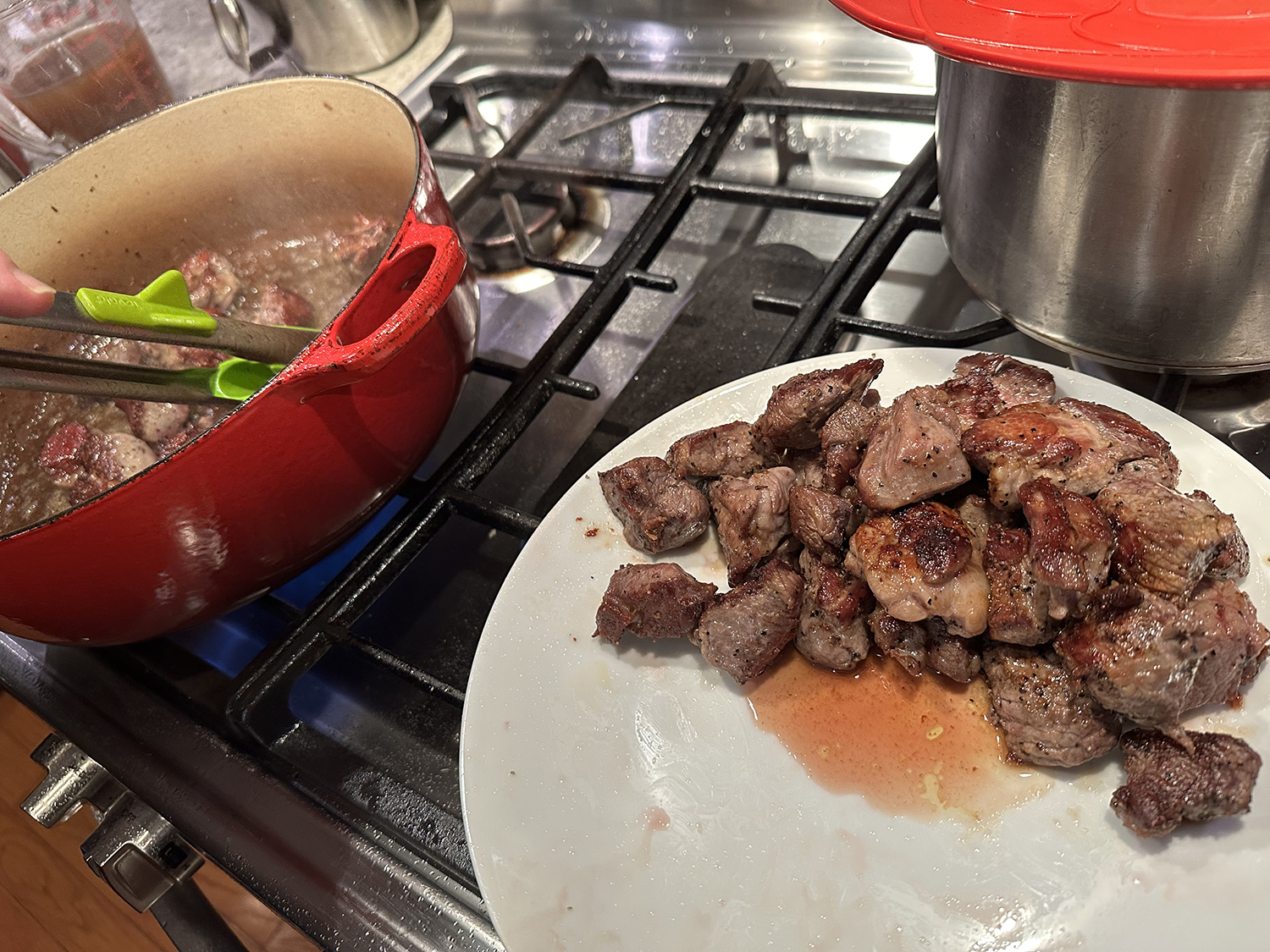
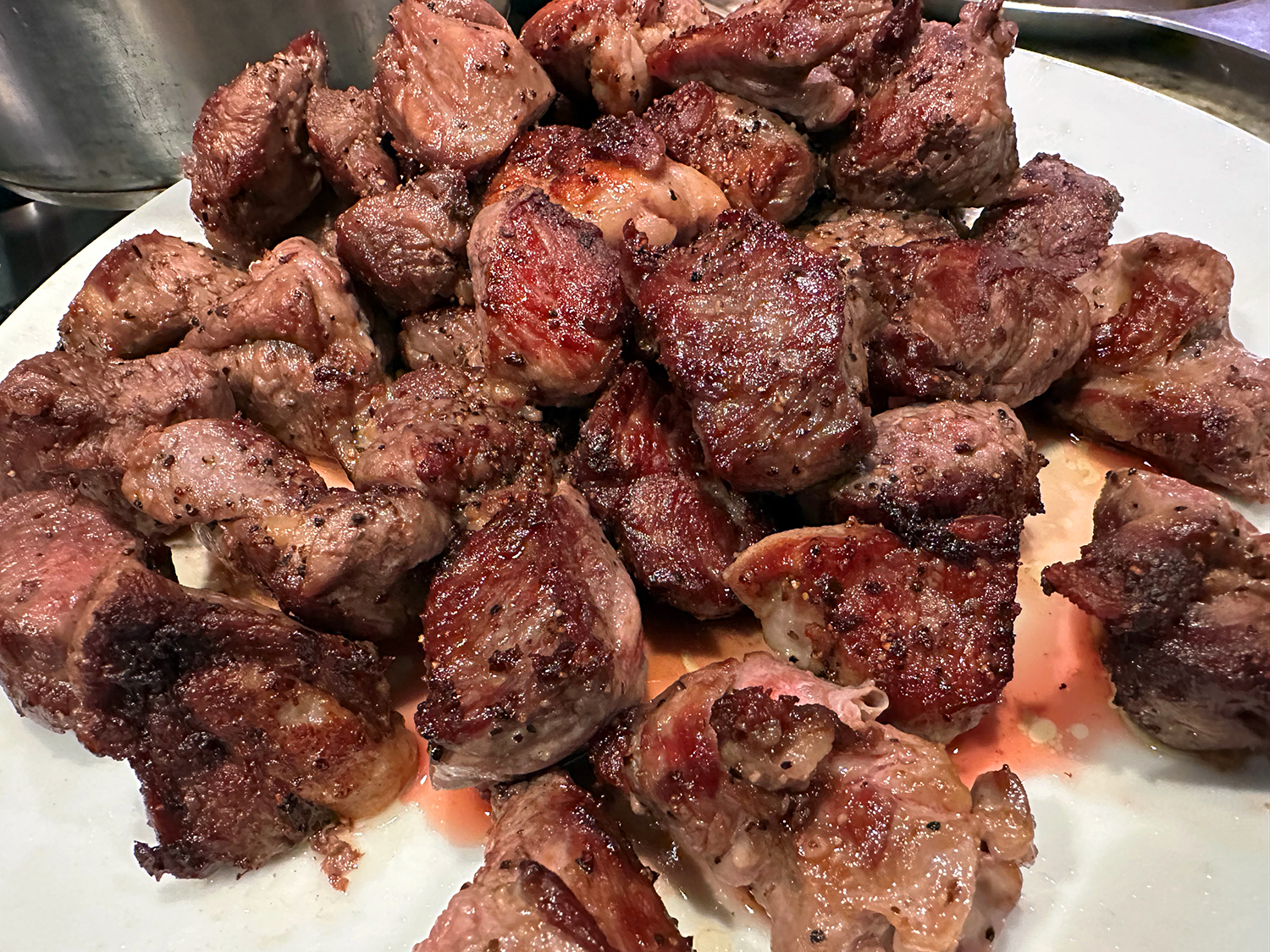
In addition, we would brown the seasoned (salt and pepper) meat chunks on all sides in shimmering oil in the Dutch oven first; in batches so as not to steam the beef. Remove the beef to a side plate, turn the heat to medium-low and add the onions, garlic and seasoning…

TIP: If making a variation on this recipe using peas and carrots, add the carrots about the same time as the green beans, and add the peas when the other vegetables are tender, cooking them for a few minutes.

To enhance the Moroccan profile, serve over couscous, We decided on garlicky mashed potatoes, because we needed to use up our spud supply. All of our changes are noted in the recipe below.

Beef Tagine with Green Beans and Olives

  • Servings: 6-8
  • Difficulty: easy
  • Print

Ingredients

  • 3 Tbsp. olive oil
  • 2 medium onions, diced (about 3 cups)
  • 3 garlic cloves, minced or pressed
  • 1 tsp. ground turmeric
  • 1 tsp. ground ginger
  • 1 small pinch saffron (optional)
  • Fine sea salt and black pepper
  • 2½ lbs. boneless beef chuck or other stewing beef, trimmed of excess fat and cut into 2-inch pieces
  • ¾ cup vegetable or beef stock, or water, plus more if needed
  • 1 cup cilantro leaves and tender stems, finely chopped, plus more for serving
  • 1½ lbs. green beans, trimmed
  • 2 carrots peeled and cut into 1/2-inch rounds
  • 2 to 3 Tbsp. seeded and finely chopped preserved lemon (about ½ lemon), plus more to taste
  • ½ cup pitted Castelvetrano or Kalamata olives, and peas (if using)
  • Bread, for serving

Directions

  1. Heat oil in a large Dutch oven over medium. Add the beef, cook, stirring occasionally, until the meat is lightly browned on all sides, about 7-8 minutes. Remove to a plate.
  2. Add onions, garlic, turmeric, ginger, saffron (if using), ¾ teaspoon salt and ¼ teaspoon pepper. Cook, stirring frequently, until the onions begin to soften, 5 to 7 minutes.
  3. Return meat to pot, add stock (or water) and cilantro, and bring to a boil over high heat.
  4. Cover the pot, adjust heat to low and simmer for about 1½ hours, until the beef has partially softened (when pressed with a fork it should feel soft but not fall apart).
  5. Stir in the green beans, carrots and preserved lemon, adjust heat to high and bring to a boil. The green beans should be partially submerged in the liquid; add stock or water as needed. Turn down to low, cover and simmer until the green beans and carrots are tender, 15 to 20 minutes. Stir occasionally to make sure the beans cook evenly.
  6. Taste and add more preserved lemon or salt as necessary. Garnish with olives and more cilantro, and serve with bread.

http://www.lynnandruss.com
Recipe by Nargisse Benkabbou for NYTimes Cooking

Classic Beef Chili

There are endless variations of chili, and here’s one of the classics. It uses lean ground chuck, but you can always substitute ground turkey if you stay away from red meat. Fresh poblanos, toasty ancho chile powder, oregano and beer are just some of the ingredients that come together to make a flavorful bowl of chili for any occasion.

When it comes to making chili, it’s important to build flavor even before you add spicy heat. Toasting the ground cumin and ancho chile powder in oil as they cook with the beef brings out their earthy flavors, adding savory undertones to the mix when combined with the fresh poblano, thyme, and oregano. Using canned beans makes this recipe especially convenient; be sure to rinse and drain the beans before adding them to the pot.

Serving to a crowd? Go ahead and set up a buffet of toppings. Serve alongside tortilla chips, cornbread, and bowls of toppings like shredded cheddar, slices of fresh jalapeño and radishes, chopped scallions, and sour cream. This way, each person can pick and choose their garnishes and personalize their perfect bowl of beef chili.

And as is the case with many soups, stews and chilis, they provide a more pronounced marriage of flavors when reheated the second time around.

The original recipe indicated it took 55 minutes total from prep through eating. With two of us prepping, it took nearly 40 minutes, so you may want to rethink the total time…

Classic Beef Chili

  • Servings: 8
  • Difficulty: easy
  • Print

Ingredients

  • 2 Tbsp. olive oil
  • 2 cups chopped yellow onion (from 1 large onion)
  • 1 cup chopped poblano chile (from 1 chile). We used 3 poblanos.
  • 8 garlic cloves, minced
  • 3 lbs. 90/10 lean ground chuck
  • 1 6-oz. can tomato paste
  • 1/3 cup ancho chile powder
  • 2 Tbsp. ground cumin
  • 1 Tbsp. kosher salt
  • 1 tsp. black pepper
  • 1 tsp. fresh thyme leaves
  • 1 tsp. chopped fresh oregano
  • 2 15-oz. cans dark red kidney beans, drained and rinsed
  • 1 15-oz. can black beans, drained and rinsed
  • 1 28-oz. can crushed tomatoes
  • 2 cups lower-sodium chicken broth
  • 1 12-oz. bottle of beer
  • Shredded cheddar cheese, for serving
  • Sliced or pickled  jalapeños, for serving

Directions

  1. Gather the ingredients.
  2. Heat oil in a large Dutch oven over medium-high. Add onion, poblano, and garlic and cook, stirring often, until tender, about 5 minutes.
  3. Add ground chuck and cook, stirring occasionally, until beef crumbles and is no longer pink, 8 to 10 minutes.
  4. Drain beef mixture well and return to Dutch oven over medium-high.
  5. Add tomato paste, ancho chile powder, cumin, salt, pepper, thyme, and oregano, and cook, stirring often, 2 minutes.
  6. Increase heat to high. Stir in beans, tomatoes, chicken broth, and beer, and bring to a boil. Reduce heat to medium-low and simmer, stirring occasionally, until heated through, at least 30 minutes. It can simmer for 60-90 minutes.
  7. Serve chili with desired toppings.

http://www.lynnandruss.com
Adapted from a recipe by Robby Melvin for Food & Wine

Marsala Chicken Meatballs

If you are fond of Chicken Marsala, then this dish may be one for you. It keeps the same flavor profile, but presents it in a different fashion. And it tends toward more of a slight sweet than savory finish.

Chicken Marsala is an Italian American classic consisting of seared pounded chicken that’s smothered in a sweet-savory Marsala wine mushroom sauce. For more spoon-ability, this crowd-pleasing dinner replaces the thin cutlets with tender chicken meatballs, simmered in a similarly indulgent Marsala sauce.

Ground chicken is very lean, so to ensure a perfectly moist bite, Marsala-soaked bread crumbs and extra-virgin olive oil are added to the meatball mixture. For a flavor-packed fond, take the time to brown the onions and mushrooms; the time spent will pay off.

This recipe is dairy-free as written, but if you’d like to finish the dish with a few pads of butter or a splash of heavy cream, the sauce will certainly accommodate the additional richness. Serve plain as is, or over a bed of mashed potatoes, polenta, orzo, or other pasta of choice.

*NOTE: Chop onions for the meatballs finely in a food processor and squeeze out most of the water using a kitchen towel before adding to chicken.

Marsala Chicken Meatballs

  • Servings: 4
  • Difficulty: easy
  • Print

Ingredients

  • 2 large yellow onions (about 10 oz. each), finely chopped
  • ⅓ cup bread crumbs
  • 1¼ cups dry Marsala wine
  • 1¾ cups of chicken stock
  • 5 Tbsp. extra-virgin olive oil
  • Salt and pepper
  • 1 lb. ground chicken
  • 1 lb. sliced button or cremini mushrooms
  • 2 Tbsp. all-purpose flour
  • 1 tsp. dried Italian herb seasoning
  • 3 Tbsp. butter
  • Chopped flat-leaf parsley, for serving

Directions

  1. To a medium bowl, add 1 cup of chopped onion, plus the bread crumbs, ¼ cup wine, 2 tablespoons olive oil, a hefty pinch of salt and a few grinds of pepper; mix until combined. Add the chicken and mix until combined. Form the meat mixture into 14 balls (about 3 tablespoons each), setting them on a sheet pan or plate.
  2. Heat a large (12-inch) heavy skillet or braiser over medium-high, and add the remaining 3 tablespoons of olive oil.
  3. Sear the meatballs for 2 to 3 minutes, until a dark brown crust forms on the bottoms, then flip, and continue searing for 2 minutes on the other sides. Return the meatballs to the sheet pan or plate.
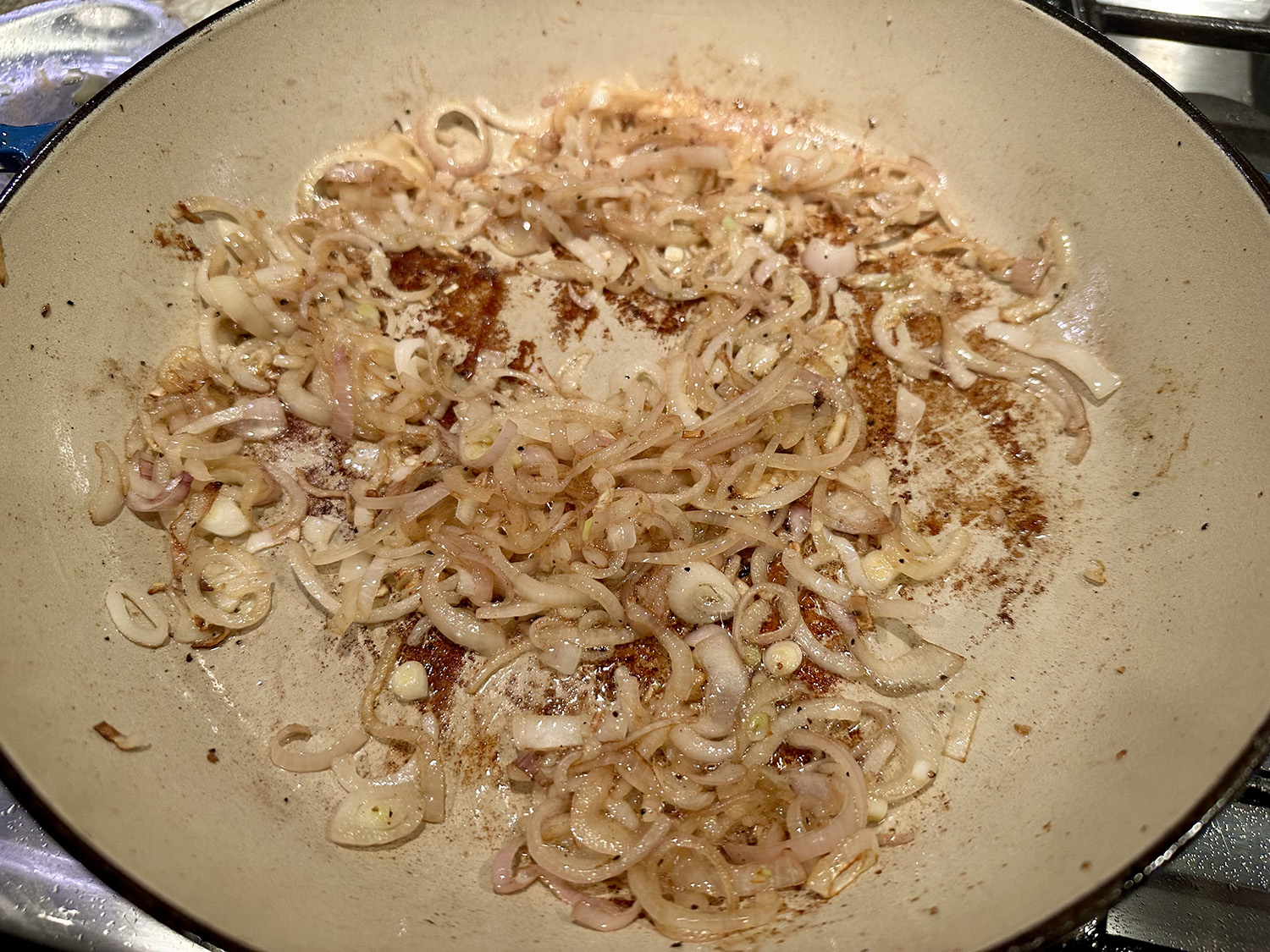
  4. Adjust heat to high. Add the remaining onions to the skillet and cook, stirring every 2 minutes, until golden, translucent and slightly darker on the edges, about 6 minutes, turning the heat down as necessary.
  5. Add the mushrooms and cook for 6 minutes, stirring occasionally, until reduced in volume and slightly darker in color. Sprinkle the flour on top, mix to coat the mushrooms and onion and continue cooking for 1 minute, lowering the heat as needed.
  6. Carefully pour the remaining 1 cup of wine into the skillet while constantly stirring. Using a wooden spoon, scrape the caramelized bits off the bottom of the pan and cook for 2 minutes, until the wine reaches a thicker, honey-like consistency. Add 1¾ cups of chicken stock and bring to a vigorous simmer. Season with a hefty pinch of salt.
  7. Return the meatballs to the skillet. Adjust heat to medium, partially cover and simmer for 12 minutes, until the sauce has thickened slightly and the meatballs are cooked through.
  8. Add the butter, stirring in until all melted. Taste and season with salt. Sprinkle parsley on top and serve.

http://www.lynnandruss.com
Adapted from a recipe by Carolina Gelen for NYTimes Cooking

Vegan Dan Dan Noodles With Eggplant

Sichuan dan dan noodles are traditionally made with ground pork, a spicy sauce and sui mi ya cai, or pickled vegetables, but this vegan version features pan-fried eggplant in place of the meat.

Cutting the eggplant into relatively chunky pieces and covering the pot with a lid while cooking is the key to achieving the right texture: It locks in moisture, ensures that the pieces don’t fall apart, and allows the flesh to become tender and smoky. Once tossed with the noodles and sauce, the eggplant breaks up and becomes creamy. If you don’t have tahini, you can substitute it with smooth peanut butter (our choice) or almond butter.

NOTE: You can also use egg noodles but the dish will no longer be vegan.

Vegan Dan Dan Noodles With Eggplant

  • Servings: 4
  • Difficulty: easy
  • Print

Ingredients

For the Sauce

  • 3 Tbsp. soy sauce
  • 3 Tbsp. black or rice vinegar
  • ¼ cup tahini (or Chinese/Japanese sesame paste)
  • 2 garlic cloves, peeled and finely grated or chopped
  • 1 (1-inch) piece of ginger, peeled and finely grated or chopped (about 1 Tbsp.)
  • 2 to 3 Tbsp. chile oil, chile crisp or doubanjiang
  • 2 tsp. granulated sugar

For the Noodles

  • 1 large eggplant (about 1¼lbs.), trimmed
  • Kosher salt (such as Diamond Crystal)
  • 12 oz. dried thin wheat noodles (see Note)
  • Neutral oil, such as canola or vegetable
  • 1 Tbsp. soy sauce
  • Black pepper
  • ½ tsp. ground Sichuan peppercorns (optional)
  • 2 scallions, white and green parts separated and finely sliced
  • A generous pinch of granulated sugar
  • Handful of cilantro leaves
  • 1 cup dry, unsalted roasted peanuts, roughly chopped
  • Chile oil or chile crisp, for serving

Directions

  1. Make the sauce: Combine the soy sauce, black or rice vinegar, tahini, garlic, ginger, chile oil and granulated sugar in a bowl, and whisk to combine. Set aside.
  2. Slice the eggplant crosswise into ¾-inch-thick circles, then cut each circle into 1½- to 2-inch pieces. (They should be quite chunky.)
  3. Bring a large pot of salted water to boil. Add the noodles and cook according to package instructions until al dente. Reserve ½ cup of the cooking water, then drain the noodles, rinse just for a few seconds to remove some of the starchy water (they should still be hot), and allow them to drain.
  4. Meanwhile, cook the eggplant: Heat a wok or large, deep-sided skillet over medium-high. When hot, add 2 tablespoons of neutral oil along with the eggplant, soy sauce, 1 teaspoon of salt and a pinch of black pepper, and toss well to combine. Cover with a lid and cook for 6 to 7 minutes, tossing every 60 seconds. If it starts to burn, reduce the heat to medium. The eggplant is ready when it is caramelized and cooked all the way through but still intact. (Don’t let it get mushy.) Remove the lid, sprinkle with the ground Sichuan peppercorns (if using), the white parts of the scallions and the sugar, and season with ½ teaspoon of salt and a pinch of black pepper. Toss for 30 seconds and then turn off the heat.
  5. Add the reserved noodle cooking water to the bowl of sauce and whisk to combine. Divide the sauce among four serving bowls.
  6. Divide the noodles among the four bowls, on top of the sauce. Finish each bowl with eggplant, scallion greens, a few cilantro leaves and some peanuts.
  7. To eat, toss everything together so that the noodles and eggplant are well coated in the sauce. Serve topped with chile oil or crisp.

http://www.lynnandruss.com

Recipe by Hetty Lui McKinnon for NYTimes Cooking

Colima-Style Shredded Braised Pork

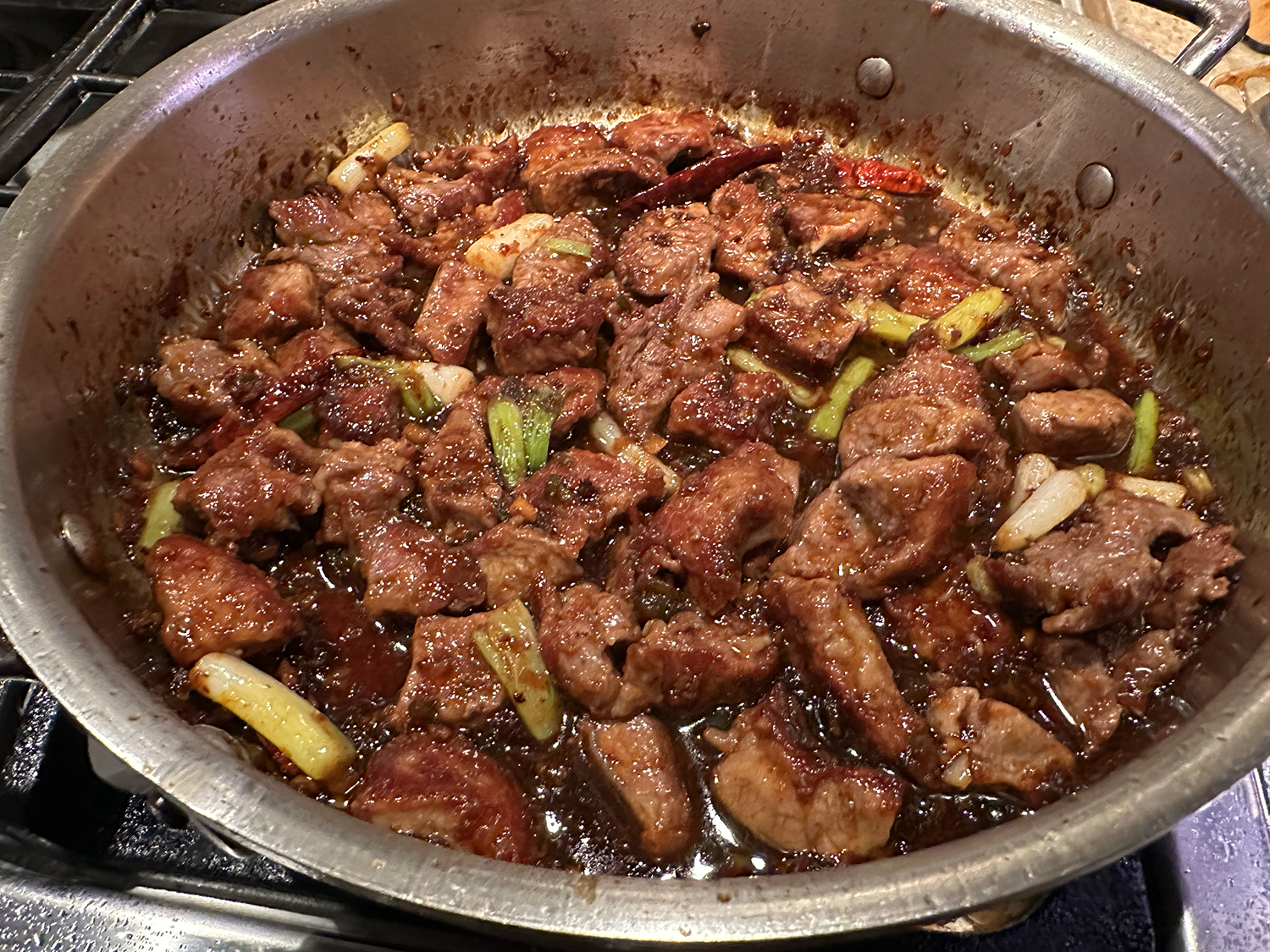
OK, this is definitely a keeper! If shredded pork is your thing, than this recipe needs to get on your short list ASAP. Milk Street Magazine cites: “The state of Colima on the western coast of Mexico is home to the pork dish called tatemado de Colima. Dried chilies, spices and aromatics, all blended to a smooth puree, are key flavorings, but a defining ingredient, other than the pork itself, is vinegar. In chef Paola Briseño-González’s version, her recipe uses a generous amount of smooth-tasting, subtly sweet coconut vinegar, a common ingredient in the coconut-producing region of Colima, and after slow-cooking the pork, she shreds the meat and mixes it with the braising liquid.”

The flavors are rich and porky but deliciously balanced by the tangy vinegar and fresh ginger, whose sharpness disappears into the mix. Milk Street adapts González’s recipe, and in doing so, found widely available rice vinegar to be a decent alternative to coconut vinegar. Braise in the oven, where the heat is steady and all-encompassing; the meat will do a fine job of soaking up the seasonings after it is shredded. The pork is briefly broiled after braising to develop deep browning, so you will need a broiler-safe Dutch oven for this recipe.

Pungent, flavorful, enticing, and delicious—this “tatemado de Colima” makes for a huge batch of succulent, juicy meat perfect on its own with a fork—or on top of some tortillas, tostada style. Now you have a dish that blows past everyday barbecue. Serve the shredded pork with rice and beans, or make tacos with it, offering shredded cabbage, chopped onion and lime wedges alongside. It’s low-carb if eaten without tortillas.

Word to the Wise: Don’t use an uncoated cast-iron Dutch oven, even if it is well seasoned. The acidity of the vinegar may react with the metal, resulting in a tinny, “off” flavor. However, an enamel-coated Dutch oven is fine.

Colima-Style Shredded Braised Pork

  • Servings: 8-10
  • Difficulty: easy
  • Print

Ingredients

  • 4 large (1¼ oz.) guajillo chilies, stemmed and seeded
  • 5-7 lb. bone-in pork butt or pork shoulder roast
  • 2 cups coconut vinegar or unseasoned rice vinegar
  • 1 cup coconut milk
  • 1/3 cup roughly chopped peeled fresh ginger
  • 9 medium garlic cloves, smashed and peeled
  • 3 bay leaves
  • 1 Tbsp. tomato paste
  • 1/2 tsp. coriander seeds
  • 1/2 tsp. cumin seeds
  • 1/2 tsp. white sugar
  • Kosher salt and ground black pepper

Directions

  1. In a small saucepan, combine the chilies and enough water to cover by about 1 inch. Bring to a boil over medium-high, pressing on the chilies to submerge them. Remove from the heat, cover and let stand until the chilies are fully softened, 15 to 20 minutes. Meanwhile, using a sharp knife, score the fat side of the pork roast with a 1-inch crosshatch pattern. Set the pork scored side up in a large enamel-coated Dutch oven.
  2. Using a slotted spoon, transfer the chilies to a blender; discard the soaking water. Add the vinegar, coconut milk, ginger, garlic, bay, tomato paste, coriander, cumin, sugar, 1 tablespoon salt and 1 teaspoon pepper. Blend until smooth, about 1 minute. Pour the puree over the pork and rub it into the meat, then cover the pot.
  3. Heat the oven to 325°F with a rack in the lower-middle position. When the oven comes up to temperature, place the pot in the oven and cook until a skewer inserted into the center of the pork meets no resistance, 4½ to 5½ hours.
  4. Remove the pot from the oven and heat the broiler. Return the pot, uncovered, to the oven and broil until the surface of the pork is deeply browned, 2 to 4 minutes. Transfer the pork to a large bowl and set aside. Tilt the pot to pool the braising liquid to one side, then use a wide spoon to skim off and discard fat from the surface, leaving just a couple tablespoons for flavor. You should have between 2 and 4 cups defatted braising liquid; if you have more than 2 cups, set the pot over medium-high, bring the liquid to a rapid simmer and cook, stirring occasionally, until reduced to about 2 cups. Meanwhile, shred the pork into large bite-size pieces, discarding the bone and excess fat.
  5. Return the shredded pork to the pot and stir to combine with the braising liquid. Cover and cook over medium-low, stirring occasionally, just until heated through, 5 to 8 minutes, then taste and season with salt and pepper.

http://www.lynnandruss.com

Recipe adapted by Courtney Hill for Milk Street

Cheesy Mushroom-Thyme Fettuccine

Inspired by the fettuccine con funghi from Italy, this recipe was developed for creating a quick yet elegant dinner using supermarket ingredients. Be sure to use dried fettuccine or pappardelle made with egg; this type typically is sold coiled into nests in 8.8-ounce packages. We opted for a 8.8 ounce package of quick cooking tagliarelle, a thin durum wheat egg pasta.

The texture of egg pasta is finer and more delicate than all-semolina pasta. Woodsy thyme is the classic herb for pairing with mushrooms; which is added in two stages for layered flavor. The aged, subtly sweet notes of brandy pair beautifully with the earthy creminis; dry sherry also works well.

TIP: Don’t use pre-sliced cremini mushrooms. They tend to be dry and cardboardy, and the mushrooms are counted on to release their own moisture to build flavor into the dish.

If you are funghi lovers like we are, increase the amount of creminis to 1½ pounds—noted in the ingredients list below. Also the original recipe directed you to reserve one cup of the pasta water before draining, but we found that insufficient in making the dish as moisturishly silky as we had hoped. You may not need the entire two cups of the liquid, it will all depend on your choice of pasta, better safe than sorry.

Served with a side salad, it was a perfect weeknight meal.

Cheesy Mushroom-Thyme Fettuccine

  • Servings: 4
  • Difficulty: easy
  • Print

Ingredients

  • ¼ cup extra-virgin olive oil
  • 2 medium garlic cloves, thinly sliced
  • 4 tsp. fresh thyme, chopped, divided
  • Pinch of red pepper flakes (optional, but worth it)
  • 1½ lb. cremini mushrooms, trimmed and thinly sliced
  • Kosher salt and ground black pepper
  • ⅓ cup brandy or dry sherry
  • 8.8 oz. package dried egg fettuccine, pappardelle, or similar pasta
  • 1½ oz. Parmesan cheese, finely grated (¾ cup), plus more to serve
  • 2 Tbsp. salted butter, cut into 2 pieces
  • Chopped fresh flat-leaf parsley, to serve

Directions

  1. In a large pot, boil 3 quarts water. In a 12-inch skillet over medium, combine the oil, garlic, half of the thyme and pepper flakes (if using). Cook, stirring, until the garlic is golden brown, about 2 minutes.
  2. Add the mushrooms, ½ teaspoon salt and ¼ teaspoon black pepper. Cook over medium-high, stirring occasionally, until the mushrooms are browned at the edges, 8 to 10 minutes. Remove the pan from the heat and add the brandy. Return to medium-high and cook, scraping up any browned bits, until the liquid is syrupy, about 1 minute.
  3. When the water reaches a boil, add the pasta and 1 tablespoon salt; cook, stirring, until al dente. Reserve 2 cups of the pasta cooking water, then drain.
  4. To the mushroom mixture, add the pasta, Parmesan, butter, the remaining thyme and ½ cup of the reserved pasta water. Cook over medium-high, tossing constantly, until lightly coated and the cheese is melted, 2 to 3 minutes.
  5. Off heat, taste and season with salt and black pepper. Serve sprinkled with parsley and additional cheese.

http://www.lynnandruss.com

Adapted from a recipe by Courtney Hill for Milk Street

Persian Barley-Lentil Soup with Spinach

This hearty vegetarian soup combines two classic Persian soups: lentil and barley. Instead of dried limes common in Persian cuisine to infuse the broth with unique citrus notes, this recipe opts for easier-to-find fresh limes and uses the zest for fragrance and flavor and the juice to add tanginess.

For efficiency, prep the spinach and cilantro while the barley and lentils cook. And to round out the meal, serve with warmed bread or flatbread and a dollop of plain yogurt for richness. We were thoroughly impressed by this deeply flavored soup.

NOTE: This is the fast method using a pressure cooker or InstaPot and it all comes together in just under and hour. The slow method takes 5 to 6 hours, and we are not posting that recipe here.

Don’t use hulled barley instead of pearled barley. Hulled barley has had its inedible outer hull removed but retains its bran. Pearled barley, on the other hand, has been polished to remove the bran, which makes it quicker to tenderize; in this recipe, it cooks at the same rate as the lentils.

Persian Barley-Lentil Soup with Spinach

  • Servings: 4-5
  • Difficulty: easy
  • Print

Ingredients

  • 2 Tbsp. extra-virgin olive oil, plus more to serve
  • 1 medium yellow onion, chopped
  • 6 medium garlic cloves, chopped
  • 2 medium carrots, peeled, quartered lengthwise and sliced ½-inch thick
  • 2 Tbsp. tomato paste
  • 4 bay leaves
  • Kosher salt and ground black pepper
  • 1 Tbsp. grated lime zest, plus 3 Tbsp. lime juice, plus lime wedges to serve
  • ¾ cup pearled barley
  • ½ cup brown or green lentils
  • 1½ qts. low-sodium vegetable broth
  • 4 cups lightly packed baby spinach, chopped
  • 1 cup lightly packed fresh cilantro, chopped

Directions

  1. On a 6-quart Instant Pot, select More/High Sauté. Add the oil and heat until shimmering. Add the onion, garlic, carrots, tomato paste, bay and 1 teaspoon salt. Cook, stirring occasionally, until the vegetables begin to brown, about 5 minutes. Stir in the lime zest and juice, barley, lentils and broth, scraping up any browned bits, then distribute in an even layer.
  2. Press Cancel, lock the lid in place and move the pressure valve to Sealing. Select Pressure Cook or Manual; set the pressure level to High. Set the cooking time for 18 minutes. When pressure cooking is complete, quick-release the steam by moving the pressure valve to Venting. Press Cancel, then carefully open the pot.
  3. Remove and discard the bay, then stir in the spinach and cilantro. Taste and season with salt and pepper. Serve drizzled with oil and with lime wedges on the side.

http://www.lynnandruss.com

Recipe by Julia Rackow for Milk Street

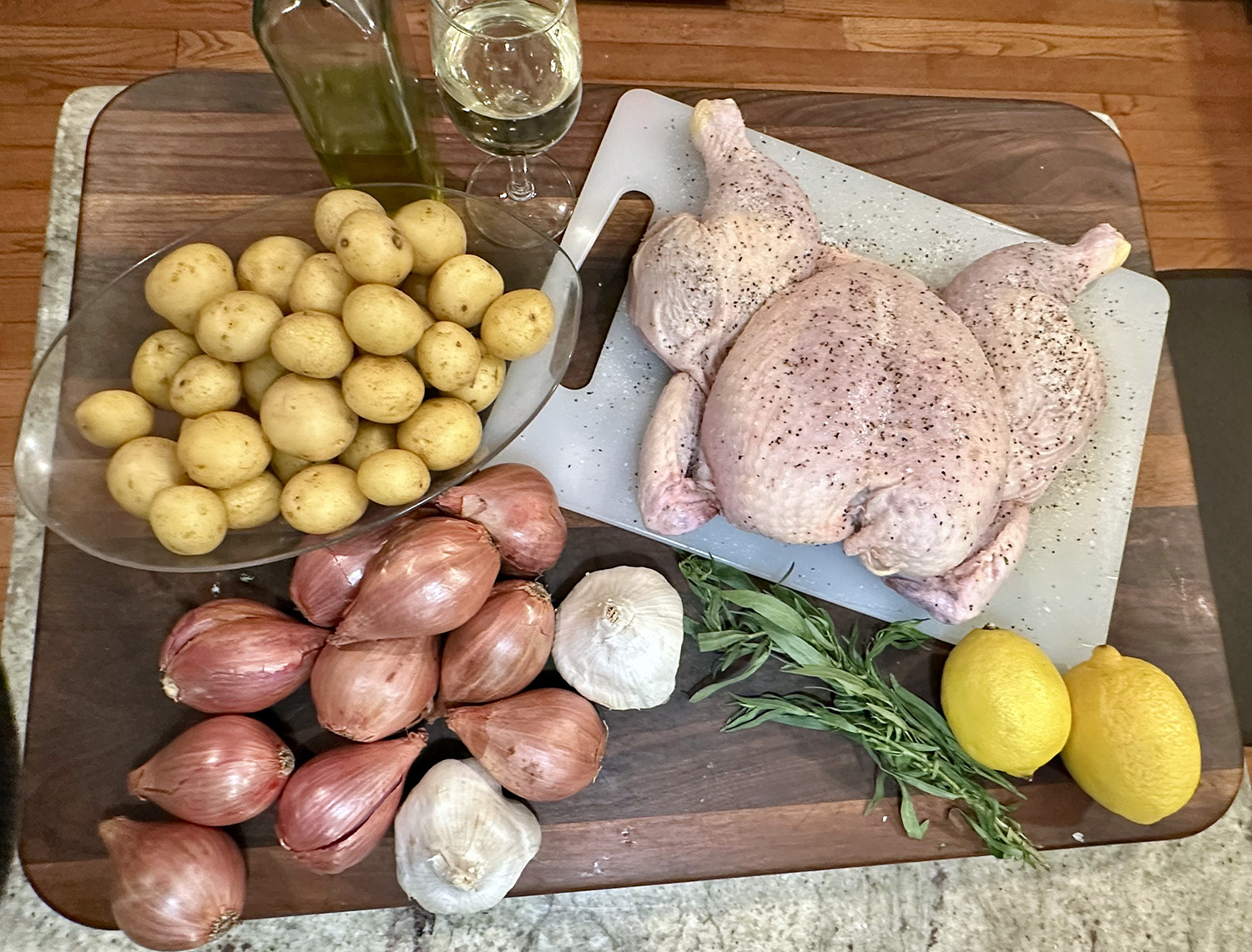
Buttermilk Roasted Chicken and Veggies

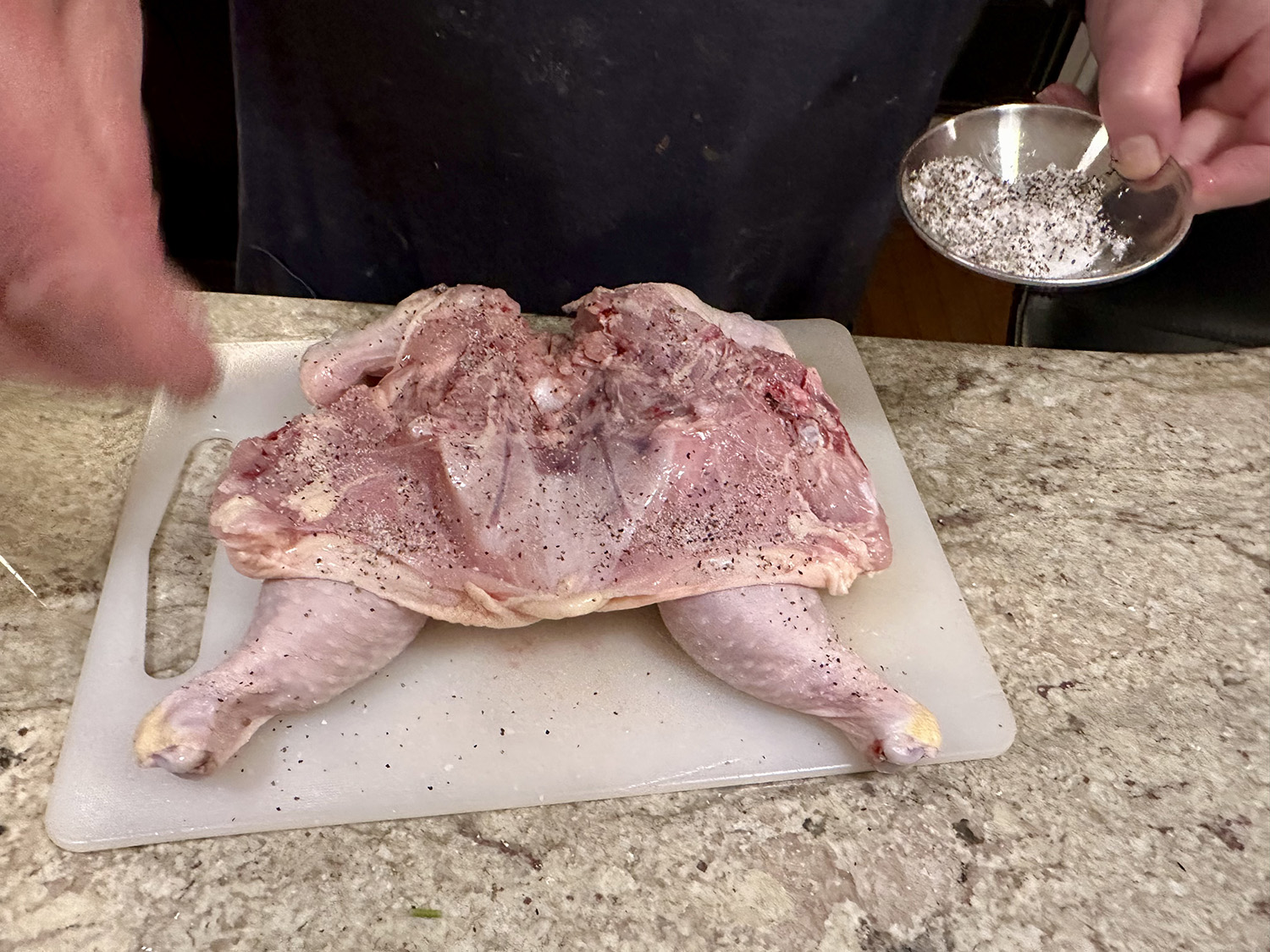
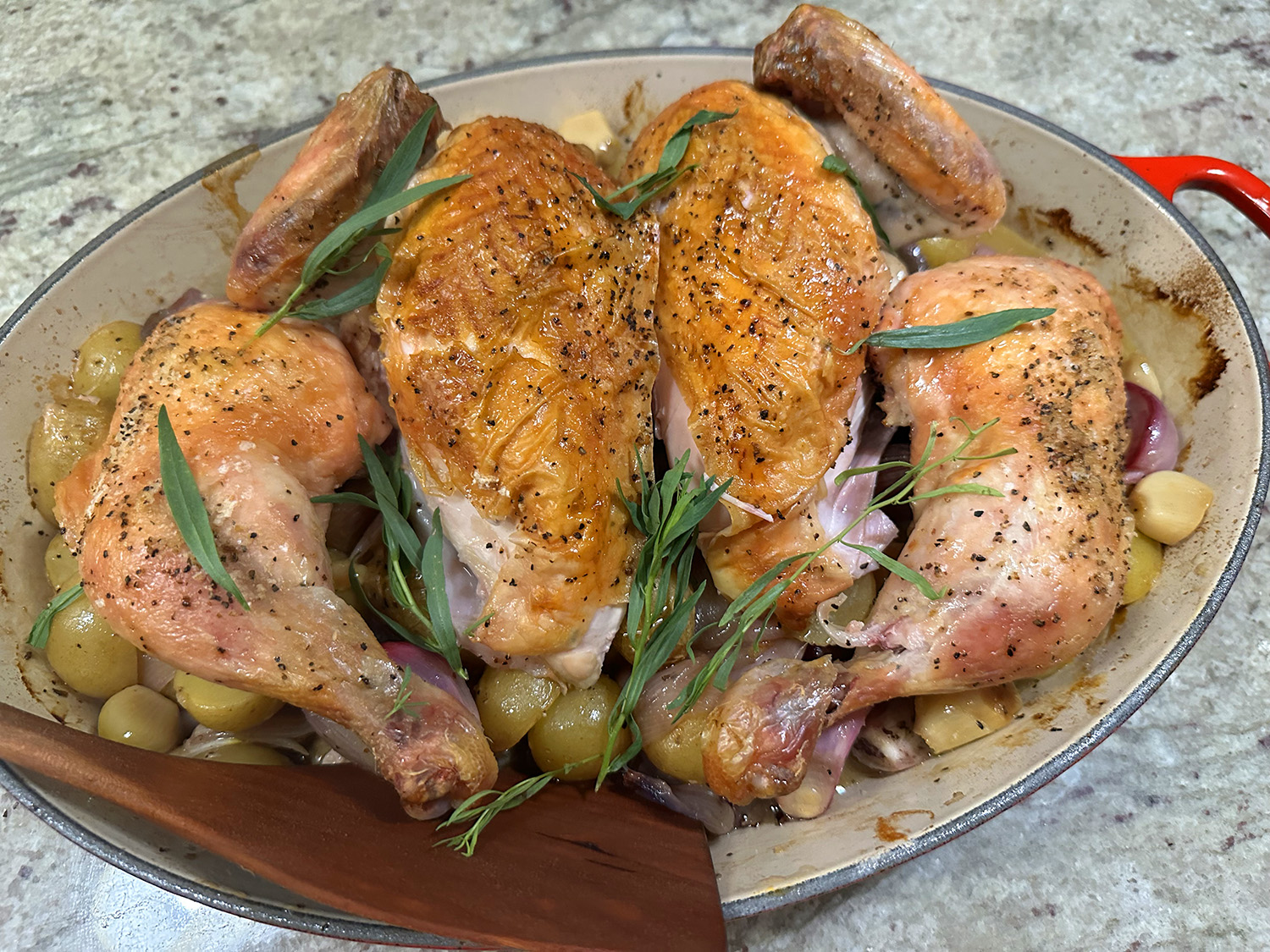
A Sunday roast chicken dinner, for me, is synonymous with the advent of Fall and through the winter months. Roast a chicken and you know you have a comfortable meal. Alter that a little by butterflying the chicken, a surprisingly simple task that can be carried out with a pair of kitchen scissors, and you have a quick dinner that satisfies the soul as well as your taste buds.

Here, buttermilk, which is usually associated with fried chicken, helps to tenderize the chicken and conveys the aromatics: you really get the full value of the rosemary, pepper and garlic. If you want to substitute maple syrup for the honey, you can. Best of all, you can leave the marinating bird in the fridge for up to two days; thus, it gets more tender and you know you have a dinner that needs no more than to be popped into the oven. Now that’s a win in my book!

In the original recipe, it directs you to line a roasting pan with tinfoil. Next time we plan to eliminate the tinfoil lining and use a rimmed sheet pan. We believe we would get better caramelization on both the bird and the vegetables.

If you are not thrilled with the vegetable choices, swap any of them out for sweet potatoes, white potatoes, carrots, onions, or parsnips. Just make sure that they will fit in one layer in the sheet pan.

Buttermilk Roasted Chicken and Veggies

  • Servings: 4
  • Difficulty: easy
  • Print

Ingredients

For the Chicken

  • 1 4-lb. chicken
  • 2 cups buttermilk
  • ¼ cup plus 2 Tbsp. vegetable oil
  • 2 cloves garlic, lightly crushed
  • 1 Tbsp. crushed black peppercorns
  • 2 Tbsp. Maldon or other sea salt
  • 2 Tbsp. fresh rosemary leaves, roughly chopped
  • 1 Tbsp. honey

For the Vegetables

  • 1 lb. Brussels sprouts, trimmed and halved
  • 4-5 large shallots, peeled, quartered through the root end
  • 1 1/2 lbs. butternut squash, cut into 1 1/4-inch cubes (we only used half of our large butternut squash)
  • 2 Tbsp. olive oil
  • Salt

Directions

  1. Butterfly chicken by placing breast side down and using heavy-duty kitchen shears to cut along both sides of backbone. Discard backbone, turn chicken over and open it like a book. Press gently to flatten it.
  2. Place chicken in a large freezer bag. Add buttermilk, ¼ cup oil, garlic, peppercorns, salt, rosemary and honey. Seal bag securely and refrigerate overnight or up to two days.
  3. When ready to start prepping the veggies, heat oven to 400 degrees.
  4. Remove chicken from marinade and place on a rack so excess can drip off. Place the cut vegetables onto the roasting or sheet pan, drizzle with 2 tablespoons oil and 1 teaspoon salt, toss with your hands to coat evenly.
  5. Place the chicken, breast side up, on top of the vegetables. Drizzle the bird with remaining 2 tablespoons oil. After roasting for 45 minutes, stir the vegetables around the edges of the pan a bit, turn sheet pan halfway, continue roasting until well browned and until juices run clear when chicken is pierced where leg joins thigh, about another 20 minutes.
  6. Place chicken on a carving board and allow to rest for 10 minutes. While the chicken rests, stir the vegetables in the pan and place them back into the oven.
  7. After the ten minute rest, cut the chicken into pieces and place a portion on each of four plates, along with some of the roasted vegetables, and drizzle each serving with pan juices.

http://www.lynnandruss.com

Loosely adapted from a recipe by Nigella Lawson

Braised Potatoes with Garlic and Bay Leaves

As Chef/author Molly Stevens states “Sharing a meal from one pot, as you often do with a braise, creates a feeling of communality that leads to sharing a congenial meal.”

Molly’s side dish is quite simple, and uses only a handful of ingredients. Place the potatoes to fit snuggly in a single layer in your saucepan. Add enough water or stock to come halfway up the potatoes and add a generous drizzle of olive oil, a few whole cloves of garlic, bay leaves, salt and pepper.

The potatoes are covered and braised gently until tender, then the lid is removed. The heat is cranked up to evaporate the liquid. Then shake the pan back and forth so the spuds roll around and get coated in the garlicky-olive oil glaze that’s forming. And voila! a simple yet tasty side dish. These are a keeper for sure.

Feel free to vary the ingredients by changing the herbs (such as rosemary instead of bay leaves), substitute dry white wine for the water or chicken stock, or butter in place of olive oil.

Braised Potatoes with Garlic and Bay Leaves

  • Servings: 4-6
  • Difficulty: easy
  • Print

Ingredients

  • 1 ½ lbs. small red or white potatoes, scrubbed
  • 3 Tbsp. Extra Virgin Olive Oil (or Garlic Olive Oil)
  • 1 cup water or chicken stock
  • 2 bay leaves, fresh if possible
  • 2 to 3 garlic cloves, peeled and bruised
  • Coarse salt and freshly ground pepper

Directions

  1. Evaluate the potatoes: If the potatoes are larger than a golf ball, cut them in half. If you are leaving them whole, check to see if they have thick skins by scraping your thumb nail across the skin. If the skin doesn’t tear, remove a strip of skin around the circumference of each potato with a vegetable peeler – this will allow the flavors of the braising liquid to penetrate the potato better. If the skins are relatively thin, leave them intact.
  2. The braise: Place the potatoes in a saucepan large enough to hold them in a snug single layer without crowding Add the olive oil and pour in enough water or stock to come halfway up the sides of the potatoes. Tear the bay leaves in half and add them along with the garlic. Season with salt and pepper. Cover and bring to a simmer over medium heat. When the water is simmering, lower the heat to medium-low so the liquid simmers gently. Braise, lifting the lid and turning the potatoes with a spoon once halfway through, until the potatoes are just tender when pierced with a thin skewer, about 20 minutes.
  3. The finish: Remove the lid, increase the heat to high, and boil, gently shaking the pan back and forth, until the water evaporates and you can hear the oil sizzle, about 5 minutes. The braised garlic cloves will break down and coat the potatoes as you shake them in the pan. Serve hot.

http://www.lynnandruss.com

Recipe by Molly Stevens

Skillet-Braised Spicy Sausage with Cannellini Beans and Kale

A Spanish-Italian mash-up of sorts, this tasty meal can be adaptable to your specific tastes. We thought it was bit shy on the meat, and therefore if you want a more meat-centric meal, you could probably double, or at least increase by half, the amount of sausage*. We also sliced the sausage into more manageable bites.

To make it a bit more Spanish, use chorizo and spicy pimenton (smoked Spanish paprika). The beans and kale provide plenty of healthy fiber.

**Additional option: drain 1 14-ounce can of diced tomatoes, reserving the liquid. Add tomatoes when adding red wine and seasonings to onions. Use reserved juices as part of the 1 1/2 cups water to kale mixture.

Skillet-Braised Spicy Sausage with Cannellini Beans and Kale

  • Servings: 4
  • Difficulty: easy
  • Print
(Cook’s Country, ATK)

Ingredients

  • 1 lb. hot Italian sausage*
  • 1 3/4 cups water, divide**
  • 1 onion, halved and sliced thin
  • 2-4 garlic cloves, sliced thin
  • 2/3 cup red wine
  • 2 Tbsp. tomato paste
  • 1 1/2 tsp. smoked paprika
  • 3/4 tsp. table salt
  • 1 lb. lacinato kale, stemmed and torn into 2-inch pieces
  • 2 15-oz. cans cannellini beans, undrained
  • 1/4 cup extra-virgin olive oil
  • 2 tsp. sherry vineager

Directions

  1. Bring sausage links and 1/4 cup water to simmer in Dutch oven over medium heat. Cover and cook until sausages register at least 135°F, 8 to 10 minutes. (If pot contents begin to sizzle, add 1/4 cup water.)
  2. Uncover, and using pairing knife, pierce each link in 8 to 10 spots to release fat and juices. Continue to cook, uncovered, moving sausages as necessary until dark fond forms on bottom of pot, 2 to 4 minutes. Transfer sausages to cutting board.
  3. Add onion and garlic slices to now-empty pot, stirring constantly for 1 minute. Stir in wine scraping up any browned bits. Stir in tomato paste, paprika and salt. Simmer, stirring occasionally, until wine is reduced to thick , syrupy glaze, 4 to 5 minutes.
  4. Stir in kale and remaining 1 1/2 cups water, cover and cook until kale is wilted, about 5 minutes. Stir in beans and their liquid, cover and cook for 5 minutes longer. Return sausages to pot nestling links into kale and beans.
  5. Cover and continue to cook until sausages register 160°F, 8 to 10 minutes, flipping sausages ad tiring halfway through cooking. Transfer sausages to cutting board and cut each link into about 1/2-inch slices on a diagonal.
  6. Off heat, stir in oil and vinegar into kale mixture and season to taste with salt. Divide kale, beans and sauce into shallow bowls. Top with sausage and serve.

http://www.lynnandruss.com

Adapted from a recipe for Cook’s Country

Twice-Baked Potatoes with Roasted Brussels Sprouts and Gouda

My twice-baked potatoes are a requested favorite when hosting family and friends. They consist of russet potatoes, a bit of butter, sour cream, crumbled blue cheese and chives or scallions. I was definitely intrigued when I happened upon this adaptation.

This riff on twice-baked potatoes is inspired by Irish colcannon and French pommes de terre braytoises, which flavors potatoes with Dijon and tangy crème fraîche. This version opts for more readily available sour cream and Brussels sprouts instead of colcannon’s classic cabbage, charring them to deepen their flavor. The dish is great as a side, but it is hearty enough to be served on its own.

We paired our twice-bakeds with aged and grilled sirloin steaks and a medley of freshly picked green beans and cauliflower.

Each stuffed half is considered to be one serving, therefore four potatoes could conceivably feed eight, with an entrée of course. But with only two of us for dinner that day, we decided to individually wrap, put in an airtight freezer bag and freeze 4 of them, which will last up to three months. Twice-baked potatoes take a fair amount of work and time to make, so making them in bulk and freezing makes so much sense.

However, we eliminated the scallions/chives from the potato mixture for the ones earmarked for the freezer. Evidently when frozen, those greens can turn and provide an unwanted taste. Wrap each stuffed potato in a sheet of plastic wrap and then in foil and transfer them to the air-tight freezer bag and label it with the date before freezing. 

Baking instructions for thawed potatoes: Unwrap the potatoes and place in a baking dish or on a baking sheet. Sprinkle the tops of the potatoes with cheese. Bake potatoes at 425°F for 15 to 20 minutes, until the potatoes are hot and the cheese has melted. Add chopped chives or scallions as a garnish.

Twice-Baked Potatoes with Roasted Brussels Sprouts and Gouda

  • Servings: 4-8
  • Difficulty: easy
  • Print

Ingredients

  • 3 lbs. (3 or 4 medium) russet potatoes, scrubbed
  • 2 Tbsp. extra-virgin olive oil, divided
  • Kosher salt and ground black pepper
  • 12 oz. Brussels sprouts, trimmed and halved lengthwise
  • 8 oz. Gouda cheese OR smoked Gouda cheese, shredded (2 cups)
  • 3 Tbsp. Dijon mustard
  • 1/3 cup sour cream
  • 1 bunch scallions, thinly sliced

Directions

  1. Heat the oven to 400°F with a rack in the middle position. Coat the potatoes on all sides with 1 tablespoon of the oil and sprinkle with 1 teaspoon salt. Place on one side of a rimmed baking sheet.
  2. In a medium bowl, toss the sprouts with the remaining 1 tablespoon oil and ½ teaspoon each salt and pepper. Arrange the sprouts cut side down on the other side of the baking sheet; reserve the bowl. Roast the vegetables until the sprouts are charred, about 20 minutes.
  3. Transfer the sprouts to a cutting board. Continue roasting the potatoes until a skewer inserted into the centers meets no resistance, about another 40 minutes. Set aside to cool for 20 to 30 minutes; leave the oven on.
  4. Roughly chop the sprouts and return them to the bowl. Halve the potatoes lengthwise. Scoop the flesh from the halves into the bowl; return the skins, hollowed side up, to the baking sheet.
  5. To the bowl, add the cheese, mustard, sour cream and most of the scallions. Fold to combine, then taste and season with salt and pepper. Use the mixture to fill the skins. Bake until golden brown, about 30 minutes. Serve sprinkled with the remaining scallions.
  6. Any leftover spuds should be cooled completely, individually wrapped, stored in a freezer bag, and frozen for up to 3 months.

http://www.lynnandruss.com

Recipe by Hisham Ali Hassan for Milk Street

Spaghetti with Fresh Soppressata

One look at the long list of ingredients and you may well just thumb past this recipe. But we’ll tell you it was well worth the effort and time.

Store-bought Italian sausage gets a wine and fennel infusion to make fresh soppressata, which is the base for this pasta’s fresh and flavorful tomato sauce. The sauce is robust with a savory, fresh acidity, and the meat is tender and juicy.

You might associate soppressata with a charcuterie board (that was my initial reaction) but this comforting pasta is inspired by a family tradition of fresh sausage-making. In this recipe, store-bought Italian sausages are marinated in white wine to make fresh soppressata, which is the base for this pasta’s fresh and flavorful tomato sauce. A heap of spaghetti clings to the garlicky, sausage-laden sauce in an easy and impressive meal made to serve a small crowd. 

Most soppressata you’ll encounter is a dry, cured pork-based salami from southern Italy that is often — but not always — a little spicy. In this recipe, fresh soppressata is made by marinating uncooked sweet Italian sausage in white wine and adding spices like fennel, black pepper, and crushed red pepper.

We allowed 6 hours for the meat mixture to marinade, ensuring those flavors would have enough chance to meld.

Spaghetti with Fresh Soppressata

  • Servings: 6
  • Difficulty: easy
  • Print

Ingredients

  • 4 garlic cloves, grated (about 1 Tbsp.)
  • 1 1/3 cups dry white wine, divided
  • 1 lb. sweet Italian sausage, casings removed
  • 1 tsp. ground fennel
  • 1/2 tsp. black pepper
  • 1/2 tsp. crushed red pepper
  • 1/4 cup extra-virgin olive oil
  • 1 small yellow onion, finely chopped
  • 1 small carrot, finely chopped
  • 1 celery stalk, finely chopped
  • 1 28-oz. can whole peeled tomatoes, undrained and crushed
  • 1 14.5-oz. can whole peeled tomatoes, undrained and crushed
  • 1/8 tsp. kosher salt
  • 1 lb. uncooked spaghetti
  • 2 oz. Parmigiano-Reggiano cheese, grated
  • 1/4 cup chopped fresh basil, plus small leaves for garnish
  • 1 cup chopped fresh flat-leaf parsley, plus more for garnish

Directions

  1. Stir together garlic and 1/3 cup wine in a large bowl. Add sausage, fennel, black pepper, and crushed red pepper; stir well to combine. Cover and refrigerate for at least 1 hour or up to 12 hours.
  2. Heat oil in a large, deep, 12″ or larger skillet over medium until shimmering. Increase heat to high, and add sausage mixture; cook, stirring occasionally to break up clumps, until lightly browned, 6 to 7 minutes.
  3. Stir in onion, carrot, and celery; cook, stirring often, until softened, about 4 minutes. Add remaining 1 cup wine; cook, scraping up any browned bits on bottom of the skillet, until wine is nearly evaporated, 5 to 6 minutes.
  4. Stir in crushed tomatoes with juices and salt. Bring mixture to a simmer over high; reduce heat to medium-low, and simmer, stirring occasionally, until thickened and reduced by about half, 30 to 35 minutes.
  5. Bring a large pot of salted water to a boil over high. Add spaghetti; cook according to package directions for al dente, about 8 minutes. Drain pasta, reserving 1/2 cup cooking liquid. Stir spaghetti into sauce in skillet; stir in cheese, basil, and parsley.
  6. Add reserved cooking liquid, 1/4 cup at a time, if needed to thin sauce to desired consistency. Increase heat to medium-high; cook, stirring often, until sauce clings to pasta, about 2 minutes. Garnish with additional basil and parsley. Serve hot.

http://www.lynnandruss.com

Recipe by Andrew Carmellini for Food & Wine