All posts by LynnHoll

Unknown's avatar

About LynnHoll

I have been an artist and designer all my life incorporating graphic design for websites, gardens, publications, fabrics, interior design and cooking. I am now retired from my professional job, but still create artistic visions in all forms on a daily basis.

For the Larb of Me, I Can’t Remember Ever Eating This

As I’ve mentioned often, Thai cuisine is among one of my favorites, yet neither Russ nor I have ever dined on larb before. The unofficial national dish of Laos, larb is also popular in Thailand and exemplifies the bold flavors of the region. Usually served with fresh vegetables as a salad, this Spicy Chicken Larb recipe is made more winter-friendly served over Thai-Style Roasted Cabbage (recipe follows).

Laoisan Style Larb is most often made with chicken, beef, duck, fish, pork or mushrooms, flavored with fish sauce, lime juice, padaek, roasted ground rice and fresh herbs. The meat can be either raw or cooked; it is minced and mixed with chili, mint and, optionally, assorted vegetables. Roughly ground toasted rice (khao khoua) is also a very important component of the dish. The dish is served at room temperature and usually with a side of sticky rice and raw vegetables.

img_0521

So as you can see, there are numerous variations of this dish. This particular one we found in the Make It Tonight series from Fine Cooking, one of our go-to places for quick, tasty weeknight meals.

Don’t be shocked how dark the cabbage gets, but be aware of the time as there is a fine line between roasted and burnt. The recipe calls for it to be cooked anywhere from 45-50 minutes, but our small head only took 30 minutes. And make sure you give it a toss every 10 minutes during the roasting period or it will be charred on one side.

LARB (can also be spelt laap, larp or laab )
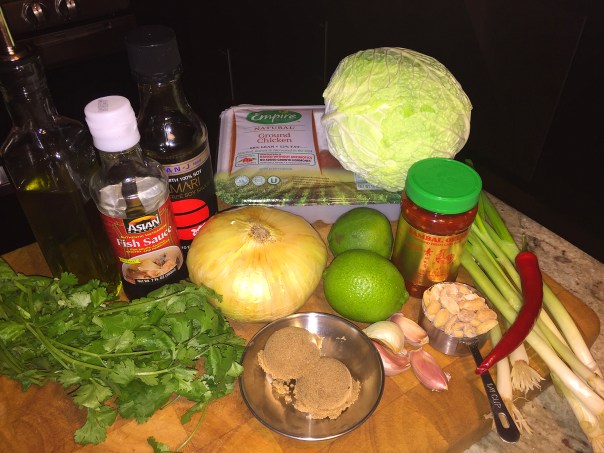
img_0503

Ingredients

  • 3 Tbs. soy sauce
  • 1 Tbs. light or dark brown sugar
  • 1 tsp. fish sauce
  • 1/2 tsp. sambal oelek; more to taste
  • 3 Tbs. grapeseed or vegetable oil
  • 1-1/2 cups finely chopped sweet onion
  • 1 Thai bird chile, half seeded and minced, half cut into rings and reserved for garnish, if desired
  • 1 tsp. minced garlic
  • 1 lb. ground chicken
  • 1/2 cup coarsely chopped fresh cilantro
  • Kosher salt
  • 1 tsp. finely grated lime zest; more to taste
  • 1 Tbs. fresh lime juice; more to taste
  • Thai-Style Roasted Cabbage
  • 3 to 4 scallions, green parts only, thinly sliced on a diagonal (about 1/4 cup)
  • 1/4 cup coarsely chopped dry-roasted peanuts

img_0508
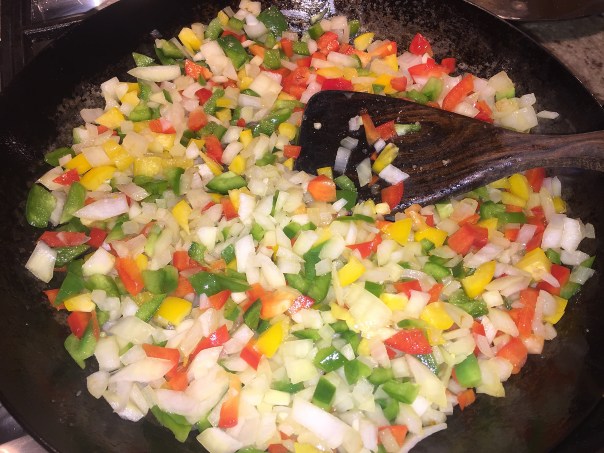
Add the onion and minced chile to a hot skillet, and cook, stirring frequently, until the onion begins to soften, then add the garlic and cook just until fragrant.
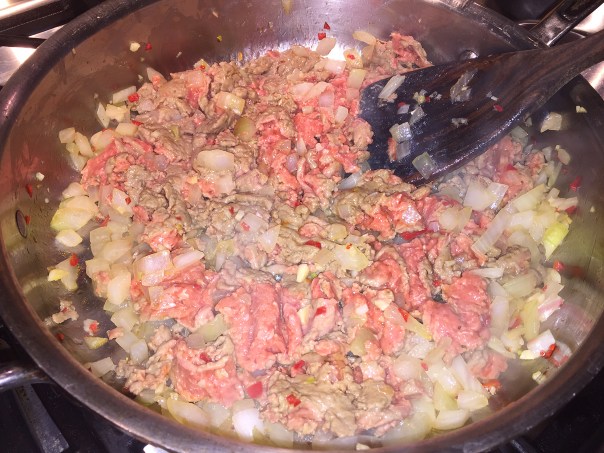
img_0509Next, add the chicken and cook, breaking it up with a wooden spoon, until no longer pink.
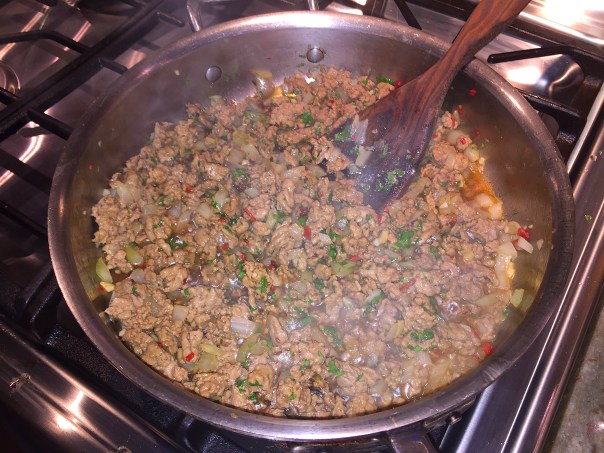
img_0513
Remove the pan from the heat, and add the lime zest and juice.

Directions

  1. In a small bowl, whisk the soy sauce, sugar, fish sauce, and sambal oelek.
  2. In a 12-inch nonstick skillet, heat the oil over medium-high heat. Add the onion and minced chile, and cook, stirring frequently, until the onion begins to soften, 2 to 3 minutes. Add the garlic and cook just until fragrant, about 30 seconds.
  3. Add the chicken and cook, breaking it up with a wooden spoon, until no longer pink, 6 to 8 minutes.
  4. Add the soy sauce mixture, half of the cilantro, and 1/4 tsp. salt. Cooking, stirring, until the pan is almost dry, about 2 minutes.
  5. Remove the pan from the heat, and add the lime zest and juice. Toss to combine, and season to taste with more zest, juice, and salt.
  6. Serve the chicken over the cabbage. Top with the remaining cilantro, scallions, peanuts, and chile rings, if using.

Thai-Style Roasted Cabbage

Peppery cabbage becomes delightfully sweet post roast. Paired with a Thai-inspired dressing, it makes a perfect side for steak and a great base for Spicy Chicken Larb.

img_0506
Spread the cabbage out on a rimmed baking sheet, and roast, tossing every 10 minutes.

Ingredients

  • 1 medium head Savoy cabbage, halved through the core, cut lengthwise into 1/2-inch ribbons, thick ribs and core discarded (about 16 cups)
  • 2 Tbs. grapeseed or vegetable oil
  • Kosher salt and freshly ground black pepper
  • 3 Tbs. fresh lime juice
  • 1 Tbs. finely chopped garlic
  • 1 Tbs. fish sauce
  • 1 Tbs. packed dark brown sugar
  • 1 Tbs. packed finely chopped fresh cilantro; more for garnish
  • 1/2 tsp. sambal oelek; more to taste

Directions

  1. Position a rack in the center of the oven and heat to 425°F.
  2. On a rimmed baking sheet, toss the cabbage with the oil, 1/2 tsp. salt, and a few grinds of pepper. Spread the cabbage out (it’s OK if the cabbage is mounded; it will shrink as it roasts), and roast, tossing every 10 minutes, until tender and most of the cabbage has turned golden brown, 45 to 50 minutes.
  3. Meanwhile, in a small bowl, whisk the lime juice, garlic, fish sauce, sugar, cilantro, and sambal oelek.
  4. Transfer the cabbage to a large bowl and toss with 2 Tbs. of the dressing. Season to taste with additional dressing and salt, top with cilantro, if using, and serve.

img_0518
Transfer the cabbage to a large bowl and toss with the dressing, season to taste with salt, and top with cilantro.

Both recipes by Diana Andrews from Fine Cooking


Backward Braising with Pork and Fennel—A Dynamic Duo

Lynne Curry from Fine Cooking dishes on the benefits of Backward Braising. Try her wonderful aromatic Braised Pork Shoulder with Fennel, Garlic, and Herbs, it is delicious!
img_0496

Braised meat is a beautiful thing. Thanks to low, slow cooking in a flavorful liquid, the meat becomes crazy tender and full of flavor. It’s the perfect choice for winter dining, when you’re hankering for a hearty meal and having the oven on for a few hours is most welcome. A braise is practically foolproof and only better if made ahead, so it’s great for both casual family meals and stress-free entertaining. This method is supposed to be even easier, although we both thought it took the same amount of time and work, if not a bit more.

When braising, you typically sear meat to brown it for flavor and color, then add liquid and aromatics before cooking it until tender. With this “backward” method, you braise the meat to tenderness first, then brown it in a hot oven. The end result is more of the meat surface is browned, which we consider a plus.

There are several rewards for doing this. You skip the messy step of searing the meat on the stovetop and have no chance of burned fat leaving an off taste. You also create a flavorful broth in the pot, which means you don’t need to have stock on hand to braise.

Slow cooking followed by a blast in the oven creates tender meat with an appealing crust, all without searing. The flavor combination in this braise is reminiscent of porchetta, and leftovers make a great sandwich. For the best results, season the pork at least a day ahead, or up to three days (ours was in the rub for 23 hours.)

The meat from this recipe can be served for dinner as is, in chunks or slices along with its sauce and, say, some potatoes. But you can also shred the meat to use in tacos, as a filling for ravioli, or as a topping for risotto, polenta, or pasta along with some of the sauce.

img_0431
Fennel seed is coarsely ground in a mortar and pestle.

img_0433
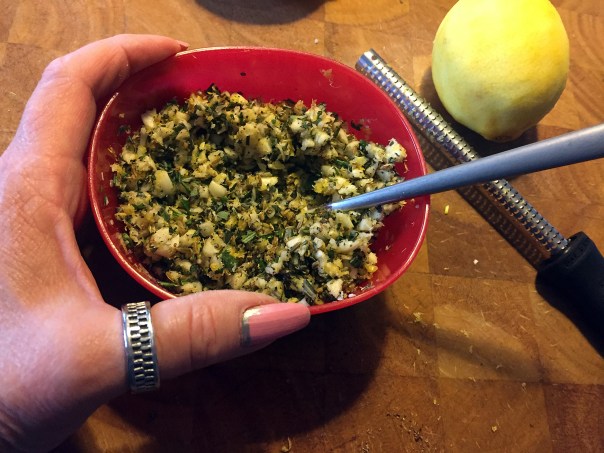
Combine the garlic, zest, rosemary, salt, sage, fennel seeds, and pepper in a small bowl.

Ingredients

For the spice rub
  • 8 large cloves garlic, minced
  • 2 Tbs. finely grated lemon zest (from about 2 lemons)
  • 2 Tbs. chopped fresh rosemary
  • 1 Tbs. kosher salt
  • 2 tsp. coarsely chopped fresh sage
  • 2 tsp. coarsely ground fennel seeds
  • 1 tsp. freshly ground black pepper
  • 1 3- to 31/2-lb. bone-in pork shoulder roast
For the braise
  • 1 medium yellow onion, chopped
  • 1 fennel bulb, chopped (about 2-2/3 cups), plus 1/2 cup fennel fronds for the braise and more for serving, if you like
  • 1 tsp. finely chopped fresh rosemary
  • 1 bay leaf, preferably fresh
  • 2 cups dry white wine

Directions

img_0441
Using a paring knife, trace the fat seams of the roast and around the bone to make a series of deep incisions on both sides, without completely separating the muscles.

img_0445
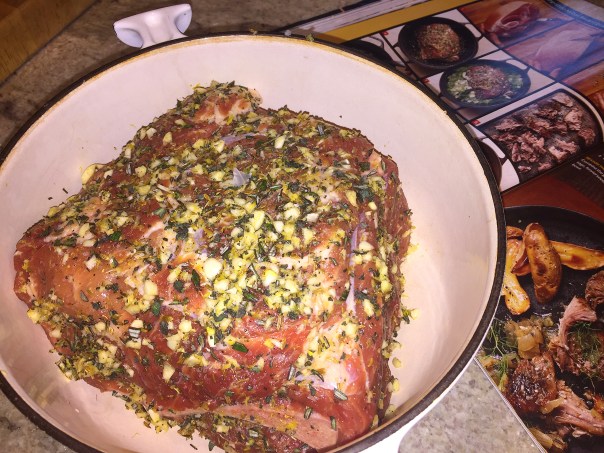
Coat the meat all over with the rub, massaging it between the muscles and on all sides of the roast.

img_0448
Put the pork in a Dutch oven or high-sided skillet that fits it snugly. Cover and refrigerate for at least 12 hours and up to 3 days.

img_0484
In order for room to add wine, and the chopped onion and fennel, we transferred the roast to a larger braising pot.

Season the pork
  1. Combine the garlic, zest, rosemary, salt, sage, fennel seeds, and pepper in a small bowl.
  2. Using a paring knife, trace the fat seams of the roast and around the bone to make a series of deep incisions on both sides, without completely separating the muscles. Score any external fat or skin and fat with a series of incisions 1 inch apart. Coat the meat all over with the rub, massaging it between the muscles and on all sides of the roast.
  3. Put the pork in a Dutch oven or high-sided skillet that fits it snugly. Cover and refrigerate for at least 12 hours and up to 3 days.

img_0485
Since our roast was nearly 4 1/2 pounds, we roasted it for 3 1/2 hours.

img_0487
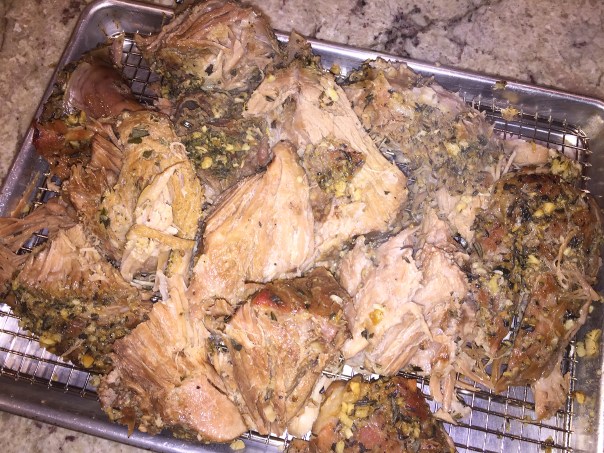
After the roast has cooled slightly, the meat is pulled off of the bone in large chunks.

img_0490
The shredded meat is put back into the pot in one layer over the veggies.

img_0492
Brown one side in high heat for 20 minutes, then turn and brown the other side for another 20.

Braise the pork
  1. Remove the pork from the refrigerator and let it sit at room temperature for 1 to 1-1/2 hours before cooking.
  2. Position a rack in the center of the oven and heat to 300°F. Uncover the pork, and add the onion, fennel bulb and fronds, rosemary, bay leaf, and wine. Cover tightly and cook until the meat is fork-tender, 2-1/2 to 3 hours.
  3. Leaving the liquid and vegetables in the pot, transfer the meat to a rimmed baking sheet to cool slightly. Separate the meat into large chunks, and remove and discard all the fat.
  4. Discard the bay leaf. Skim the fat from the broth. Return the meat to the pot, and arrange the pieces in a single layer. (The dish can be prepared up to this point and refrigerated for 1 to 2 days. Reheat at 300°F, covered, for 30 minutes before proceeding with the recipe.)
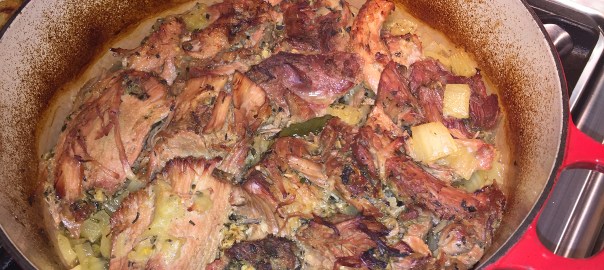
  5. Raise the oven temperature to 425°F. Cook the pork, uncovered, flipping once, until the exposed surface is well browned, about 40 minutes. Serve with the vegetables and sauce, garnished with fennel fronds, if you like.

by Lynne Curry from Fine Cooking
img_0499
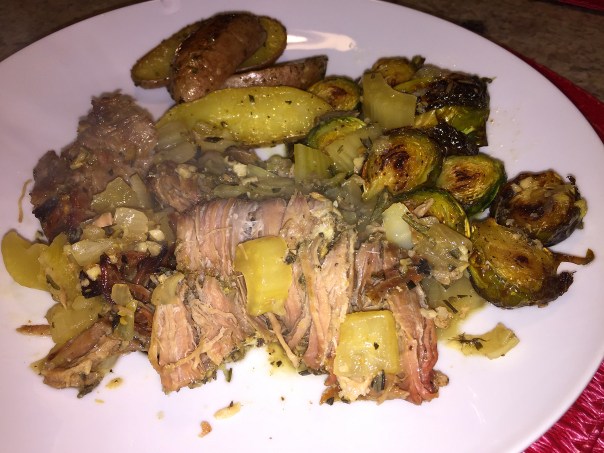
We served ours with roasted fingerling potatoes and Brussels sprouts.

FYI, while braising is similar to stewing, the two cooking methods do have some slight differences.

BOTH are moist heat, slow cooking methods that tenderize the beef and develop rich beef flavor.
BOTH start with less-tender beef cuts as this cooking method softens the strong muscle fibers and connective tissue, guaranteeing tender, moist, flavorful results.

The Difference?
Braising cooks large cuts of beef in enough liquid to partially cover the meat .
Stewing uses small, uniform pieces of beef pot roast or beef for stew meat that are totally immersed in liquid.

Hell-UVA Cool Atmosphere

It was a Saturday and we had no fixed plans for dinner. Initially we thought of making reservations at a nearby restaurant, but while online to make a res, up popped a link for UVA Ristoranti Italiano. I mean, who doesn’t like Italian cuisine? It was an establishment unbeknownst to us, which always entices our foodie curiosity. The extensive menu tempted us enough to call, where we also found out they’re a BYO—our preference.

img_0449

UVA (Italian word for “grape”) is located on Second Street Pike in Richboro, PA at one end of a small strip mall, about a 20-minute ride from our home. Pulling into the parking lot you immediately notice their neon purple sign beckoning you in. Patronage was a bit light, but that was to be expected because it was only 5:45, way early for us but the only workable time we could get a reservation on such short notice. However, by the time we left the placed was packed to the rafters!

img_0454
The wall partitions turned different colors as bubbles created an intriguing graphic movement.

img_0455
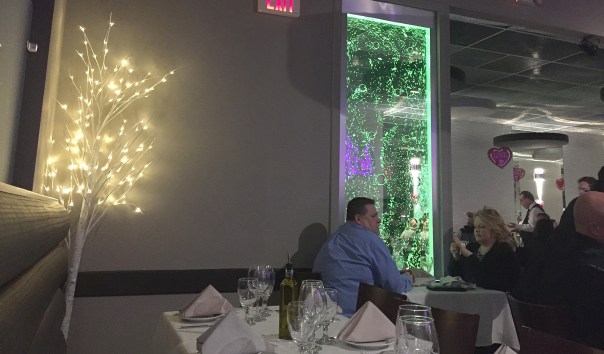
Mood lighting is everywhere without being intrusive.

img_0453
This side of the dining area was pretty empty when we first arrived.

Our first impression of the upscale vibe with modern decor was very positive. The unusual ceiling discs, glowing partitions with color-changing bubbling liquid, branches with twinkling lights, and fascinating wall sconces all worked together in exuding a hip lounge-like atmosphere. After taking our coats, the cheery hostess promptly seated us at a table for two near a window looking directly into the foyer, which provided Russ an ample view of the steady stream of customers piling in as the evening wore on.

Initially, a soft jazz wafted in the background, a pleasant atmosphere for easy conversation in an intimate dinner setting. But as time wore on, that all changed. We didn’t notice how close all of the tables were until we needed to use the restrooms (very nicely appointed, btw) and worm our way through the completely full dining areas. And at some point an experienced lounge singer began her set of well-known songs, but with sound levels that made conversation difficult.

img_0451
Two different vegetable spreads were delivered to each table with a basket of fresh bread.

There was a large attentive waitstaff who took orders, brought meals, filled water glasses and just made sure everything was as it should be. At first it was. While pondering the menus, a basket of fresh bread and a plate of two spreads were presented. Not sure what they were, but liking them a lot, we found out that one was a carrot spread and the other was made with zucchini with a slight sweet note to it. We noted (and overheard) that other diners received similar but different spreads, i.e. eggplant.

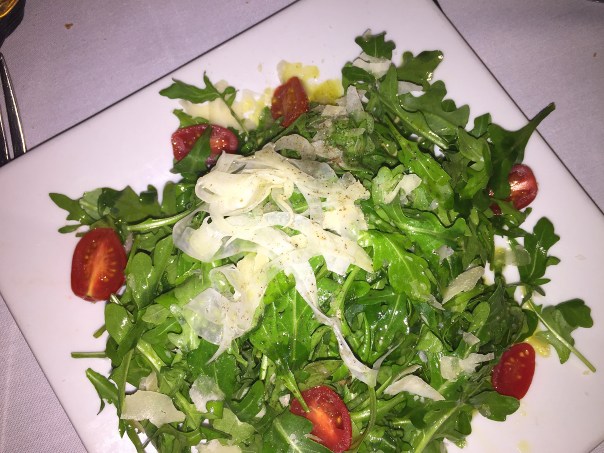
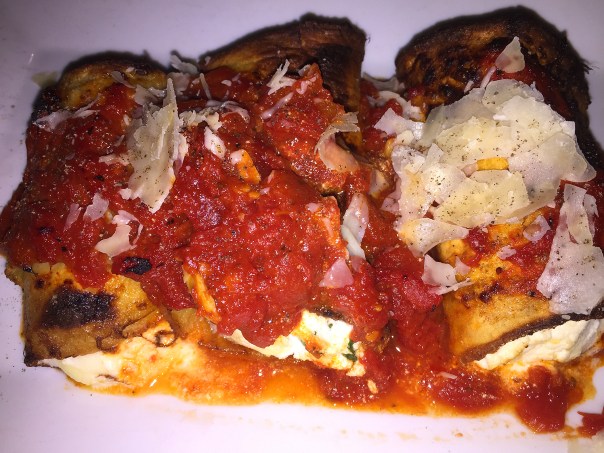
I started with a large Arugula Salad and allowed Russ to take nearly half of it, while I asked for just a small bite of his Eggplant Rollatini. Both appetizers were hefty in size and very tasty, although not earth shattering.

img_0459
ARUGULA SALAD—With fennel, tomato, lemon and oil topped with shaved parmigiano

img_0458
EGGPLANT ROLLATINI—Stuffed with ricotta and prosciutto in marinara and parmigiano

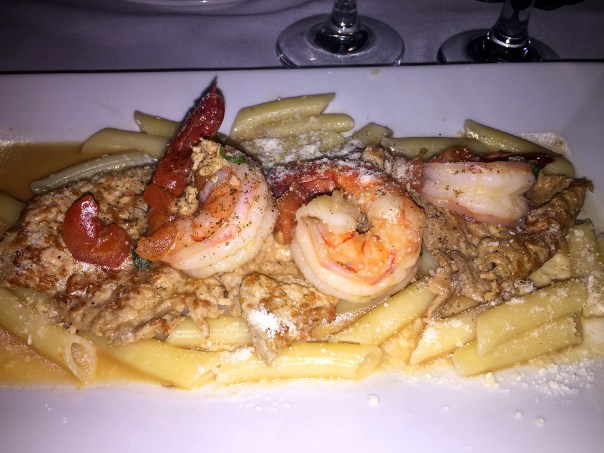
Things went a bit downhill once our entrees started to arrive. Russ chose the Veal D-Uva accompanied by shrimp in a fresh tomato and champagne sauce. But once it was delivered and he couldn’t find any shrimp, he realized he got someone else’s order and it took a few minutes to flag down a waiter to remedy the situation.

In the meantime, my Grilled Cajun Salmon dinner arrived several minutes before Russ got his correct meal. And even though my dinner was plated nicely, the salmon itself was overcooked. Russ did enjoy his veal over a bed of gluten-free penne, but again, pretty average in taste.

A nuance that particularly irritates us is when fine restaurants serve most entrées with the same sides, such as the mashed potatoes, instead of using originality and pairing each meal with appropriate accompaniments. I know it saves time and money, but lacks the finesse of a high-brow establishment.

img_0461
GRILLED CAJUN SALMONDusted with Cajun spices, topped with tomato bruschetta, and served over a sautéed bed of kale, with a side a creamy mashed potatoes.

img_0462
Russ originally received this veal dish which was not what he ordered.

img_0465
In the end, Russ enjoyed his entrée choice of Veal D’Uva.

Despite the shortcomings, we liked the place enough to try again and will give it another shot. We’ll just make an effort to be more specific with our orders when we do return…

SkyBrunch at Top of the Tower

The day dawned dismal with rain and fog blanketing the entire area, not necessarily the best conditions to enjoy a brunch 50 floors up in the city skyline. But we had reservations, A Deal for Two from TravelZoo, and still looked forward to a scrumptious meal, no matter how limited our views would prove to be—and limited they were.

SkyBrunch in Philadelphia is on the 50th floor of Three Logan Square at 1717 Arch Street, and features some of the most spectacular views in Philadelphia from the expanse of the western horizon to the Art Museum, Parkway and City Hall. Available with a side of awe, it sits 50 stories above the city streets, with a panorama beyond anything you’ve ever seen before—if the weather is cooperating…

img_0476
Our less-than-spectacular view.

Convenient parking is available through a back entrance underneath the building. Luckily for us, we then didn’t have to schlepp out in the rain, instead we took one elevator up to the lobby, then an express elevator to the 50th floor. The hostess greeted us in the center of a long hallway backed by sweeping views of the city behind her, and food stations flanking her on either side.

img_0466
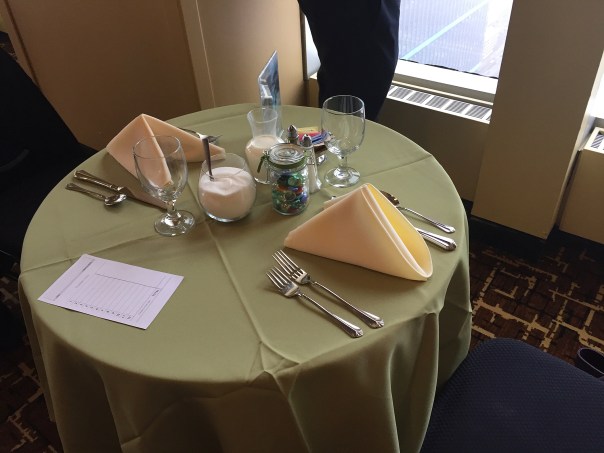
Our table by a window when we first arrived.

IMG_0467.jpg
A partial view of one of the dining areas.

Within a few minutes we were lead to our table at one end of the floor (there is an identical dining area on the opposite end) at a table round for two overlooking what would have been an impressive vista.

Overall the waitstaff is very attentive and professional without being overbearing or in-your-face. Our waitress Javaughn explained that in addition to coffee, tea or a variety of juices, we were entitled to a free cocktail, so we both settled on the Silver Lining, a libation akin to a Bloody Mary made with Skyy vodka, V8 juice, fresh horseradish, worcestershire, tabasco, lemon juice, topped with a cherry tomato, olive and pepper jack skewer—excellent! There is a full-service bar if you wish to imbibe on beer, wine or other cocktails.

img_0478
Our perfectly seasoned, on-the-house Silver Lining cocktail.

img_0473
Russ’ first plate was all from the Seascape station.

img_0474
Offerings from the Seascape and Landscape stations.

img_0472
A side of the Tower caesar salad caprese.

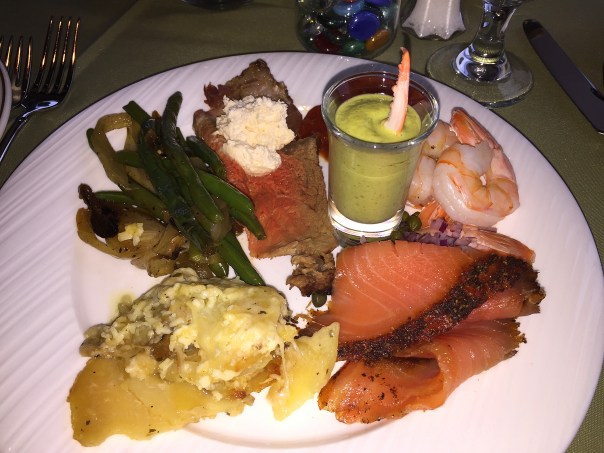
Our first foray to the food stations started at the Seascape with jumbo shrimp cocktail, a crab claw shooter and smoked salmon (all stations described in full detail below), and pretty much ended for me at the Landscape with the perfectly medium-rare prime rib with merlot and horseradish sauces, an unbelievably good green bean dish with caramelized onions, just a taste of the very rich Gruyere potato gratin, and the Tower caesar salad caprese.

There were four stations I didn’t even attempt, although Russ helped himself to a sampling from a few of them. After the meal, we enjoyed some hot tea and coffee and decided to check out the Sugar High station with an array of miniature desserts. You know I pretty much never eat dessert, but this time I did take a bite or two of a couple samples, namely the chocolate chip and walnut blondie and a mini chocolate chip cheesecake. Russ savored his lemon and raspberry cheesecake minis.

img_0470
The unmanned Panorama Station offers yogurt, fruit and granola.

img_0468
The Sugar High dessert station is the the only one inside the dining area.

img_0479
A close-up of a few mini desserts from the Sugar High Station.

All you can eat buffets are not necessarily a bargain for me, but looking around at the amount other patrons piled on their plates, they certainly got their money’s worth. Regular price for adults is $50 a pop, making it more of a special occasion place in my opinion. But for kids 13 and under you only pay $1 per year (i.e. a 6-year-old would cost only $6).

They do not serve meals any other time during the week, but they will hold special events such as Cupid in the Sky on Valentine’s Day. Over the years, Top of the Tower has seen it all. Spectacular fireworks watching VIP parties on the 4th of July…Intimate 50th wedding anniversaries…Birthday parties from Sweet 16 to 60+… Commitment Ceremonies… New Year’s Eve Parties… Senior Proms and Formals for nearby schools… Graduation Receptions and Brunches from Penn to Villanova.

And on the 51st floor, there is a bar on Wednesdays through Saturdays, although we didn’t have access to check it out on that Sunday afternoon.

clear-view
What the view looks like on a clear day.

*****************************************

Chef Matt Lane’s stations include seven options plus, there’s a table of charcuterie and cheeses with pickled vegetables and artisan mustards and a display of assorted dessert miniatures.

SEVEN SUMPTUOUS BUFFET FOOD STATIONS

THE OUTLOOK: Honey-Stung Fried Chicken, Crème Brulee Brioche French Toast, Chantilly Cream and Mixed Berries, Shemanski Farm PA Pure Maple Syrup, House Made Jams and Butters, Breakfast Pastries

THE LANDSCAPE: Carved to Order Meats featuring Pepper-Cured Prime Rib, Merlot Sauce and Horseradish Cream, Fresh Vegetables, Pasta of the Day, Gruyere Potato Gratin, Tower Caesar Salad Caprese, Charcuterie

THE SEASCAPE: Cocktail Shrimp en Barigole, Crab Claw Shooters, Variety of Duck Trap Smoked & Cured Salmon, Classic Garnitures and Cream Cheese Varieties, Sushi by Zento

THE VIEW: Pecan Smoked Bacon, House Crafted Sausages, Baby Yukon Home Fries

THE PANORAMA: Assorted Cereals, Fresh Fruit, Yogurt Parfait, Metropolitan Granola

THE SUNNY SIDE: Omelets & Scrambles

THE SUGAR HIGH: Hand Dipped Chocolate Ganache Strawberries, Variety of Miniature Desserts, Cookies and Brownies

DRINKS FIRST ROUND’S ON US!

Each adult is offered a complimentary cocktail from among the following …

PIECE OF HEAVEN: Oatmeal Infused Skyy Vodka, PA Pure Maple Syrup, Light Cream, Fireball Whiskey, Dash of Cinnamon

BLUE SKYY: Blueberry Skyy Vodka, White Cranberry Juice, Blue Curacao, Splash of Lime Juice, Fresh Blueberry Skewer

SILVER LINING: Skyy Vodka, V8 Juice, Fresh Horseradish, Worcestershire, Tabasco, Lemon Juice, Cherry Tomato, Pepper Jack Skewer

CLOUD 50 COCKTAIL SPRITZER: La Marca Prosecco and Freshly Squeezed Blood Orange Juice

PIE IN THE SKY (FOR THE LITTLE GUYS): Apple Juice, Sprite and a Dash of Grenadine with a Cherry Garnish.

When You Don’t Feel Like Red Sauce

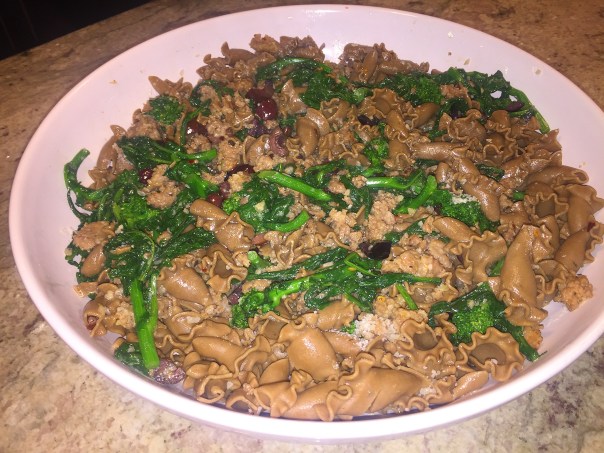
Don’t you just love all of those interesting twisty pasta shapes? Until recently, trying to find gluten-free options wasn’t a walk in the park. But somewhere in the not too distant past, we purchased this bag of porcini mushroom flavored large trumpets which worked perfectly for Campanelle with Broccoli Raab, Sausage and Olives.

Served with a side salad, this could become a weeknight favorite when wanting a pasta dish without red sauce. Don’t get me wrong, I love red sauce, but just like anything else, you need a change every now and then—except for maybe your partner, but I’ll leave that decision up to you!

img_0099

In it’s original inception, this recipe is heavier on the greens (although we will double the amount next time) and lighter on the pasta than most. But we used a 9-ounce bag of campanelle so we added extra broth (1 cup instead of 3/4 cup) to moisten it. And our package of bulk sausage came as one-pound, and I’m pretty sure I incorporated more than a 1/2 cup of olives, not to mention extra garlic and red pepper flakes. So go ahead and adjust the ingredients to your own personal preferences.

img_0087

Ingredients

  • 1 lb. broccoli raab, thick stems trimmed off, leaves and florets rinsed well
  • 6 oz. dried campanelle pasta (2 cups)
  • 3 Tbs. extra-virgin olive oil
  • 3/4 lb. sweet Italian sausage (bulk sausage or links removed from casing)
  • 3 cloves garlic, minced
  • 1/4 tsp. crushed red chile flakes
  • 3/4 cup homemade or low-salt chicken broth
  • 1/2 cup pitted Kalamata olives, quartered
  • 2 tsp. finely grated lightly packed lemon zest
  • 1/3 cup freshly grated Pecorino Romano
  • Kosher salt

img_0090Trimmed broccoli raab gets rinsed before cooking.

img_0092
With tongs or a slotted spoon, transfer the broccoli raab to the bowl of ice water to stop the cooking.

img_0094
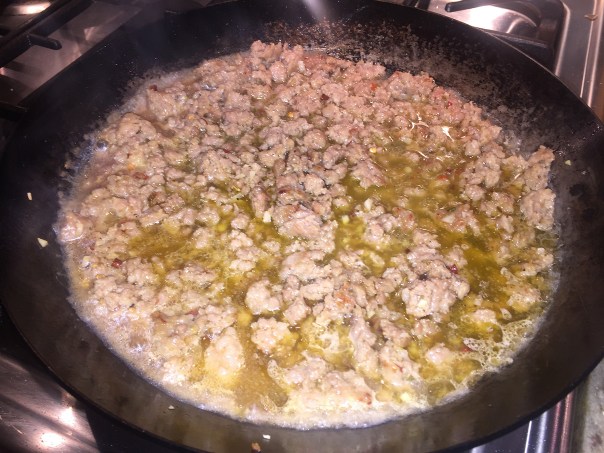
Add the sausage to hot skillet and cook, stirring and breaking it into smaller pieces with a wooden spoon until it’s browned and almost cooked through.

img_0096
Broccoli raab, olives and lemon zest are added after the broth reduces.

img_0097
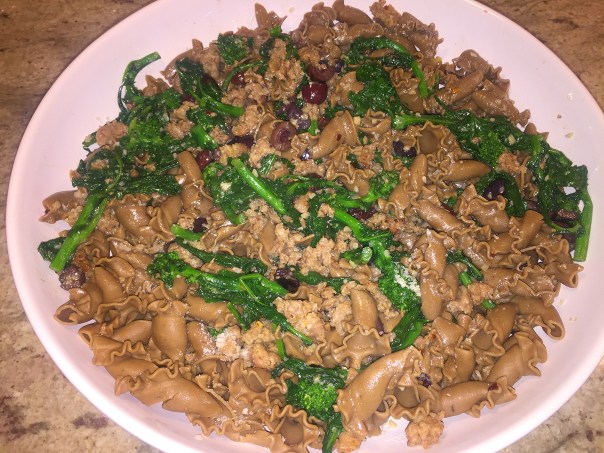
There was not enough room in our skillet to add the pasta and cheese, so we moved it all to a large bowl and tossed together.

Directions

  1. Bring a large pot of well-salted water to a boil over high heat. Have a bowl of ice water ready. Add the broccoli raab and cook until bright green and tender, 2 min. (the water doesn’t have to come back to a full boil once the broccoli raab has been added).
  2. With tongs or a slotted spoon, transfer the broccoli raab to the bowl of ice water to stop the cooking. Drain well and gently squeeze the broccoli raab to remove excess water.
  3. Return the pot of water to a boil, add the pasta, cook according to package directions, and drain.
  4. While the campanelle cooks, heat the oil in a 12-inch skillet over medium- high heat. Add the sausage and cook, stirring and breaking it into smaller pieces with a wooden spoon until it’s browned and almost cooked through, 4 to 6 min.
  5. Add the garlic and chile flakes and cook until the garlic is lightly golden, about 1 min. Pour in the broth and bring to a boil; cook, scraping the pan with a wooden spoon occasionally, until the broth is reduced by about half, 3  to 4 min.
  6. Add the broccoli raab, olives, and lemon zest and cook, stirring, until hot, 1  to 2 min.
  7. Add the pasta and cheese to the skillet and toss well. Season to taste with salt and serve immediately.

By David Bonom from Fine Cooking

img_0100

Quick Sear-Roasted Chicken

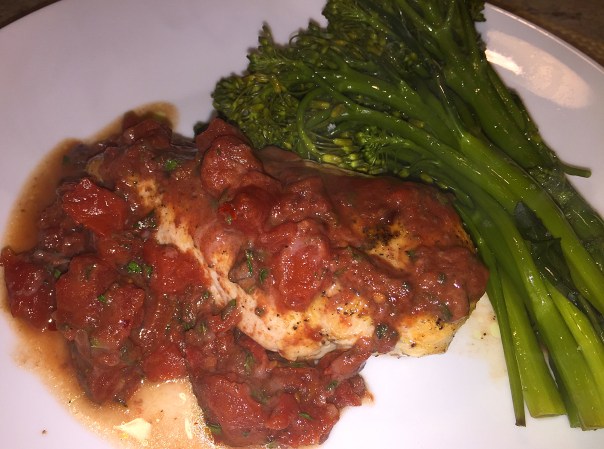
It’s a weeknight, you don’t have much time yet want to serve something healthy that everyone (or maybe just you) will enjoy. This Sear-Roasted Chicken with Tomato and Red Wine Sauce recipe fits the bill. Paired with some steamed broccolini, this dinner is low-calorie, low-carb and gluten-free.

img_0396

When you sear-roast chicken breasts you get perfect browning and even doneness. It’s a simple restaurant technique you can do at home with great results. Here’s a tip to get the most out of this dish: Be sure that the oven has reached 425°F before starting to sear—most ovens take 20 to 30 minutes to heat up thoroughly. And ours is no exception.

For a quick sauce, it had a wonderful depth of flavor. If, like us, you like things spicy, make that “pinch” of red pepper flakes a healthy one!

img_0373

Ingredients

For the Chicken:
  • 4 boneless, skinless chicken breast halves (about 1-1/2 lb. total)
  • Kosher salt and freshly ground black pepper
  • 2 Tbs. olive oil, canola oil, or peanut oil
For the Tomato and Red Wine Sauce:
  • 1/2 cup red wine
  • 1 14-1/2-oz. can diced tomatoes (preferably “petite-cut”), with their juices
  • 2 Tbs. loosely packed chopped fresh oregano
  • Pinch crushed red chile flakes
  • 1/3 cup freshly grated Parmigiano-Reggiano
  • Kosher salt and freshly ground black pepper

img_0376
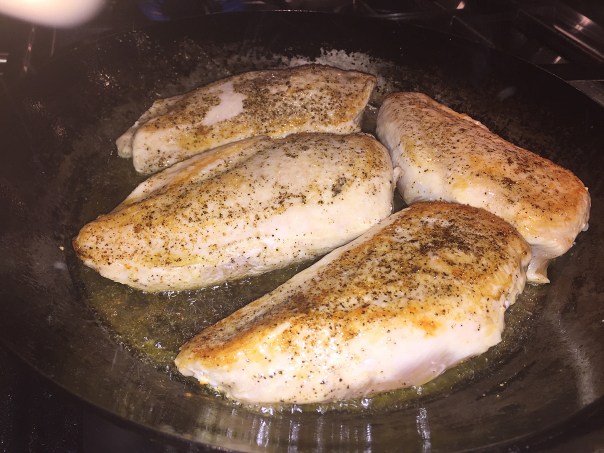
Pan-sear a couple of minutes on each side in a hot skillet.

img_0380
Our chicken breasts came to temperature after 10 minutes in the oven.

img_0383
Pour off any excess fat from the skillet. Return the pan to high heat and add the red wine.

Directions

Sear-roast the chicken:
  1. Heat the oven to 425°F. Turn the exhaust fan on to high. Pat chicken dry with paper towels. Season both sides generously with salt and pepper (about 1 tsp. of each total). Heat a 12-inch heavy-based ovenproof skillet over medium-high heat until a droplet of water vaporizes in 1 or 2 seconds, about 1 min. (If the water skitters around the pan and doesn’t evaporate, the pan is too hot; take it off the heat for about 30 seconds to cool.)
  2. Add the oil, swirl it around the pan, and then evenly space the chicken in the pan. Cook without touching for 2 min. Using tongs, lift a corner of the chicken, check that it’s both well browned and easily releases from the pan, and flip it over. (If it sticks or isn’t well browned, cook for 1 to 2 more min. before flipping.) Cook the second side for 1 min. and then transfer the skillet to the oven.
  3. Roast until the chicken reaches an internal temperature of 165°F and is firm to the touch, about 5 to 8 min. Using potholders, carefully remove the pan from the oven, transfer the chicken to a large plate, tent with foil, and let it rest while you prepare the sauce in the same skillet.
Prepare the pan sauce:
  1. Pour off any excess fat from the skillet. Return the pan to high heat and add the red wine. Cook, scraping the pan with a wooden spoon to incorporate any browned bits, until the wine is reduced to a glazy film.
  2. Add the tomatoes with their juices and the red chile flakes; cook until the juices reduce to a saucy consistency, about 3 min.
  3. Stir in the oregano and Parmigiano; season generously with salt and pepper to taste. Serve immediately spooned over the sear-roasted chicken.

img_0388
Without wiping out the pan, add the tomatoes with their juices and the red chile flakes.

img_0389
Once the tomatoes are reduced to a saucy consistency, stir in the oregano and Parmigiano.

img_0393
Serve immediately spooned after the sauce is over the sear-roasted chicken.

By Tony Rosenfeld from Fine Cooking

Will Thai One On Again

Nearly a year had passed since the Ethnic Dining Group was able to continue their treks to discovering new culinary delights. So the timing was perfect when thanks to a tip from my coworker Kami, we made reservations at Thai Tida in Lambertville, NJ. A few weeks earlier, Kami couldn’t stop raving about the restaurant and when I told her Thai was one of my favorite cuisines, she said we MUST go soon. That’s all it took to convince me…

This charming BYO is located conveniently off of North Union Street, where curbside parking is available as well as a large lot behind their building. Although it wasn’t clear the parking was for the restaurant, we took advantage of the space. The restaurant entrance plants you directly into a very small foyer area which doesn’t allow for much room if you have to wait. Luckily we had reservations and were seated promptly at a window table in the single dining area.

img_0290

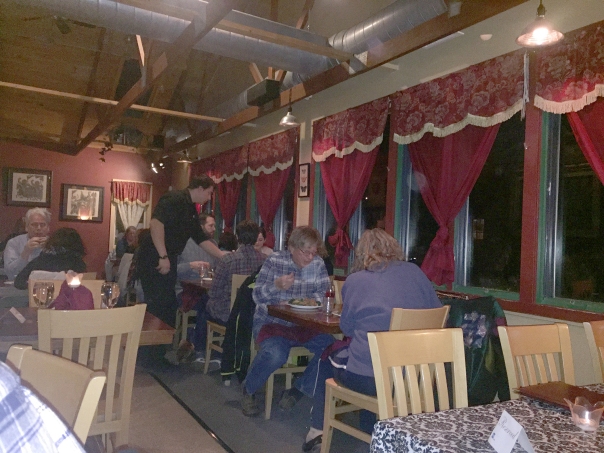
Inside, the cozy atmosphere is awash in a maroon color palette with soaring beamed ceilings, industrial pipes and light fixtures, and plenty of room between tables so that you are not in the laps of fellow diners. Oddly, some tables had cloths, such as ours, while many others were bare wood.

img_0293
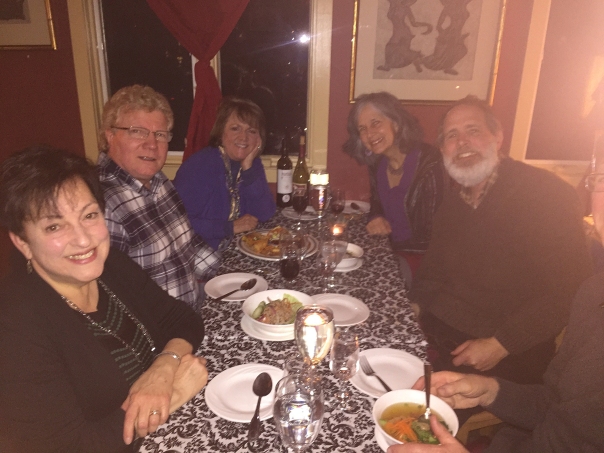
I asked our waiter to take a couple of pictures of the 6 of us, yet both times he cropped out Joe on the right.

We had some menu questions addressing a limited diet of one of our companions due to health reasons, but our waiter was not a big help in that area, so he sent what may have been one of the owners to assist us. Through her we learned they use very little oil in their cooking, and certain dishes could be made without any at all.

duck
Russ and Teresa both enjoyed the de-boned Duck Panaeng Curry.

img_0302
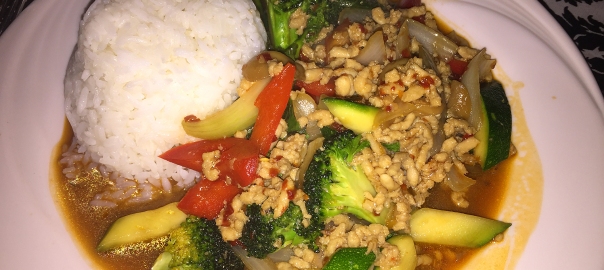
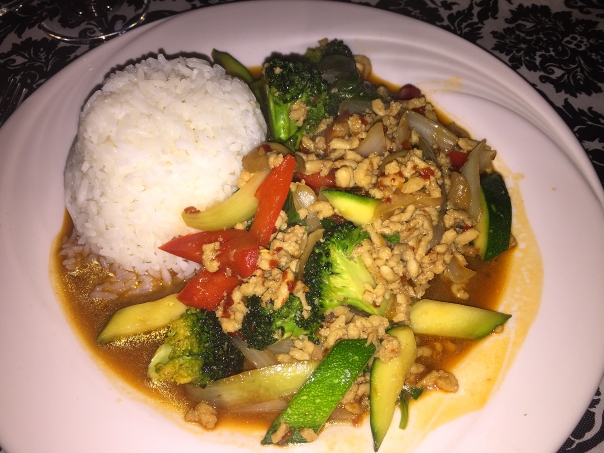
I chose the delicious Pad Ka-Praw, Thai Basil Stir-Fry with fresh Thai basil, onion, shiitake mushroom, vegetables and chicken, with spicy basil brown sauce.

After some catching up and scrutinizing the lengthy vegan, wheat and gluten-free friendly menu, we put in our orders. To be fair, Russ and I eyeballed that menu pretty thoroughly online at home before going out. Once Russ saw the Duck Panaeng Curry his mind was made up—and I was all over the Thai Basil Stir-fry. Most curries and stir-fries come with a choice of vegetarian, chicken, shrimp, beef or pork, with the option of as mild or as spicy as you’d like.

img_0294
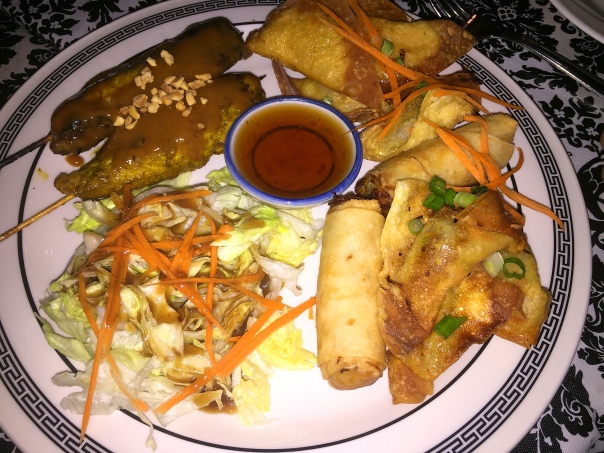
Appetizer Combo for 2—Grilled Chicken Satay, Crispy Siamese Spring Roll, Vegetable and Chicken Wonton with sweet-sour dipping sauce, accompanied with a side of mini-house salad.

img_0291
An order of Tom Yum Soup with Thai spicy lemongrass, seasoned with chili and lime caught the attention of Maria Odilia. While Joe feasted on Tom Jued Tao Hou, a lightly flavor clear soup with tofu and vegetables. Perfect for vegan, but can be ordered with chicken or shrimp (not pictured.)

For starters they offer numerous appetizers, soups, and an extensive selection of salads. A few of the diners started with soup or salad, but Russ and I couldn’t decide so we opted for the Appetizer Combo for 2, and shared with the whole table. While most of the combo items were very good, we were most fascinated with the delicious mini-salad and plan to order that alone next time.

img_0298
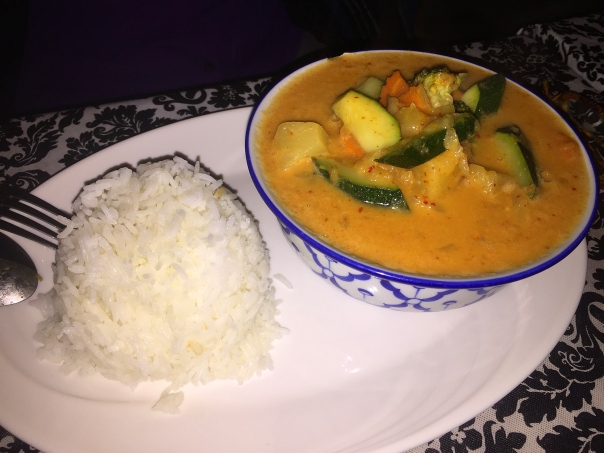
Maria Odilia loved her sweet and aromatic Kaeng Kua Pupparod – Pineapple Curry which was a marvelous red curry with coconut milk based with pineapple and vegetables.

img_0300
Steve enjoyed the Vegetable Pad Thai—a grand mix of textures and tastes with stir-fried rice noodles, bean sprouts, scallions and crushed peanuts, with homemade Pad Thai sauce.

Their offerings are extremely affordable with generous portions. And I can’t say enough about how good our meals were! Yes, there is no doubt we will be back—hopefully very soon… Thanks Kami for the tip! I know without a doubt, Thai Tida will become one of our go-to restaurants when we have a hankering for Thai cuisine.

Lime-Ginger Butter Adds Pizzazz

Cool weather season is always a good excuse to try as many Brussels sprout recipes as possible, at least in our line of thinking. And we came across the Brussels Sprouts and Leeks with Lime-Ginger Butter recipe in the Fine Cooking Make-It-Tonight series. Here, lime and ginger brighten the deeply nutty character of well-browned Brussels sprouts and silky leeks in a very good way.

I know, you don’t like Brussels sprouts, right? They really deserve to be featured on dinner plates more often than they usually are. The unfortunate fate of many Brussels sprouts is overcooking, which is why so many people have unpleasant childhood memories of a nasty, sulfurous odor emanating from the stove.

So even if you’ve had a bad experience with them in the past (I mean, who didn’t?), they’re worth giving another shot because they are low in calories and high in nutrients. Brussels sprouts are a part of the cruciferous vegetable family, which also includes the nutritional powerhouses kale, broccoli, cauliflower, cabbage, and collard greens, all of which supply loads of nutrients for a small amount calories. If you are trying to improve your diet, cruciferous vegetables should be at the very top of your grocery list.

And guess what? When combined with whole grains, Brussels sprouts make a complete protein. That means they’re a great option for vegetarian meals. Plus for the guys, Brussels sprouts are also said to increase male virility.

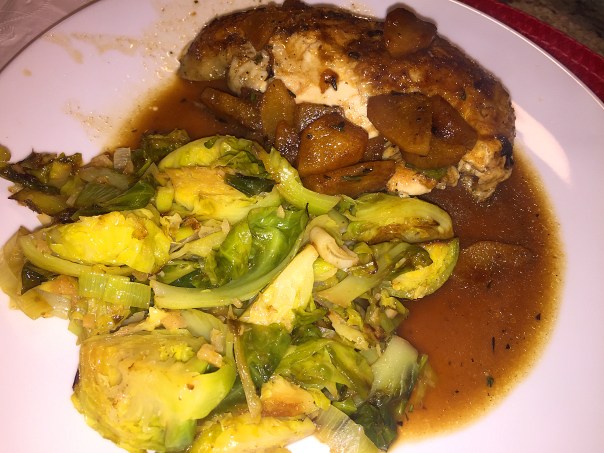
The time factor for this recipe is a pretty quick turn around for both chopping and cooking, so it makes for a plausible weeknight side dish, as well as for more formal affairs. We paired it with delicious Whole Braised Chicken with Rosemary and Pears, and what a dynamic duo they made!

img_0200
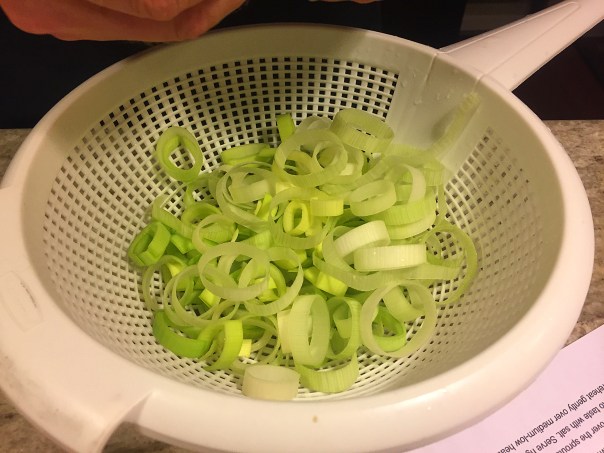
Cut the leeks into 1/2-inch-thick rounds, rings separated and washed well but not dried.

img_0203
After the leeks are cut into rings, Russ quarters our extra-large sprouts.

img_0223
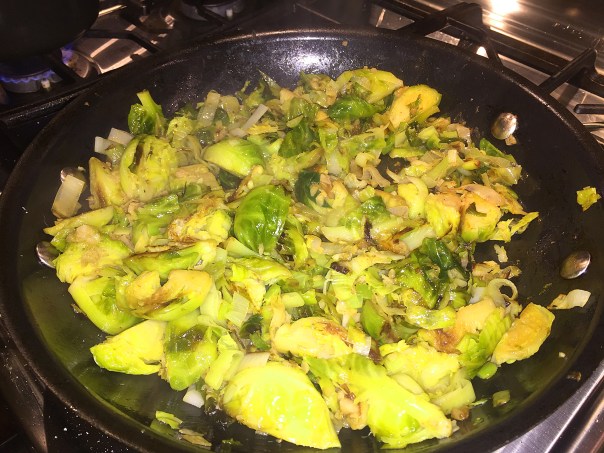
Push the vegetables back into a single layer so that most have direct contact with the pan, until the leeks are limp and the sprouts are well browned.

Ingredients

  • 2 Tbs. unsalted butter
  • 1 Tbs. minced peeled fresh ginger
  • 1 medium lime, finely grated to yield 1 tsp. zest and squeezed to yield 1 Tbs. juice
  • 3 Tbs. extra-virgin olive oil
  • 1-1/4 lb. Brussels sprouts, trimmed, and quartered lengthwise if large, halved if small
  • Kosher salt
  • 3 medium leeks, white and light-green parts only, cut in half lengthwise, then cut into 1/2-inch-thick rounds, rings separated and washed well but not dried

Directions

  1. Melt the butter in a small skillet or saucepan over medium-low heat. Cook, swirling occasionally, until the milk solids turn light brown, about 5 minutes. Add the ginger and stir for a few seconds. Remove the pan from the heat, add the lime zest and juice, and swirl to combine.
  2. Heat the oil in a 12-inch nonstick skillet over medium heat. Add the Brussels sprouts and 1 tsp. salt; toss well to coat with oil.
  3. Cover the pan with the lid ajar by about 1 inch. Turn the heat down to medium low, and cook, stirring occasionally, until the sprouts start to brown, 8 to 12 minutes. As the mixture cooks, you should hear a gentle sizzle.
  4. Uncover, turn the heat down to low, add the leeks (with any water still clinging to them) and cook, stirring occasionally and then pushing the vegetables back into a single layer so that most have direct contact with the pan, until the leeks are limp and the sprouts are well browned, about 15 minutes.
  5. Remove the pan from the heat. Pour the butter mixture over the sprouts and leeks and stir, scraping the bottom of the pan and tossing well to coat. Season to taste with salt. Serve right away or let sit off the heat, partially covered, until ready to serve, and then reheat gently over medium-low heat.

By Susie Middleton from Fine Cooking
img_0232
The Brussels sprouts accompanied the braised chicken and pears entrée.

For the Love of Lentils (and Salmon)

This dinner, North African Spiced Salmon Over French Lentils, ended up being one of those meals that far exceeded our expectations. While the recipe sounded real good when we read it in our Fine Cooking Magazine, the final result was fantastic! Even if you’re not overly fond of lentils, or haven’t tried them in some time, do yourself a favor and give them another chance.

Lentils are an inexpensive, low-carbon, high-fiber source of protein with plenty of important nutrients, including potassium and folate. But mainly, they’re down-right delicious! Although they weren’t high on my list (for some unexplainable reason) all that many years ago… I’m glad I came to my senses since then…

img_0271

Dried lentils are a year-round staple, essential for rounding out salads during hot weather and hearty soups in the winter months. Regardless of the season, their quick-cooking, no-soak-required nature makes them ideal for healthy weeknight meals. It’s also important to buy the freshest lentils you can find and then use them within a few months. Older lentils take longer to cook and tend to shed their skins during cooking.

With some variation, lentils are earthy and sweet. Their texture ranges, depending on the type and how long the’ve been cooked, from nubby and just tender, to soft and almost puréed, perfect for soups and stews. (See the list of the most common and their characteristics at the end of this post.) Cooked lentils will keep refrigerated for about a week.

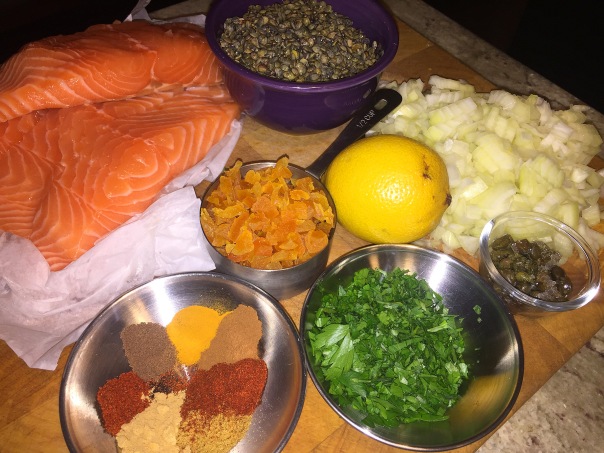
According to award-winning food, nutrition and travel writer, Marge Perry, go to any French bistro, and you’ll likely find a dish of lentils and salmon. It’s a classic for good reason: lean, mellow lentils complement the richness of the fish. Her version, North African Spiced Salmon Over French Lentils, includes a Moroccan-inspired spice rub on the salmon. (Do not substitute other lentils for the French in this recipe.)

The rich peppery flavor of French Green Lentils is due in part to the volcanic soils where they grow. Also known as puy lentils, they were originally grown in Puy, in southwest France. Today they are also grown in Italy and North America, but are still identified as “Puy lentils” or “lentilles du Puy” because of their origins. And while their color is mostly a beautiful slate green, they are marbled with flecks of darker slate blue. If they were stones, I’d love to make jewelry out of them, but I digress…

img_0149

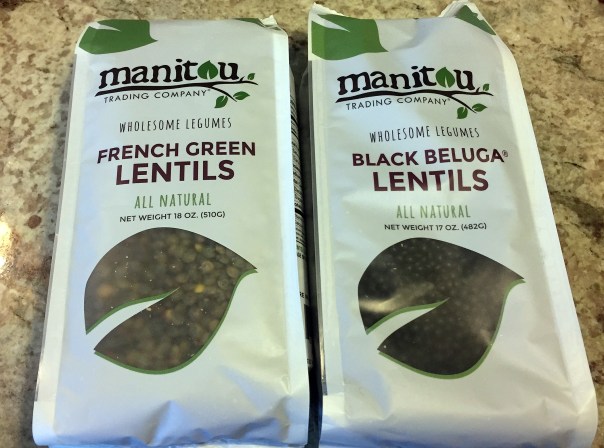
French lentils are not always easy to find. Our main grocery store, which carries a lot of unusual and exotic food items, did not have them; but our local, less upscale supermarket did carry them along with Beluga lentils (which I will blog about in the future.) There’s also a subtle flavor difference with French lentils which have a slightly flinty taste—earthy with a slight mineral edge.

For the full-flavor experience as you eat, flake the salmon into the lentils to better distribute those aromatic spices throughout the dish… then sit back and savor every bite…

img_0238

img_0241
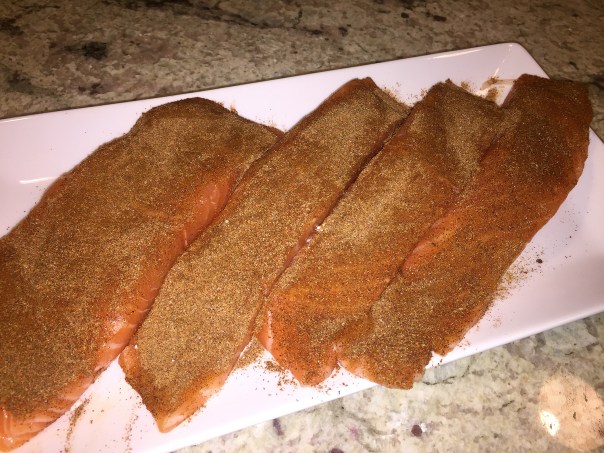
Mix the spices together and rub all over the top flesh side of the salmon.

img_0245
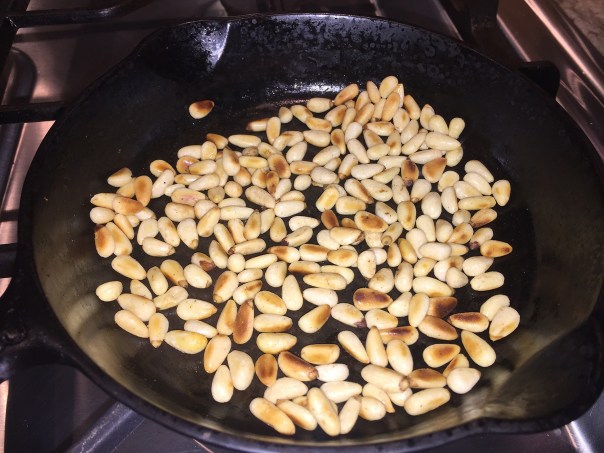
Toast the pine nuts, but watch carefully as they will burn quickly.

Ingredients

  • 1 cup French lentils (lentils du Puy), rinsed
  • 1/3 cup dried apricots, finely diced
  • 2 Tbs. olive oil
  • 1 large onion, chopped (about 2 cups)
  • 1/4 cup chopped fresh flat-leaf parsley; more for serving, if you like
  • 1 Tbs. drained capers
  • 1/2 tsp. finely grated lemon zest
  • 1 Tbs. fresh lemon juice
  • Fine sea salt
  • 1/2 tsp. ground cumin
  • 1/2 tsp. paprika
  • 1/4 tsp. ground cinnamon
  • 1/4 tsp. ground ginger
  • 1/4 tsp. ground turmeric
  • 1/8 tsp. ground allspice
  • 1/8 tsp. cayenne
  • 4 6-oz. salmon fillets, skinless or skin on
  • Lemon wedges, for serving

img_0252
Chopped dried apricots and French lentils simmer for about 35-45 minutes (ours took 37 minutes.)

img_0254
After the onions cook, add the lentils, parsley, capers, lemon zest and juice, and salt…

img_0266
…and stir to combine.

img_0264
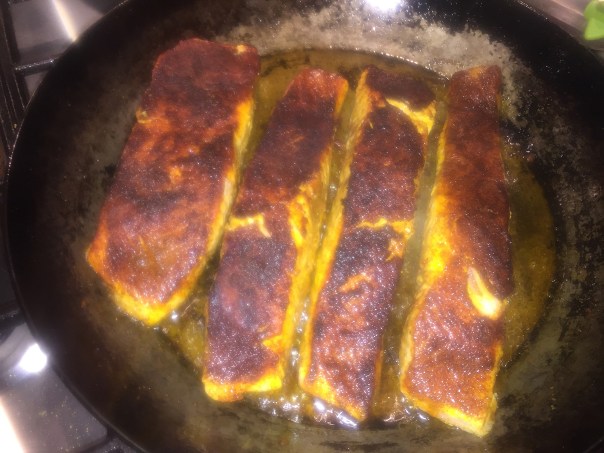
Cook the salmon, flesh side down, until golden brown, 3 to 4 minutes, then flip.

img_0268
Salmon fillets are plated and ready for serving.

Directions

  1. In a 4-quart saucepan, bring the lentils and 3 cups water (see our note below*) to a boil over medium-high heat. Reduce to a simmer, add the apricots, and gently simmer until the lentils are tender but still hold their shape, 35 to 45 minutes. Drain.
  2. Meanwhile, heat 1 Tbs. of the oil in a 12-inch skillet over medium heat. Add the onion and cook, stirring occasionally, until soft and golden, 6 to 8 minutes. Add the lentils, parsley, capers, lemon zest and juice, and 1/4 tsp. salt, and stir to combine. Keep warm over low heat.
  3. Combine the cumin, paprika, cinnamon, ginger, turmeric, allspice, cayenne, and 1/2 tsp. salt in a small bowl. Pat the spice mix onto the salmon.
  4. Heat the remaining 1 Tbs. oil in another 12-inch nonstick or cast-iron skillet over medium-high heat. Add the salmon, flesh side down, and cook until golden brown, 3 to 4 minutes.
  5. Turn and cook to your liking, another 2 to 3 minutes for salmon that’s barely opaque in the center. Serve the salmon over the lentils, garnished with more parsley, if you like, and with the lemon wedges.

FYI—The directions indicate to simply cook the lentils in water*, because a number of other additional ingredients will lend a variety of flavor nuances. But if making them alone, I learned from another favorite cookbook author, Dorie Greenspan to cook in plenty of homemade stock with one lone clove, a bay leaf, and a bit of Cognac. These few ingredients make all of the difference in the world because the flavors are so much deeper and more pronounced, the one little clove will add warmth, the stock a meatiness, and the Cognac a bit of richness that you don’t often find in legumes.

img_0256
And keep your eyes peeled for an upcoming blog on our side salad: Orange, Pear, and Date Salad with Orange-Rosemary Vinaigrette… (unfortunately my camera lens was fogged and many of the pictures are not crisp 😦

The Six Most Common Types of Lentils

Yellow and Red

Cook time: 20 to 25 minutes
Small split lentils with a tendency to break down during cooking. Great for making thick soups or dal, an Indian lentil stew usually served with rice.

Green

Cook time: 20 to 30 minutes
Widely available, large, and mild in flavor, these cook quickly, making them a good choice for a simple side dish. Just toss with fresh herbs, oil, and vinegar.

Brown

Cook time: 20 to 30 minutes
The most common variety sold in the United States. Large and rich, but prone to mushiness. Stir into a vegetable stew to add protein and thickness.

Black (Beluga)

Cook time: 30 to 40 minutes
Like caviar (hence the name), these are small and nearly spherical, with a firm texture that makes them a great addition to cold or warm salads.

French (du Puy)

Cook time: 40 to 45 minutes
Small and dark green, with a deep, earthy flavor. They take longer to cook but retain their shape, making them a fine upgrade for classic lentil soup—and this recipe!

Goulash or Stew? Does It Really Matter?

Not too long ago, I wrote about the differences between cooking a meal in your choice of a pressure cooker for a real quick turn around, or a slow cooker which obviously takes much longer but produces the same luscious results. This Short Rib Goulash is another one in the series written about in the January issue of Better Homes & Garden Magazine.

img_0076

There’s stew and then there’s its amazing cousin: goulash. Technique-wise, there’s not a huge difference between goulash and other beef stews. Traditional goulash is a stew/soup, usually using a cheaper cut of meat suited to slow cooking. It usually contains potatoes and other vegetables, as well as noodles.

Ask a bunch of people what a goulash is—and you’ll get as many different answers: a soup, a stew, a meat dish served on a plate; brown, red, mild, hot, spicy; made with beef, pork, mutton, game, even vegetarian. Although goulash originated in Hungary, this popular dish later spread beyond its borders, first to the Austrian Empire, Germany, and the Balkans, and finally around the world. That’s why there are so many versions of goulash today. Paprika seems to be the one undisputed staple that must be included.

img_0046
The night prior, I seared the ribs and let them cool before storing in the refrigerator.

In almost all cases, you want to make sure to sear the short ribs first, which allows them to brown more efficiently, giving the goulash more flavor while also ensuring that the meat stays very tender. They will emerge from the cooker fork-tender and bathed in a gravy punched with flavor from butternut squash and a healthy dollop of horseradish. Doesn’t that sound heavenly on a cold winter’s night?

This recipe takes quite a bit longer than the Salmon with Lentil Hash and Bacon dish using either method, so keep that in mind. That falling-off-the-bone goodness is known territory for the slow cooker, but the pressure cooker cranks out the same delectable goulash in a half hour at pressure—giving you enough time to cook your noodles.

Because the slow method takes 12 hours and I could leave it get happy all day while we were at work, we chose the slow cooker again as opposed to the pressure cooker. But I did much of the prep the night before.

img_0064
We used a gluten-free fettuccine, but you could also serve over egg noodles or polenta.

We were about a pound shy of the ribs and a half-pound over on the squash. After dinner, I suggested we make a quick soup out of the leftover butternut and beef broth. So Russ heated up a cup and half of the broth in the same pot we cooked the noodles, then added the already tender squash and used an immersion blender to make a very tasty, creamy soup. Instant lunch!

Total Time (includes hands-on prep)—
Slow Cooker: 
10 hrs 30 mins to 12 hrs 30 mins (low); or 5 hr 30 min to 6 hr 30 min (high)
Pressure Cooker: 1 hr, plus time to build and release pressure 

img_0045

Ingredients

  • bone-in beef short ribs (3 3/4 to 4 1/2 pounds total), trimmed
  • tablespoon paprika
  • teaspoons kosher salt
  • 1/4 teaspoon freshly ground black pepper
  • tablespoons olive oil
  • pounds butternut squash, and/or rutabaga, peeled, seeded, and cut into 2-inch cubes (about 4 cups)
  • 1/2 cup beef broth (preferably homemade)
  • 1/2 cup dry red wine
  • tablespoons soy sauce
  • cloves garlic, minced
  • teaspoon dried thyme, crushed
  • tablespoons tomato paste
  • tablespoons prepared horseradish
  • Hot cooked noodles (we used gluten-free fettuccine noodles)
  • Fresh thyme

img_0058
After prepping most of the ingredients the night before, I put everything in the slow cooker before leaving for work, and turned it on low.

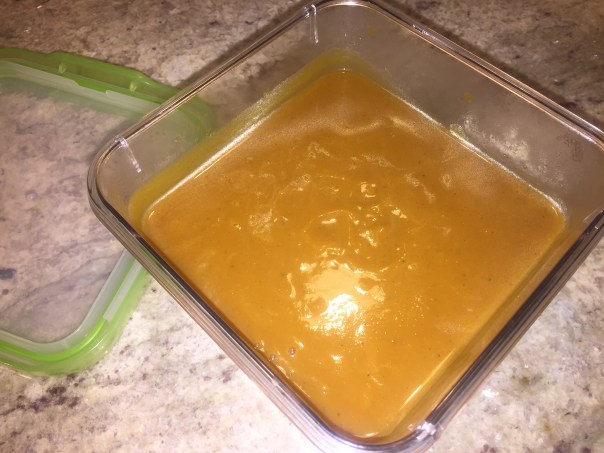
img_0071After I got home from work, I removed the meet and squash to a covered dish and poured the sauce into a gravy separator.

img_0066
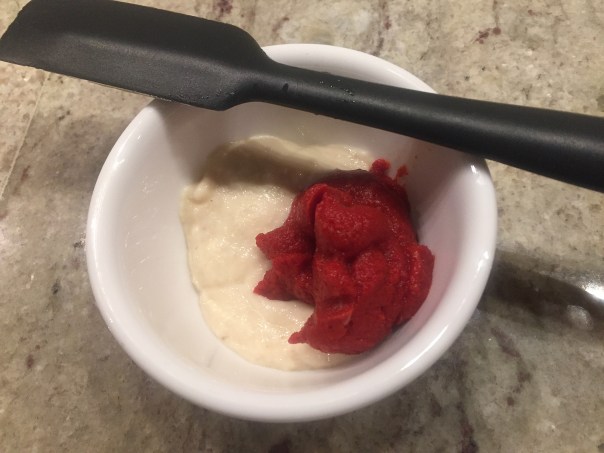
Horseradish sauce and tomato paste are measured out….

img_0073
…then whisked into the strained liquids.

Directions

  1. SLOW COOKER: Season ribs with paprika, salt, and black pepper. In a very large skillet, brown meat in hot oil over medium-high heat or until well browned, turning occasionally (or use slow cooker browning function).
  2. Transfer to 6-qt. slow cooker. Add squash, broth, wine, soy sauce, garlic, and dried thyme. Cover; cook on low 10 to 12 hours or high 5 to 6 hours.
  3. Remove ribs and vegetables to a serving dish. Skim fat from cooking liquid. (I found using a gravy separator makes it an easy task.) Whisk in tomato paste and horseradish. Serve sauce with ribs and noodles. Top with fresh thyme.
  1. PRESSURE COOKER: Season the ribs with paprika, salt, and black pepper. For a 6-qt. electric cooker, use saute setting to brown ribs, half at a time, in hot oil. For a 6-qt. stove-top cooker, brown meat, half at a time, in hot oil in cooker.
  2. Return all meat to cooker. Add squash, broth, wine, soy sauce, garlic, and thyme. Lock lid.
  3. Set electric cooker on high pressure to cook 30 minutes. For stove-top cooker, bring up to pressure over medium-high heat according to manufacturer’s directions; reduce heat enough to maintain steady (but not excessive) pressure. Cook 30 minutes.
  4. Remove from heat. Let stand to release pressure naturally, at least 15 minutes. Open lid carefully.
  5. Transfer ribs and vegetables to serving dish. Skim fat from cooking liquid. Whisk in tomato paste and horseradish. Serve sauce with ribs and noodles. Top with fresh thyme.

img_0082
We had quite a bit of leftover cooked butternut squash so we made a quick creamy soup with more beef broth using an immersion blender.

Heaven on a Plate

There is just nothing better on a cold Winter’s day than dining on a sumptuous braised chicken dish. Enter Molly Stevens, one of our all-time favorite cookbook authors. This recipe, Whole Chicken Braised with Pears and Rosemary, is from her All About Braising cookbook, practically a bible in our kitchen.

It’s a lovely alternative to roast chicken. Even better, in fact, because the chicken makes its own pear-and-rosemary-scented sauce as it braises. The secret is stuffing a quartered pear and a few branches of rosemary into the cavity before braising. As the chicken simmers to tenderness, the pear juices flow into the meat, embellishing it with a subtle sweetness.

The pear-enriched chicken drippings mingle with the braising liquid to create a complex sauce with a hint of fruit and a whiff of rosemary. You will be drooling before the meal is even plated. Russ made the comment “The sauce is so good I could drink it straight!”

Yes, it is a bit prep-intensive and the braising time is 1 1/4 hours, then you have to finish the sauce, so it’s not a quick weeknight meal, but oh my, your family will be thanking you for having served them heaven on a plate!

img_0152
Russ cut off the wings so that it would be easier to brown all over.

img_0156
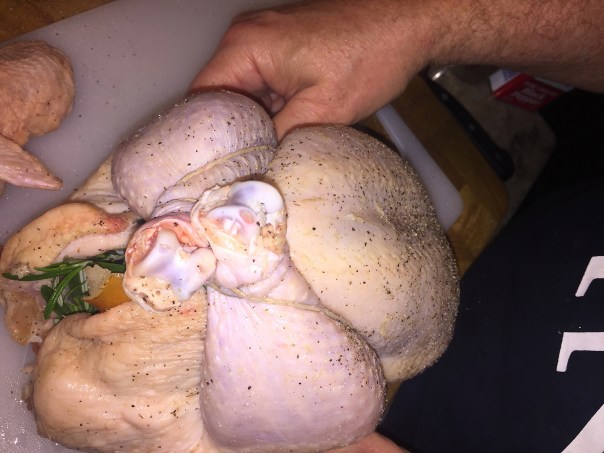
After the chicken is seasoned with salt and pepper inside and out, stuff the cavity with pears and rosemary.

img_0160
The stuffed bird is now trussed according to directions.

img_0161
Once the bird is all tied up it’s ready to be seared in the braising pot.

img_0166
Start searing the bird on it’s breast side for 4 minutes.

img_0171
Turn the chicken every four minutes or so to get a nice brown color on all sides.

img_0173
After the bird is seared, remove it to a plate and sear the wings, gizzard and neck.

Whole Chicken Braised with Pears and Rosemary

  • Servings: 4-6
  • Difficulty: moderate
  • Print

The Braise

  • One 3 3/4 to 4 1/4 pound chicken
  • Coarse salt and freshly ground black pepper
  • 1 just-ripe Bosc pear
  • 3 leafy fresh rosemary sprigs
  • 2 tablespoons unsalted butter
  • 1 tablespoon extra-virgin olive oil
  • 1 1/3 cups finely chopped leek, white and pale green parts only
  • 1/4 cup finely chopped shallots (2 medium)
  • 1/4 cup dry white wine or dry white vermouth
  • 1/2 cup chicken stock, preferably homemade
  • 1 tablespoon white wine vinegar

img_0183
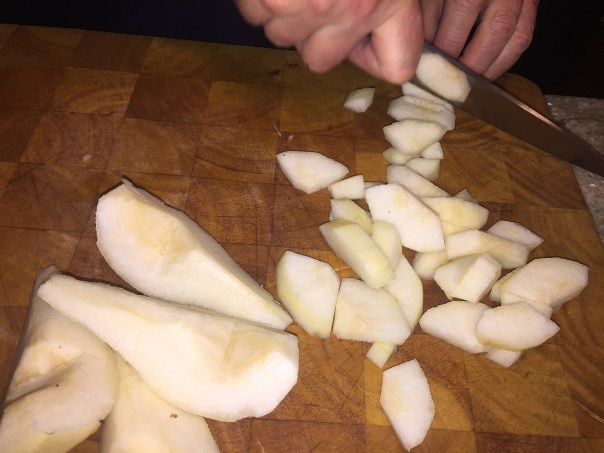
Peel and core 2 ripe, but firm bosc pears; quarter and slice into 1/2″ thick pieces.

img_0188
The pears cook in butter in a sauté pan then sugar, rosemary, salt and pepper are added.

img_0190
The pears are checked for doneness with a sharp knife.

img_0194
Once the pears are caramelized, add the balsamic vinegar.

The Pear Garnish

  • 2 just-ripe Bosc pears
  • 2 tablespoons unsalted butter
  • 2 teaspoons sugar
  • 1 teaspoon finely chopped fresh rosemary
  • Coarse salt and freshly ground black pepper
  • 1 tablespoon balsamic vinegar

img_0169
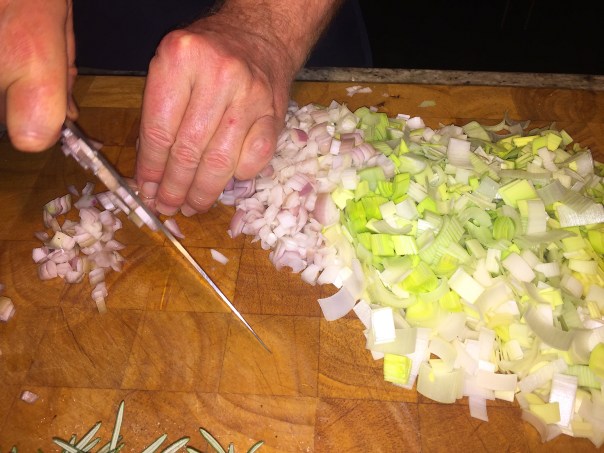
Dice the shallots and leeks.

img_0175
Add more butter to the pot and toss in the leeks and shallots.

img_0176A rosemary sprig is also added to the sautéing veggies.

img_0177
Place the chicken on top of the vegetables, breast side up, and pour in any juices that seeped onto the plate where it rested.

Directions

  1. Heat the over to 300 degrees.
  2. Rinse inside and out with cool water and dry completely. Season inside and out with salt and pepper. Cut the pear (unpeeled and uncored) into quarters and stuff into the cavity. Slide two rosemary springs alongside the pear.
  3. Truss the chicken with kitchen string: Loop the middle of the string around the ends of the two drumsticks to pull them together. Next, bring the ends of the string back alone the sides of the chicken, running the string between the leg and the breast on both sides, then turn the chicken over and snag the string over the base of the neck. Knot the string securely and trim off the string close to the knot.
  4. Heat 1 tablespoon of the butter and the oil in a medium Dutch oven. Pat the surface of the chicken dry again (the drier it is, the better it will brown and not stick to the surface.) Gently lover the chicken, breast side down into the hot pan.
  5. Brown the chicken without disturbing it for about 4 minutes, then nudge one side with a wooden spoon and peek to see whether the skin has developed a deep brown color. When it has, maneuver the chicken onto one side and continue cooking on each side until all four sides are are an appealing roasted brown color, 12 to 18 minutes total. Lift the chicken and set it aside on a large plate.
  6. Pour off all the fat from the pot and discard. With a damp paper towel, wipe out any burnt specks from the bottom of the pan, being careful to leave behind all the delicious caramelized bits. Return the pot to medium heat and add the remaining tablespoon of butter.
  7. Add the leek, shallots, and remaining rosemary sprig, season with salt and pepper, and sauté, stirring occasionally with a wooden spoon for about 7 minutes. Pour in the wine, raise the heat to medium-high, and boil, stirring until the wine is reduced by half, about 1-2 minutes. Add the stock and white wine vinegar, and boil for 2 more minutes to meld the flavors.
  8. Place the chicken on top of the vegetables, breast side up, and pour in any juices that seeped onto the plate where it rested. Set a tight-fitting lid in place. Slide the pot into the lower third of the oven. Braise, basting every 20 minutes with a large spoon, until an instant read thermometer reads 170 degrees when inserted between the breast and the thigh, about and hour and fifteen minutes.
  9. Meanwhile, prepare the pear garnish. Peel the pears, cut them into quarters, remove the cores, and then cut each quarter crosswise into 1/2 inch thick slices. Heat the butter in a large skillet over high heat. Add the pears and toss to coat with the butter.
  10. Add the sugar, rosemary, and salt and pepper to taste. Saute briskly, shaking the skillet and turning the pears frequently, until they begin to caramelize on all surfaces, about 5 minutes. Add the balsamic vinegar and continue to shake and stir until the vinegar has reduced to a glaze that coats the pears, barely 30 seconds. Transfer to a large plate, spreading them out so they will stop cooking and do not steam and become mushy while you finish the sauce.
  11. Remove the chicken from the pot by spearing a meat fork into the cavity, tipping the chicken toward you so that the juices run back into the pot, and lifting gently, and set the chicken on a carving board. Tent with foil to keep warm.
  12. Strain the braising liquid into a small saucepan, pressing down lightly on the vegetables, to extract as much liquid as you can. Discard the vegetables. Using a wide metal spoon, skim the clear surface fat from the sauce. Set the sauce over medium-high heat and bring to a gentle boil. Simmer the sauce to concentrate the flavor and give it some body, about 6 minutes. The sauce should be the consistency of a thick vinaigrette. Taste for salt and pepper. Add the pear garnish to the sauce to warm through.
  13. Carve the chicken and spoon some sauce and pears over each serving.

img_0205
Remove the chicken from the pot by spearing a meat fork into the cavity, tipping the chicken toward you so that the juices run back into the pot.

img_0208
Strain the braising liquid into a small saucepan, pressing down lightly on the vegetables.

img_0218
Discard the vegetables. Set the sauce over medium-high heat and bring to a gentle boil.

img_0235
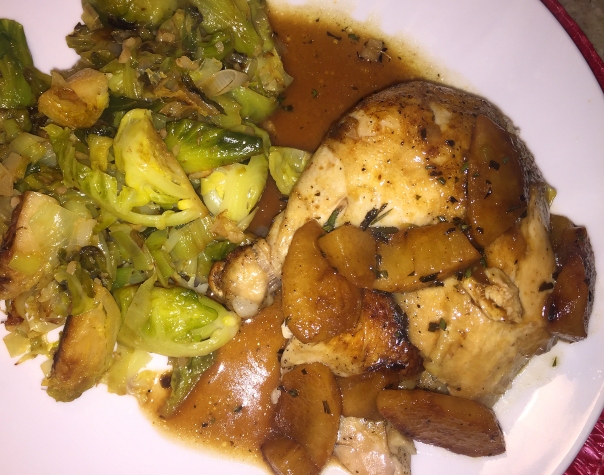
Carve the chicken and spoon some sauce and pears over each serving, and plate with your favorite sides.

http://www.lynnandruss.com

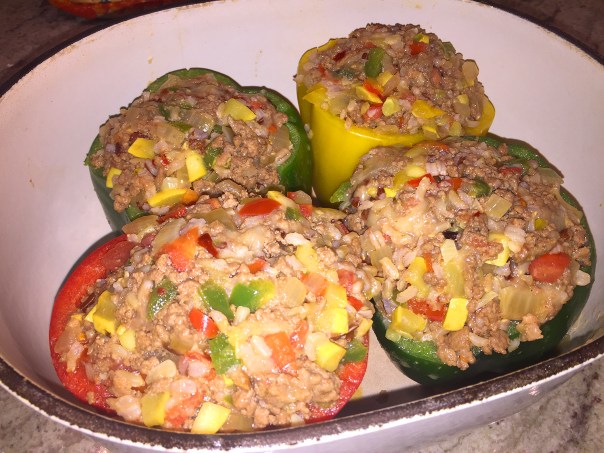
Confetti Stuffed Peppers

Loaded with a lot of good-for-ya veggies, these Confetti Stuffed Peppers pack a tasty punch. Over the years, I’ve made all kinds of stuffed peppers. Sometimes I’d cut the pepper in half and mound the raw meat and rice mixture directly into the shell without precooking the ingredients. But that approach can be hit or miss when it comes to perfectly cooking the rice.

A bit of back story. I planned having a night off from cooking because we’d purchased some promising looking pre-made stuffed peppers at Costco the previous Saturday. Apparently the Food Gods had other ideas though, because on Sunday morning when I went downstairs, what do you think I found sitting atop the china closet?? Seems hubby put the package up there “temporarily” while he opened the basement door to tote groceries to the downstairs fridge, then totally forgot about them. Urrrgghh….

Believe me, we had some discussion about the feasibility of still serving them for dinner, but realizing they’d been sitting out for over 16 hours, we grudgingly came to our senses. With thoughts of agonizing stomach torture, or even a possible trip to the ER, our health meant a lot more than saving $15! (Did we really even give it a second thought?) So out in the trash they went, and onto the grocery list went the ingredients to make them from scratch.

img_0051

Let’s face it, there are as many ways to make stuffed peppers as there are to make meatloaf. But if, like us, you try to get in as many vegetables when preparing a meal, this recipe checks a lot of boxes.

Then there’s the debate about which rice to use, white or brown? There are pluses and minuses to each. The upside is, brown rice, unlike white rice, still has the side hull and bran. Other facts:

The Good—

  • Brown rice has more micronutrients: magnesium, phosphorus, and potassium. It also has a lot of manganese, selenium, and copper.
  • Brown rice has a lower glycemic index than white rice.
  • The fiber content of brown rice keeps bowel function at it’s peak since it makes digestion that much easier.

The Bad—

  • Brown rice has 43 more calories per cup than white rice.
  • Brown rice has 7g more carbohydrates per cup than white rice.

The Ugly—

  • That would only pertain to those who have a rice allergy…

Alright, the rice choice is totally up to you and those who will be eating the stuffed peppers.

To make the meal more weeknight-friendly, I made the recipe on a Sunday afternoon up to the first line of Step 7, and then refrigerated them over night. It sure made for an easy dinner prep the next day. And because I had 1 1/2 cups of tomato puree leftover from another dinner, I mixed it with a small 8 ounce can of tomato sauce. Waste not, want not, right?

We did have nearly one cup of the meat mixture leftover after stuffing the peppers, so we just divvied it up between the two of us as a little snack while we were preparing other meals. Keep in mind, if you can’t buy large peppers, purchase 5 or 6 medium to small ones, otherwise you’ll have a lot of stuffing with no where to put it!

Enjoy!

img_0007

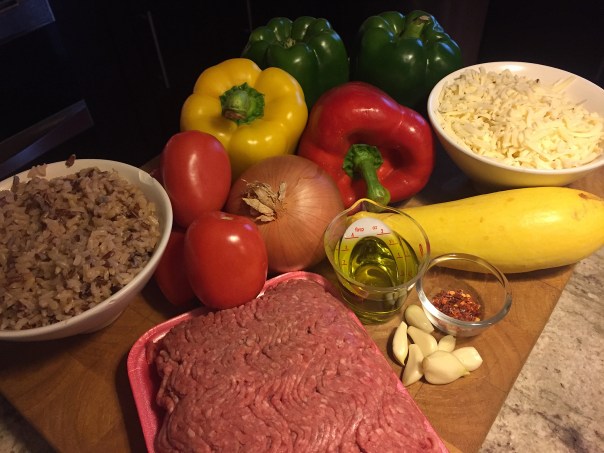
Ingredients

  • 1 1/2 pounds lean ground beef or turkey
  • 4 large bell peppers, a mix of colors
  • 4 tablespoons olive oil
  • Kosher salt and freshly ground black pepper
  • 4 cloves garlic, finely minced
  • 1 onion, finely diced
  • 1 medium zucchini or summer squash, finely diced
  • 4 plum tomatoes, seeded and finely diced
  • 1/2 teaspoon red pepper flakes, more to taste
  • 1 1/2 cups cooked brown or white long grain rice
  • 2 cups tomato sauce, more to taste
  • 1 1/2 cups grated pepper Jack cheese

img_0014
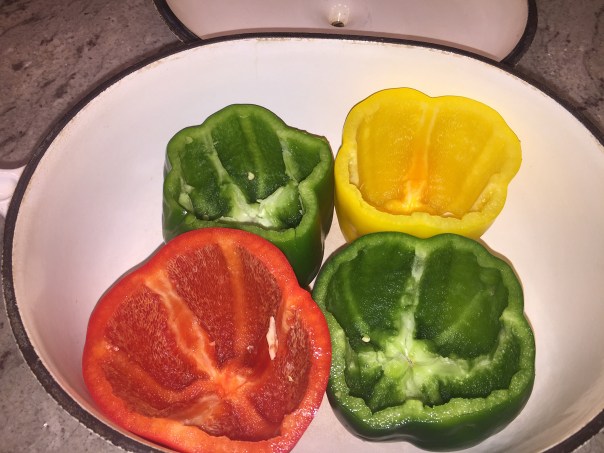
Slice off the top of the peppers and remove the stem. Finely dice the tops.

img_0015
Place peppers in a pot that is high enough and roomy enough to fit them snugly.

img_0018
After your ground meat is browned, place onto a paper towel-lined plate to remove any excess fat.

img_0019
Wipe out the skillet and add the remaining olive oil. Add the onions and chopped peppers and cook until beginning to soften.

img_0020
Next, add the garlic and zucchini/squash and cook for another minute.

img_0021
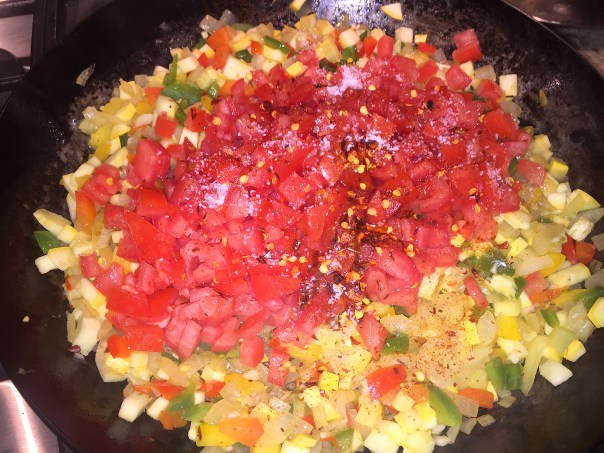
Next toss in the diced tomatoes and season with salt and red pepper flakes. Cook until everything is heated through.

img_0022
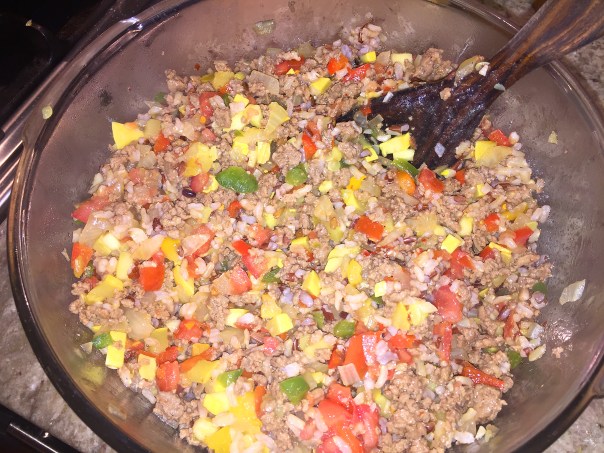
In a large mixing bowl, add the cooked veggies, meat and rice, and stir in 1 cup of the cheese.

img_0025
Pack the mixture into the pepper shells and mound the top.

img_0049
Before you top with tomato sauce and put back in the oven, siphon the moisture out of the bottom of the pot.

Directions

  1. Preheat the oven to 350 degrees F.
  2. Cut the tops off the peppers. Remove and discard the stems, then finely chop the tops; set aside. Scoop out the seeds and as much of the membrane as you can. In a baking dish large enough to hold them upright, place the peppers in cut-side up.
  3. Heat 2 tablespoons of the olive oil in a large skillet over medium-high heat. Add the meat, season with salt and pepper and cook, breaking up the lumps, until it is cooked through and just beginning to brown, 8 to 10 minutes. Remove as much fat from the pan, then transfer the meat to a paper towel-lined plate to get rid of the remaining fat.
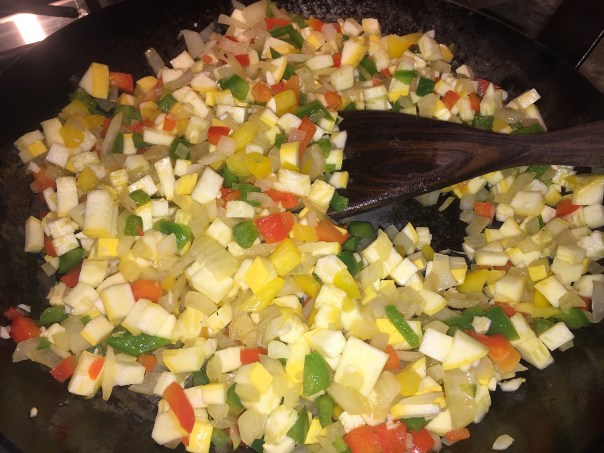
  4. Wipe out the skillet and add the remaining 2 tablespoons olive oil. Add the onions and chopped peppers and cook until beginning to soften, 3 to 4 minutes. Add the garlic and zucchini/squash and cook for another minute.
  5. Add the diced tomatoes and season with salt and red pepper flakes. Cook until everything is heated through.
  6. In a large mixing bowl, add the cooked veggies, then stir in the meat and rice. Taste and adjust the seasoning. Stir in 1 cup of the cheese.
  7. Fill the peppers with the rice mixture. Pour a small amount of water into the bottom of the baking dish. Cover with foil and bake for 30 minutes. (If you refrigerated overnight, cook for 45 minutes.)
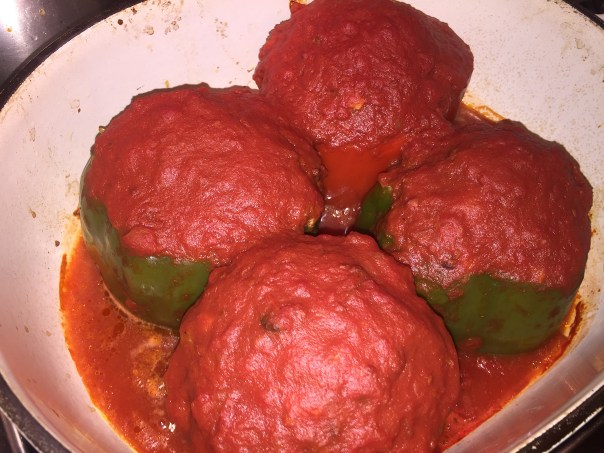
  8. Uncover, siphon out the moisture from the bottom of the pot, pour tomato sauce over the peppers and cook for another 15 minutes, then top each with a sprinkle of the remaining 1/2 cup cheese. Bake until the peppers are soft and the cheese is melted and lightly browned, another 10 minutes or so.
  9. Serve in shallow bowls and top with more tomato sauce from the bottom of the pot, if desired.

img_0053
After placing a pepper in the bowl, top with more tomato sauce.

img_0056
Sliced open, the meat and veggie mixture falls out with the oozy cheese.

The Brick is Back? Not Sure…

Originally built in 1763, The Brick Hotel is a beautiful restaurant, bar, and 15-room quaint inn with a Victorian era ambience. The main dining areas are encircled with a glass enclosed porch with very desirable seating as it wraps around and overlooks historic Newtown and their garden, where diners can sit and enjoy the outdoor view. Very charming—at least at one point in time.

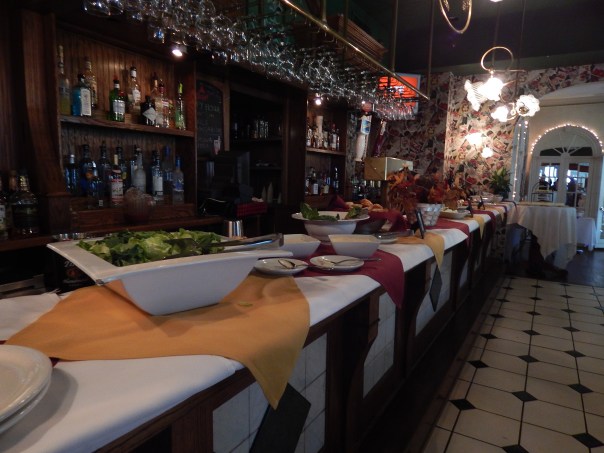
Once a popular destination, The Brick denigrated down to a Trip Advisor’s rating of only 2.5. And we can attest to that. In October 2014, Russ, his son Daniel and I went for a Sunday brunch which is supposed to last until 2:00. We arrived at 12:30 and the offerings were all but gone and were not replenished for the duration of the brunch! At $27 per head, it was inexcusable. It was obvious, the aging inn was struggling to maintain the polish for which it was once revered.

bartop
The cold buffet offerings are spread out on the bar…

beef-station
…while the hot food is across the way. You can see there were pretty slim pickins.

roast-beef-potatoes2
A sample of the hot offerings that were scraped together.

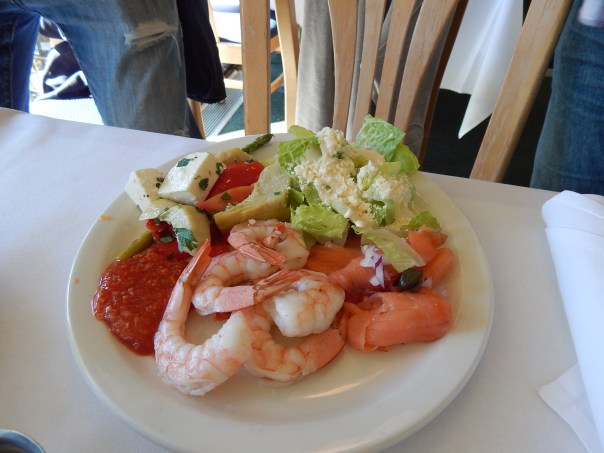
shrimp-salmon
And morsels from the cold buffet.

french-toast-cannoli
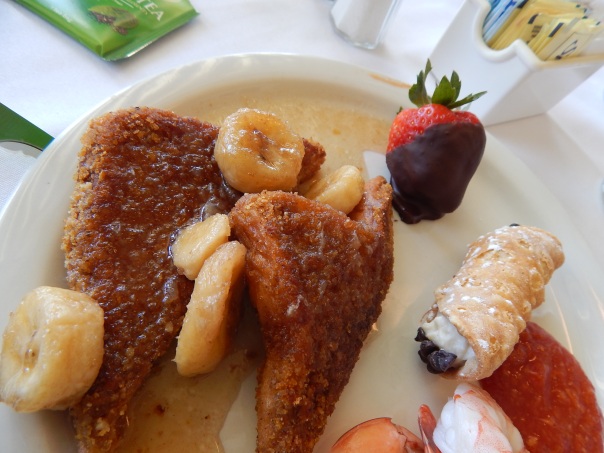
Daniel and Russ even found room for dessert.

In November 2015, infamous British culinary and hospitality expert Gordon Ramsay took on The Brick in Fox TV’s Hotel Hell. After revamping the menu and addressing hygiene issues, he and his team gave the walls and furniture a sleek remodeling with a palette of classy shades of grey. Now renovated with a trendy entrance area, The Brick still has many features from the seventeen hundreds still intact, such as the first-floor staircase.

ramseystaff-1ec5207b
Gordon Ramsay instructs the waitstaff on the new menu.

brickhotelinterior
The foyer with the famous revamped staircase.

But our first visit back in quite some time, even before the brunch episode, was the Thursday evening before Labor Day weekend 2014. We made it just in time for the end of their happy hour. The fact that hardly anyone was around, either inside or out, was an indication of the Brick’s slow demise—although we didn’t know it at the time.

2014-08-28-07-13-37
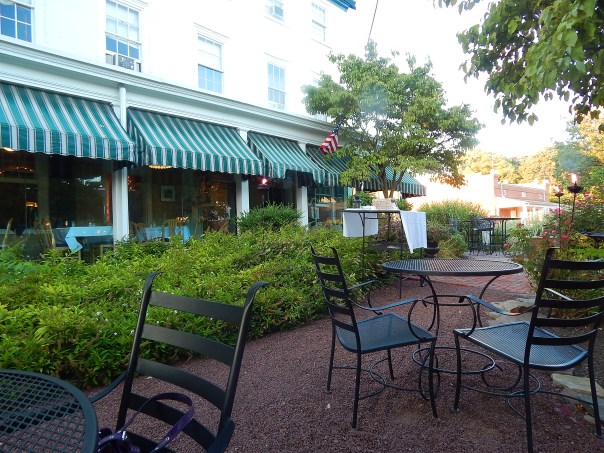
Our view from the garden during happy hour back in August 2014. It’s apparent that there were few, if any, other patrons. Our much younger waitress kept calling us “you’s lovebirds.”

2014-08-28-07-36-20
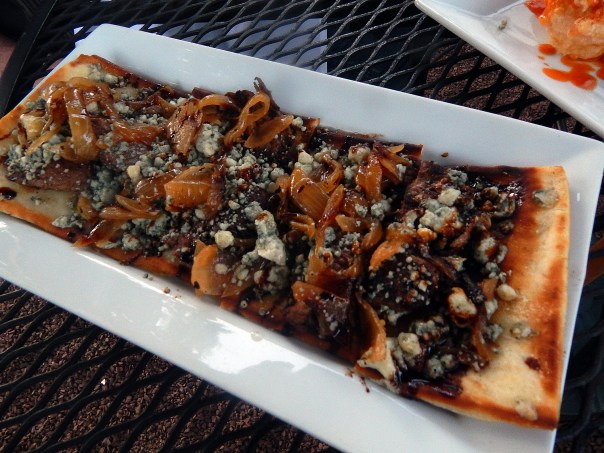
We shared the dinner menu appetizer Black & Blue grilled flatbread with blackened steak, crumbled bleu cheese and caramelized onions. 

2014-08-28-07-35-52
We also shared a Happy Hour Special called Buffalo Shrimp with a trio of battered crispy tiger shrimp, garlic buffalo sauce, bleu cheese slaw and remoulade. 

Even though recent Trip Advisor reviews are still complaining about the shabby hotel accommodations, we were ready to give it another chance, this time for dinner on a Saturday night. Let’s just say it wasn’t a promising start! Entering into that large revamped foyer, no one was manning the hostess station, so Russ ventured into the bar area, but again nobody there…

He finally caught sight of someone in the kitchen and got her attention (although Russ swore she was trying to vanish). She asked us if we had reservations—are you kidding me??—there were only two other occupied tables on the wrap around porch, and no one else in sight! Finally seated and with menus in hand, we selected a bottle of wine then set about deciding what to order—if not a bit fearfully.

img_9860
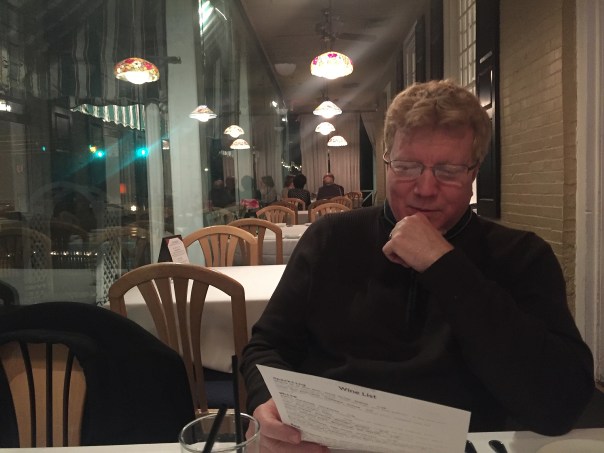
Russ reviews the menu in the all-but-empty wraparound porch.

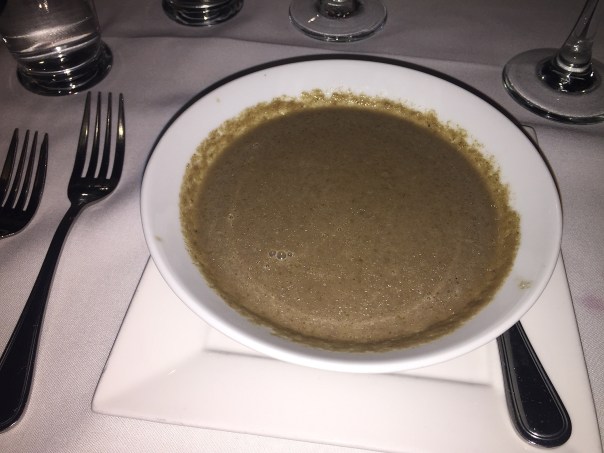
The Sherry Infused Wild Mushroom Soup appealed to both of us as a starter, and it was delicious! Russ chose the New York Strip, medium rare, drizzled wth a demi-glaze that came plated over a mound of risotto and wilted spinach. He had no complaints.

img_9863
The not very exciting to look at mushroom soup, that tasted superb.

img_9868
Russ’s New York strip came pre-sliced.

My entree, Center Cut Pork Chops (something I usually never order when I’m out, so I don’t know what possessed me) arrived over a bed of roasted baby potatoes, sautéd brussels sprouts, and sweet and spicy apples. The accompaniments were probably some of the best I’ve ever eaten, so moist, tender and full of flavor. The chops on the other hand, were dry and overdone, a real disappointment.

img_9866
Lynn’s pork chop dish looked great, but the meat was dry and overdone.

In the past couple of years, we have had their bar menu in the garden; their Sunday brunch and Saturday dinner, both on the wrap-around porch. It hasn’t exactly been “three strikes your out” but I imagine if things don’t improve and patron traffic increase, The Brick Hotel will definitely be history—literally…

Brussels Sprouts with Oranges and Bacon

Vegetable Side Dish Blog #3—
A final wrap-up to veggie side dishes for a spell…

Wondering what veggie dish to accompany our leg of lamb dinner, I recalled a Brussels sprouts side dish that Russ made years ago with orange juice and shallots. In his search to find that recipe, he came across this intriguing version from Martha Stewart. And the beauty of it was we had some blood oranges on hand, and you know how I adore blood oranges!

img_0035

When we buy brussels sprouts, we tend to get them still on the stalk if possible. This way we can cut off what we want, and the remaining sprouts stay fresher until we need more. Our latest stalk carried ginormous, almost baseball-size sprouts on the lower end!

sprouts-on-stalk
This stalk had nearly baseball size sprouts at one end!

However, there’s a BIG BUT here. A quick glance at the directions and one could see that roasting 1/2 inch pieces of bacon in a 425 degree oven for about 45 minutes, and thin slices of orange for over an hour—would result in a charred black mess! C’mon Martha, you can do better than that.

Actually, it was probably the editor’s who mistakenly left out the fact that you have to REMOVE the oranges and the bacon after so many minutes and then return them to the pan near the end. Our directions will reflect this.

I must admit, the combination of sweet orange, lightly smoky bacon, and caramelized brussels sprouts is absolutely addictive, if they’re cooked properly. So follow our updated instructions. Note, you can eat the orange rinds, which have a bit of a bitter taste. I personally like them, but you may not, so just cut the flesh away from the rind. Make sure to start with thin-skinned oranges.

Ingredients

  • 1/3 cup extra-virgin olive oil, plus more for brushing
  • 2 small, thin-skinned oranges (blood oranges if you can get them), cut in half, then into 1⁄2-inch slices
  • Kosher salt
  • 3 to 4 strips thick-cut bacon, cut into 1⁄4-inch pieces (1 cup)
  • 1 1/2 pounds brussels sprouts, trimmed and halved

img_0030
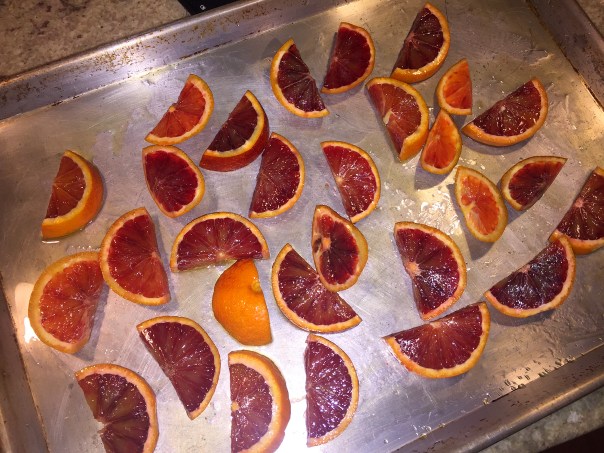
Add oranges, in a single layer, on an oil rubbed rimed baking sheet, turning the slices to coat. Season with salt and drizzle with more oil.

img_0031
After 15 minutes or so when the slices start to char, transfer the oranges from the oven to a plate or bowl.

img_0032Next, roast the bacon on the same baking sheet for about 12 minutes then transfer to the plate with oranges.

img_0029
Toss Brussels sprout halves with the remaining oil, and season with salt.

img_0035
All of the ingredients are roasted together for a final 5 minutes.

Directions (see our comments above)

  1. Preheat oven to 425 degrees. Brush a rimmed baking sheet generously with oil. Add oranges, in a single layer, turning to coat. Season with salt and drizzle with one tablespoon oil; roast 15-18 minutes. Remove the slices to a plate.

  2. Add bacon and roast until crisp, about 12 minutes. Remove the bacon to the plate with the oranges.

  3. Toss brussels sprouts with remaining 4 tablespoons oil; season with salt. Add to baking sheet; toss to combine. Roast, tossing once, until sprouts are tender and browning at edges.

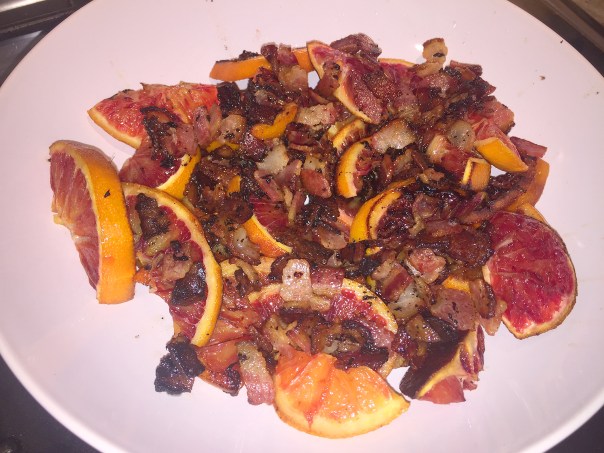
  4. Add back the oranges and bacon with the sprouts and roast another 5 minutes.

According to Martha, if you take the time to separate a few of the sprouts into leaves, you will be rewarded with crunchy, almost burnt bits along with the softer caramelized sprouts. You may find you want to make a whole tray of them.

img_0040The colors alone make you eat with your eyes.

Two Simple Sumptuous Sides

Vegetable Side Dish Blog #2—
While I’m on the topic of veggie side dishes, I’m going to continue blogging in that vein for a couple of postings. In this particular post you’re getting a twofer (aka two-for-one.)

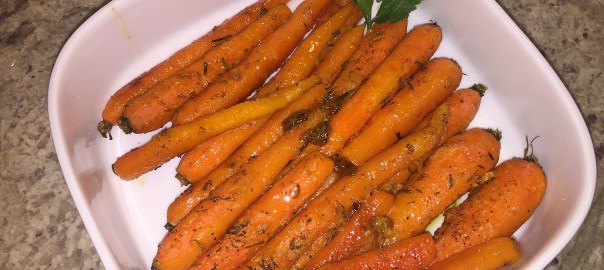
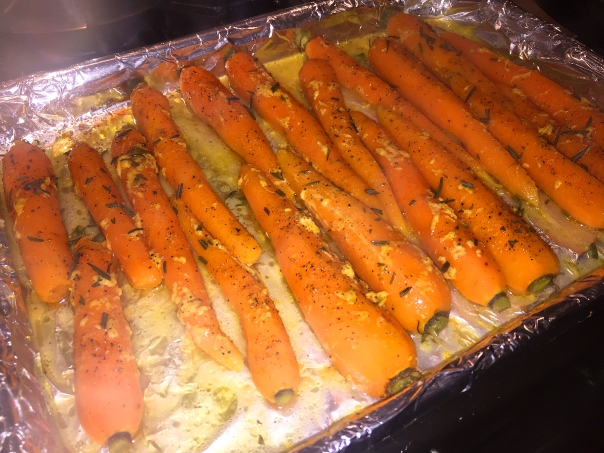
Roasting slender carrots whole gives this easy side dish—Roasted Carrots with Blood Orange and Rosemary—a dressy feel, as does using blood oranges, one of my all-time favorite citrus fruits. We recently served it with Steak Diane and Creamy Mashed Cauliflower.

img_9960

Our carrots were on the heftier side of slender so I roasted them covered in foil for 25 minutes, and after removing the foil, I drizzled the maple syrup all over and cooked for another 25 minutes. Perfect! Although this amount of time may knock it out of contender status for a weeknight.

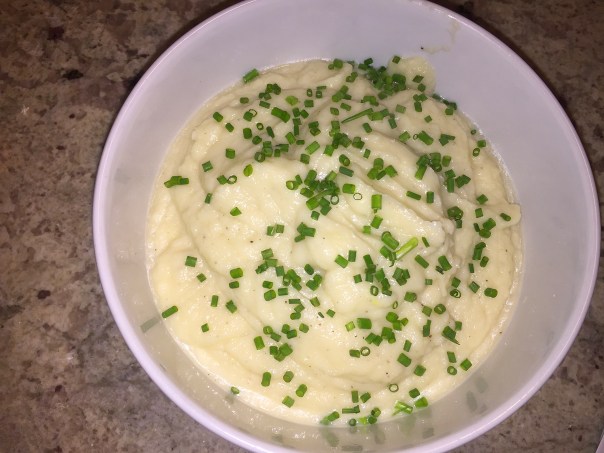
The savory cauliflower puree (recipe follows) makes a perfect low-carb stand-in for mashed potatoes. It gets its fabulous flavor from garlic, buttermilk and a touch of butter and, best of all, it has about one-quarter of the calories of typical mashed potatoes. Next time I will not add the additional olive oil at the end, as I believe it made the dish just a bit too soupy.

img_9952

My bad however, was not steaming the garlic cloves with the cauliflower. In my defense, I actually looked at the recipe several times wondering when the garlic was supposed to be added. I saw it mentioned in Step 2, but actually thought it would make more sense to be steamed with the veggie—and of course that was exactly what was supposed to happen. So our mash had a very green garlic intensity instead of the soft mellow taste had it been steamed. Now you have no excuse…

Roasted Carrots with Blood Orange and Rosemary

img_9924
Buy fresh slender carrots with their greens.

img_9927
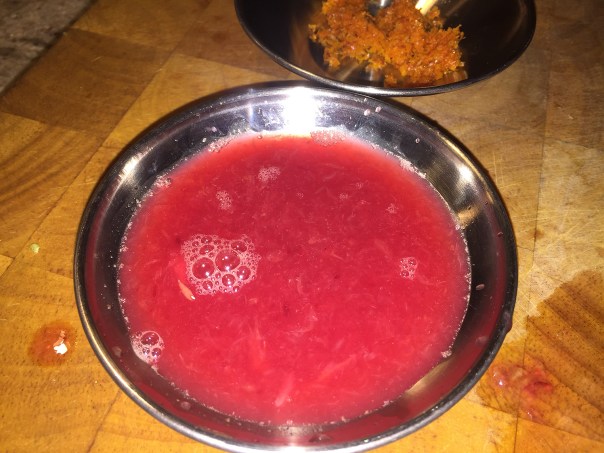
Zest and juice a blood orange.

img_9928
The color of blood orange juice is so vibrant!

Ingredients

  • 1-1/2 lb. slender carrots, peeled and trimmed, leaving a smidge of greens at the top if possible
  • 3 Tbs. extra-virgin olive oil
  • 1 tsp. Dijon mustard
  • 1 medium blood orange or regular orange; zest finely grated and juice squeezed
  • Kosher salt and freshly ground black pepper
  • 1/2 Tbs. fresh rosemary leaves
  • 1 Tbs. pure maple syrup

img_9930
Arrange the peeled carrots in a single layer on a foil-lined rimmed baking sheet.

img_9932
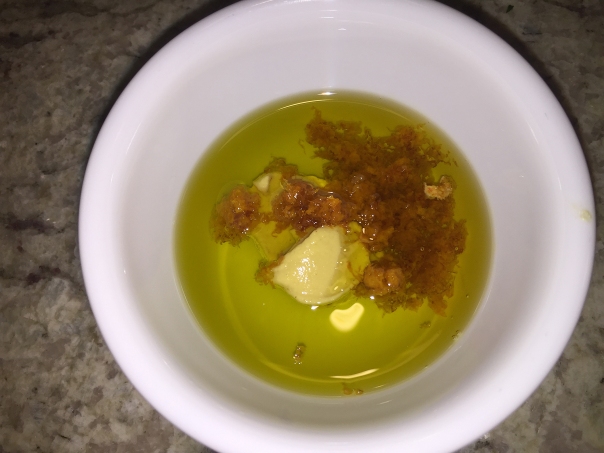
In a small bowl, whisk together the olive oil, mustard, and orange zest.

img_9934
Roll the carrots in the mustard mixture, season with salt and pepper, then pour the orange juice around the carrots.

img_9936
After 20 minutes roasting covered with foil, uncover, drizzle with maple syrup and roast, uncovered, until tender and beginning to brown, 15 to 20 minutes more.

Directions

  1. Heat the oven to 425°F.
  2. Arrange the carrots in a single layer on a foil-lined rimmed baking sheet.
  3. In a small bowl, whisk together the olive oil, mustard, and orange zest. Pour over the carrots and toss to coat. Season generously with salt and pepper.
  4. Pour the orange juice around the carrots. Top with the rosemary. Cover tightly with foil and roast until the carrots are nearly tender, 15 to 20 minutes.
  5. Uncover, drizzle with the maple syrup, and roast, uncovered, until tender and beginning to brown, 15 to 20 minutes more. Gently toss, season to taste with salt, and serve.

Carrot recipe by Laraine Perri from Fine Cooking

Creamy Mashed Cauliflower

img_9951

Ingredients

  • 8 cups bite-size cauliflower florets (about 1 head)
  • 4 cloves garlic, crushed and peeled
  • ⅓ cup nonfat buttermilk
  • 4 teaspoons extra-virgin olive oil, divided
  • 1 teaspoon butter
  • ½ teaspoon salt
  • Freshly ground pepper to taste
  • Snipped fresh chives for garnish

img_9946
Place the cooked cauliflower and garlic in a food processor. Add buttermilk, oil, butter, salt, pepper, and process until smooth and creamy.

Directions

  1. Place cauliflower florets and garlic in a steamer basket over boiling water, cover and steam until very tender, 12 to 15 minutes. (Alternatively, place florets and garlic in a microwave-safe bowl with ¼ cup water, cover and microwave on High for 3 to 5 minutes.)
  2. Place the cooked cauliflower and garlic in a food processor. Add buttermilk, two teaspoons oil, butter, salt and pepper; pulse several times, then process until smooth and creamy. Transfer to a serving bowl. Drizzle with the remaining 2 teaspoons oil (I would omit this step) and garnish with chives, if desired. Serve hot.

Recipe found on EatingWell.com