A Real BOON to Our Vacation

California Bay Area Part 3 of 5—

A few days into our West Coast visit, we drove up to the Russian River Valley in Sonoma County with Russ’s sister Dee and her husband Dave. It was less than a two-hour trip by car, and after about an hour on Highway 101 we exited onto River Road and meandered through towering redwood forests to our destination in the quaint town of Guerneville.

img_7650
Dave checks out the Russian River on one of our excursions.

The area became popular with wealthy vacationers from San Francisco and surrounding communities in the late 19th century. Then the 1960’s marked a period of decline for many of the older resorts. But a renaissance took place in the late 70’s as entrepreneurs from San Francisco identified the area as a prime recreational destination for weekends. And obvious to all, there still are a smattering of leftover aging hippies still stuck in the 70’s!

Our destination was the boon hotel+spa. The location once housed the local miner community, but during the aforementioned 70’s boom, someone bought the land and renovated it into the first generation of the hotel. In April 2008 the current boon hotel+spa was born. While it’s not new modern construction—its using the best of what was already there to preserve the past, yet emphasizing the present—we couldn’t wait to chill in the present for a few days…

img_7700
Our view as we walked under the arched foliage “hallway” from the parking lot into the boon oasis.

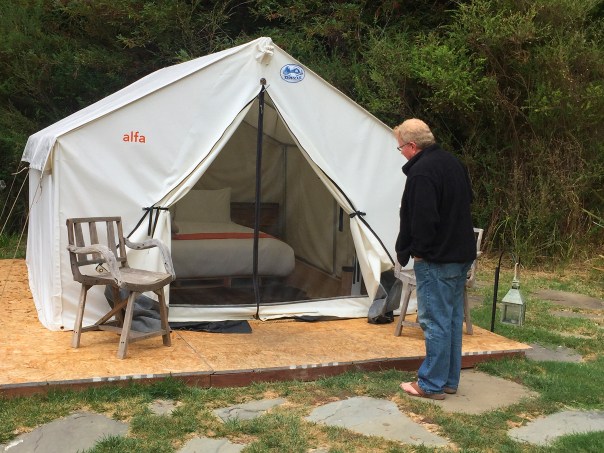
The entrance opens into a courtyard centered around a central saline pool, a hot tub hidden among the foliage and an “honor” bar, all complemented by gray and stark white décor with bright orange accents. Fourteen green-chic rooms are modeled after a Balinese resort with a clean, contemporary design. Our rooms, like the others, sat on six-foot stilts, above the 100-year flood level of the nearby Russian River. (There was also an option for “glamping”—glamorous camping, pictures follow.)

img_7647
Dee and Russ wait in the shade (in was in the high 90’s that day) while Dave and I check in at the office.

img_7701

img_7702
Not many customers chilling around the pool while we were there.

Once settled in, Dave was anxious to take us wine tasting. Not long after he retired, Dave had a short stint working at a winery on Alameda Island, so he’s a pretty knowledgeable guy to act as tour guide. Not to mention the fact that he’s been to a few—or countless—wineries in his day.

Our first stop, (Dee stayed at the resort and got a full body massage during one of our wine tasting excursions) was the Iron Horse winery “where rustic meets elegance.” The estate was named after a railroad stop, which crossed the property in the 1890s. Iron Horse is one of Sonoma County’s most beautiful, small, independent, estate, family-owned wineries. It is located in cool, foggy Green Valley, is renowned for its prestigious sparkling wines, and is currently building a legacy of estate bottled chardonnay and pinot noir.

img_7655

img_7656

img_7658
Our wine guide, originally from Michigan, chats it up with Dave.

img_7669
The postcard-worthy panoramic view walking up to the Iron Horse Winery.

img_7667
Enjoying a fine pinot noir while basking in the sunshine with a view overlooking the vineyards.

Our wine guide noticed my University of Michigan T-shirt which was an immediate conversation starter because that was also his alma mater (ehhem, a few years behind me); plus he’s from Brighton, Michigan which is where one of my nephews and his wife currently reside… small world.

Not interested in the sparkling wines, we did flights of the chardonnay and pinot noir—which were incredibly smooth, and the winery’s rising star. The panoramic vistas are incredible to look at as you listen to the history while sipping some fabulous wine. I find it interesting that three generations live on the property ranging in age from 21 to 86 years old. Now that’s a family affair!

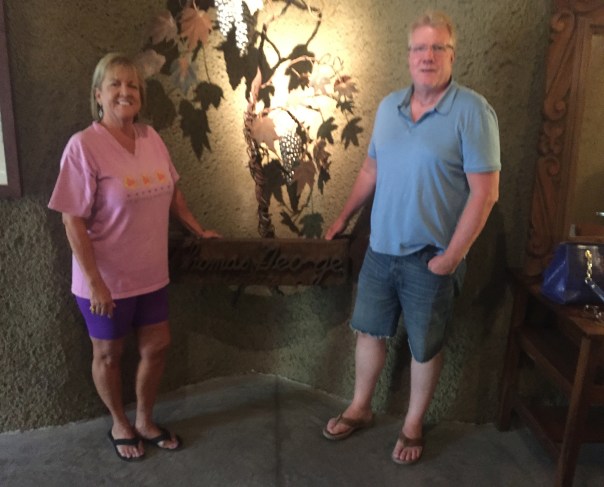
In no particular order, we visited 5 other wineries over the course of two afternoons, two of which stand out in my mind. The Thomas George Estates, a Russian River Valley producer of small-lot artisan wines, was offerings tastings in their cave on the afternoon we ventured in. Completed in 2010, the 8,000-square-foot cave features full tasting facilities, including a tasting bar, private tasting lounge, a wine library, and can host up to 70 people for a sit down dinner.

img_7712
The exterior of the wine tasting cave.

img_7714
The interior of the wine tasting cave—nice and cool on a hot day.
img_7715

img_7717
This statue on the grounds of the Thomas George Estates was so soothing.

Another winery of note was the Hop Kiln (HKG Estates.) This structure served the important hop industry of California’s north coast region, once the major hop-growing area in the west. Built in 1905 by a crew of Italian stonemasons, it represents the finest existing example of its type. The building consists of three stone kilns for drying hops and an attached wooden cooling barn with a two-story press for baling hops.

They have 250 acres in the heart of Russian River Valley Pinot Noir Country, and an incredible variety of soil types and microclimates, allowing for vast differentiation. The day we arrived the sky was a glorious blue, and the grass a surreal green compared to the various shades of brown and gold in the surrounding hills.

img_7705
The Hop Kiln also serves as their tasting room and marketplace.

img_7707
Russ stands next to a hop plant growing up the facade of the kiln building.

img_7711
Dave and Russ enjoying a fine pinot noir.

Well, so far I haven’t mentioned food once—but we did eat—and well! The boon hotel+spa delivers breakfast directly to your room (or tent) at your discretion between the times of 6:30 and 10:00 a.m. Knowing Russ had a wheat allergy, they made sure his toast and yogurt with granola were gluten-free. The tray also came with french-press coffee, two glasses of fresh-squeezed orange juice, a home-made biscuit, butter and jam. Although Dee and Dave agreed with us that it was odd we only got one linen napkin each morning!?

img_7699
Breakfast is served—with only one linen napkin…

They do not serve lunch or dinner but have a restaurant a few short miles away on the main street in Guerneville. boon eat + drink is a modern California bistro where they source most of their products right from Sonoma county. They support local farms and businesses and use primarily organic ingredients—some from the garden at the hotel. The menu is comprised of small plates, charcuterie, artisan cheeses, panini, salads, and seasonal main dishes, serving only Russian River wines and micro brews from Sonoma and Mendocino counties. Suffice it to say, we were happy campers here…

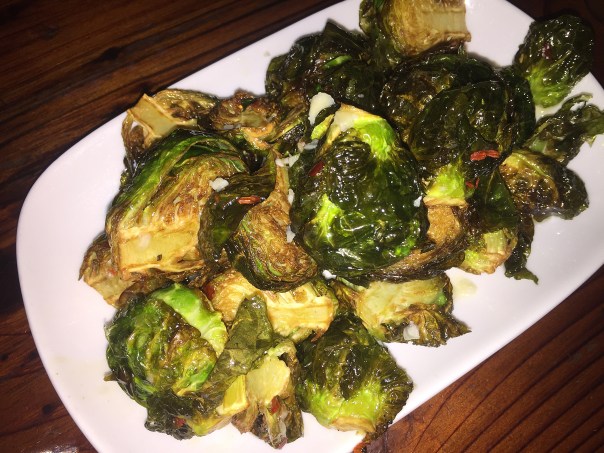
Intrigued by the Flash Fried Brussel Sprouts, we placed an order to share. Made with lemon, garlic, olive oil, and chili flakes, we are now on a mission to get this recipe. Another veggie dish calling out my name was the Lacinato Kale, adorned with seasonal stone fruit, Redwood Hill goat cheese, Marcona almonds, and a Verjus vinaigrette.
img_7691

img_7694

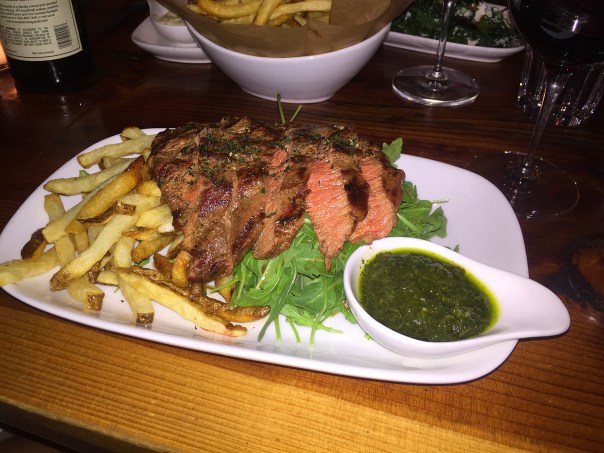
For entrees the guys couldn’t help but order the Flat Iron Steak, complete with truffle fries, chimichurri sauce, and a wild arugula salad with sherry-shallot vinaigrette. And the ladies entrée of choice was the Crispy Seared Salmon, artfully assembled in a bowl with cranberry bean summer succotash, and herbed pistou.
img_7696

img_7697

img_7765
The organic garden at boon that partially supports their organic restaurant.

img_7759
Hoping we had some food to throw their way, the free-range chickens came over to greet us.

Our next dinner was at the Agriculture Public House at Dawn Ranch which focuses on locally sourced organic products (an obvious theme in this area.) It is a nice, higher end restaurant that features a wood burning fireplace and vaulted beam ceilings, with an ambience that is of Pacific north woods—modern rustic, yet warm.

agriculture-1-1024x683

dining-room-2-1024x683

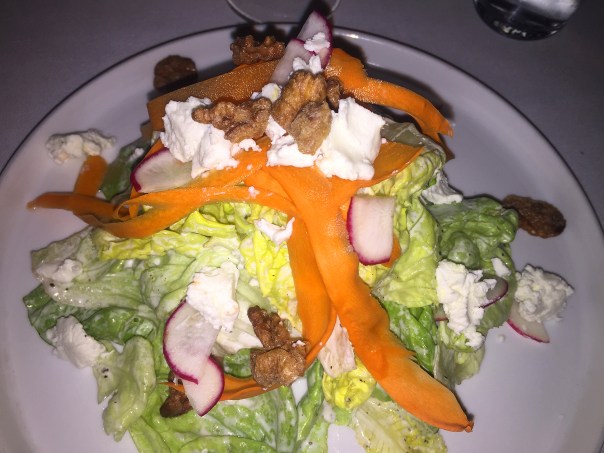
Dee and I both enjoyed salads for starters while the guys went for their famous Steamed Mussels that came with chorizo, tomato, shallots, and a lightly grilled baguette. My Dawn Ranch Salad was deliciously fresh comprised of butter lettuce, carrot ribbons, radish slices, candied walnuts, Laura Chenel goat cheese and ranch dressing. And Dee seemed to be taken with her Squash Salad made with garden squash, shaved red onion, parmesan, dill, all lightly dressed in a mustard vinaigrette.

img_7734

img_7732

img_7735

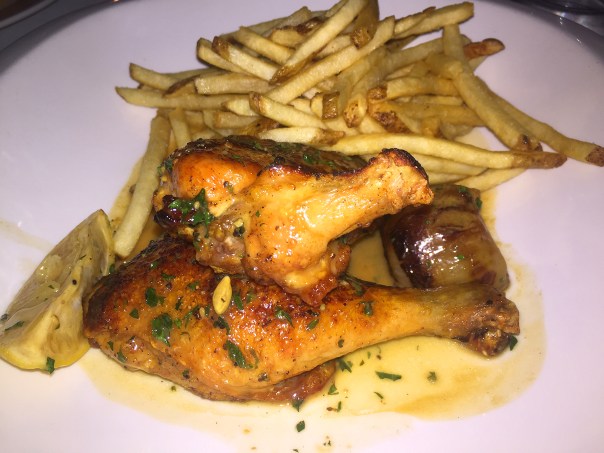
Of the entrees, there was only one complaint. Russ had ordered Mary’s Chicken that comes with both a breast and thigh, pommes frites, and a delicious pan jus topped with parsley. While he loved almost everything about it, he said the breast was dried out, possibly from sitting too long. Have to take off a few points for that…
img_7741
img_7738
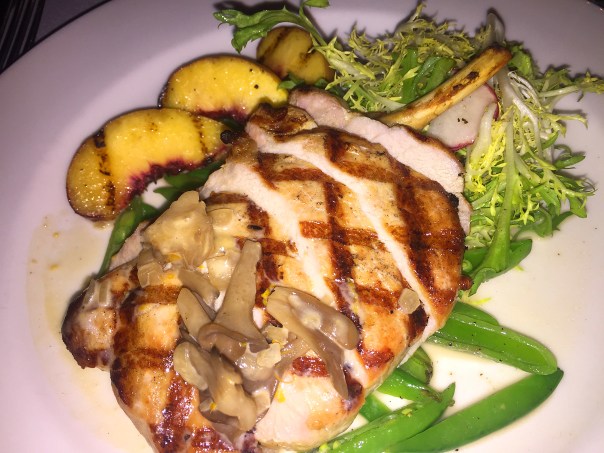
The dinner of choice for both ladies was the Berkshire Pork Chop, a succulent, thick brinded chop, plated with snap peas, grilled white peach slices, frisée, and a delightful mushroom marsala sauce. It was slap-your-mamma-good!
David went for the big guns when he ordered the 14-ounce Niman Ranch Rib Eye topped with a compound butter and accompanied by 3 luscious looking heirloom tomato slices garnished with a hefty portion of Pt. Reyes Blue!
img_7740

All said and done, I’d say we chilled pretty well over the course of two days. We recommend the Russian River Valley to anyone who’s not looking for a pretentious, crowded getaway. With over 15,000 acres planted to grapevines, wine connoisseurs will adore the area; but there are also many other ways to entertain yourself in this laid-back part of California. Hopefully you’ll get the chance to check it out for yourselves!

img_7748

img_7749
Russ checks out the interior of one of the tents in case you want to “glamp” amongst the redwoods at boon hotel+spa.


A Berkley Landmark; An Oakland Icon

California Bay Area Part 2 of 5—

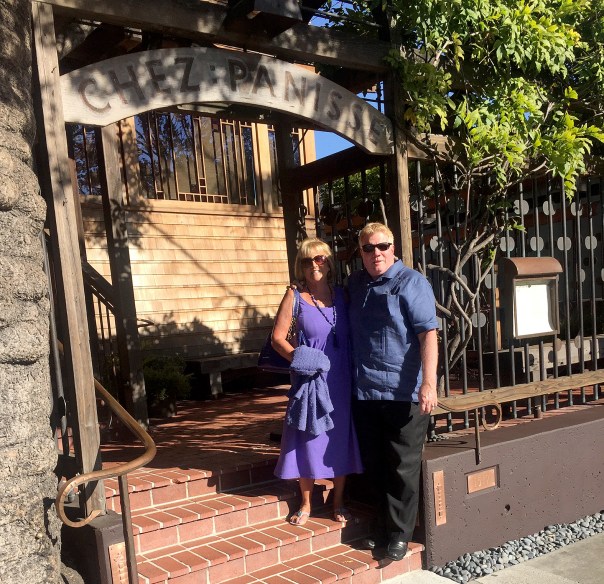
We hit the Motherload! On a recent trip to California visiting family members, the foodie gods (or more precisely, our brother-in-law David) presented us with an opportunity to dine at a superstar of the American restaurant revolution, Chez Panisse. Founded by Alice Waters and a group of idealistic friends, it opened its doors in 1971. A Berkeley, California restaurant, it’s known as one of the inspirations for the style of cooking known as California cuisine. Russ dubbed it “The Vatican of New American Cuisine.”

A neighborhood bistro, Chez Panisse is named after Honoré Panisse, a character in Marcel Pagnol’s 1930s movie trilogy about waterfront life in Marseille (Marius, Fanny, and César), as an homage to the sentiment, comedy, and informality of these classic films.

IMG_7609.jpg

img_7606

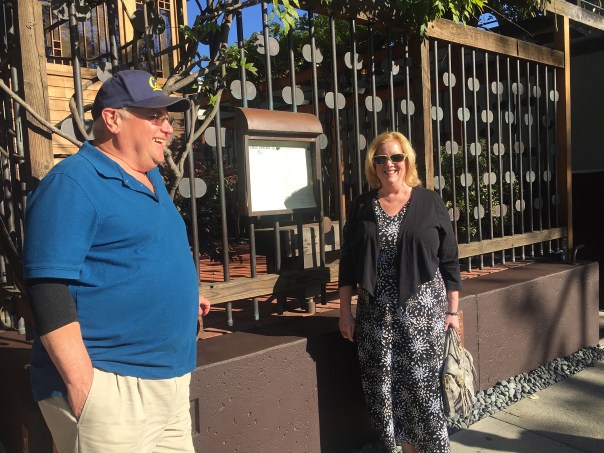
We had an hour to kill before our dinner reservation, so David suggested we check out César, a treasured Bay Area tapas bar with a serious pedigree, opening 18 years ago next door to the famed farm-to-table temple Chez Panisse—founded by alums of the fabled restaurant. It has since become renowned for a rotating menu of authentic tapas created from ingredients from Spain and local produce, meat and seafood. Knowing Russ’s penchant for everything Spanish, we were all for it!

The compact, elegant bar-restaurant routinely makes the list for The San Francisco Chronicle’s annual “100 Best Restaurants of the Bay Area.” Its cookbook, César: Recipes from a Tapas Bar, was hailed by Food & Wine magazine as “one of the ten best cookbooks of the year.”  With accolades like that, you bet we were going to try it!

img_7615img_7614
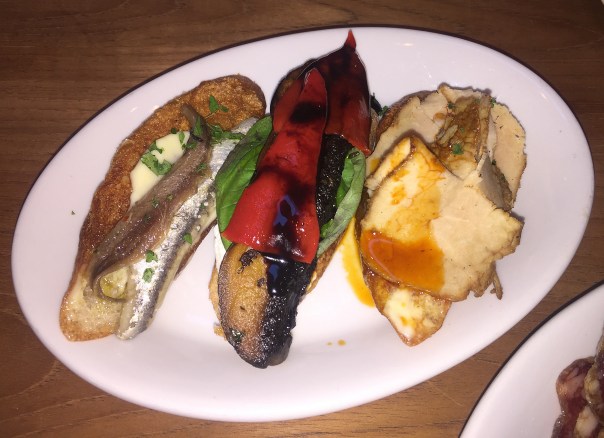
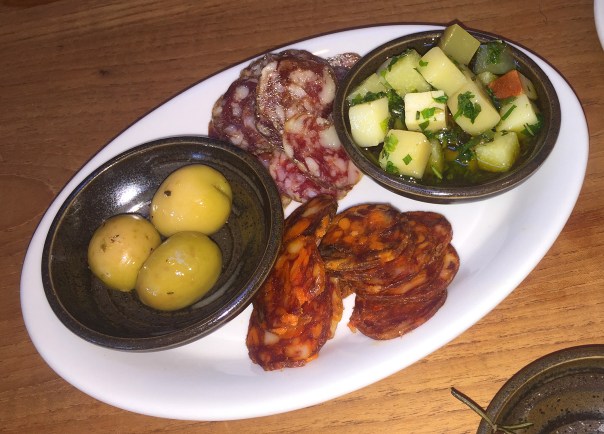
We split two small tapas: Montaditos—an assortment of three toasts one with portobello mushroom, piquillo pepper and queso fresco, another with boquerones and anchovies with alioli, and a third with roasted pork loin in brine with pincho spicy alioli;  Plato de Charcuteria—chorizo ibérico, ibérico longanzia salchichon, and surtido de quesos.

Back to CP—David’s family had been in the linen business for years and that’s how how he got to meet Alice back in the 70’s. Unfortunately on the night of our visit, Ms. Waters was out of the country so we didn’t make her acquaintance, however we did get to meet a few of the chefs in action back in the kitchen, but I’m getting ahead of myself here…

We knew a few months in advance about our reservation at CP, and also knew the menu changes every night. It’s designed to be seasonly appropriate and composed to feature the finest sustainably-sourced, organic ingredients—in our case, it featured seafood for the main course.

chez-pansse-menu

Seated in a corner (Table #11) the guys got a view of the open kitchen in action, while us ladies enjoyed eyeballing the dining room decked out in craftsman-mission style decor with a view out the front window. While scoping out the interior, our pleasant waiter Robert suggested an Etna Rosata Rosé from the Grachi Winery to accompany the seafood dinner. I’m a bit skittish because rose’s can be a bit too sweet for my taste, but I went along with the ride figuring I could switch if necessary—but necessary it wasn’t.

In the meantime, we were served a complimentary, very smooth glass of Champagne with dry red vermouth; while Dee opted to have a glass of the infamous Navarro Winery grape juice instead. Our bottle of wine arrived shortly after a basket of fresh crusty bread was delivered table side, followed by an aperitivo of a very tasty gazpacho topped with a purple edible flower prepared by head chef Cal Peternell.

img_7621

img_7618

I can’t say enough about our over-the-top delicious salad. Simplistic in its ingredients, the end result was a well composed culinary delight. I just adored the Pennyroyal Farm goat cheese frittelles with a drizzle of roasted fig vinaigrette accompanied by watercress, red onion and little yellow beans.

img_7627

The attention to detail when plating the main course was a work of art! Who could not appreciate this Sicilian-Style Fish and shellfish couscous with saffron and almonds? Assembled with pops of color from roasted sweet red peppers, wilted spinach and a gorgeous green chermoula sauce, it was an awesome continuation of the dining experience.

img_7629

You know by now that I rarely eat dessert, but this time I made an exception. The Frozen Cassata with strawberry sherbet was, in a word, divine. I ate nearly half, which for me was a feat in itself. Cassata in its traditional format is a sweet from Sicily, Italy, consisting of sponge cake moistened with fruit juices or liqueur and layered with ricotta cheese, candied peel, and a chocolate or vanilla filling similar to cannoli cream. As you can see from the photo, ours was an updated version.

img_7631

img_7634
For the finale, we were served a small plate of candied gingered lemon peel and espresso coated truffles. Nice touch!

In order to access the bathrooms, one has to walk through the kitchen and Russ so taken with the whole experience, he felt in doing so, it compared to a walk up to the altar at St. Peter’s Basilica. A bit of an exageration? Perhaps, but needless to say, we were in awe.
Being an artist who lived in New Jersey for a time and worked in NYC, I found it interesting that restaurant chef Cal Peternell, below, grew up on a small farm in New Jersey and graduated with a BFA in painting from the School of Visual Arts in New York City. After graduation, Cal moved to Lucca, Italy, with his wife to pursue their art careers. Upon his return to the United States, and stints at several different US restaurants, Cal joined Chez Panisse in 1995 and has been chef since 2000.

img_7638
img_7635
img_7639
A few of the other chefs went about their business as our waiter Robert gave us a first-hand tour of the working kitchen.

A BIT ABOUT ALICE
Alice Waters, chef, author, and the proprietor of Chez Panisse, is an American pioneer of a culinary philosophy that maintains that cooking should be based on the finest and freshest seasonal ingredients that are produced sustainably and locally. She is a passionate advocate for a food economy that is “good, clean, and fair.” Over the course of nearly forty years, Chez Panisse has helped create a community of scores of local farmers and ranchers whose dedication to sustainable agriculture assures the restaurant a steady supply of fresh and pure ingredients.

On a side note, Kim Cochrane (our sister-in-law who lives in Marin County) told us that she actually talked with Alice Waters via the phone to discuss the creation of their sustainable, organic garden that Kim and her colleagues designed at the school where she teaches special ed. Now if she can only obtain a photo op!

img_7642

On our way home from Berkley, David wanted to show us another Bay Area icon, this one in Oakland. Heinold’s First and Last Chance is a tiny waterfront saloon opened by Johnny Heinold in 1883 on Jack London Square. The name “First and Last Chance” refers to the time in which for many sailors, the pub was the first and last chance to drink alcohol heavily before or after a long voyage.

img_7640
The view from this angle doesn’t look like much.

img_7644
Our last chance for the evening…

It also known as “Jack London’s Rendezvous,” as it was the inspiration for scenes from the Oakland writer’s novels Call of the Wild and The Sea Wolf. The pub in its original form was built from the remnants of an old whaling ship at the foot of Webster Street in Oakland, where it remains today. It was originally designed as sleeping quarters for the workers of the nearby oyster beds.

img_7643
This huge mastiff seemed to be the bar mascot, with his own beverages of choice.

img_7641

As David explained, Heinold’s floor collapsed during the great earthquake of 1906 and it has not been fixed since! If you sit on one of only 4 bar stools, you are at a steep angle—which self-corrects your posture after a couple of drinks.

Heinold’s is the last commercial establishment in California with its original gas lighting. The tables came from a whaling ship and the walls and ceilings are covered with business cards, hats of past patrons and money, often signed by sailors about to deploy so they would have money for a drink waiting for them upon their return. Now, is that thinking ahead, or what?


We Had It Coming and Going

California Bay Area Part 1—

With some of Russ’s family clear on the other side of the country, it’s not often that we get to visit. Sure, there’s always the phone and social media, but actually spending time with loved ones is much more special—well, in most cases 😉 We were recently afforded the opportunity to fly to the West Coast and spend some quality time with Russ’s sister Dee, her husband David, step-brother Ken and his wife Kim, and what a treat it was!

Dee and David picked us up at the Oakland airport, a mere 15-minute drive from their charming home on Alameda Island. Knowing we’d probably be a bit exhausted from the cross-country flight, with a stop-over in Phoenix, they graciously offered to cook us dinner. So after cocktail hour with an array of olives, cheese and cracker hors d’oeuvres, they prepared one of our all-time favorites—lamb!

img_7559
Bougainvillea surrounded both sides of their front porch.

img_7600
A panoramic view of the beach on the bay; you can see San Francisco in the distance to the left of the trees on the right.

img_7645
Unfamiliar with this gnarly old tree, there seemed to be a slew of them dotting the island. 

img_7553
The three amigos—I mean chefs—Russ, Dee and Dave pose for a pre-dinner photo.

img_7548
The lamb steaks get happy with a bit of olive oil and rosemary.

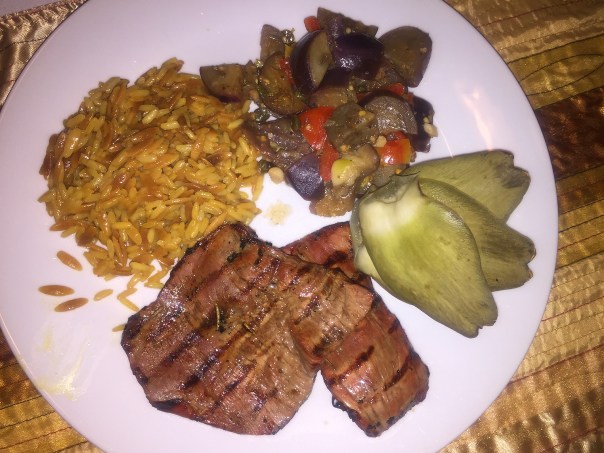
There was a twist however, these were lamb flank steaks, the likes of which we’d never seen, or consumed before. Beautiful lean morsels of meat, lightly seasoned with fresh rosemary that cooked in no time flat. And of course you can’t go to California without eating artichokes! Dave steamed two gorgeous globes with arching, deeply lobed, silvery, glaucous-green leaves, accompanied by a mayo-lemon-caper dipping sauce.

img_7556
A work of art, the steamed artichoke in all its glory.

Never ate one? Cook until tender, then pull off outer petals, one at a time. Dip white fleshy end in melted butter or sauce. Next, tightly grip the other end of the petal. Place in mouth, dip side down, and pull through teeth to remove the soft, pulpy, delicious portion of the petal. Discard remaining petal. Voila! (Cooking time depends on how large the artichoke is, the larger it is, the longer it takes to cook.)

img_7545
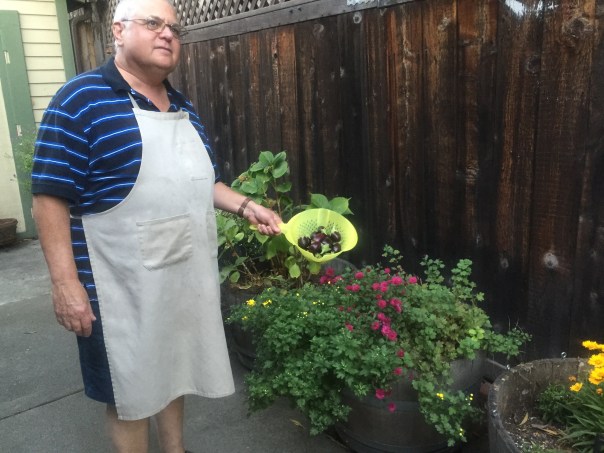
David poses with a colander full of baby eggplant near their side garden.

img_7558

Rounding out the feast was a tasty sauté of baby eggplants and red peppers accompanied by a flavored rice dish. Easy, simple, nutritious and delicious—no complaints from the East Coast contingent. Thanks Dee Dee and Dave for a yummy start to our vacation!

img_7546
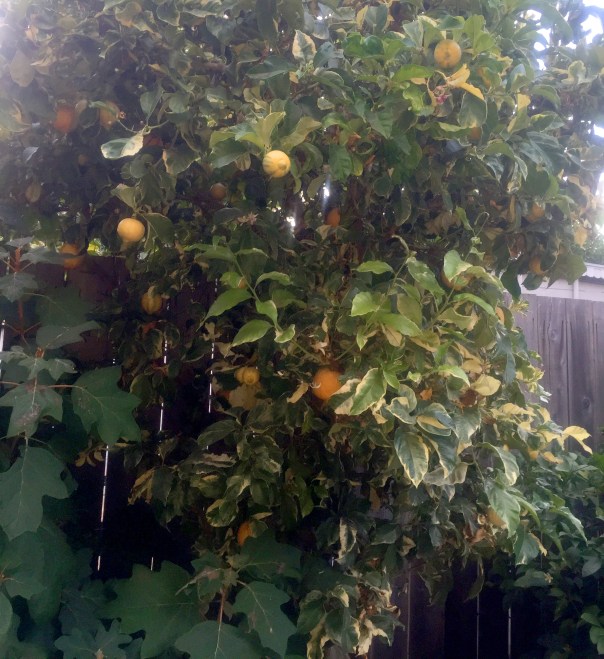
A close up of a lemon tree growing along with a myriad of other veggies in their year-round backyard.

Over a week later, our last meal before we flew back East was also lamb. (Between those two meals we did a LOT of dining out—those blogs to come.) This final dinner was a group effort in tandem with Kim and Ken Cochrane, Russ’s brother and wife who live in San Rafael, Marin County.

It hadn’t been planned in advance because Ken wanted us to go on a shopping trip with him to nearby Costco’s and see what struck our fancy. Costco is my favorite of the big-box stores (recently getting a membership to the new one near my office) because their quality seems to be on a higher level than the unmentionable others.

And what struck our collective fancies? A beautiful leg of lamb of course! We selected a six-pounder and several bottles of wine and then hightailed it out of there to go to Mollie Stone’s for the rest of the purchases. WOW, what a store Mollie’s is—family owned, locally devoted—a true food lover’s experience.

Mollie’s first market was in Redwood City, California, and carried only natural and organic products. Decades later, their roots remain in healthy, natural and specialty foods, and their buyers work closely with local producers around the greater Bay Area showcasing high quality products in every aisle. Worth a trip to one if you ever get the chance…

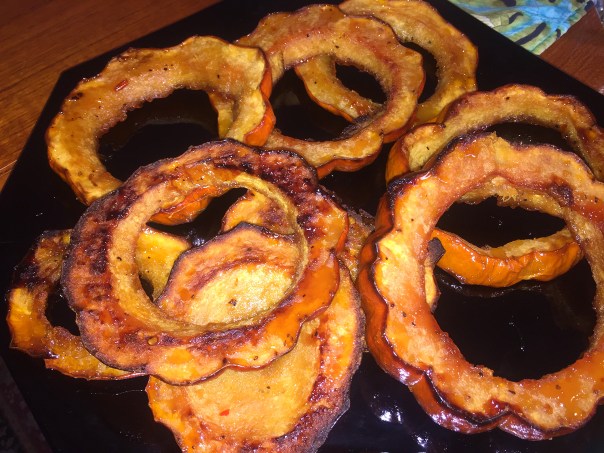
Almost immediately upon walking in, we noticed a man filling up a jug from a fresh-squeezed orange juice machine, impressive! After weighing the pros and cons of who likes or can eat what, as far as vegetables, our selections narrowed down to gorgeous heirloom tomatoes and fresh basil for a caprese salad, and acorn squash for a roasted side dish I blogged about last January.

img_7894
The Cochrane’s didn’t have Sriracha or hot sauce, so we used the next best thing, a sweet chili sauce, which made the roasted squash less spicy—which for some was a better option.

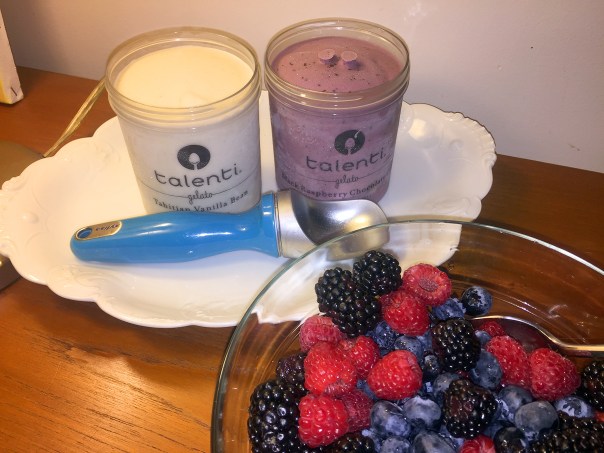
Next dilemma, dessert. Ken ventured over to the bakery section and after contemplating the various dietary restraints, decided perhaps the way to go was fresh berries and some ice cream. So we picked up blueberries, raspberries and blackberries before venturing over to the ice cream aisle. Here the guys zeroed in on Talenti Gelato which is made with fresh milk straight from the farm, fine, pure cane sugar (not high-fructose corn syrup) and the finest ingredients sourced from all around the world. Our picks were the Venetian Vanilla and Black Raspberry Chocolate Chip—OMG, I can only say I hope that brand is available in our area!!

img_7905

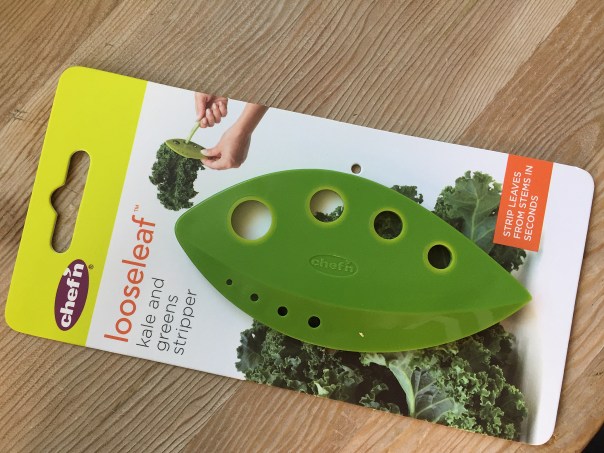
In prepping the meat the night prior to our dinner, we had the opportunity to use our two new kitchen gadgets purchased earlier in the week from Sur La Table (a fabulous kitchen gadget store) in San Francisco while on a lunch outing to Hog Island Oyster Company. We took the ferry over from Alameda with Dave’s son Nate—and while Dave and Nate stood in line to be seated, an hour and twenty minutes mind you, Russ, Dee and I went shopping.

img_7563
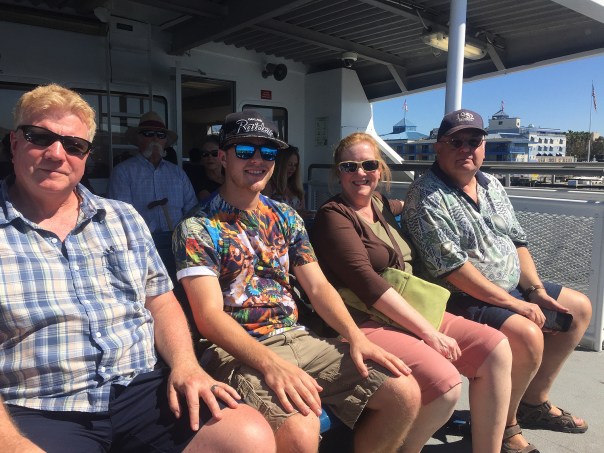
Russ, Nate, Dee and Dave on the ferry ride over to San Francisco.

img_7590
On the way back from San Fran we passed a pirate ship.

img_7822

img_7823
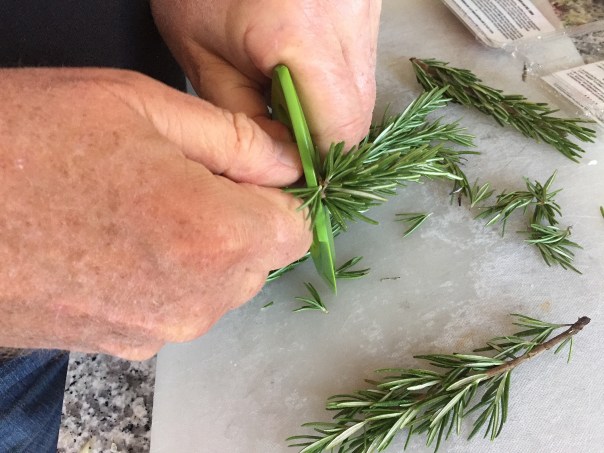
I’m thinking this new greens stripper is about to become my next best friend.

img_7817

img_7819
This gizmo makes peeling garlic cloves a breeze!

img_7890
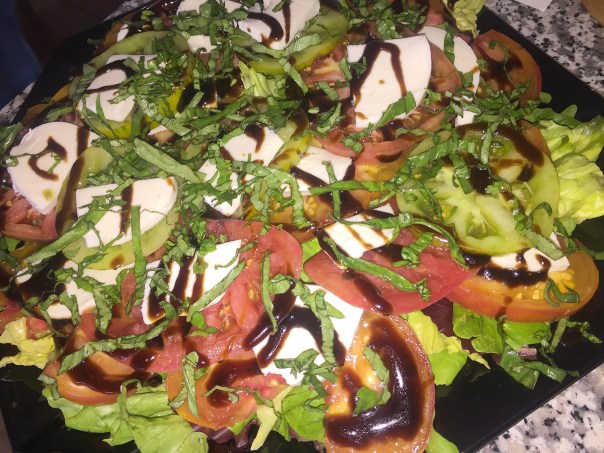
Caprese salad with heirloom tomatoes, fresh mozzarella, a basil chiffonade, all on a bed of greens from Dee’s garden, heaven!

img_7829
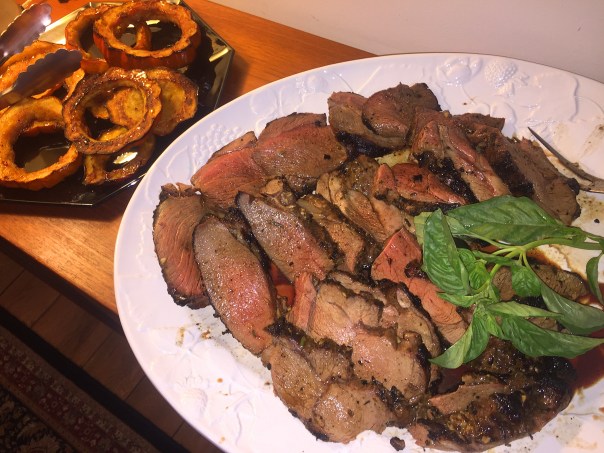
Russ spread a mixture of olive oil, dijon mustard, fresh rosemary, balsamic vinaigrette, soy sauce, minced garlic, salt and pepper all over the lamb, which then marinated in the frig overnight.

What’s a party without Dee and Dave? We hadn’t seen them in a few days, so they buzzed over to San Rafael from Alameda—anywhere from a 30- to 75-minute drive depending on Rt. 880 traffic. With wine in hand and the makings for another caprese salad (somehow our signals got crossed) we all set about toasting our last meal together before our departure the following morning.

img_7902
Kim was thrilled that there was leftover salad and meat so she could make a lunch for work the next day.

img_7883
Russ, Ken and Dave pose before the grilling gets underway.

img_7888
The sista-in-laws are true gal-pals.

To sum it up, we had lamb coming and going, and the review for both meals was two thumbs up! Time for the West Coasters to make a trip East…

Autumn is Calling

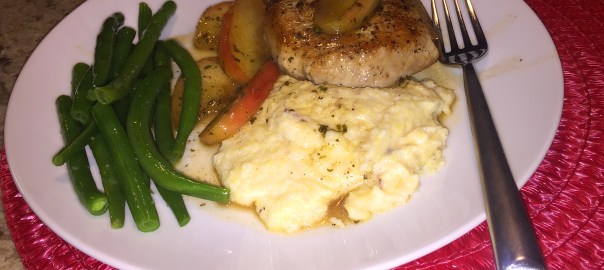
With just a few days before the official start of Autumn, the temps were still ranging in the high-80s but I was in a Fall cooking frame of mind. Flipping through our latest edition of Fine Cooking Magazine, I came across Pork Chops with Thyme-Scented Apples over Cheddar Polenta. Yeah, that sounded like a good place to start…

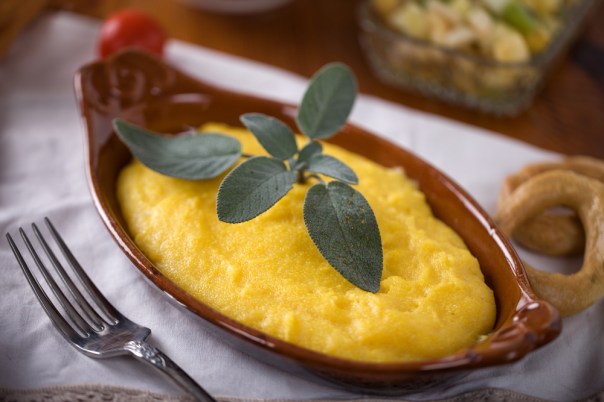
But first a little background on the versatile polenta. It is perfect for both vegetarians and vegans because it is made from just cornmeal and water (or in the case of this recipe, milk and cheese.) Polenta is part of the staple diet of Italy; originally most common in the north of Italy, today it is a popular dish which is enjoyed in many other parts of the world. It was traditionally thought of as a peasant dish because it’s cheap and easy to prepare, yet filling and wholesome. This made it a useful dish for people who were working on the land who required food that was high in energy.

italian-polenta

Don’t get confused in thinking that polenta and grits are one and the same, because the two are different — even if that difference is slight. In most cases you could use the same cornmeal to make a polenta dish as you would a grits dish, but the type of corn traditionally used to make each food is different.

Polenta is made from a corn variety that grows in Italy known as flint corn. It holds its shape better than the Southern US corn used for grits, which is called dent corn. This means that grits often come out on the mushier side while polenta is generally a little coarser. In a pinch, sure, use that medium or coarse-ground cornmeal for polenta. But when possible, try to seek out the cornmeal that’s labeled “polenta,” as this is most likely to be the real stuff.

Back to the recipe. Russ has always been an avid fan of polenta, but I must admit until recently, I wasn’t too keen on it (and still don’t like grits.) Having purchased a wonderful Bellavitano Merlot Parm-Cheddar with a Merlot rub wash while on a recent trip to Culpeper, VA, I decided to incorporate it into the polenta, resulting in a velvety finish, or as Russ put it “An A++.” Thanks for the vote of confidence, Babe.

Like a well-conducted symphony, the pork and apple juices mingle beautifully and make a lovely sauce for the chops and cheesy polenta. For a pop of color to the dinner plate, I added some steamed green string beans coated with a light splash of Galega EVOO and a Sicilian Lemon White Balsamic Vinegar, also both purchased in Culpeper.

If you don’t mind the extra calories—although, who does?—for a creamier finish replace 1 cup of whole milk with heavy cream. Buon appetito!

img_7494

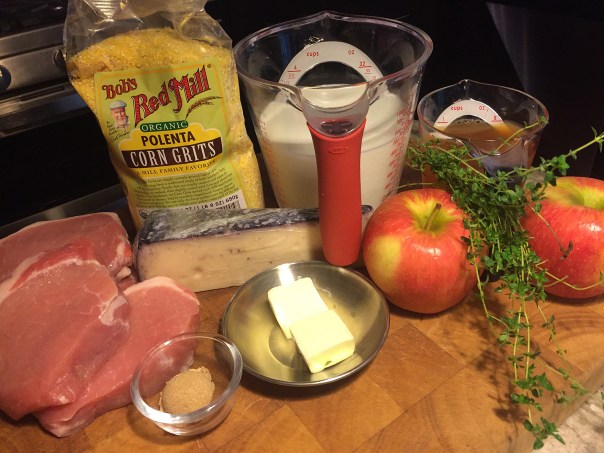
Ingredients

  • 3 cups whole milk
  • Kosher salt
  • 1 cup polenta (cornmeal)
  • 3 oz. sharp Cheddar, coarsely grated (about 1 cup)
  • Freshly ground black pepper
  • 2 Tbs. unsalted butter
  • 4 1-inch-thick boneless center-cut pork chops (about 1-1/2 lb.)
  • 1 cup apple cider
  • 2 tart apples, cored and sliced into 16 wedges each (we used Honey Crisps)
  • 1 tsp. chopped fresh thyme leaves
  • Light brown sugar

img_7500
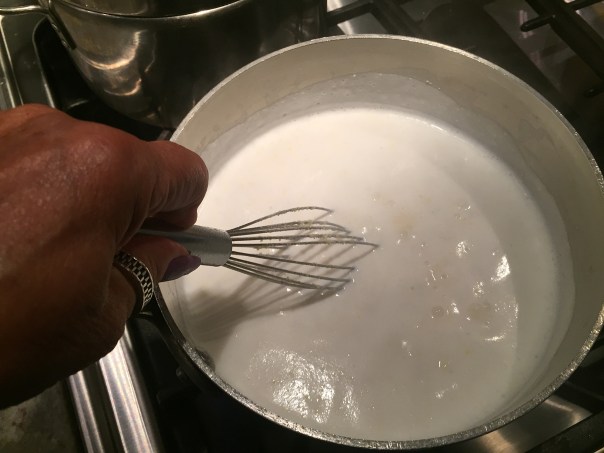
The dry polenta gets whisked into the simmering milk.

img_7505
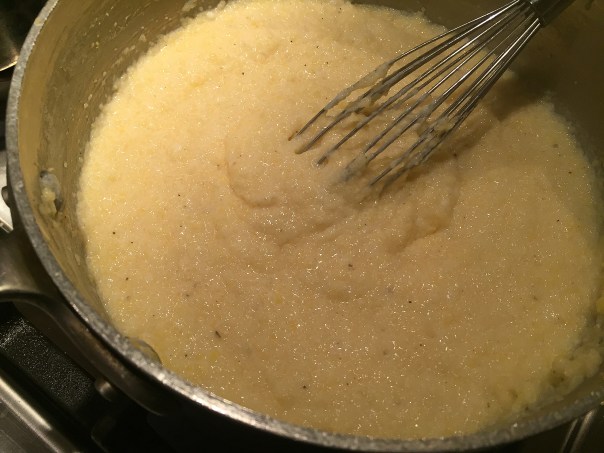
The polenta thickens even after water is added.

img_7497
Approximately 3 ounces of a good cheddar is coarsely grated.

img_7508
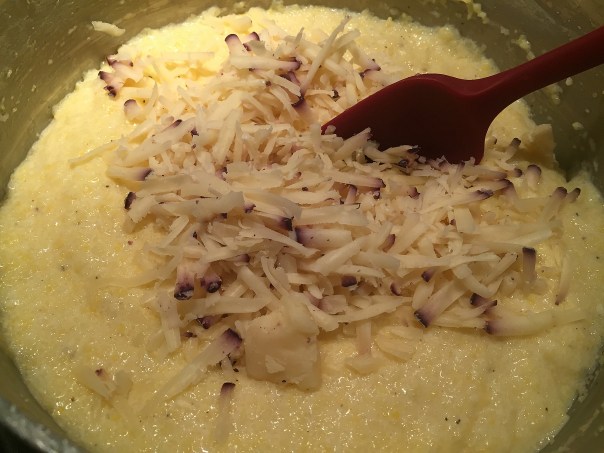
Remove polenta from heat and fold in the grated cheese and some salt and pepper.

Directions

  1. In a 3-quart saucepan, bring the milk and a large pinch of salt to a simmer over medium heat. Slowly whisk in the polenta, reduce the heat to medium low, and cook, stirring often, for about 5 minutes.
  2. Stir in 1 cup water and cook, stirring occasionally, until the polenta is thick and creamy, 10 to 12 minutes. Remove from the heat, stir in the cheese, and season to taste with salt and pepper.
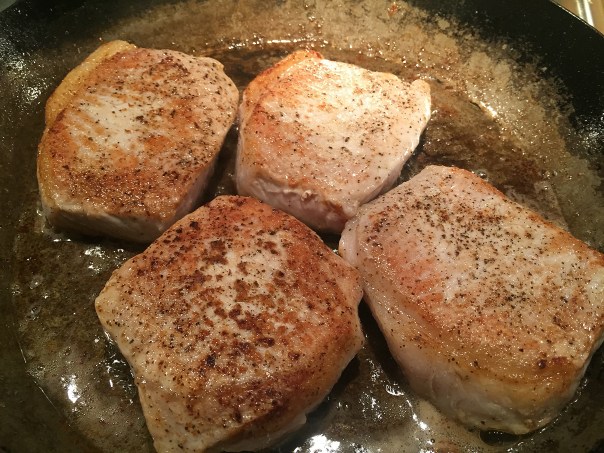
  3. Meanwhile, melt the butter in a 12-inch skillet over medium-high heat. Season the pork with salt and cook, flipping once, until an instant-read thermometer inserted in a chop registers 140°F, about 8 minutes total. Transfer to a plate and keep warm.
  4. Add the apple cider, apples, and thyme to the skillet and cook, stirring occasionally, until the apples begin to soften, about 8 minutes. Add brown sugar to taste. Serve the apples and sauce over the pork chops and polenta.

img_7502
The chops are turned once after 4 minutes to brown for another 4 minutes on the other side.

img_7507
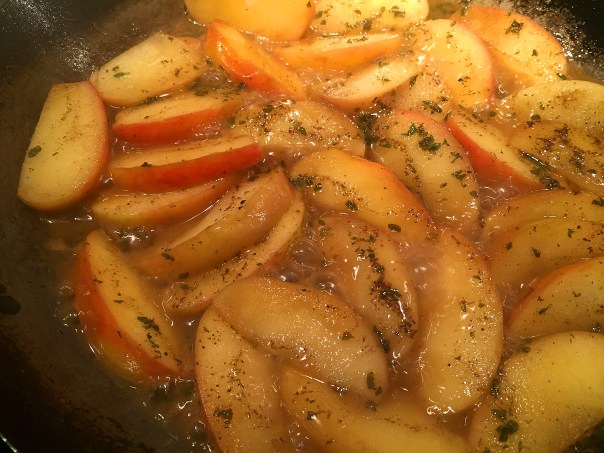
The apple slices, cider and thyme get happy together in the skillet for about 8-10 minutes. Add about 1 teaspoon of brown sugar at the very end.

img_7511
Dig in and enjoy!

Recipe by Erica Clark from Fine Cooking

Melt in Your Mouth Delicious!

Thai is one of my favorite cuisines, so when Thai Watercress and Steak Salad popped up in our “Make It Tonight” series from Fine Cooking, I knew we had to try it. Perfect for supper on a warm weeknight—which are starting to dwindle now that summer is but a not-so-distant memory. Plus, no cooking other than the few minutes the meat is on the grill.

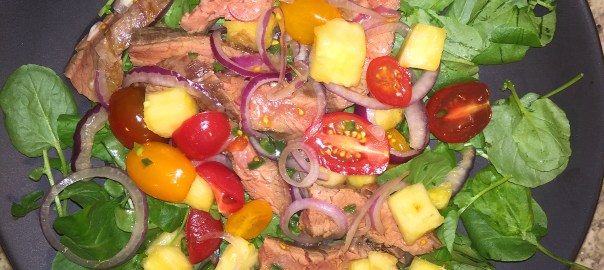
A bright, tangy, fruity Thai dressing enhances the peppery bite of raw watercress, fabricating a myriad of flavors and colors to engage your senses. And engage it did. The steak was amazingly tender, and all of the flavors came together in perfect harmony. Russ was even surprised to learn there was jalapeño in the dressing. Yes, it was only a half of one, but it added just enough tang to be the perfect counterpoint to the sweet pineapple chunks.

Thinking ahead, we purposely chose a flank steak that was over 1 1/2 pounds, so that we’d have some leftover slices for a future meal—or to be honest, just to munch on when the urge arose.

Those of you who do not include red meat in your diet, feel free to substitute some leftover chicken, pork tenderloin or tofu.

IMG_7213

IMG_7215
Oil and season the flank steak with salt on both sides.

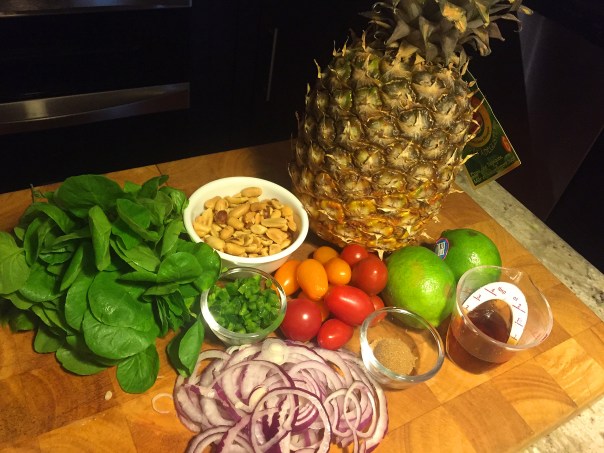
Ingredients

  • 1 lb. skirt steak or flank steak
  • 1 Tbs. canola or other neutral oil
  • Kosher salt
  • 2 Tbs. fish sauce
  • 1-1/2 Tbs. fresh lime juice
  • 1 tsp. dark brown sugar
  • 1/2 jalapeño, seeded and finely chopped
  • 3/4 cup halved cherry or grape tomatoes
  • 3/4 cup diced fresh pineapple
  • 1/2 cup thinly sliced red onion
  • 1 large bunch watercress (about 7 oz.), stemmed and torn into bite-size pieces
  • 1/4 cup chopped unsalted peanuts

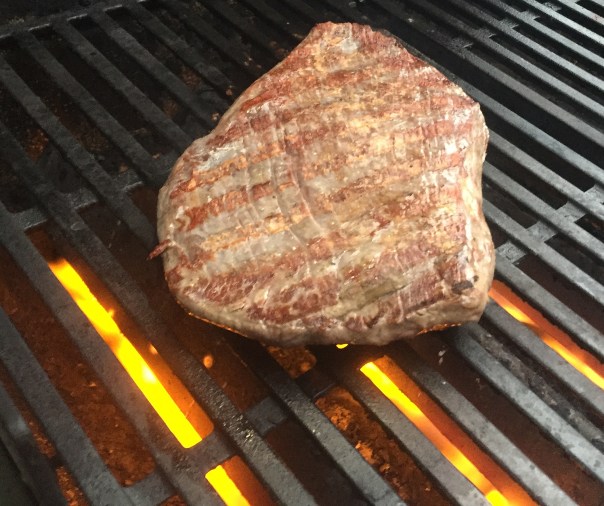
IMG_7217Grill the steak for 3 minutes on each side over direct heat.
IMG_7220
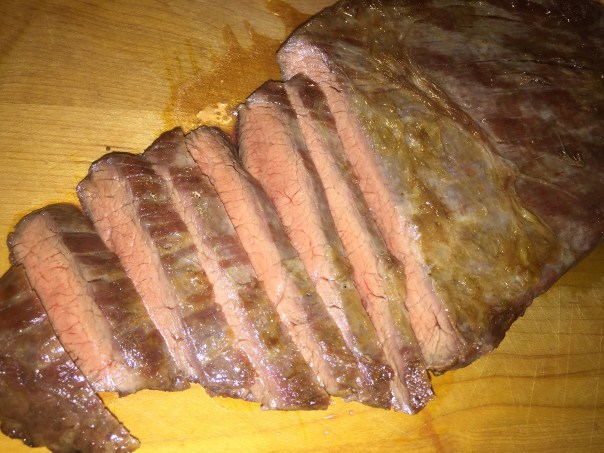
After resting under tented foil for 10 minutes, the steak is sliced against the grain.

IMG_7221
Once cooled enough, toss the meat slices with the other ingredients before plating on the bed of watercress.

Directions

  1. Prepare a medium (350°F to 375°F) gas or charcoal grill fire or heat a grill pan on the stove over medium-high heat. Brush the steak with the oil and season all over with 1/4 tsp. salt.
  2. Grill the steak, turning occasionally, until cooked to your liking, about 3 minutes per side for medium rare (125°F). Transfer the steak to a cutting board and let cool slightly, about 10 minutes (if the steak is too hot, it will wilt the greens).
  3. Meanwhile, in a small bowl, stir together the fish sauce, lime juice, sugar, and jalapeño.
  4. Thinly slice the steak against the grain. In a large bowl, combine the steak, tomatoes, pineapple, and onion. Add the dressing and toss to combine.
  5. Just before serving, put the watercress on a platter, lightly salt, and toss. Top with the steak mixture and peanuts, and serve.

by Laura B. Russell from Fine Cooking

IMG_7225Top with peanuts for an added crunch factor.

Flavor on Main; A Wedding in Reva

Nestled at the foot of the Blue Ridge Mountains / Shenandoah National Park, and just an hour drive from Washington D.C, Culpeper, Virginia has so much to offer with its vast history and nicely preserved historic buildings. (Coincidentally, just a few short weeks ago, we were visiting friends at the HEAD of the Blue Ridge Mountains near Nazareth, PA.)

We were in town to attend a friend’s daughter’s wedding, so a little bonding time with Culpeper was in order—as it was our first time in the area. After a slight mishap at checkin (our friends had mistakenly reserved the room for a Russell Bishop instead of Russell Hartman), we familiarized ourselves with the layout of the town via online maps. On the ride down I made early dinner reservations because we were invited for an after-the-rehearsal get together with the bridal party and families.

For this dinner we stepped back in time at Flavor on Main, a roaring twenties and thirties themed restaurant on an historical art deco style main street that was voted “Top Ten Main Streets in America.” History comes to life in this beautifully decorated restaurant with its wonderful ambiance, delicious cuisine and amazing specialty and prohibition cocktails. They also have hotel rooms that can accommodate everyone from the curious tourist to a large bridal party.

the-chaplin-room
The Chaplin Room.

While we chose to sit outside on the veranda, inside dining options include rooms with elaborate 1920’s and ‘30’s detail, with the décor vibe in Prohibition jazz style showcasing hand-stamped ceilings and chrome, exuding an overall slick, clean look. These theme inspired dining rooms are appropriately named The Great Gatsby and The Chaplin Room. When combined, the private dining area can seat up to 80 guests. (I was so impressed with the bathroom, below, that I had to take a photo!)

img_7420

ONE CANNOT THINK WELL, LOVE WELL, SLEEP WELL, IF ONE HAS NOT DINED WELL.

img_7409

In addition to the regular menu, our waitress informed us of the night’s specials, and one intriguing appetizer, Bison Carpaccio, caught my immediate attention. It arrived on a piece of slate with a smooth river rock heated to 500 degrees. The tenderloin of bison came uniformly sliced atop a bed of chimichurri sauce with healthy dollops of an olive tapenade and a delicious cherry compote accompanied by a lightly dressed arugula salad offering a bright note to the dish.

img_7415

It was worth ordering for the visual presentation alone, but then you add in the interactivity of searing each slice of bison on top of the hot rock to cook to your desired doneness, what fun, and oh how amazingly delicious! I was so caught up in it that the Executive Chef Garth Hansen—a very young guy—came out to personally thank me for my enthusiasm over his creation.

img_7412

Russ enjoyed Flavor’s Caesar Salad with grilled baby romaine hearts, buttermilk caesar, homemade croutons, parmesan, heirloom tomatoes and anchovies. Simple in it’s origin, you can tell they used the best local ingredients. And to his delight, Russ noticed the anchovies were “fresh cured”—in Spain known as boquerones. 

img_7417

For our main entrees we went with items from the regular menu. I chose the Crispy Crab Cakes on a mound of crisp-tender brussels sprouts (in exchange for the white truffle whipped potatoes), topped with asparagus spears and playfully surrounded with quarter-sized balls of a Cajun remoulade.

img_7418

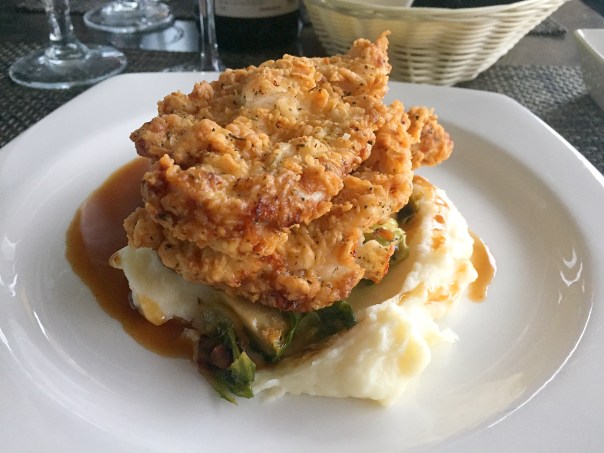
Russ’s Southern Comfort, was a new take on fried chicken because it was pickled. It came plated over a mound of the most creamiest white truffle mashed potatoes he’s ever tasted with red-eyed gravy and the aforementioned brussels sprouts. So good that this Northern boy almost licked the plate!

During our meal we engaged in a conversation with another couple who were born and bred in Culpeper and have remained there for their entire lives. They got to describing some of the sights and happenings around town which we were able to take advantage of the next day before the onset of the late afternoon wedding.

In addition to a Friday evening festival, a Saturday morning farmer’s market, historical museums, famous distilleries, breweries and wineries, Davis Street is the place for shopping—offering quintessential Southern boutiques in spades. And we contributed generously to their local economy… not surprisingly, most of it food-related with imported chocolates from Frenchman’s Corner, gluten-free uncommon pasta shapes and flavored vinegars and oils from Taste, and fabulous imported and local cheeses from Culpeper Cheese Company, to name a few.

dsc09645-edit-jpg-1024x0

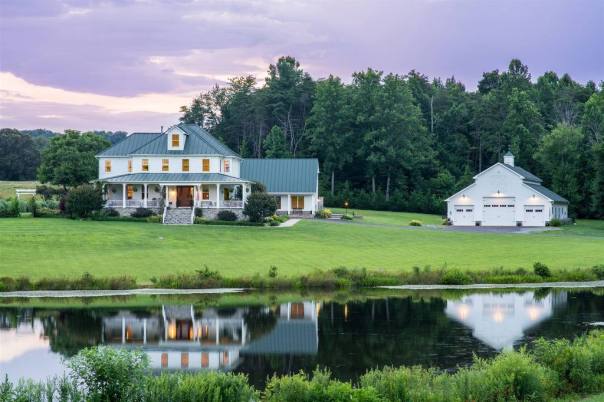
Shopping aside, I have to mention the wedding venue. OMG, what a place! Walden Hall, a luxury bed and breakfast, is a short drive from Culpeper and sits on 10 acres of rolling farmland in the tranquil countryside of Reva, Virginia.

img_7460
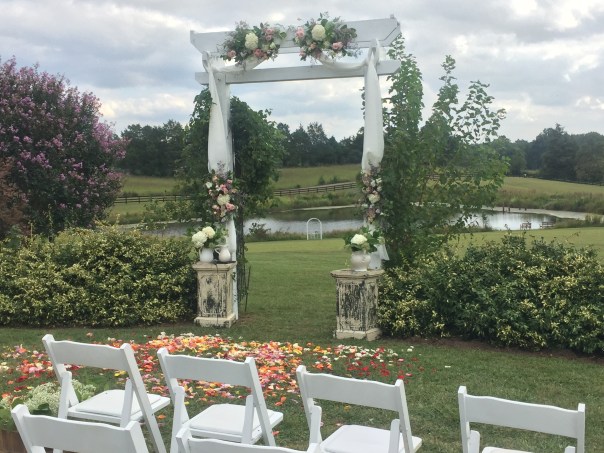
It was a mostly cloudy day, until just minutes before the ceremony began when the clouds parted and brilliant sunshine lit up the countryside.

img_7453
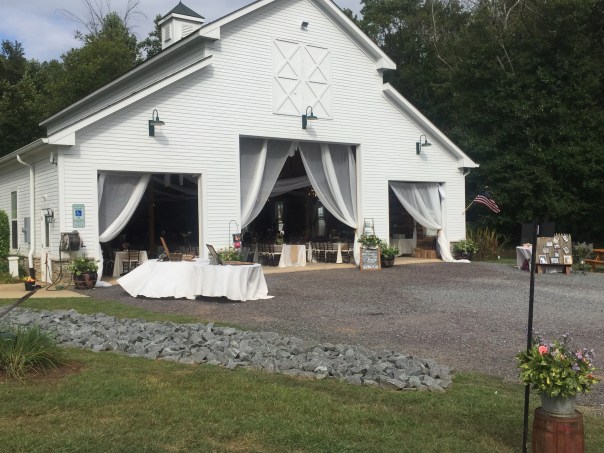
The barn is getting ready to receive guests for a reception after the ceremony.

img_7464
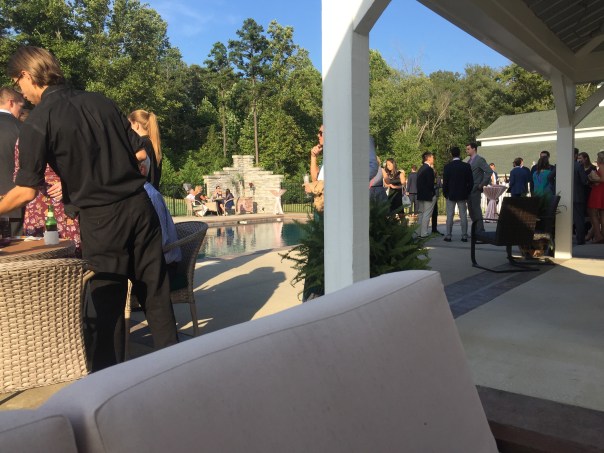
Cocktail hour was held by the pool prior to heading for the barn reception.

The owners, Dave and Julie, took possession of the property (appropriately) on Valentine’s Day, 2015, and over the next three months, oversaw an incredible renovation that included adding two bathrooms, knocking down walls, adding windows, and repainting, decorating and furnishing the 16,000 square foot home. The final product was revealed on May 1, 2015, and Walden Hall opened for business.

Five guest rooms, each with en suite bathroom, feature hand-picked furniture inspired by the 19th-century poets for whom they are named. The bridal suite where the bride and groom stayed was a four-room affair with a shower as big as someone’s bedroom!

img_7483
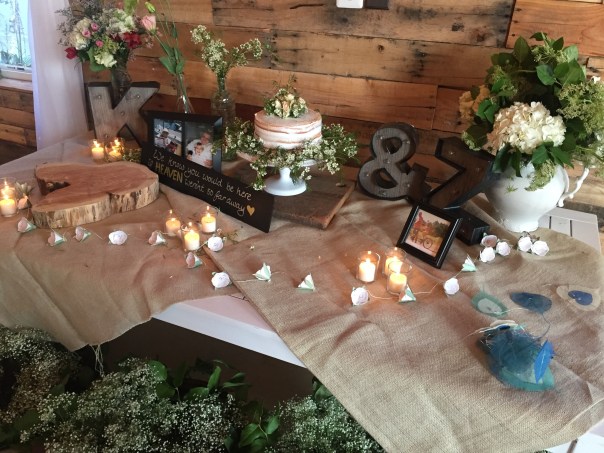
Just one of the attention to details scattered about the barn reception.

img_7486
A live band played an array of tunes long into the night.

If you ever get the opportunity, take a trip to Culpeper and check out all the town has to offer, and top it off with a visit to Walden Hall. After all, it is a fantastic destination for weekend jaunts with interesting places to stay, fantastic food, and plenty of liquid love to go around.

Color Your World Healthy

Like vegetables? Even if you don’t so much, preparing them this way may persuade you to eat them more, because it’s totally up to you exactly which veggies and fresh herbs to choose, and there’s no measuring!

Russ and I have been grilling a fresh vegetable medley, three out of four seasons, for years. Not only is it extremely healthy for you, and tasty to boot, but you can round up any that are starting to be questionable, or if you have dribs and drabs that would otherwise get thrown out (hopefully into your compost bin.) Plus we enjoy discovering new varieties such as the mini-oblong eggplant and tiny green-yellow bell peppers used this time.

img_7308
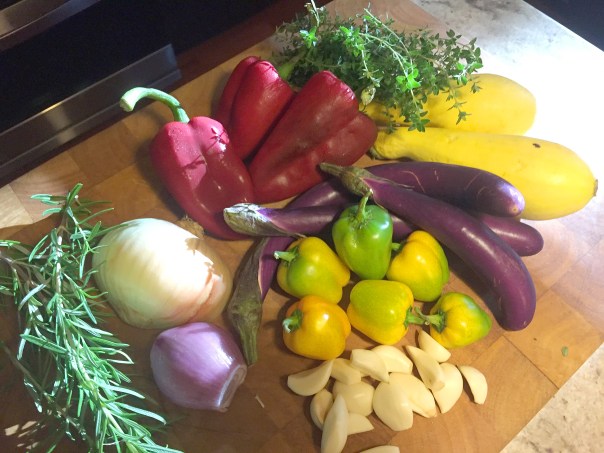
Our medley included vidalia onion, shallot, red bell peppers, mini green bell peppers, summer squash, eggplant, garlic cloves, rosemary and thyme.

One of our favorite additions is incorporating cloves of fresh garlic. Make sure to smash them slightly with the flat blade of a chef’s knife to infuse their flavor onto the rest of the participants. In the end, they caramelize adding a soft, mellow flavor to the overall dish.

img_7310
The cut veggies are added to a ziploc bag.

img_7313
Once the oil, herbs and spices are added, seal the bag and toss around.

Once you’ve cut them down to bite-size pieces, add them to a ziploc bag, pour in 1/4 cup extra virgin olive oil (or a good flavored one of choice), sprinkle in your minced herbs, and add about 1 1/2 teaspoons of kosher salt and a 1/4 teaspoon black pepper. Zip up the bag, toss around for several seconds to coat everything evenly. It’s best to let them marinate between 1-4 hours—any longer could compromise the integrity of some vegetables. If marinating longer than one hour, put in your frig until a 1/2 hour prior to grilling.
img_7317
Use a grill basket to keep the vegetables corralled. 

Turn on the burners on one side of the grill, placing your basket over the indirect heat side. Cover with grill lid, and turn every ten minutes or so for about 30-40 minutes, depending on which vegetables you are cooking. Once they seem soft enough, move over above the direct heat, turning every couple of minutes until you get the desired char. If you want to add cherry or grape tomatoes, don’t incorporate them into the mix until you move the basket over direct flames.
img_7318
The veggies are perfect once you see this slight char all over the medley. Move from grill basket to serving dish.

Some other vegetables to try in the medley:

  • Mushrooms (any kind)
  • Peppers (any kind)
  • Zucchini
  • Asparagus
  • Greeb Beans
  • Scallions
  • Butternut/Acorn Squash
  • Pattypan Squash
  • Fennel (sliced thin)
  • Fingerling potatoes, sliced in half (you should microwave these first for a few minutes)

img_7321
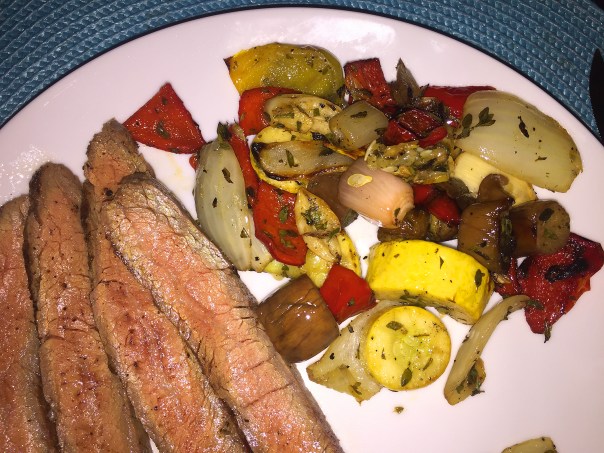
With a few slices of grilled flank steak, this made a perfect lo-carb meal.

So go ahead and experiment, just make sure you use a variety of colors, after all, we eat with our eyes first!


Be Proudah Yo Corn Chowdah

Corn season is winding down, so why not end it with a grand finale? This Creamy Corn Chowder is NOT one of those quick, get-it-done-in-15-minutes recipes. All said and done it’s going to takes nearly 3 hours to prep and cook, so take a page from my book and do the first two steps the night before—unless of course you have time on your hands… (and who the heck are you people anyway?)

It’s not necessarily diet-friendly either. But who says you have to shovel down a large bowlful? Enjoy a smaller amount (after all, it is filling), with a side salad for a complete meal—very French—all about pleasure. Eating is sensory, so eat with all five senses, and appreciate the little experiences of small portions and bites.

Fresno chiles are not the easiest to find, so the best substitute is a Jalapeño; and if you want to kick it up a notch use Serrano chiles (we incorporated 3 Serranos and the kick was barely discernible.) To make this vegetarian, just omit the bacon and replace with more shiitake mushrooms; sautéing them until they’re golden brown.

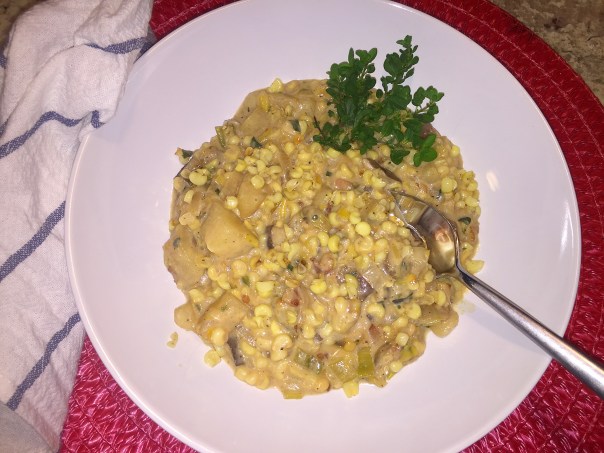
We both concurred, this was THE BEST corn chowder we’ve ever had! You’ll be dreaming about it until next corn season rolls around… Mmmmm… savor the flavor…

img_7378
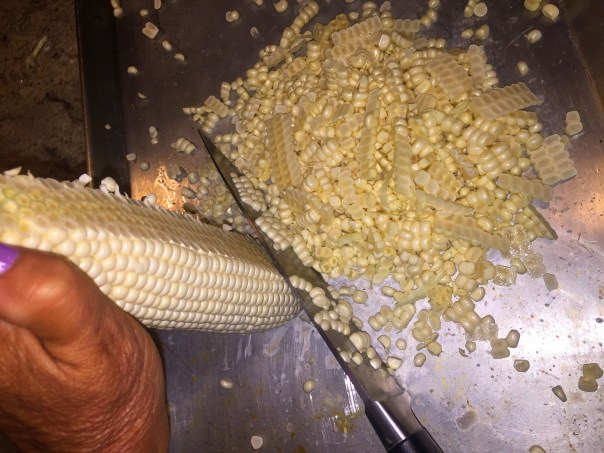
Slice the corn right off the cob with a large, sharp chef’s knife.

img_7380
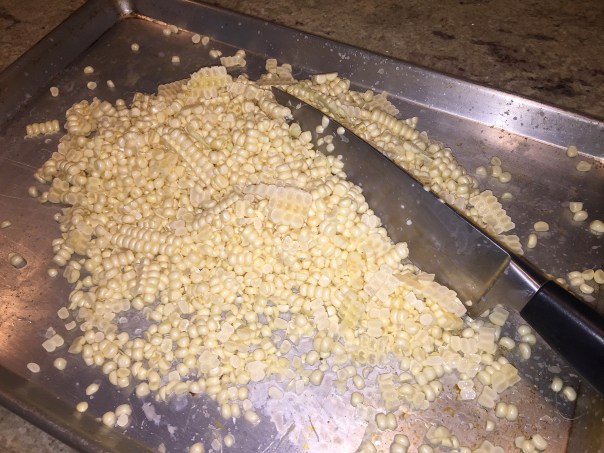
To catch errant kernels, use a rimmed baking sheet as you slice corn off the cob.

img_7383
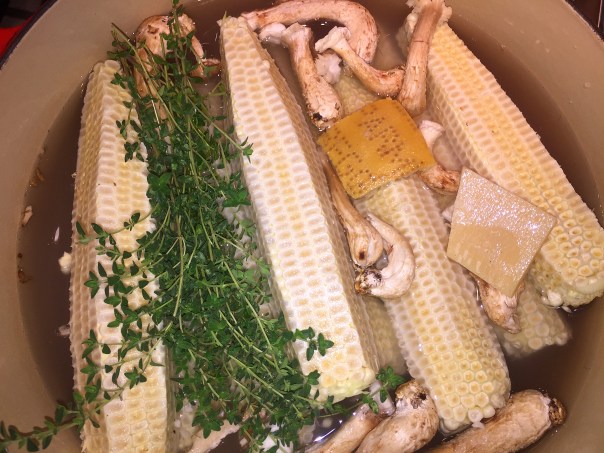
To make broth, add 8 cups water, cobs, parmesan rinds, mushroom stems, bay leaf and thyme.

img_7387
After simmering for nearly an hour, drain the solids from the broth.

Ingredients

  • 8 ears of corn
  • 2 Parmesan rinds (about 4 ounces; optional)
  • 4 ounces shiitake mushrooms, stems removed and reserved, caps cut into ¼-inch pieces
  • 2 sprigs thyme
  • 1 bay leaf
  • Kosher salt
  • 5 tablespoons unsalted butter, room temperature, divided
  • Freshly ground black pepper
  • ¼ cup dry white wine
  • 4 ounces thick-cut bacon, cut into ¼-inch pieces
  • 1 pound russet potatoes, peeled, cut into ½-inch pieces
  • 3 shallots, thinly sliced
  • 1 medium leek, white and pale-green parts only, quartered lengthwise, thinly sliced
  • 2 garlic cloves, finely grated
  • 2 Fresno chiles, seeded, finely chopped
  • 2 tablespoons all-purpose flour
  • 2 cups heavy cream
  • 1 tablespoon chopped marjoram
  • Chopped parsley and crushed oyster crackers (for serving)

img_7390
Heat butter in a large heavy pot, add corn kernels cook, stirring occasionally, until corn is tender and juices have evaporated and browned on the bottom of the pot.

img_7392
Add wine to pot and cook, scraping up browned bits, until liquid is syrupy.

img_7393
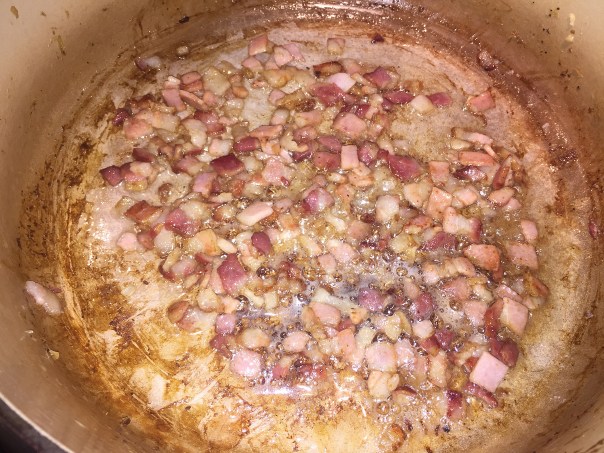
Cook bacon until golden brown and fat has rendered.

img_7395
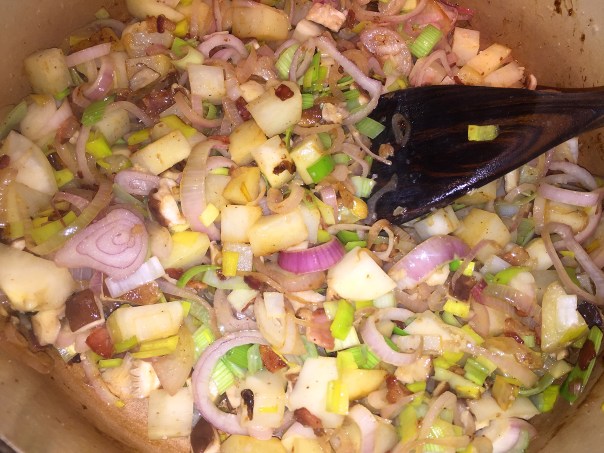
Add potatoes, shallots, leek, garlic, and chopped mushrooms and cook, stirring occasionally, until vegetables have softened.

img_7397
Add reserved broth, and cook, stirring occasionally, until potatoes are fork-tender; the chowder starts to thicken at this point.

img_7400
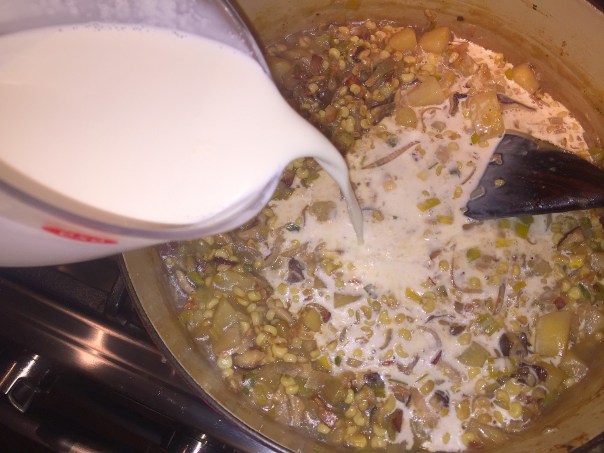
Next, add cream and corn mixture and cook, stirring, until chowder has thickened.

Directions

  1. Cut kernels from cobs and place in a large bowl. Place cobs in a medium pot and add Parmesan rinds, if using, mushroom stems, thyme, bay leaf, 2 tsp. salt, and 8 cups water.
  2. Bring to a boil, then reduce heat to medium-low and simmer, stirring occasionally, until broth is fragrant and reduced by half, 40–50 minutes. Strain through a fine-mesh sieve into a medium bowl; discard solids and set broth aside.
  3. Meanwhile, heat 4 Tbsp. butter in a large heavy pot over medium-high. Add corn kernels, season generously with salt and pepper, and cook, stirring occasionally, until corn is tender and juices have evaporated and browned on the bottom of the pot, 12–15 minutes. Reserve ½ cup corn for serving; transfer remaining corn to a medium bowl.
  4. Add wine to pot and cook, scraping up browned bits, until liquid is syrupy, about 2 minutes. Scrape into bowl with remaining corn.
  5. Heat remaining 1 Tbsp. butter in same pot over medium and cook bacon until golden brown and fat has rendered, about 6 minutes. Add potatoes, shallots, leek, garlic, and chopped mushrooms and cook, stirring occasionally, until vegetables have softened but haven’t taken on any color, 12–15 minutes.
  6. Add chiles and cook until fragrant and softened, about 3 minutes. Stir in flour and cook until nutty and fragrant, about 1 minute.
  7. Add reserved broth, bring to a boil, and cook, stirring occasionally, until potatoes are fork-tender, 10–15 minutes.
  8. Add cream and corn mixture and cook, stirring, until chowder has thickened, 5–10 minutes. Remove from heat and stir in marjoram. Let sit 15 minutes before serving.
  9. Divide chowder among bowls. Top with parsley, oyster crackers, and reserved ½ cup corn; season with pepper.
img_7407

Recipe by Rick Martinez from Bon Appetit


The Baum Shelter

As has been our practice for many years now, in late summer we often visit good friends Merry Sue and Fred Baum at their home of 16 years in Nazareth, PA lovingly dubbed “The Baum Shelter.” Their expansive panoramic view of the Blue Ridge Mountains (with the Appalachian Trail on the other side) is to die for, and it is so blissfully peaceful one can’t help but relax and decompress. So after some quick chit-chat, we don our swimsuits and head down to the in-ground pool to get our chill on…

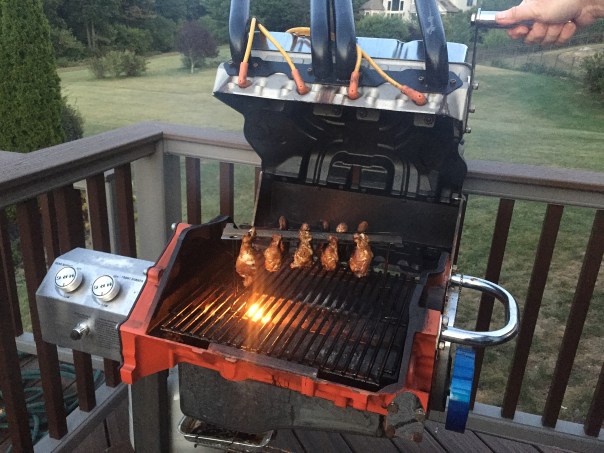
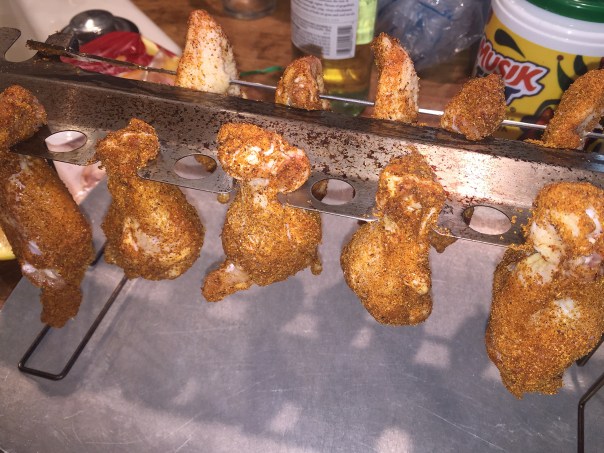
In the early evening we’re back up in the house for cocktail hour. My view from the kitchen barstool was watching Freddie prepare dinner. I’d be remiss if I didn’t blog about his chicken wing contraption. It was brilliant! He got the main piece from a local tractor supply company and did his mechanical engineering magic on it so that the drumsticks fit perfectly in the notches on one side, and the wings are threaded onto a skewer on the other side.

img_7355
Freddie threads the wing pieces onto the skewer side.

img_7357
The foreground displays the drum knuckles in the notches, while the wings hang in the background.

First, he made a dry rub mix, coated the chicken pieces, assembled them appropriately onto the wing gizmo, and then set the entire thing on a hot grill, resulting in perfectly cooked, nongreasy, crispy deliciousness. I liked mine with a squirt of Sriracha (I know, you’re shocked…)

img_7359
Russ and Fred pose in front of the wing gizmo, while Merry Sue buzzes by in the background.

img_7360
The wings are cooked over a hot fire on Fred’s engine grill.

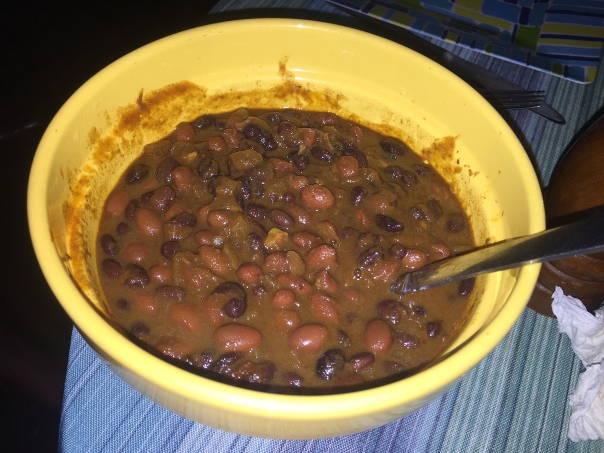
Along with the wings, we did “simple” for dinner including our shrimp cocktail, and the fresh corn on the cob picked the day before at our local farm market—can’t get much easier than that. Also on the menu were Fred’s homemade baked beans in a bourbon sauce, and his ginormous burgers made from a mix of ground beef and pork, chopped onion and spices, with your choice of cheese (I did Swiss), sliced red onion and fabulous tomatoes—compliments of the neighbor’s garden. I can’t believe I ate the whole thing!

img_7353

img_7364
The aroma of Fred’s tasty homemade baked beans in bourbon sauce wafted through the house upon arrival earlier that day.

img_7365
The burgers dwarfed the buns but allowed plenty of room for toppings.

img_7361
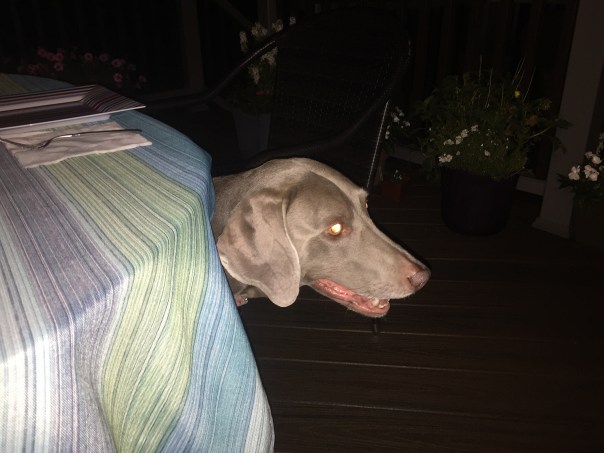
Weimaraner Lucy looks out from under the table hoping one of us will accidentally drop some food.

Sunday morning Merry Sue was the hostess-with-the-mostest serving as a short order cook making individual breakfast requests, one at a time. Apparently their new son-in-law-to-be who works in the hotel industry, informed them of the correct ordering system:

(Eggs over easy are a Merry Sue specialty)

img_7369
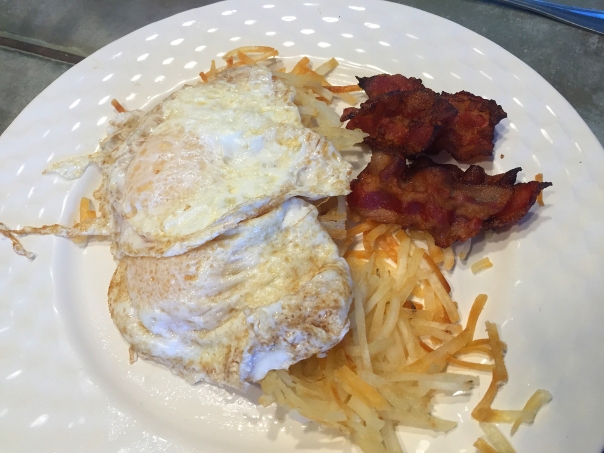
Russ’s #47: 2 eggs over easy on a bed of crispy hash browns with a side of bacon—hold the toast.

All four of us are crossword aficionados, and Sunday morning/afternoon we outdid ourselves solving four different versions in a row—which included the two biggies: The NY Times and Los Angeles Times. My head was hurting after that marathon…

As we filled in those squares, a conversation over a trip to the NY Finger Lakes in October began to take shape. So online we went only to find out every single B&B was booked up through Thanksgiving—people are serious about their fall foliage sightseeing in the Northeast. I guess I had a few brain cells left because I suggested the Hudson River Valley as an alternative, and luckily we scored—that story to be continued…

img_7375
Attire for the weekend is T-shirt and sandal casual.

Only an hour and a half away via several major interstates, yet it feels like another world when visiting The Baum Shelter. Late Sunday afternoon crept up on us and it was time to head back to reality—but we know in a few short weeks we’ll be getting together again and exploring the Hudson River Valley… and patronizing some of their restaurants…


You’re Definitely Going to Want Leftovers

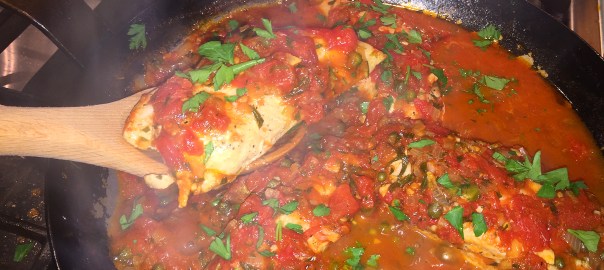
This recipe was originally developed by Pierre Franey in 1991 for the 60-Minute Gourmet column, a weekly feature dedicated to Times-worthy dishes that were easy, quick and inexpensive. Chicken Breasts with Tomatoes and Capers fit the bill perfectly, and it still does today. Just sauté the chicken breasts until they are lightly browned. Then add shallots and garlic, tarragon, tomatoes, vinegar, capers, white wine and tomato paste. Stir well and cook for about 9 minutes more. That’s it. Or at least, that’s what they wrote…

A slew of ripe locally-grown tomatoes lined our countertop which we used as opposed to plum or canned. If using fresh, the directions didn’t mention removing the tomato skins, which can create a stringy, unappealing texture in an otherwise lovely sauce. So off they came!

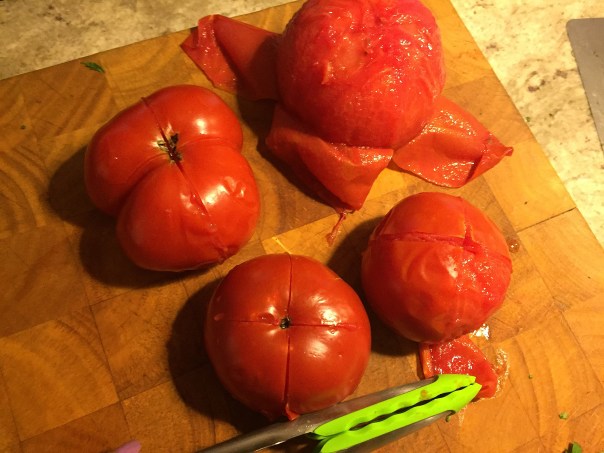
I have found the easiest way to remove skins is to slice a shallow X on the bottom of the fruit, drop them top down into a pot of boiling water for only 30 seconds, remove and place the tomatoes directly into a prepared bowl of ice water and let them cool off. This will help to stop any “cooking” that has started.

img_7291
After boiling for 30 seconds and plunging into a cold bath, the skins are easily removed.

img_7293
Slice down the skinless tomatoes and remove the seeds and liquidy flesh, then chop down and drain.

Nor do the directions indicate to drain the plum tomatoes, and even though I sliced our big boys and removed the seeds and liquidy flesh, I still should have drained them of excess moisture. Several reviewers removed the chicken while the sauce cooked down to a desired consistency, avoiding overdone, rubbery fowl, so I decided to heed their advice.

Our mixture was quite watery indeed requiring an extra 30 minutes (not exactly desirable on a weeknight) to reduce and thicken the sauce to the desired consistency. Then I replaced the chicken, and covered the skillet for about 5 minutes until done. Russ thinks next time, after the garlic and shallots are fragrant, we should pour in the other liquids (wine and vinegar) and let it burn off some, thus eliminating some moisture up front. That’s what I like about that guy, he’s always thinking…

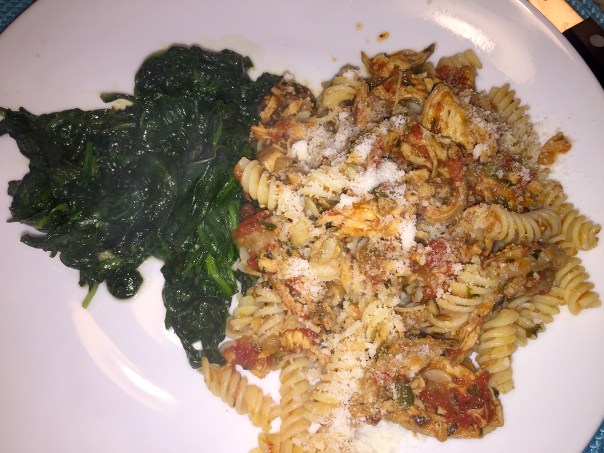
Our changes are incorporated in the directions below. Do yourself a favor, to save time use canned San Marzano tomatoes, you’ll eliminate several steps—and I’m guessing with equally amazing results! Luckily, we had leftovers, so we shredded the chicken, reheated the sauce and served over pasta. Would also be really good over mashed potatoes, rice, or polenta.

img_7288

Ingredients

  • 4 boneless, skinless chicken breasts (about 2 1/4 pounds)
  • Salt and freshly ground white pepper to taste
  • 2 tablespoons olive oil
  • 2 tablespoons butter
  • 6 tablespoons finely chopped shallots
  • 2 teaspoons finely chopped garlic
  • 4 teaspoons finely chopped fresh tarragon, or 2 teaspoons dried tarragon
  • 1 28-ounce can of San Marzano tomatoes, drained and chopped (or 8 ripe plum tomatoes cut into small cubes and drained)
  • ¼ cup red wine vinegar
  • ¼ cup drained capers
  • 1 cup dry white wine
  • 2 tablespoons tomato paste
  • ¼ cup chopped fresh parsley leaves

img_7294
Salt and pepper both sides of the chicken breasts.

img_7296
In a large skillet, brown all sides in butter and oil.

img_7297
After the chicken is browned for about 5 minutes, sauté the minced shallot and garlic.

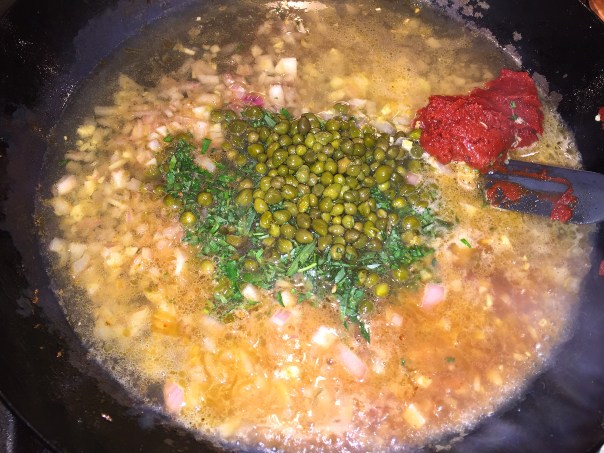
img_7298
Next time, we will add the white wine and vinegar to the shallot-garlic sautée before adding the rest of the ingredients to reduce down the amount of liquid. 

Directions

  1. Sprinkle the chicken with salt and pepper. Heat the oil and butter in a heavy-bottom skillet. Add the chicken breasts and saute over medium-high heat, turning the pieces often until lightly browned, about 5 minutes.
  2. Move chicken to a platter and cover with tin foil.
  3. Add the shallots and garlic to the hot skillet. Cook briefly; then add the white wine and red wine vinegar, reducing down about 2 minutes.
  4. Next add the tarragon, tomatoes, capers, and tomato paste. Stir to dissolve the brown particles adhering to the bottom of the skillet.
  5. Blend well, bring to a boil, and simmer for 9 minutes or more, reducing to preferred consistency.
  6. Add the chicken back to the skillet, cover and simmer for 5 minutes (longer if necessary, check with a meat thermometer.)
  7. Sprinkle with parsley and serve.

img_7304
The original meal was so good we were glad there were leftovers… 

img_7324
Leftovers mixed with pasta and a side of sautéd spinach, really good!

The New Kid in Town

Oh, my, my… There’s a new kid in town
Ooh, hoo
Everybody’s talking ’bout the new kid in town
Ooh, hoo
Boccaccio come lately, the new kid in town…
(paraphrased from The Eagles song)

For reasons we couldn’t fathom, one of our favorite BYO’s in Newtown, Tiramisu, closed unexpectedly this past spring. Every time we’d drive by the shuttered facility on State Street, we’d anxiously glance to see if a new restaurant had taken over. Finally we were rewarded with the sign “Now Open, Boccaccio, authentic Italian food.”

The first opportunity I had to check it out was a night Russ had other commitments so I enticed my “gal-pals” Rosanne and Jeremy to join me on a maiden voyage. Arriving first, I was greeted by the host Rosalba (who I’d later find out was the owner), and once seated, John our waiter asked about water preference and explained the specials will be revealed when the rest of the party appears.

img_7340
Husband and wife team Rosalba and Antonio.

While I waited, it gave me a chance to eyeball the new decor which was fresh and clean, leaning toward the modern, but not drastically changed. With the extra time I also scrutinized their dinner menu, and while not huge in scope, it offers about a dozen choices each under their tempting Appetizers, Pastas, and Main Entrees lists.

My gals appeared shortly and we set about uncorking the wine and chatting up a storm before John came by to entice us with the specials of the night. As we pondered what to order, we received a bread basket containing a few varieties paired with a dish of olive oil layered with fresh herbs and spices.

IMG_7350.jpg

As an appetizer we all agreed to share the Gamberoni, consisting of three large, pancetta-wrapped shrimp that were dipped in beer batter, lightly fried to perfection and served with homemade buffalo sauce. OMG, you have to try these babies! The sauce had a bit of a kick to it, but nothing overwhelming.

img_7326

Side salads are not usually something to write home about, but I must admit, their homemade dressing  contained stone ground mustard that was just delicious topping the crisp-fresh salad ingredients.

img_7330

For some odd reason it is uncommon for me to order pork when we dine out—I don’t know why, I love pork! Although several decades ago there was about a 10-year period when I did’t eat it at all. Again, don’t know why, just didn’t. But I kept going back to the Macellaio on the menu and decided that was the dish for me. Jeremy was torn between a few different items, but in the end, copied me and got the pork too.

The 10-ounce tenderloin finished with sun-dried tomatoes came plated with a crown of broccoli rabe and sliced garlic resting on a bed of the most creamiest mashed potatoes I’ve indulged in recently, all nestled in a shallow wash of marsala sauce. While the broccoli rabe was very tasty, my only complaint about the dish was that the stems were a bit tough to cut through. Nonetheless, the meal was a winner!

img_7331

After careful consideration, Rosanne opted for one of the night’s specials, Lobster Ravioli which arrived bathing in a white wine and cheese sauce with pancetta bits and cherry tomatoes—although they weren’t visible to the eye. When Rosanne mentioned that the tomatoes were missing, she was told they were part of the sauce. OK, we went with that…

img_7332

As you know, dessert is just not my thing, but Jeremy and Rosanne couldn’t resist sharing an order of the Crème Brûlée, and what a pretty presentation it was. The dessert consists of a rich custard base, traditionally flavored with vanilla, topped with a contrasting layer of hard caramel and served at room temperature. A two-spoon effort, I wasn’t hearing any complaints from the gal-pals.

img_7341
Crème Brûlée is also one of Russ’ faves, and after hearing our rave reviews, he can’t wait until we go back.

img_7347

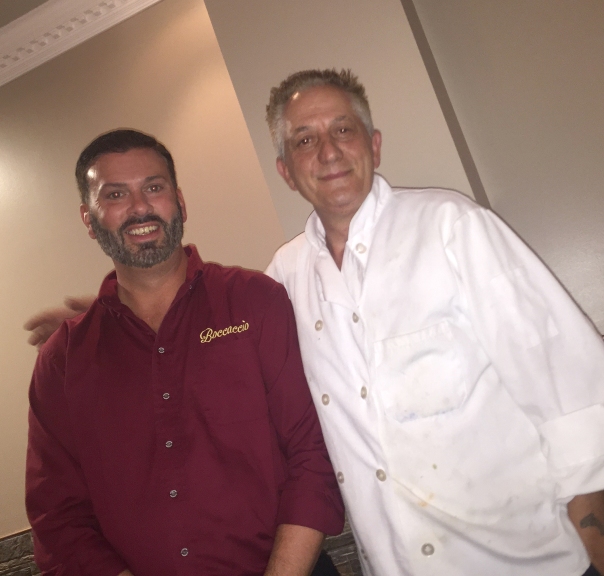
As noted on their website, Chef Ciro started cooking in Italy at the age of 8 and studied to become a chef in Tuscany, after which he moved to the U.S. and worked in Atlanta for a hotel chain before opening Boccaccio. Lucky for us, Ciro (above in the chef’s jacket) agreed to pose for a photo with waiter John. It was becoming a family affair—and that’s exactly how they made us feel, like family!

img_7346
A parting gift, Italian chocolates!

Congrats to the entire Boccaccio team. All hail the new kid in town, who hopefully will become a well-known neighbor for years to come!

Multi-Dimensional Steak Glaze

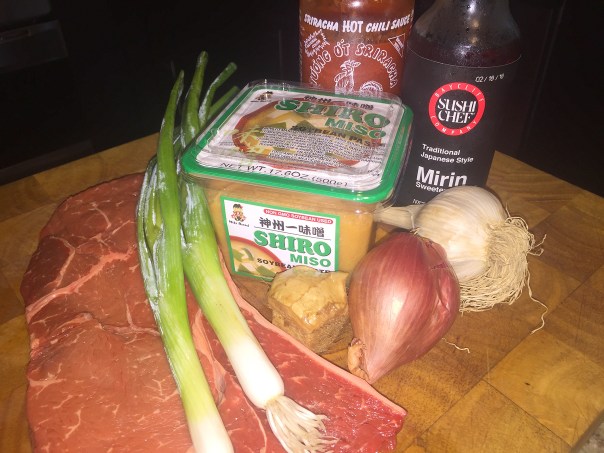
Here’s another recipe using my much beloved Miso, which makes me-so-happy! This time we made sure to have the white variety on hand for the Hanger Steak with Spicy Miso Glaze. Failing to locate it in the refrigerated section of the supermarket where we’ve always found it in the past, a grocer lead us to a container sitting on a shelf in the ethnic food aisle. Who knew? We didn’t, but now we do.

What the supermarket did not have though, was hanger steak. Grrrrrr. A butcher saw our frustration and said he would order it for us to pick up later in the week. Unfortunately, that was going to be too late. For a long period of time it wasn’t even sold to the general public, reserved mostly for ground beef, or taken home by the butchers (earning it the nickname “butcher’s steak”)—hmmm, maybe they DID have some lurking in the back chiller after all…

These days, it’s become so popular that it’s no longer as dirt cheap as it used to be—after all, there are only two on each steer, and they aren’t particularly large—but it still comes in at around half to a third the price of a typical high-end steak at the supermarket. If you can’t find it, use sirloin tip steak like we did, keep in mind it just cooks more quickly.

And for this reason, we made adjustments with the directions. Figuring the steak would be overcooked if we finished it in a 400 degree oven, we eliminated that step. And good thing because after only 6 minutes of pan searing, the meat was perfectly medium-rare. And that glaze! It hinted at most of the five basic tastes—salty, sour, sweet and umami (savory)—except perhaps bitter—providing a multi-dimensional tasting experience.

So if you plan to make this delicious recipe, ask your butcher to order hanger steak for you ahead of time. Lesson learned.

IMG_6752

IMG_6759
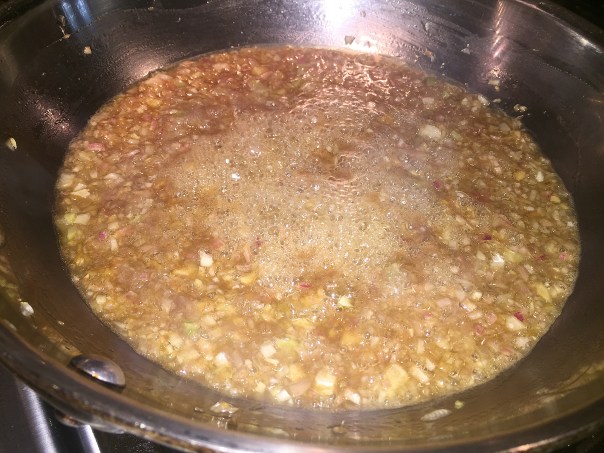
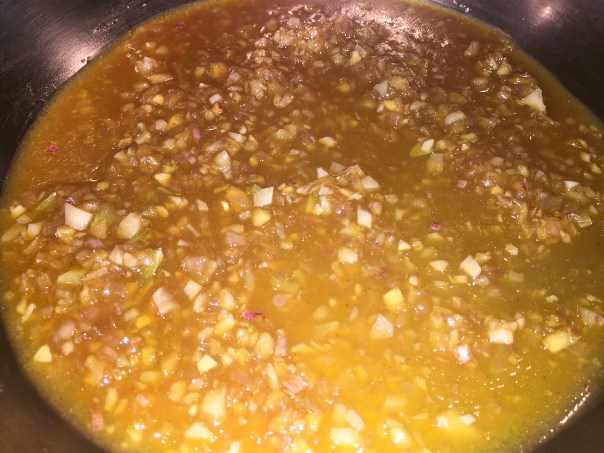
Simmering the mirin, shallots, ginger, and garlic over medium heat until the mixture is syrupy and large bubbles form.

IMG_6760
Grapeseed oil, miso, and the hot sauce are added after the skillet is removed from the heat.

Ingredients

  • 1/2 cup mirin
  • 2 Tbs. minced shallots
  • 2 Tbs. minced fresh ginger
  • 1 tsp. minced garlic
  • 1 Tbs. plus 2 tsp. grapeseed oil
  • 2 tsp. light miso
  • 1/4 tsp. Asian hot sauce, such as Sriracha
  • 1 1-3/4- to 2-lb. hanger steak, trimmed
  • Kosher salt and freshly ground black pepper
  • 1/4 cup thinly sliced scallions

IMG_6761
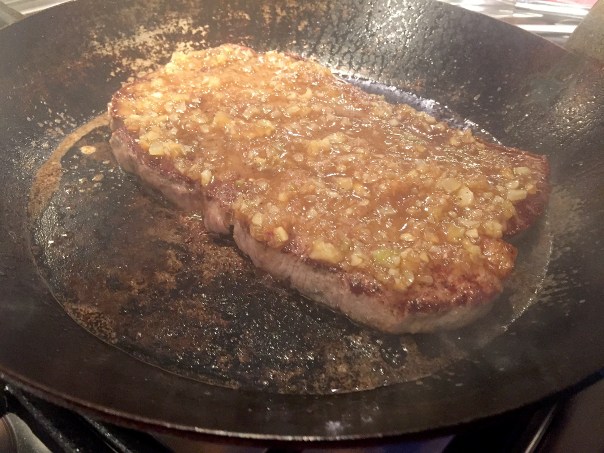
Cook the steaks over high heat, flipping once, until browned, about 4 minutes total.

IMG_6762
We spread the glaze evenly over the steaks with a spoon instead of a pastry brush. It is here that you would put into a 400°F oven if cooking hanger steak.

IMG_6763
Instead of putting in the oven, we cooked the sirloin a minute or two longer in the skillet until it reached 130°F to 135°F for medium rare.

IMG_6770
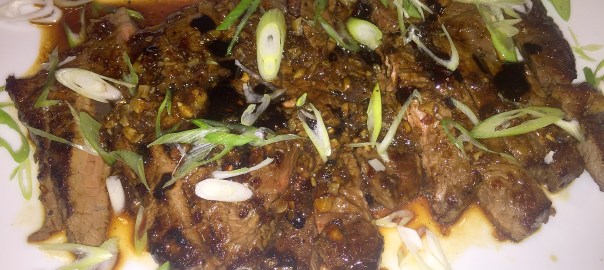
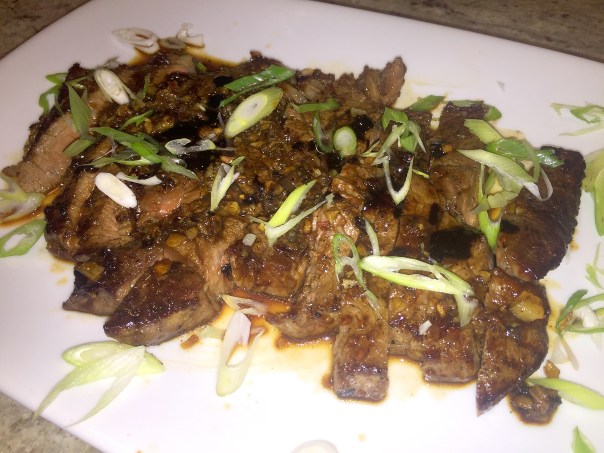
After resting for five minutes, the sirloin was sliced down, topped with the glaze and sprinkled with sliced scallions.

Directions

  1. Position a rack in the center of the oven and heat the oven to 400°F.
  2. Simmer the mirin, shallots, ginger, and garlic in an 8-inch skillet over medium heat until the mixture is syrupy and large bubbles start to form, about 5 minutes. Remove from the heat and whisk in 1 Tbs. of the grapeseed oil, the miso, and the hot sauce. Set aside.
  3. Season the steaks generously with salt and pepper. Heat a 12-inch oven-safe skillet over high heat until very hot. Add the remaining 2 tsp. oil, swirling it until the pan is well coated. Cook the steaks, flipping once, until browned, about 4 minutes total.
  4. Using a pastry brush, spread the glaze evenly over the steaks, transfer to the oven, and roast until an instant-read thermometer inserted into the thickest part of the steak reads 130°F to 135°F for medium rare, about 4 minutes.
  5. Transfer the steaks to a cutting board, let rest for 5 minutes, and then cut on the diagonal into 1/2-inch-thick slices. Pour any juice remaining in the pan over top and sprinkle with the scallions.

Adapted from Arlene Jacobs of Fine Cooking

IMG_6772

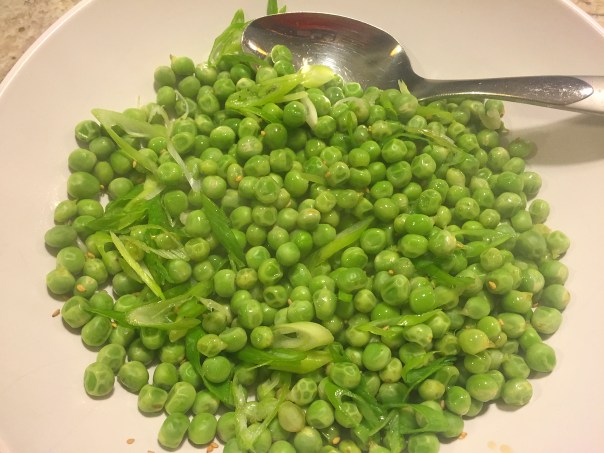
Side Dish: Scallion-Sesame Sweet Peas

  • 2 cups peas (fresh or frozen)
  • 1 Tbsp. toasted sesame seeds (white and black if you have them)
  • 2 scallions, slivered
  • 1 tsp. Asian sesame oil

Cook peas until tender, about 3 minutes over high heat, drain. Toss with the sesame seeds, scallions and sesame oil. Salt and pepper to taste.

Short on Time?

If spicy is your thing, and it sure is mine, than you have to try this very easy, very healthy, and very, very quick Spicy Miso-Broiled Shrimp dinner. In it, white miso, ginger, and cayenne combine to give this shrimp dish a bright, savory flavor with a punch of heat. Keep it brisk and serve it with some sautéed watercress and bok choy, a quick Asian take on sautéed greens.

One side note, if you are using a gas stove, the broiler will take quite a few more minutes than an electric stove broiler would. I swear, next time we purchase a new range, we’re highly considering a gas stove top with an electric oven for that very reason… As you can tell, I am not a fan of gas oven broilers ;(

IMG_7198
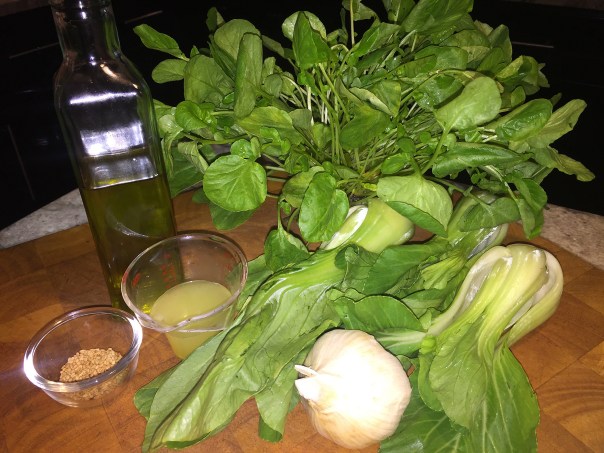
Ingredients are gathered for the shrimp dish.

Ingredients

  • 3 medium scallions, sliced, whites and greens separated
  • 1 Tbs. chopped fresh ginger
  • 1 Tbs. fish sauce
  • 2 tsp. white miso
  • 2 medium garlic cloves, coarsely chopped
  • 1/2 tsp. ground cayenne; more to taste
  • 1/2 tsp. sweet paprika
  • 1-1/2 lb. colossal shrimp (13 to 15 per lb.), peeled and deveined, tails left on

IMG_7202
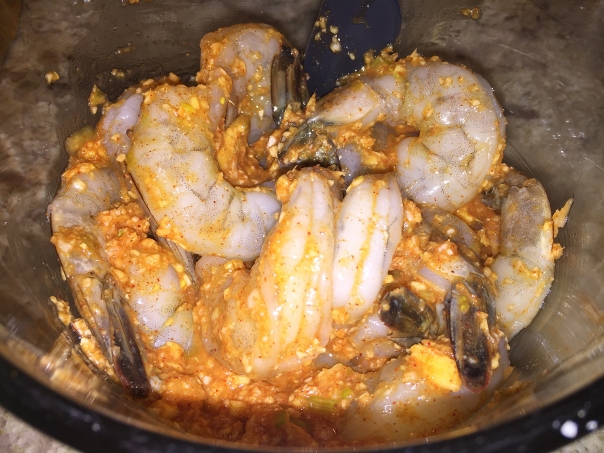
The colossal shrimp marinate in the pungent chunky paste.

IMG_7204
In a half sheet pan lined with foil, we arranged the shrimp in preparation for the broiler.

Directions

  1. Position a rack 6 inches from the broiler and heat the broiler on high. Line a rimmed baking sheet with foil.
  2. In a small food processor, combine the scallion whites, ginger, fish sauce, miso, garlic, cayenne, paprika, and 2 Tbs. water and pulse to a chunky paste. Transfer to a large bowl, add the shrimp, and toss to coat.
  3. Spread the shrimp on the baking sheet and broil, flipping once, until opaque, about 7 minutes.
  4. Drizzle any liquid from the shrimp pan over the shrimp, and garnish with the scallion greens.

IMG_7210
by William Mickelsen from Fine Cooking

Sautéed Watercress and Bok Choy

IMG_7196

Ingredients

  • 2 tsp. vegetable oil
  • 3 cloves garlic, thinly sliced
  • 7 to 8 oz. watercress, cut into 1-inch pieces
  • 4 oz. trimmed baby bok choy, cut into 1-inch pieces
  • Kosher salt
  • 2 Tbs. chicken broth or water
  • 1/2 tsp. toasted sesame seeds

IMG_7207

Directions

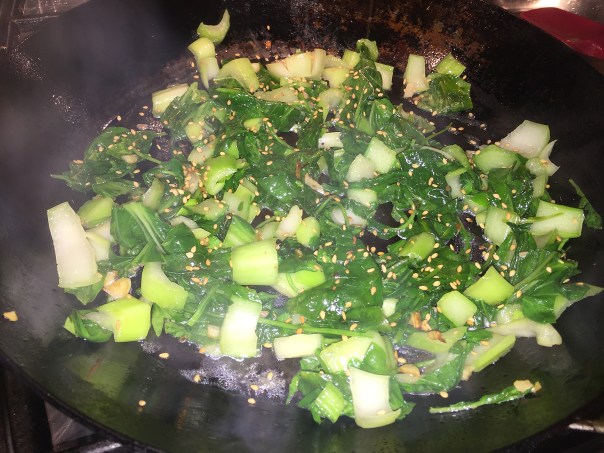
Heat the oil in a 12-inch skillet over medium-high heat. Add the garlic and cook, stirring, for 30 seconds. Add the watercress and bok choy; sprinkle with 1/2 tsp. salt. Add the chicken broth or water, cover, and cook, stirring occasionally, until just wilted, about 2 minutes. Sprinkle with the sesame seeds.

by Genevieve Ko from Fine Cooking

La Salade de Pommes de Terre

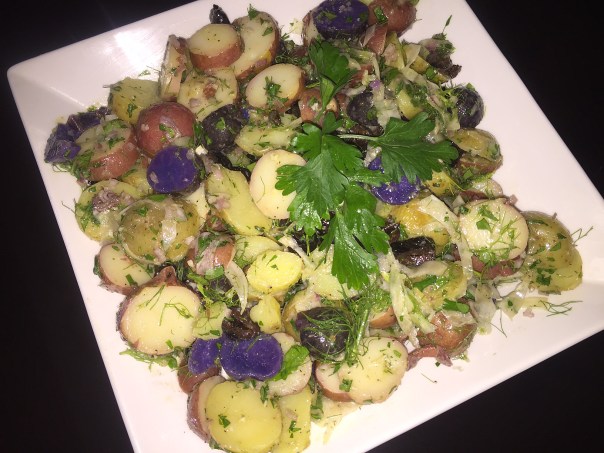
Seems I’ve been on a French kick the last few blogs, so I thought I’d follow up with yet another one, this time with French Potato Salad with Fennel, Tomato and Olives adapted from Cooks Illustrated.

IMG_7264
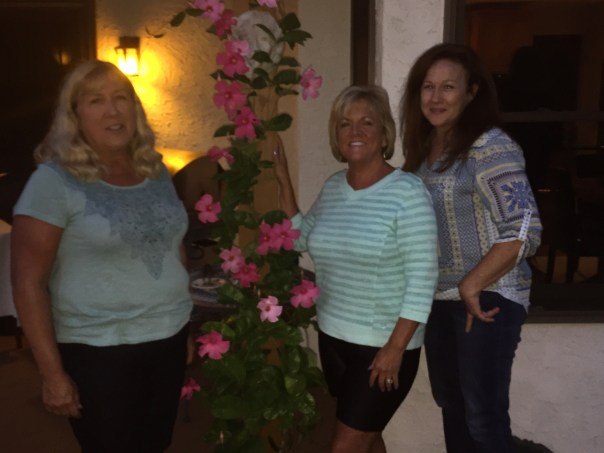
Barb, Lynn and Fran pose by the flowering mandeville.

IMG_7269
Grant, Russ and Brad are enjoying the evening and the fact that Hurricane Hermine was a bust for us.

We were invited to a weekend BBQ, and offered to bring a side dish—but the main course had not yet been decided. What goes with just about everything that might be grilled? One answer to that is potato salad. To be perfectly honest, we are not huge fans of mayo-based potato salads, so Russ mentioned a French recipe he recently found that was vinegar and mustard-based. C’est génial!

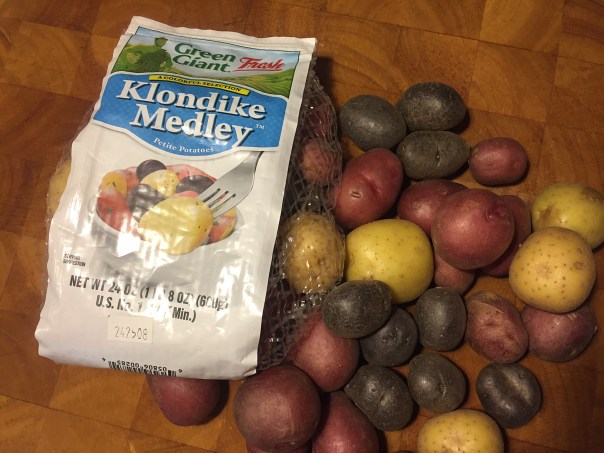
Of course we often find ourselves altering a recipe, and this was no exception. Instead of all small red potatoes, we used the red, white and blue variety (after all, it was patriotic Labor Day weekend.) And because we thought the coloring might bleed while boiling, producing an unappealing muddy-gray color, they were boiled whole and sliced afterward.

A couple of other tweaks were eliminating the tomato altogether, and using only about a quarter of the fennel bulb, sliced wafer-thin. Fennel can be overwhelming if used with a heavy hand, and we wanted the potatoes and other ingredients to “have their say” as well. Oh, and I completely forgot to save a 1/4 cup of the potato water, even though I put a measuring cup right next to the boiling pot (I cashed in a “senior moment” card), so I added about an 1/8 cup hot water to the dressing to thin it slightly.

Deliscioso!

IMG_7249

Ingredients

  • pounds small red potatoes (about 2-inch diameter), unpeeled, scrubbed, and cut into ¼-inch-thick slices
  • tablespoons table salt
  • medium clove garlic, peeled and threaded on skewer
  • 1 ½ tablespoons champagne vinegar or white wine vinegar
  • teaspoons Dijon mustard
  • ¼ cup olive oil
  • ½ teaspoon ground black pepper
  • small shallot, minced (about 2 tablespoons)
  • tablespoon minced fresh parsley leaves
  • bulb fennel, sliced very, very thin
  • medium tomato (about 6 ounces), peeled, seeded, and diced medium (optional)
  • ¼ cup black olives (oil-cured), pitted and quartered

IMG_7251
A clove of garlic is skewered and partially blanched in the hot water.

IMG_7254
I parboiled the potatoes first before slicing them so the colors wouldn’t bleed.

IMG_7255
The mustard vinaigrette is drizzled over the warm slices.

Directions

  1. Place potatoes, 6 cups cold tap water, and salt in large saucepan; bring to boil over high heat, then reduce heat to medium. Lower skewered garlic into simmering water and partially blanch, about 45 seconds. Immediately run garlic under cold tap water to stop cooking; remove garlic from skewer and set aside.
  2. Continue to simmer potatoes, uncovered, until tender but still firm (thin-bladed paring knife can be slipped into and out of center of potato slice with no resistance), about 5 minutes. Drain potatoes, reserving 1/4 cup cooking water. Arrange hot potatoes close together in single layer on rimmed baking sheet.
  3. Press garlic through garlic press or mince by hand. Whisk garlic, reserved potato cooking water, vinegar, mustard, oil, and pepper in small bowl until combined. Drizzle dressing evenly over warm potatoes; let stand 10 minutes.
  4. While potatoes are standing, trim fennel bulb of stalks and fronds; roughly chop fronds (you should have about 1/4 cup). Halve bulb lengthwise; using paring knife, core one half of bulb, reserving second half for another use. Cut half crosswise into very thin slices.
  5. Toss shallot and parsley in small bowl. Transfer potatoes to large serving bowl; add shallot/parsley mixture, fennel, tomato, and olives; mix gently with rubber spatula to combine. Serve immediately

For best flavor, serve the salad warm, but to make ahead, follow the recipe through step 2, cover with plastic wrap, and refrigerate. Before serving, bring the salad to room temperature, then add the shallots and other ingredients. When chopping the fennel fronds, use only the delicate wispy leaves, not the tough, fibrous stems to which they are attached.

IMG_7257


The French Connection

Take a schlep out to Montgomery County to try this quaint little bistro with chef extraordinaire Sam Jacobson, who brought his signature skills to Jenkintown (the town where Russ resided before we shacked up together 😉  The place? Shabby chic Leila’s Bistro, an ambitious 28-seat BYOB serving innovative French-inspired American fare. (It’s previous life was an optometrist’s digs.)

LEILA: Name of Arabic origin, and means “night beauty”. An exotic, beautiful, caring name—describing a beautiful woman, who has charm and class.

Good friend and previous coworker with Russ, Lorraine “Witty” Winsey suggested we pick the venue so we researched convenient destinations somewhere between her place of residence and ours. Russ immediately thought of a restaurant he’s been itching to try that garnered great reviews with an overall rating of 4.7 out of 5 stars. With Lorraine’s blessing, reservations at Leila’s were made for the Friday of Labor Day weekend.

Situated on a street corner with one small sidewalk bistro table, it’s not exactly an ideal al fresco dining experience, so we ventured in and were offered a choice of tables. You have to understand, for most of the second half of the summer, East Coast weather ran inhumanely hot and humid, but on the day we patronized Leila’s it was spectacular, a 10-out-of-10! Luckily we had both taken off of work and enjoyed the great outdoors for most of the day, so sitting inside was not an issue.

With Lorraine treating, we offered to bring the wine, a red and a white also of French persuasion, which we thought would pair perfectly with the restaurant’s theme. It had been over a year since we all saw each other so we spent a good twenty minutes catching up while sipping our libations. During this chat we found out “Witty” (my new nickname for her since she is just a hoot a minute) had a connection to Jenkintown too. Apparently her ex-husband was from the town, yet she hadn’t been there in nearly 30 years!

Their menu is a simple white piece of paper with an unembellished list of that days starters and entrees, offering 6-8 of each. Both Lorraine and hubby ordered uncommon appetizers with Russ choosing the Fried Brussels Sprouts with bacon and caramel. I tasted them and WOW were they good!

IMG_7243

IMG_7241

IMG_7235

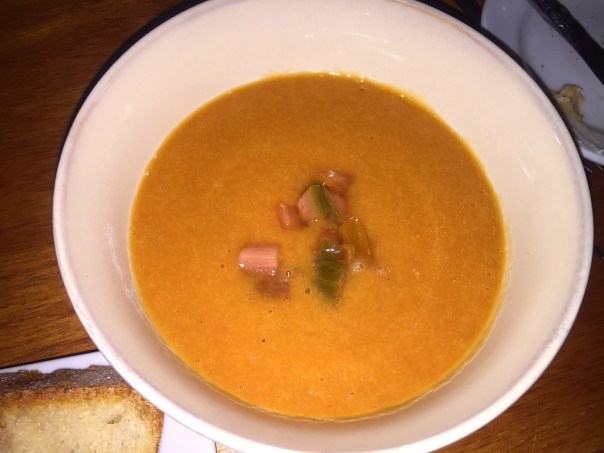
Lorraine selected the very summery Peach Gazpacho with pickled grapes and cucumber. What an interesting combination and beautiful presentation! And apparently very tasty too because that bowl was almost spotless when she was done. While my choice, Mixed Green Salad with stone fruit dressing and arugula, was boring in comparison, it was none-the-less trés bon.

IMG_7246

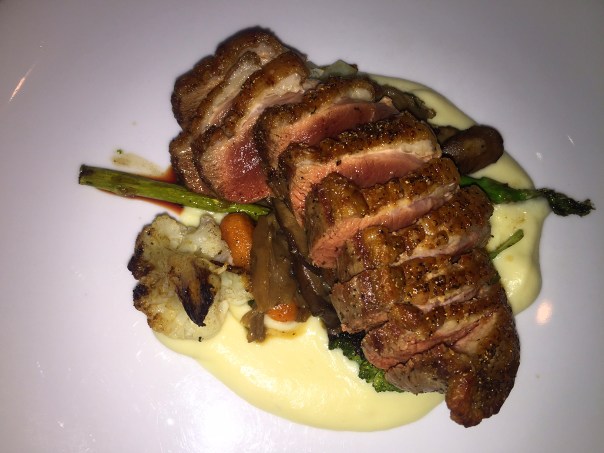
I should have bet money on Russ’ entree choice beforehand because he barely hesitated before choosing the Duck Breast which came with an outstanding mushroom ragout and parsnip puree. It apparently called out to Lorraine also because she got the same thing—and they concurred, the meal was magnifique!

IMG_7244

Me, I felt adventurous and selected the Fish of the Day: Black Drum served in a spicy yellow pepper sauce on a bed of kale. What I learned was Black Drum Fish have a mild, sweet flavor with firm flesh and large, moist flakes—comparable to Red Snapper—but the flesh of Black Drum lack hues of color and are simply white. Both the Red Drum and Black Drum Fish have similar flavors, although Black Drum has a coarser, meatier flesh. The smaller fish of both species tend to be sweeter and flakier. Yes indeedy, I would order it again.

In fact, we will make a concerted effort to return to Leila’s because small little “J-Town” is making a name for itself as a destination spot with it’s new restaurants (yes there are several more), and the nostalgia factor for Russ who lived there for 17 years.

Leila connection factoids: Back in my 20’s I had decided if I ever had a daughter, I would name her Leilyn; and to this day Eric Clapton’s song Layla invokes many a good memory…