Tag Archives: white wine

Roman-Style Chicken Cacciatore

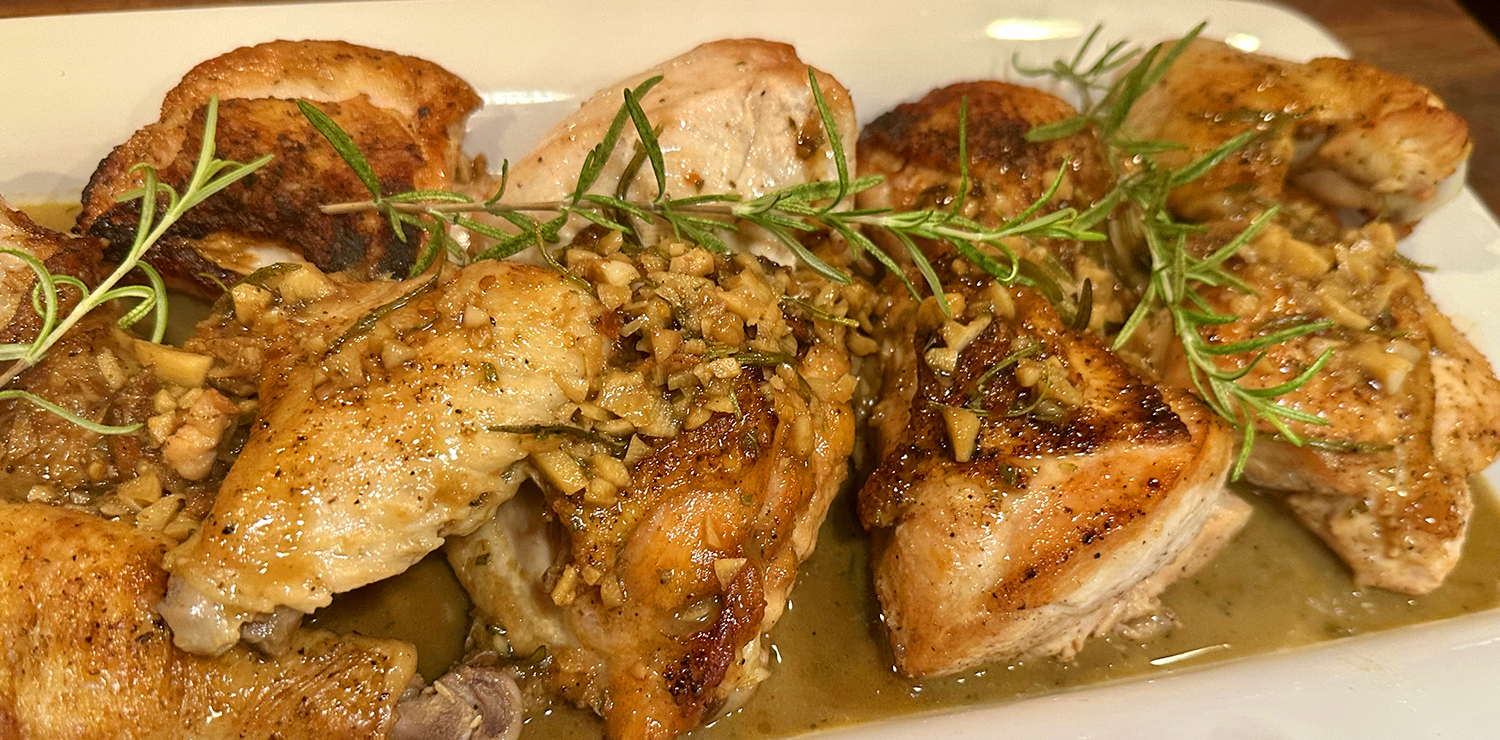
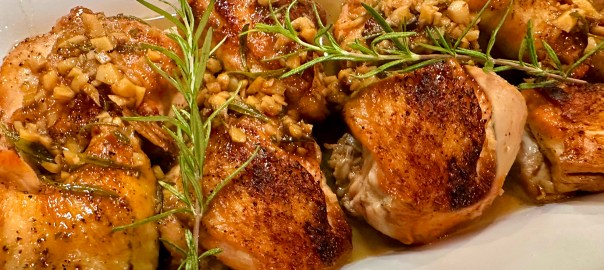
Cacciatore without tomatoes? As it turns out, it is not always a chunky, tomato-heavy braise. At Piatto Romano in Rome, Milk Street learned how to make the Roman version—an elegant, minimalist dish bright with the acidity of white wine and vinegar and heady with rosemary, garlic and anchovies, not a tomato in sight. (And you would never know there were anchovies in it.)

With so few ingredients, deeply searing the bone-in, skin-on pieces is necessary for developing rich flavor. A quick sauté of aromatics followed by a deglazing with a full bottle of a light, dry white wine forms the cooking liquid that becomes the fabulous sauce.

To preserve the chicken’s browning during braising, the pieces are only partially submerged in liquid and cooked, uncovered, to completion in a 450°F oven; the dry heat keeps the skin crisp and caramelized even as the liquid simmers in the bottom of the pan. (You will need an oven-safe 12-inch skillet for this recipe.)

A good measure of white wine vinegar and minced rosemary finishes the dish, adding a surge of tartness and herbal notes to keep the flavors vibrant. This cacciatore is best with a starchy side, such as crusty bread, polenta or mashed potatoes. We served ours with garlic and rosemary-infused mashed potatoes, and a side of roasted carrots and Brussels sprouts.

What a tremendous weeknight meal that can just as well be the feature of an intimate dinner party. Adding the final zip of vinegar is just the right balance of acid.

Don’t forget to lower the heat before adding the wine. This helps prevent fiery flare-ups if the wine splashes out of the skillet.

Instead of chicken pieces, we used a whole chicken, cut it up and saved the remaining body parts (neck, back, heart, etc.) to add to our “body bag” of frozen chicken parts for future homemade stock.

Roman-Style Chicken Cacciatore

  • Servings: 4-6
  • Difficulty: easy
  • Print

Ingredients

  • 3-4 lb. bone-in, skin-on chicken thighs or breasts, trimmed and patted dry
  • Kosher salt and ground black pepper
  • 2 Tbsp. extra-virgin olive oil
  • 6 – 8 oil-packed anchovy fillets, patted dry
  • 6 medium garlic cloves, minced
  • 3 5-inch rosemary sprigs, plus 1 tsp. minced fresh rosemary, reserved separately
  • 1/4 tsp. red pepper flakes
  • 750 mL bottle dry white wine, such as pinot grigio or frascati
  • 1/4 cup white wine vinegar

Directions

  1. Heat the oven to 450°F with a rack in the middle position. If the chicken breasts are larger than about 12 ounces each, cut them in half crosswise. Season the chicken all over with salt and pepper.
  2. In a 12-inch oven-safe skillet over medium-high, heat the oil until shimmering. Add the chicken skin-side down and cook until golden brown on both sides, 8 to 10 minutes, flipping the pieces halfway through. Transfer to a large plate; set aside.
  3. To the skillet over medium, add the anchovies, garlic, rosemary sprigs and pepper flakes. Cook, stirring, until the anchovies have broken down and the mixture is fragrant, about 1 minute. Reduce to low, then slowly add the wine. Bring to a simmer over medium-high and cook, scraping up the browned bits, until the wine has reduced by about half, 8 to 10 minutes.
  4. Return the chicken skin-side up to the pan and add the accumulated juices. Transfer to the oven and cook until a skewer inserted into the thickest part of the chicken meets no resistance, 12 to 15 minutes.
  5. Remove the skillet from the oven (the handle will be hot) and set it on the stovetop. Transfer the chicken, skin side up, to a deep platter. Remove and discard the rosemary sprigs from the skillet. Add the minced rosemary and vinegar to the liquid in the skillet; bring to a simmer over medium-high. Cook, stirring, until reduced by about half, about 5 minutes. Remove from the heat, then taste and season with salt and black pepper. Spoon the sauce over and around the chicken.

http://www.lynnandruss.com

Adapted from a recipe from Courtney Hill for Milk Street

Madeiran Pork with Wine and Garlic

From a recent issue of Milk Street, we found out that Carne Vinha D’alhos, or pork with wine and garlic, is a traditional Christmas dish from the Portuguese island of Madeira and the precursor to the spicy Indian curry called vindaloo.

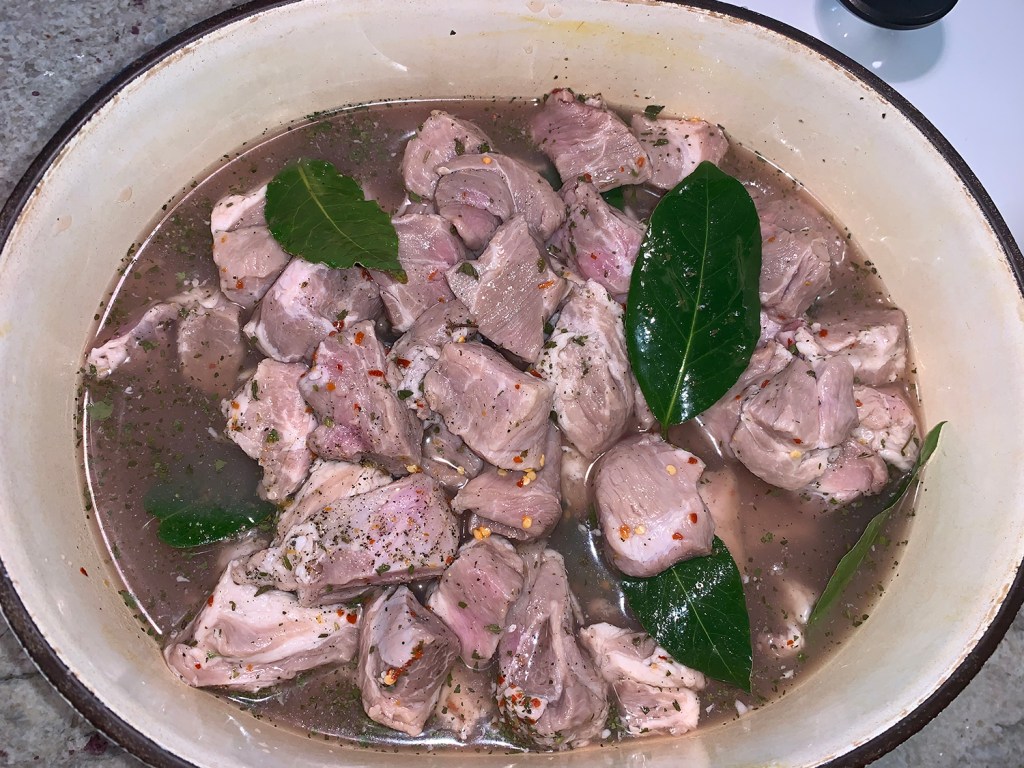
To make it, chunks of pork are marinated in a heady mixture of wine, vinegar, garlic and herbs for up to a few days before they’re cooked until tender. This version of Madeiran Pork with Wine and Garlic was streamlined using pork shoulder instead of leaner pork loin, and the meat can marinate anywhere from 1 to 48 hours. (Ours marinated for 24 hours.)

Pork shoulder is a cut that requires lengthy cooking to become tender, so this oven-braised for about 1½ hours. Next, you brown the meat after simmering to develop a rich, flavorful caramelization. The marinade is then reduced to a light glaze, and the pork is finished by coating it with the reduction.

In Madeira, the pork typically is piled onto crusty rolls to make sandwiches, but we paired ours with another recipe from Milk Street: Portuguese Wine-Braised Potatoes with Garlic and Chiles where a mixture of wine and chicken broth are used for simmering the spuds to render them soft and tender.

After simmering the pork, be sure to drain the pieces on a rack as directed. This helps ensure nice caramelization when the pork is browned in the skillet. Finally, when skimming the fat off the braising liquid, be sure to reserve it for browning the pork.

Tip: Don’t use an uncoated cast-iron Dutch oven. Enamel-coated cast-iron is fine, but in an uncoated cast-iron pot—even in one that is well seasoned—the acidity of the marinade may react with the iron, producing metallic “off” flavors. A stainless steel cooking surface is fine, too, but avoid aluminum unless it has been treated to make it nonreactive.

Madeiran Pork with Wine and Garlic

  • Servings: 4-6
  • Difficulty: easy
  • Print

Ingredients

  • 5 lbs. boneless pork shoulder, trimmed and cut into 1- to 1½-inch chunks
  • 2 cups dry white wine
  • 1 cup cider vinegar
  • 10 bay leaves
  • 6 medium garlic cloves, smashed and peeled
  • 1 Tbsp. dried oregano
  • 1 tsp. red pepper flakes
  • 6 whole cloves (optional)
  • Kosher salt and ground black pepper
  • 1 cup Madeira wine
  • ¼ cup minced fresh oregano

Directions

  1. In a large Dutch oven, stir together the pork, wine, vinegar, bay, garlic, dried oregano, pepper flakes, cloves (if using) and 1 teaspoon each salt and pepper. Cover and refrigerate for at least 1 hour or for up to 48 hours.
  2. When you are ready to cook the pork, heat the oven to 325°F with a rack in the lower-middle position. Set the pot, uncovered, over medium-high and bring to a simmer, stirring occasionally. Re-cover, transfer to the oven and cook until a skewer inserted into the pork meets just a little resistance, about 1½ hours, stirring once about halfway through.
  3. Set a wire rack in a rimmed baking sheet. Using a slotted spoon, transfer the pork and garlic to the rack, removing and discarding the bay and cloves (if used); set aside. Tilt the pot to pool the cooking liquid to one side, then use a wide spoon to skim off as much fat as possible; reserve the fat. Or use a fat separator.
  4. Add the Madeira to the pot, bring to a boil over medium-high and cook, stirring occasionally, until the mixture has reduced to about 1 cup, 15 to 20 minutes; set aside. (We ended up with a LOT of liquid, so it took twice as long to reduce.) Remove and discard any large bits of fat on the exterior of the pieces of pork.
  5. In a 12-inch nonstick skillet over medium-high, heat 2 tablespoons of the reserved pork fat until barely smoking. Add the pork and cook, stirring every 2 to 3 minutes, until well browned on all sides, 5 to 7 minutes.
  6. Remove the skillet from the heat and add the reduced cooking liquid. Return to medium-high and continue to cook, stirring occasionally, until the liquid has reduced and the pork is lightly glazed and begins to sizzle, 3 to 5 minutes.
  7. Taste and season with salt and black pepper, then stir in the fresh oregano. Transfer to a serving dish.

http://www.lynnandruss.com

Recipe by Diane Unger for Milk Street