All posts by LynnHoll

Unknown's avatar

About LynnHoll

I have been an artist and designer all my life incorporating graphic design for websites, gardens, publications, fabrics, interior design and cooking. I am now retired from my professional job, but still create artistic visions in all forms on a daily basis.

Classic Butter Chicken—Minus Most of the Butter

Here’s a great Butter Chicken recipe that uses very little butter but actually makes a creamier chicken. How’s that? Boneless chicken thighs are briefly marinated in yogurt and spices, then broiled until lightly charred. You will then make a separate sauce into which the chicken is stirred.

As you know, in many recipes for butter chicken, copious amounts of butter and heavy cream supply richness, but with this recipe, as in India, cashews are pureed with a small amount of water until smooth. The nut puree adds creaminess without making the dish heavy. Brilliant!

Butter Chicken

We were shy almost 1 tablespoon of garam masala, and at our previous grocery shopping attempt, they weren’t carrying any. I decided to go ahead with the lesser amount because there were so many other flavor ingredients, I didn’t think it would be missed (it wasn’t). There are online recipes to make the spice yourself, if you are interested, but it’s best made from toasted seeds.

Don’t scrape the marinade off the chicken before broiling. The yogurt and honey help the chicken brown and char under the broiler. Serve this with steamed basmati rice for soaking up the sauce—and it makes a LOT of sauce.

Classic Butter Chicken (with little dairy)

  • Servings: 4-6
  • Difficulty: easy
  • Print

Ingredients

  • 1 cup plain whole-milk yogurt
  • 2 Tbsp. honey
  • 1 Tbsp. sweet paprika
  • ½ teaspoon cayenne pepper
  • 4 Tbsp. garam masala, divided
  • 2 Tbsp. ground cumin, divided
  • 2 Tbsp. finely grated fresh ginger, divided
  • Kosher salt and ground black pepper
  • 2½ lbs. boneless, skinless chicken thighs, cut crosswise into 3 strips
  • 1 cup roasted salted cashews
  • 4 Tbsp. (½ stick) salted butter, cut into 2 pieces, divided
  • 1 large yellow onion, finely chopped
  • 6 medium garlic cloves, finely grated
  • 28 oz. can crushed tomatoes
  • ¼ cup finely chopped fresh cilantro
  • 2 Tbsp. lime juice

Directions

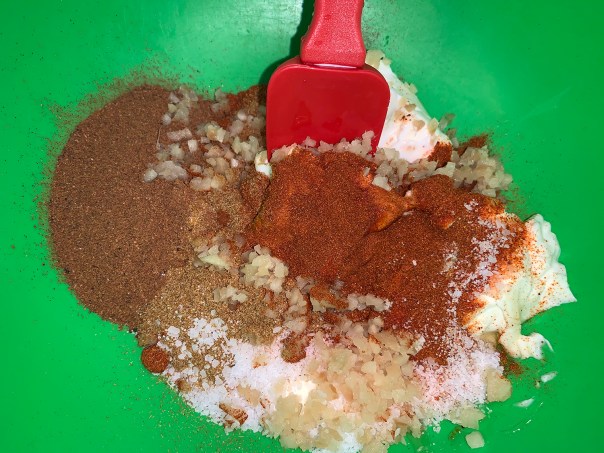
  1. In a large bowl, whisk together the yogurt, honey, paprika, cayenne, 3 tablespoons garam masala, 1 tablespoon cumin, 1 tablespoon ginger and 2 teaspoons salt.
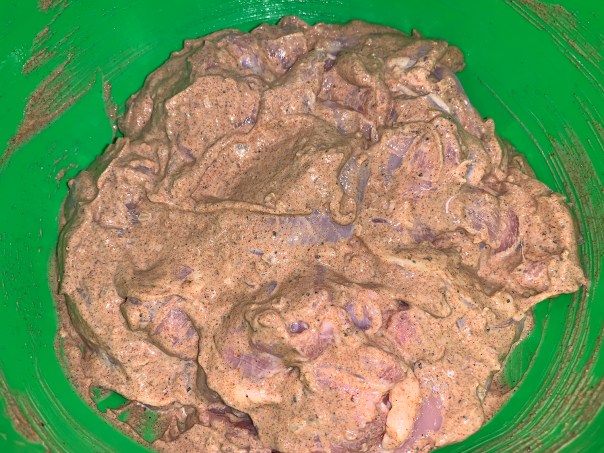
  2. Add the chicken and stir until evenly coated. Cover and refrigerate for at least 30 minutes or for up to 1 hour.
  3. Heat the broiler with a rack about 6 inches from the broiler element. Line a rimmed baking sheet with foil, set a wire rack in the baking sheet and mist it with cooking spray.
  4. In a blender, puree the cashews with ¾ cup water until smooth, about 1 minute; set aside.
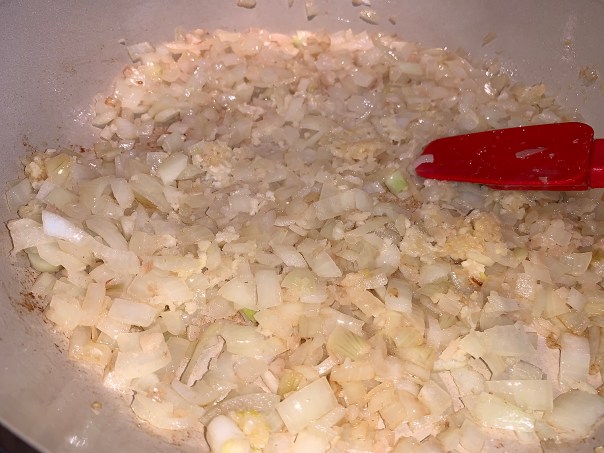
  5. In a large Dutch oven over medium, melt 2 tablespoons of butter. Add the onion and cook, stirring occasionally, until beginning to brown, about 5 minutes. Stir in the remaining 1 tablespoon ginger and the garlic, then cook until fragrant, about 30 seconds.
  6. Stir in the remaining 1 tablespoon garam masala and the remaining 1 tablespoon cumin. Add the cashew puree and cook, stirring constantly, until the mixture begins to brown, about 3 minutes.
  7. Stir in the tomatoes and 2 cups water, scraping up any browned bits. Add the remaining 2 tablespoons butter and bring to a simmer, stirring to combine. Reduce to medium and cook, stirring often, until the sauce is thick enough to heavily coat a spoon, 12 to14 minutes.
  8. Taste and season with salt and pepper. Remove from the heat and cover to keep warm.
  9. Arrange the chicken with its marinade still clinging to it in an even layer on the prepared rack. Broil until well browned and lightly charred on both sides, 15 to 20 minutes, flipping the pieces once about halfway through.
  10. Transfer to the sauce, bring to a simmer over medium and cook, stirring occasionally, until a skewer inserted into the chicken meets no resistance, about 10 minutes.
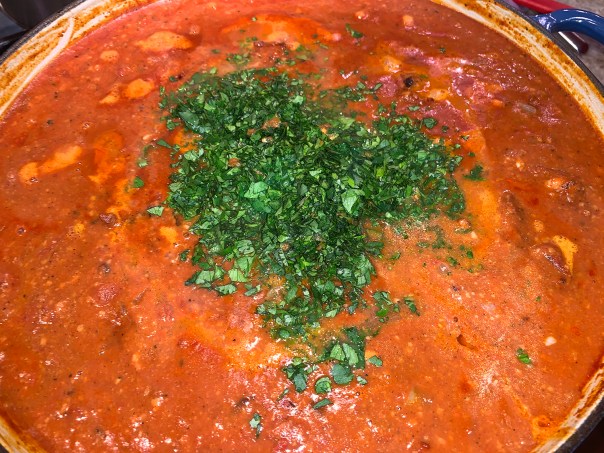
  11. Off heat, stir in the cilantro and lime juice, then let stand for 5 minutes. Taste and season with salt and pepper.

http://www.lynnandruss.com

Adapted from a recipe by Diane Unger from Milk Street

Potato, Fennel and Leek Gratin—To Die For!

As promised when I posted our Easter Sunday braised lamb dinner, here’s the recipe for that luscious and so-decadent potato gratin side dish by Molly Stevens. The original recipe indicated it would serve 12, however with just the two of us (COVID-19 lockdown was still in effect), we halved the amount and still ended up with enough to feed eight.

Here’s where we went rogue. First of all, when we did the grocery shopping, there was no heavy cream to be had, so we bought light cream. You can create a substitute by adding butter, but with all of the cheese, I didn’t want to contribute even more calories and fat. In the end, the light cream worked out just fine since the starch from the potatoes naturally thickens it.

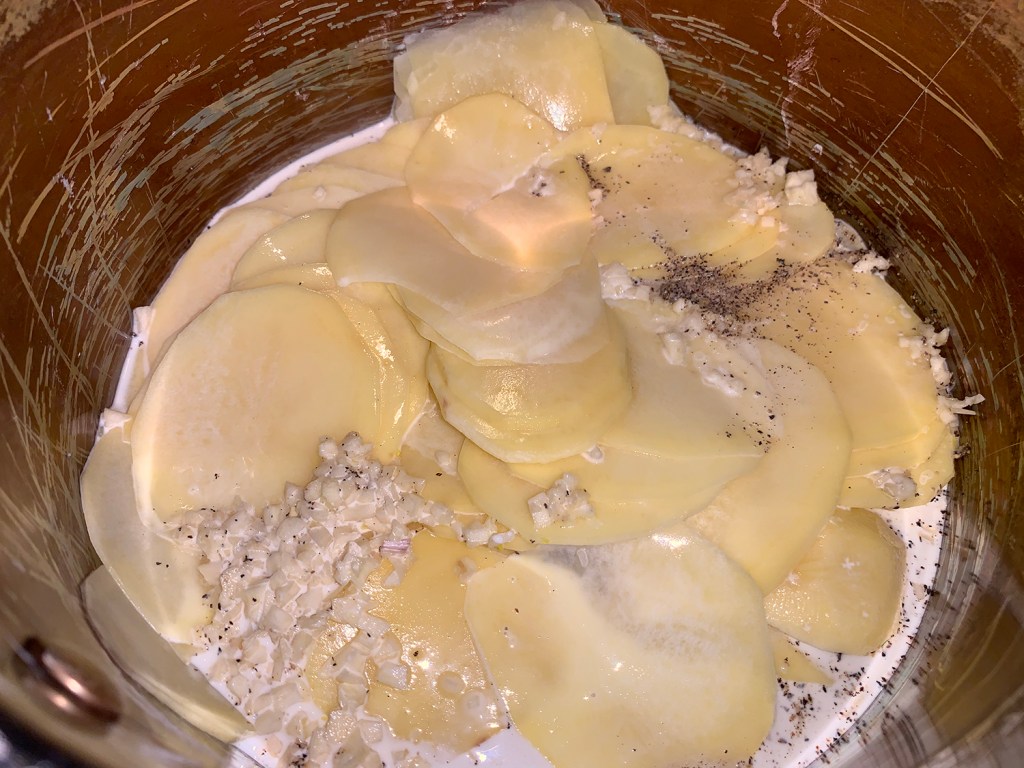
At the point where you are supposed to combine the potatoes and cream with the leek mixture, I opted to layer the ingredients instead. I was concerned that stirring everything together would break up the thin slices of potato and become a heaping mess as opposed to a more controlled layered dish.

The layers started with potatoes, followed by half of the leek mixture, then a layer of cheese. More potatoes on top of that cheese, the rest of the leek/fennel, the last layer of potatoes and finally all of the remaining cheese.

To Die For!

Potato, Fennel and Leek Gratin

  • Servings: 10-12
  • Difficulty: moderate
  • Print

Ingredients

  • 3 Tbs. unsalted butter, softened
  • 2-1/2 lb. Yukon Gold potatoes, peeled and sliced 1/8 inch thick (about 7 cups)
  • 2-1/2 cups heavy cream
  • 2 cloves garlic, finely chopped
  • Kosher salt and freshly ground black pepper
  • 1 tsp. fennel seeds, lightly crushed
  • 3 large leeks, white and pale-green parts only, trimmed, halved, and sliced crosswise 1/2 inch thick
  • 1-1/2 to 1-3/4 lb. fennel bulbs, trimmed, quartered, cored, and thinly sliced (about 5 cups)
  • 8 oz. Gruyère, grated (about 2 cups)

Directions

  1. Position a rack in the center of the oven and heat the oven to 400°F. Grease the bottom and sides of a 10×15-inch (4 quart) baking dish with 1 Tbs. of the butter.
  2. Put the potatoes, cream, garlic, 1-1/2 tsp. salt, and 1/2 tsp. pepper in an 8-quart pot. Bring to a simmer over medium heat and cook, stirring occasionally, until the potatoes are barely tender when pierced with a fork, about 8 minutes.
  3. Meanwhile, melt the remaining 2 Tbs. butter in a heavy-duty 12-inch skillet over medium heat. Add the fennel seeds and stir just until fragrant, about 30 seconds. Add the leeks and fennel, season lightly with salt and pepper, and cook, stirring occasionally, until just tender, 8 to 10 minutes.
  4. Gently mix the leeks and fennel with the potatoes. Transfer to the prepared baking dish, evening out the vegetables. Top with the cheese, and bake until the cheese is deep golden brown, the cream has thickened, and the potatoes are tender when pierced with a knife, 35 to 40 minutes. (If the top is becoming too brown before the vegetables are done, cover the gratin loosely with foil.) Let cool for 10 to 20 minutes before serving.
  5. If desired, sprinkle the finished gratin with fennel fronds for a pop of color.

http://www.lynnandruss.com

Lamb Lovers Rejoice: Herb-Stuffed Leg of Lamb Braised in Red Wine

Boneless leg of lamb makes a reliable main course for a sit-down dinner party. It’s elegant, it’s not at all fussy to cook, and it carves as neatly as a loaf of bread, according to chef/author Molly Stevens. Would I miss the rosy-pink interior of a roasted leg? This was Easter Sunday after all, and it is pretty much a given that we would serve lamb on this festive occasion, so why not give braising a try?

“The Lamb is Glam; the Sauce is Boss”

Supposedly, nothing matches the succulence of a braised leg of lamb. Here, the boned leg gets rolled up around a simple stuffing of herbs, garlic, and shallots to add flavor and color to the meat. And, the best part: the strained braising liquid turns instantly into a wonderful silken savory sauce that tastes as good as something you’d get in a fine restaurant. The Sauce was Boss IMHO!

The Hubs loved the silky sauce so much that he claimed he could just drink it straight from a glass. Cheers!

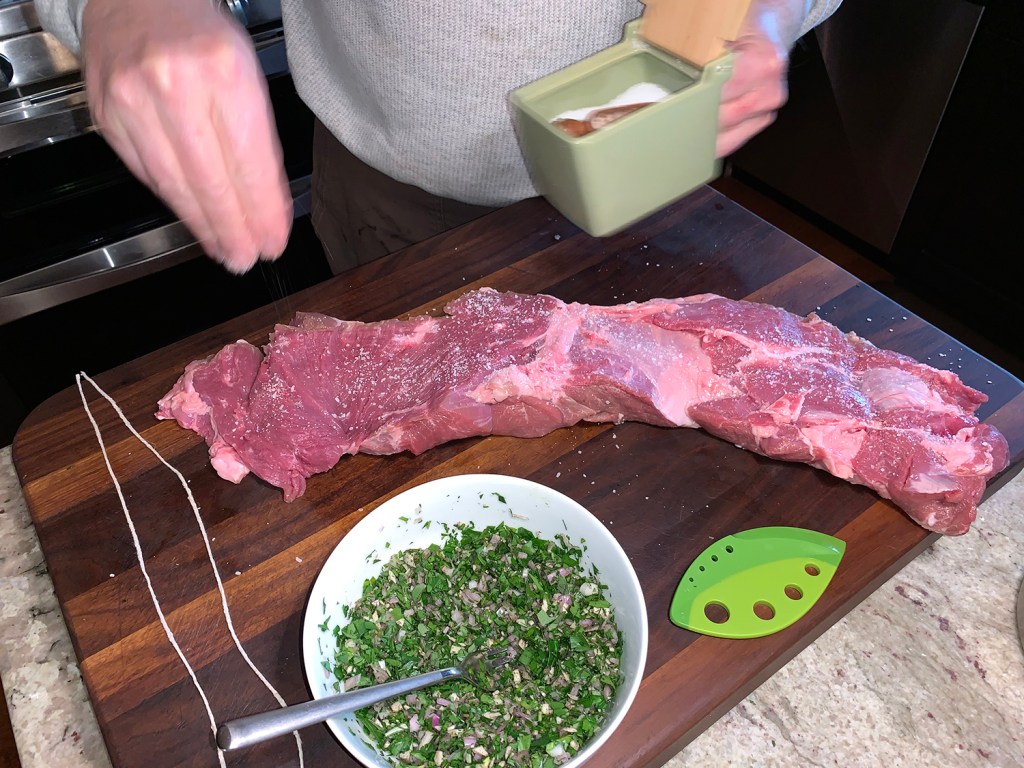
Most food markets carry boned/rolled leg of lamb. In order to stuff the lamb, you’ll need to slip off the netting or butcher twine that holds it together. Then it’s simply a matter of rolling it back into a cylinder and tying it up with kitchen string after stuffing. Molly offers this tip: If you have a butcher who does bone the lamb for you, ask him to saw or chop the bones into 1-inch pieces so you can add them to the braising pan. They will add flavor and body to the sauce. We did not have this option.

While yes, this is a decadent entrée, consider that it’s also egg-free, gluten-free, lactose-free, low carb, peanut- and soy-free. Of course, our side of cheesy potato gratin was none of those things! But then the fresh spring peas provided a nice pop of color while containing a fair amount of fiber and antioxidants.

Note — Working ahead: The lamb can be seasoned, rolled, tied, covered, and refrigerated up to 18 hours before braising (steps 1 and 2). Ours got happy in the herbed stuffing for nearly 15 hours beforehand.

Our accompaniments consisted of the best-ever Potato, Fennel and Leek Gratin by Jeanne Keeley from Fine Cooking. Jeanne claims the cheesy Gruyere topping will have you coming back for seconds! Believe me, I wanted more, but was just too full. I will post that blog soon, so stay tuned.

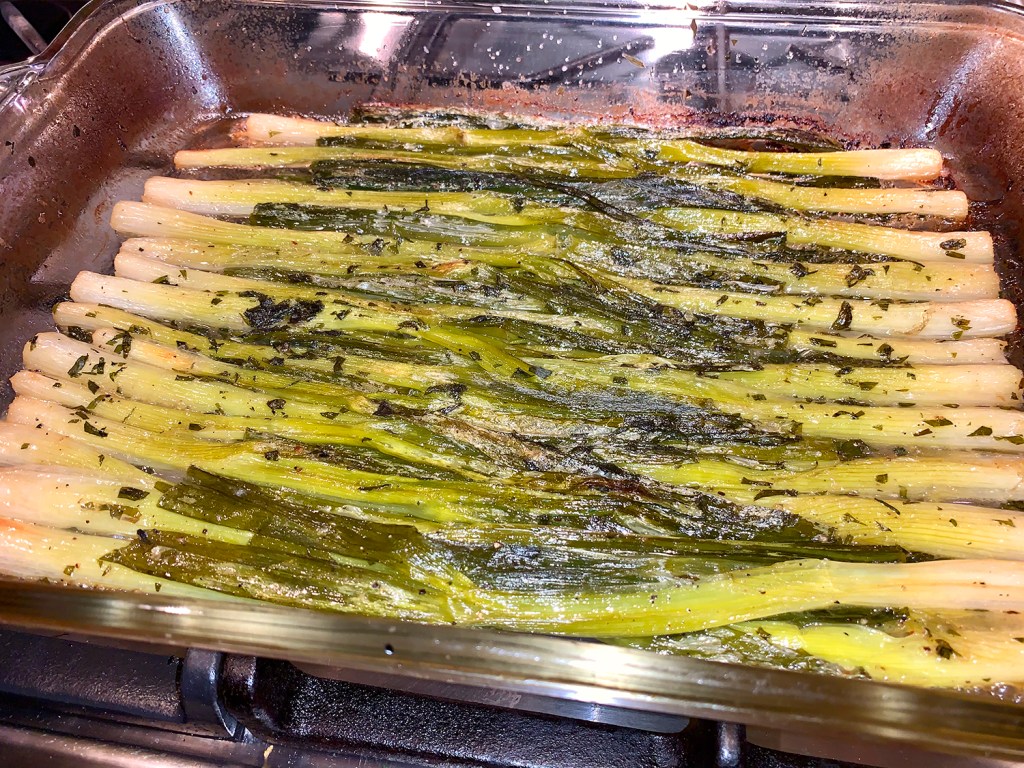
We also enjoyed Sweet Braised Whole Scallions (5 bunches worth!), a recipe also from Molly Stevens. If you’ve never had them, you’re in for a treat. As the scallions braise, the sweet anise flavor of the tarragon mingles with their oniony juices.

Finally, sweet fresh peas are a must on a Spring table. For this, we followed a recipe by Alton Brown, although his included adding cheese. We omitted that ingredient since our potato dish was brimming with it.

Herb-Stuffed Leg of Lamb Braised in Red Wine

  • Servings: 6-8
  • Difficulty: moderate
  • Print

Ingredients

  • One 5-pound boneless leg of lamb (plus reserved bones, sawed or chopped into 1-inch pieces; optional)
  • Coarse salt and freshly ground black pepper
  • ½ cup chopped flat-leaf parsley; stems reserved
  • 2 tablespoons chopped fresh thyme, mint, rosemary, and/or sage (in any combination)
  • 1 shallot, finely chopped
  • 2 garlic cloves, minced
  • ¼ teaspoon ground allspice
  • 2 tablespoons extra virgin olive oil
  • 1 large yellow onion (about 8 ounces), coarsely chopped
  • 2 large carrots, coarsely chopped
  • 2 tablespoons tomato paste
  • 1 teaspoon chopped fresh thyme, mint, rosemary, and/or sage (the same combination you used in the stuffing)
  • 2 bay leaves
  • Reserved parsley stems from the stuffing, torn into 4-inch lengths
  • 1 cup dry red wine
  • 2 cups lamb, veal, or chicken stock, homemade or store-bought

Directions

  1. Trimming the lamb: open the lamb out flat, fat side down, on your work surface. If there are any especially thick spots, make a lengthwise incision with a knife, without cutting through the meat, and lay it open like a book. You want to get the meat as even in thickness as possible while keeping it intact. Season the cut side generously with salt and pepper.
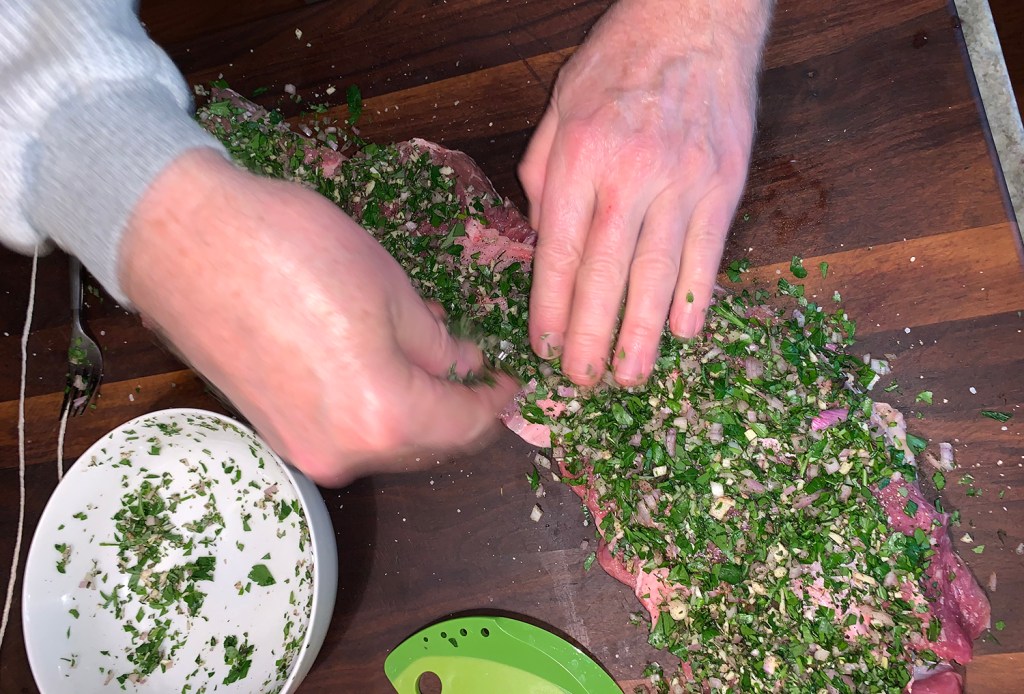
  2. The stuffing: in a small bowl, combine the parsley, mixed herbs, shallot, garlic, and allspice. Stir until evenly mixed together.
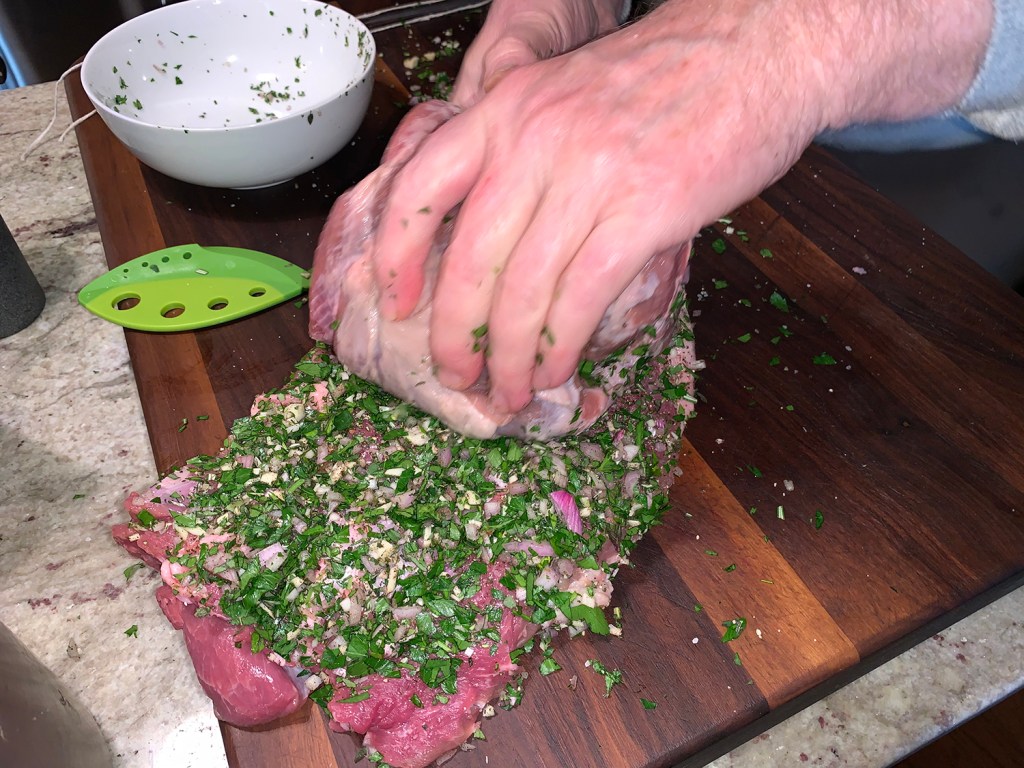
  3. Stuffing and shaping the lamb: spread the stuffing over the cut side of the leg of lamb with a rubber spatula. Press the stuffing into the meat with your hands to make it adhere, and spread it around so that it covers the entire inside surface. Roll the lamb up into a cylinder, and tie it neatly and snugly with kitchen string. Season the outside of the meat with salt and pepper. (The lamb can be prepared to this point and refrigerate for up to 18 hours before braising. When you are ready to braise the lamb, remove it from the refrigerator, and let it sit at room temperature while you heat the oven.)
  4. Heat the oven to 325 degrees.
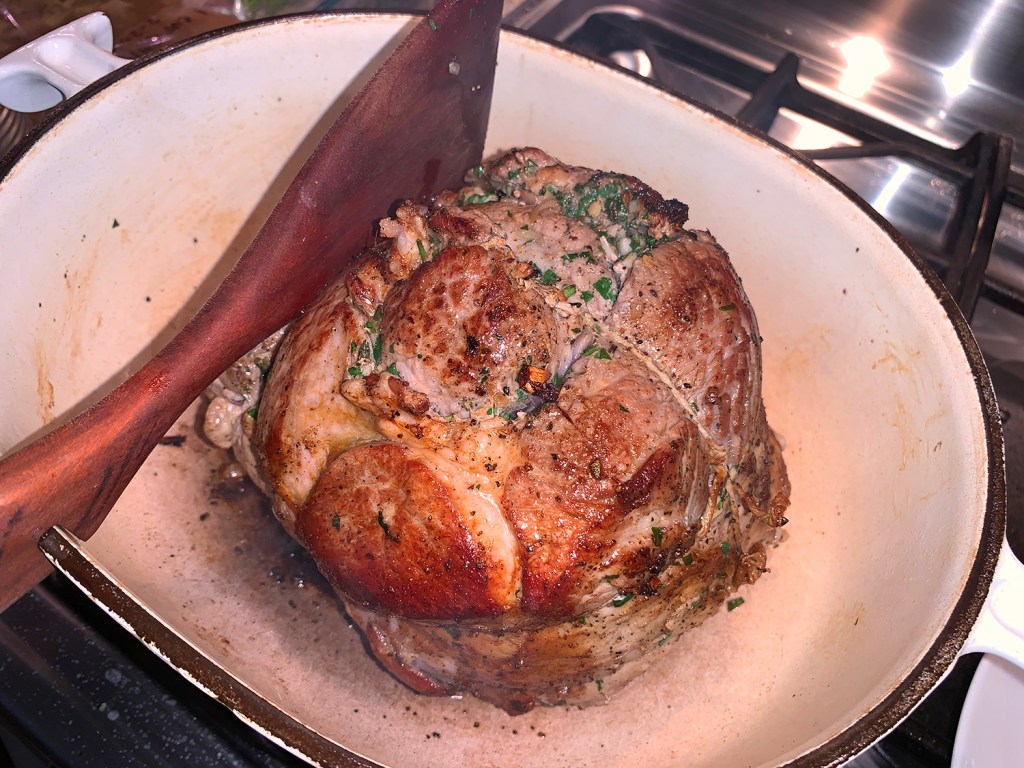
  5. Browning the lamb: add the oil to a heavy lidded Dutch oven or braising pan just large enough to hold the lamb (5-quart), and heat it over medium-high heat until it simmers. Lower the lamb into the pot with tongs, and brown it evenly, turning to brown all sides, until mahogany in spots but not at all burnt, 10 to 12 minutes total. Transfer the lamb to a platter. Add the bones to the pot if you have them, and brown them as best you can without charring, turning them ever 4 minutes, for about 12 minutes. Set aside with the lamb. Pour off all but about 1 tablespoon of fat from the pot. If the bottom is at all blackened, wipe those bits out with a damp paper towel, doing your best to leave behind the caramelized juices.
  6. The aromatics and braising liquid: return the pot to medium-high heat, add the onion and carrots, and sauté, stirring, until beginning to brown, about 4 minutes. Add the tomato paste and stir it in with a wooden spoon so it coats the carrots and onions. Add the teaspoon of herbs, the bay leaves, and parsley stems. Pour in the wine and bring it to a boil, stirring and scraping with the spoon to dislodge all those wonderful caramelized bits stuck to the bottom of the pot from browning the lab. Boil to reduce the wine by about half, about 2 minutes. Pour in the stock and bring to a boil. Continue to boil, stirring occasionally, for about 4 minutes allowing the flavors to meld.
  7. The braise: return the lamb to the pot, along with any juices that have seeped from the meat, and tuck the bones, if using, around the meat. Cover with a piece of parchment paper, pressing down so the paper nearly touched the meat and the edges extend over the sides of the pot by about an inch. Then put the lid in place, and slide the pot onto a rack in the lower third of the oven. After about 15 minutes, check to see that the liquid is simmering gently, not aggressively. If it’s simmering too vigorously, lower the oven heat 10 or 15 degrees. Continue to braise, turning the lamb with tongs and basting once or twice, until the meat is fork-tender and cooked through, 2 to 2 ½ hours.
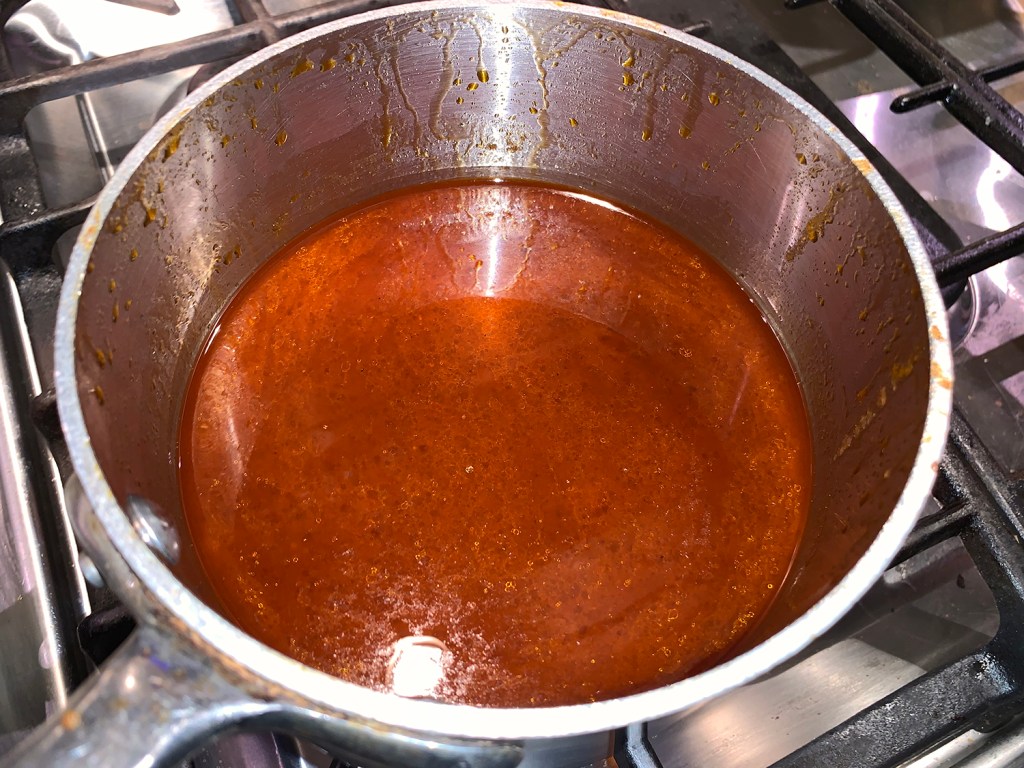
  8. The finish: transfer the lamb to a carving board with moat or platter to catch the juices, and cover loosely with foil to keep warm. Strain the pan juices into a saucepan, and skim off and discard excess fat – there may be as much ½ cup, so it’s a good chance to use your gravy separator, if you have one. Bring the sauce to a boil and simmer for 5 minutes to concentrate the flavor and thicken it some. Taste: if it tastes too brothy, boil for another 3 or 4 minutes. Taste again for salt and pepper.
  9. Serving: remove the string from the lamb, pour any juices that have accumulated on the carving board into the sauce, and carve the lamb into ½ inch slices. Arrange the slices on dinner plates or a serving platter, and pour over enough sauce to moisten. Pass the remaining sauce at the table.

Don’t forget to brown the end caps. Our notched wooden spatula helps hold the meat in place while the ends brown.

http://www.lynnandruss.com

Pork Chops Milanese

To get you up to speed, the milanesa is a South American variation of an Italian dish where generic types of breaded meat fillet preparations are known as a milanesa. It consists of a thin slice of beef, chicken, veal, or as in this case, pork. Cutlet is one of most typical dishes from Milan, Italy, typically a veal cutlet, coated with egg, covered with bread crumbs and then fried in butter with sage.

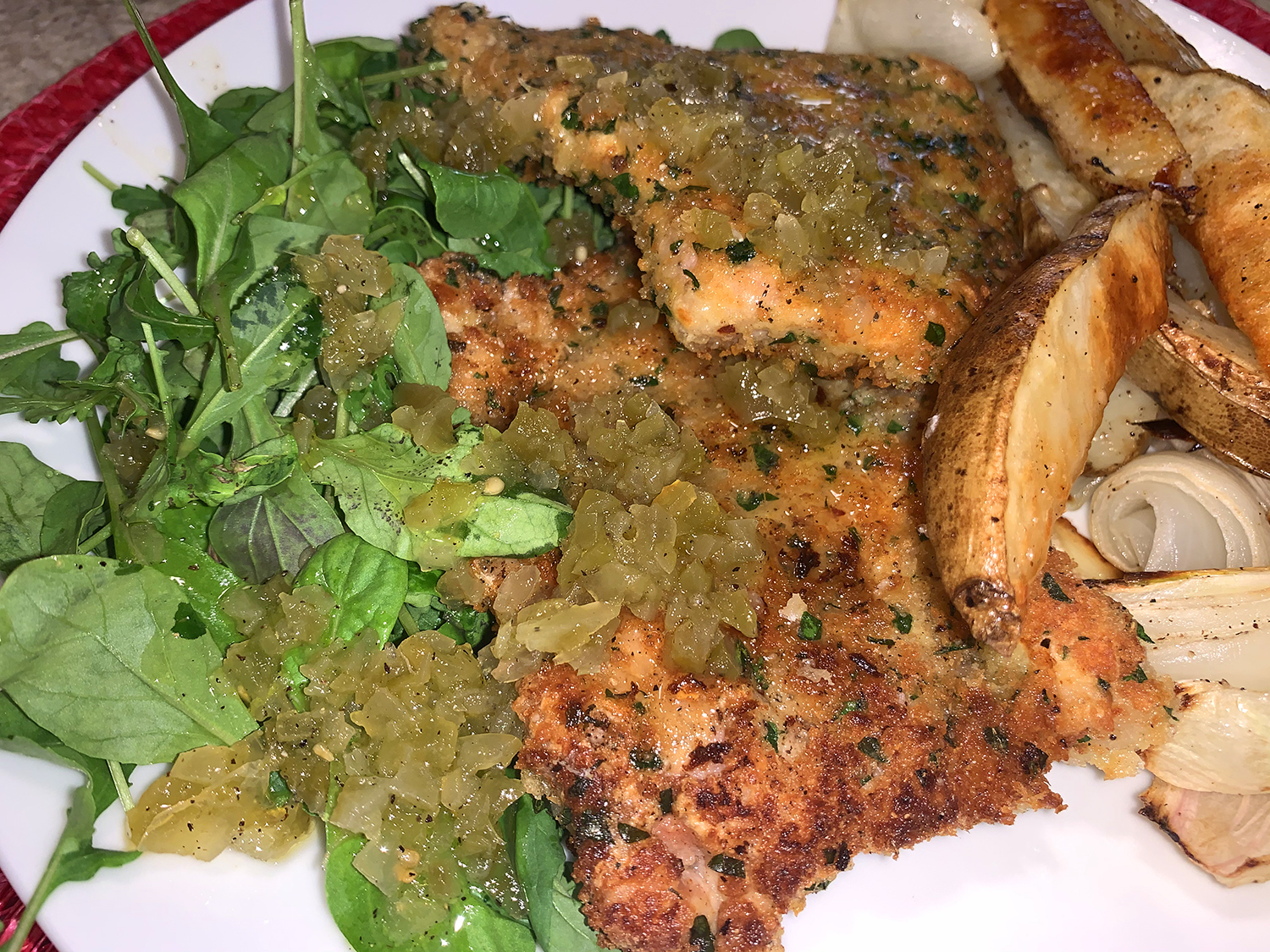
This version of Pork Chop Milanese hailed from Ronne Day of Fine Cooking. She claims you can’t have too much of the sweet-sour dressing to sop up the crispy bites of pork chop. Sweet meat is not our beat, so we reserved our thoughts regarding this marriage of ingredients until after we consumed the dinner. In the end, we both thought the mostarda dressing was a little too sweet for our taste.

You may never have even heard of mostarda, which is a Northern Italian condiment made of candied fruit and a mustard-flavored syrup. Traditionally mostarda was served with boiled meats, more recently it has become a popular accompaniment to cheeses. Just use it sparingly until you get a feel for how much suits your own palette.

Originally this recipe was formulated with bone-in frenched rib chops. And many reviewers noted the amounts of panko and flour were grossly excessive, so I took it upon myself to adjust quantities which are reflected in the recipe below—and they worked out perfectly, BTW.

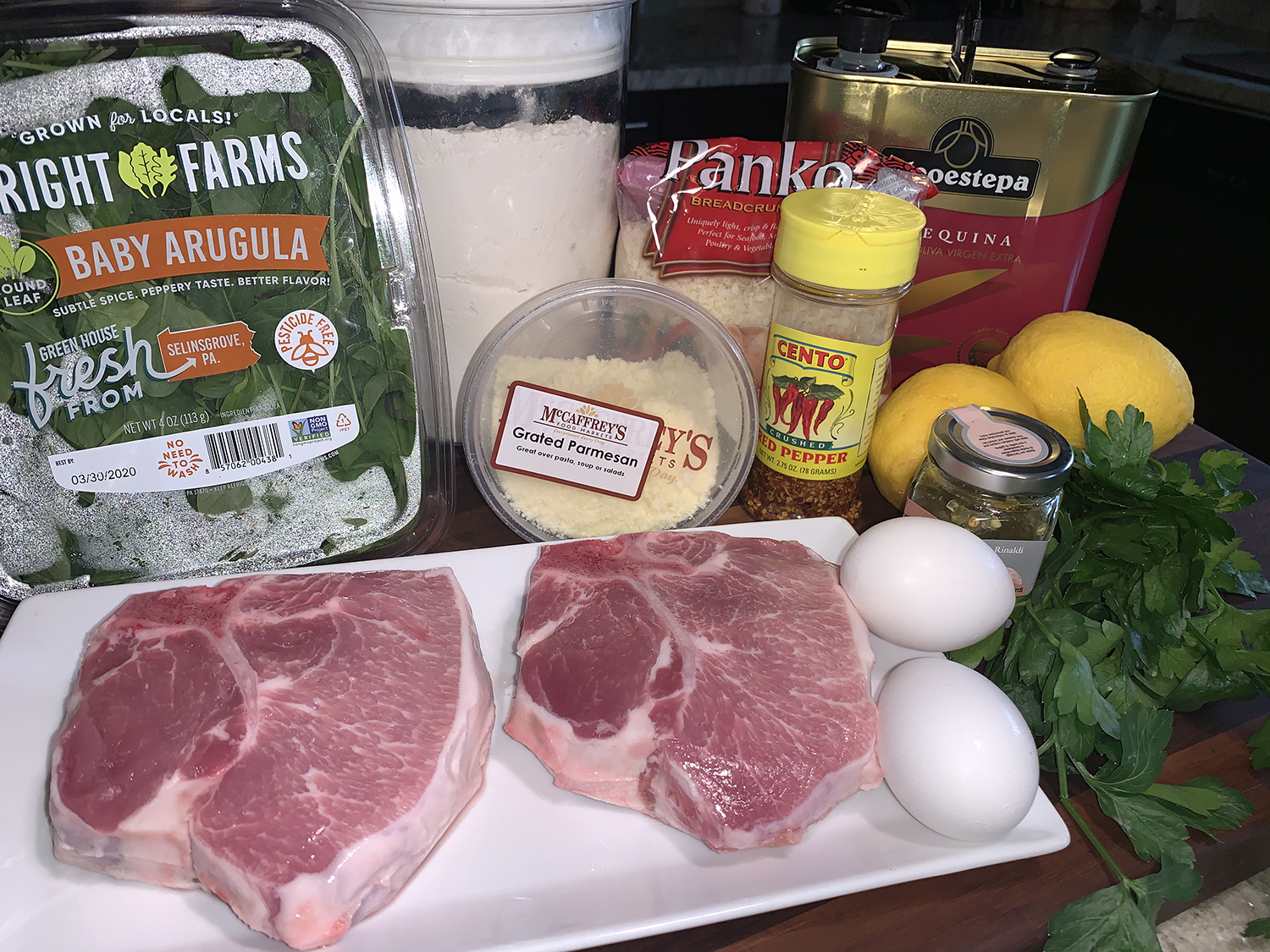
We had two thick pork chops in the freezer, so instead of buying rib chops we just used what we had. However, we did need to make a few adjustments, such as cutting the meat off the bones (it was almost impossible to pound down with a center bone). This resulted in six fillets because the large side, once pounded thin, was then cut in half.

IMG_4715

My suggestion is just to buy boneless pork cutlets to begin with, which are cheaper than frenched rib chops. Plus, you don’t have to keep spooning oil over the large end because they are a consistent thickness. Speaking of oil, we had a container of oniony olive oil from a previous meal which added a notch of additional flavor.

We didn’t toss the bones either, but rather seared them in the olive oil which provided more seasoning (plus it was a nice little nosh for the Hubby). To further streamline the process, I did not wipe out the pan between cooking the chops, this saved both time and oil. While we weren’t entirely sold on the mostarda sauce, we absolutely loved the pork fillets!

IMG_4696

Pork Chops Milanese

  • Servings: 3-4
  • Difficulty: easy
  • Print

Ingredients

  • 1/4 cup fresh lemon juice
  • 1/4 cup mixed-fruit mostarda, finely chopped
  • Kosher salt and freshly ground black pepper
  • 3/4 cup extra-virgin olive oil, divided
  • 4 boneless pork cutlets, trimmed of fat (if your chops have bones, cut the meat away before pounding thin)
  • 1/2 cup all-purpose flour
  • 1/2 tsp. crushed red pepper flakes, ground in a spice grinder
  • 2 large eggs
  • 1 cup plain panko
  • 1/2 cup finely grated Parmigiano-Reggiano
  • 3 Tbs. finely chopped fresh flat-leaf parsley
  • Baby arugula, enough for each serving
  • Lemon wedges, for serving
  • Flaky sea salt, for serving

Directions

  1. In a small bowl, combine the lemon, mostarda, 1/4 tsp. salt, and 1/4 tsp. pepper. Whisk in 1/4 cup. cup of the extra-virgin olive oil. Set aside.
    IMG_4714
  2. Put each chop between two pieces of plastic wrap, and pound with a mallet until about 1/4 inch thick. Season both sides with salt and pepper. (All this meat shown below came from two bone-in chops.)
    IMG_4712
  3. Have ready three shallow bowls large enough to hold one pork cutlet at a time. In one bowl, combine the flour and red pepper; in another, beat the eggs with 1 Tbsp. water; and in the third, combine the panko, Parmigiano, parsley, 1/2 tsp. salt, and 1/4 tsp. pepper.
    IMG_4703
  4. Position a rack in the center of the oven and heat to 200°F. Put an oven-safe wire rack on a rimmed baking sheet and set it in the oven.
  5. Dredge each pork chop in the flour, then egg, and finally panko, lightly pressing the panko to adhere. Transfer to a plate.
  6. Heat 1/4 cup of the olive oil over medium-high heat in a large nonstick skillet. Fry one chop (two if your pan allows) at a time, about 2-1/2 minutes per side, then transfer to the wire rack in the oven to keep warm. Repeat with the remaining chops.
    IMG_4719
    IMG_4722
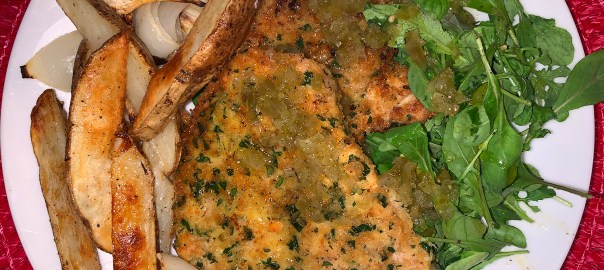
  7. Serve the chops with the arugula and a drizzle of the dressing. Pass the lemon wedges, flaky salt, and any extra dressing at the table.
    IMG_4725
    We paired ours with a side of roasted potato and onion wedges.

http://www.lynnandruss.com

Adapted from a recipe by Ronne Day from Fine Cooking

Yum, Yum and YUM. Shiitake-Sesame Braised Chicken

In Hong Kong, clay pot meals—called wu wei—arrive steaming with succulent marinated meat and savory rice in shops offering up to 60 combinations of toppings. Minced beef with egg. Chinese sausage with bits of salt-cured fish. Pulled chicken thighs with abalone. One constant—the flavor profile. The meat generally is marinated in a savory blend of soy sauce, sweet rice wine and oyster or fish sauce, as the recipe is here.

From Milk Street, this dish (now a favorite) packs tons of umami into the dish, while ginger adds a balancing piquancy. Although it seems a sacrilege, don’t forget to remove the chicken skins after searing. The skins are left on for browning to develop drippings that add depth to the finished dish and to render flavorful fat that’s used for sautéing the mushrooms and aromatics. But the skins will turn soggy when cooked in liquid, so remove them before nestling the thighs into the pot for braising.

IMG_4748

However, don’t necessarily discard the skin. If there’s a crispy skin lover in the family, (which typically I’m not), they will adore the treat. I tried one and was astounded by the taste and the crackle, so The Hubs proceeded to scarf the remainder as a pre-dinner nosh.

Some of you may be put off by large slices of ginger, quite the contrary for us, but if you rank among the latter group, either toss it after the cooking is done, or chop it finely at the get-go, but don’t disregard altogether.

As a garnish, a sprinkle of sliced scallions add a freshness, while toasted sesame seeds lend a subtle nuttiness. I’m so glad we had leftovers for lunch the next day. YUM!

Shiitake-Sesame Braised Chicken

  • Servings: 4
  • Difficulty: easy
  • Print

IMG_4735

Ingredients

  • 2 lbs. bone-in, skin-on chicken thighs, trimmed and patted dry
  • Kosher salt and ground black pepper
  • 2 Tbsp. grapeseed or other neutral oil
  • 12 oz. fresh shiitake mushrooms, stemmed and halved
  • 1 medium yellow onion, halved and thinly sliced
  • 1 cup low-sodium chicken broth
  • 6 Tbsp. oyster sauce
  • ¼ cup low-sodium soy sauce
  • 3 Inch piece fresh ginger, peeled and thinly sliced
  • 1 tsp. cornstarch
  • Thinly sliced scallions, to serve
  • Sesame seeds, toasted, to serve

Directions

  1. Season the chicken with salt and pepper. In a large Dutch oven over medium-high, heat the oil until barely smoking. Add the chicken skin down, reduce to medium and cook without disturbing until the skin is well browned, about 10 minutes.
    IMG_4737
  2. Flip and cook until lightly browned on the second sides, about 3 minutes. Transfer to a large plate, then pour off and discard all but 3 tablespoons of fat from the pot. Remove and discard the skin from the chicken thighs.
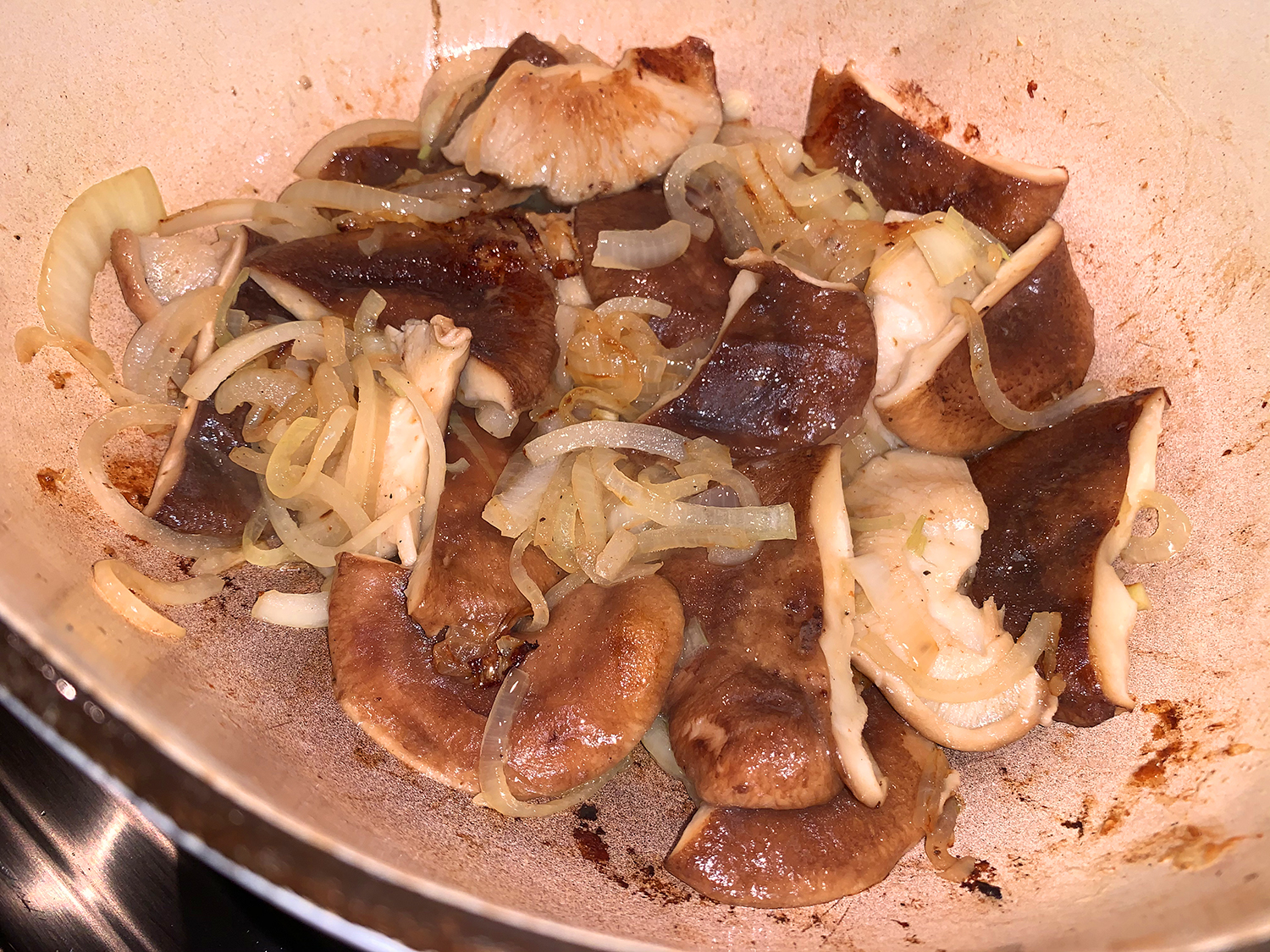
  3. Return the pot to medium and add the mushrooms and onion. Cover and cook over medium, stirring occasionally, until the mushrooms begin to brown and the onion has softened, 6 to 8 minutes.
    IMG_4742
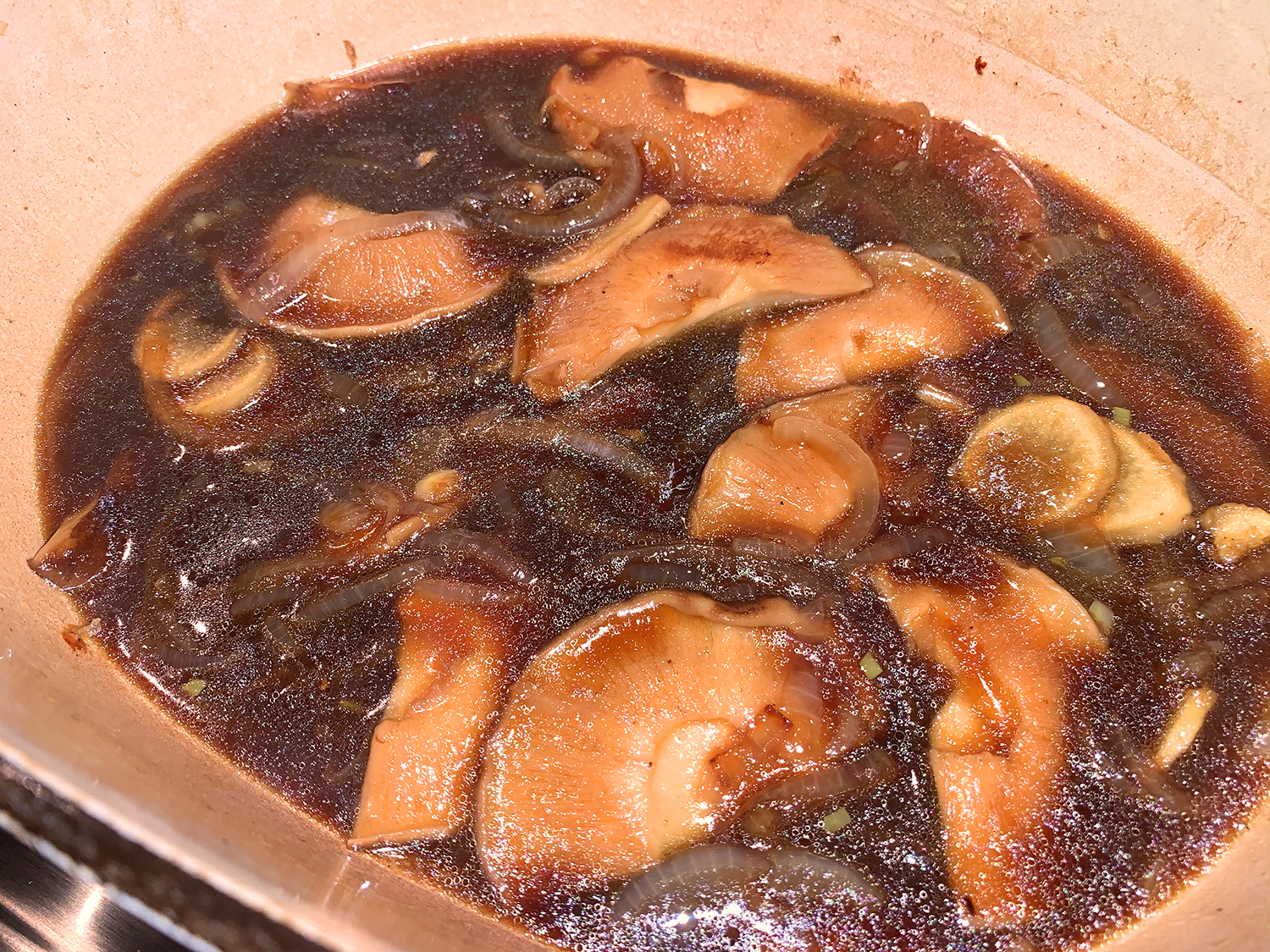
  4. Stir in the broth and 1 cup water, scraping up any browned bits. Stir in the oyster sauce, soy sauce and ginger, then bring to a simmer.
    IMG_4744
  5. Return the chicken and accumulated juices to the pot, cover and cook over medium until a skewer inserted into the largest thigh meets no resistance, about 40 minutes, flipping the pieces halfway through.
    IMG_4745
  6. Using tongs, transfer the chicken to a serving dish and cover to keep warm.
  7. In a small bowl, stir together 2 tablespoons water and the cornstarch, then whisk the mixture into the cooking liquid. Bring to a simmer over medium-high and cook, stirring constantly, until thickened, about 2 minutes.
    IMG_4747
  8. Taste and season with salt and pepper, then spoon the mushrooms and sauce over the chicken. Sprinkle with scallions and sesame seeds.
    IMG_4755

http://www.lynnandruss.com

Festoni Con Polpette Di Mamma

Another meatball recipe?? Why not, there are so many variations that it doesn’t make culinary sense to prepare the same old/same old each time. Take a walk on the wild side and break out of your solitary meatball confines. Although to be brutally honest, Mamma Gina’s Meatballs really aren’t all that novel.

But they’re definitely very good. The Hubs made them for a men’s group retreat a few weeks ago along with Sunday Sauce and the guys loved ’em! So with time on our hands, and the necessary ingredients in the house, we were good to go. In fact, I upped the fun factor by using Festoni pasta instead of the ho-hum penne or spaghetti.

IMG_4810

Festoni is a long, wide noodle, sort of like pappardelle only with curly edges, and it is swirled into little bunches that get dropped into boiling salted water. As they boil though, the nests unfurl into long strands. But of course, if you have a different shape of pasta on hand, just use that.

The sauce for this dish provides a lovely topping to pasta and the ‘bath’ for the meatballs to simmer in. No precooking or browning the meatballs beforehand. Once the meatballs are removed, the sauce carries the aroma of the meat and tastes wonderful on your pasta. Of course, we had to tweak it a bit by increasing the amount of crushed tomatoes, include additional garlic and a parmesan rind. Adjust the amount of crushed red pepper to suit your own preferences (we like it spicy).

The meatballs should be served along side the pasta, NOT on top, as that is the true Italian way.

IMG_4831

Festoni Con Polpette Di Mamma

  • Servings: about 22 meatballs
  • Difficulty: easy
  • Print

Ingredients

  • ½ lb. ground pork
  • ½ lb. ground veal
  • ½ lb. ground beef 85/15 blend
  • 1 Tbsp. chopped parsley
  • 1 Tbsp. kosher salt
  • 1 tsp. freshly ground black pepper
  • 2 eggs, beaten
  • 1 cup freshly grated Pecorino Romano cheese
  • 1 cup bread crumbs, preferably Italian seasoned
  • ½ cup milk
  • ½ cup brodo di mamma, cooled (see recipe below)

Directions

  1. In a large bowl, hand mix all the ingredients. The mixture will be very soft but resist the urge to add more bread crumbs, this makes a tender, melt in your mouth meatball!
    IMG_4816
  2. Once all the ingredients are just combined, wet your hands and pinch ¼ cup of the mixture and roll into balls. (Ours weighed about 2.2 ounces.) Place on a baking sheet.
  3. Carefully drop the meatballs into the sauce. If the pot seems to be full, simply shimmy the pot back and forth to make more room. (If you stick a spoon in the pot you will break the meatballs apart.)
    IMG_4823
  4. Allow to simmer in the sauce for 45 minutes or up to 2 hours.

*Mamma Gina’s meatballs freeze exceptionally well.  Freeze on the baking sheet and then transfer to freezer bags.  Will keep up to a month.  When ready to cook, make Mamma’s brodo and drop frozen meatballs right into the sauce.  And don’t forget to shimmy!  Cook for 1 hour or up to two.

http://www.lynnandruss.com

Brodo Di Mamma (Italian Red Sauce)

Brodo Di Mamma

  • Servings: 6-8
  • Difficulty: easy
  • Print

Makes about 8 cups of sauce

Ingredients

  • ½ cup Italian extra virgin olive oil
  • Fresh basil leaves; 5 whole, 1 Tbsp. chopped
  • 4 cloves garlic, peeled and smashed
  • 2 tsp. crushed red pepper (optional and more to taste)
  • 3 28 oz. cans crushed tomatoes
  • 2 cups of water
  • 2 Tbsp. tomato paste
  • 1 Tbsp. kosher salt
  • 1 tsp. freshly ground black pepper
  • 2″ parmesan rind, optional to throw into sauce

Directions

  1. In a small saucepan, combine olive oil with basil and garlic (crushed red pepper flakes for a spicy brodo). On very low heat, allow the basil and garlic to simmer in the olive oil for 10 to 15 minutes. This steeping process will allow olive oil to become fragrant. Careful that garlic gets toasted brown but not black.  Remove from heat and strain aromatics. Set aside.
    IMG_4813
  2. In a large pot or Dutch oven, pour in the tomato sauce and the water. Add tomato paste and salt and pepper.
    IMG_4814
  3. Pour reserved olive oil into the sauce and mix to combine. Bring to a boil and then immediately reduce to a simmer. If also making meatballs, remove ½ cup of the brodo and set aside to cool.
  4. Add parmesan rind to sauce. Partially cover the pot and allow sauce to simmer for at least 45 minutes or up to 2 hours. The longer it cooks, the better it tastes.
  5. Mix to combine in olive oil that has separated to the top and add chopped basil.
  6. Serve with your pasta of choice, in this case, festoni.
    IMG_4828

http://www.lynnandruss.com

Adapted from Mamma Gina’s Meatballs and Sunday Sauce found on annasheirloomkitchen.com

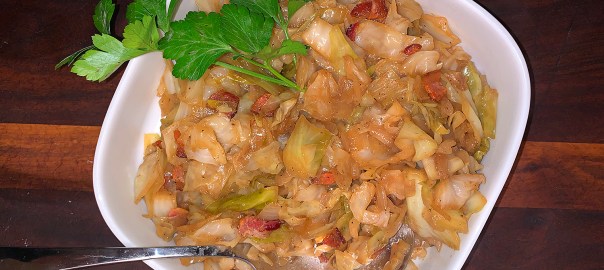
Southern Fried Cabbage, Y’all

Thanks to a conversation with cousin Maureen for introducing us to Southern Fried Cabbage. I noticed her posting on Facebook a few weeks back, and then we got to chatting via phone about our culinary endeavors while on the pandemic “lockdown.” She really gushed about how she and her husband Marty loved the dish, and I knew I had to get it into the dinner rotation soon.

Truth be told, I was a tad worried about the bacon factor. Now don’t get me wrong, I love the smell and taste of bacon, but it often doesn’t love me back. But I powered through my hesitation and went full steam with the recipe. Boy, am I glad I did, and so was the Mister.

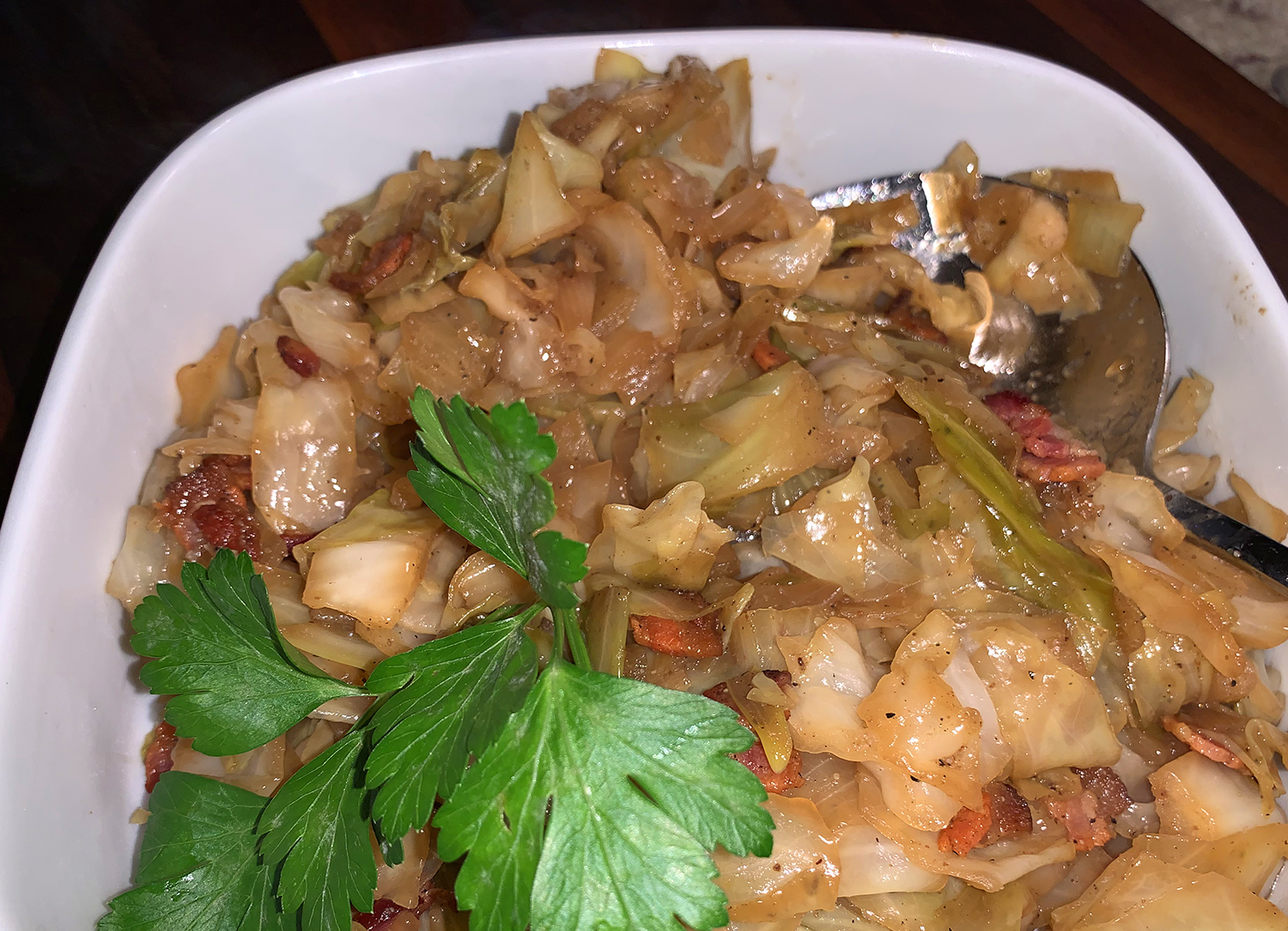
Bacon gives it the smoky flavor that is put over the top by just enough brown sugar and apple cider vinegar—the right proportions so as not to overwhelm. The cabbage is melt-in-your-mouth tender and succulent, amazingly so because there is very little fat (just a couple of tablespoons from the bacon) and no other liquid.

Our steak entrées were first cooked in a water bath with fresh herbs and garlic. They were finished with a quick sear with a little butter and those herbs in a super-hot carbon steel pan. As a side dish, the cabbage was a perfect compliment to our medium-rare rib-eye steaks. Oh, and a glass of pinot noir didn’t hurt either… Bellísimo!

IMG_4782

Southern Fried Cabbage

  • Servings: 6-8
  • Difficulty: easy
  • Print

Ingredients

  • 5 strips bacon, diced raw
  • 1 head cabbage, chopped
  • 1 large onion, diced
  • 2 Tbsp. Worcestershire
  • 1 Tbsp. apple cider vinegar
  • 2 Tbsp. brown sugar
  • 1 tsp. garlic powder
  • Black pepper to taste

Directions

  1. Add chopped bacon to a large heavy pot such as a dutch oven.
  2. Cook bacon over medium heat until extra crispy.
    IMG_4783
  3. Remove bacon from pot, leaving the fat.
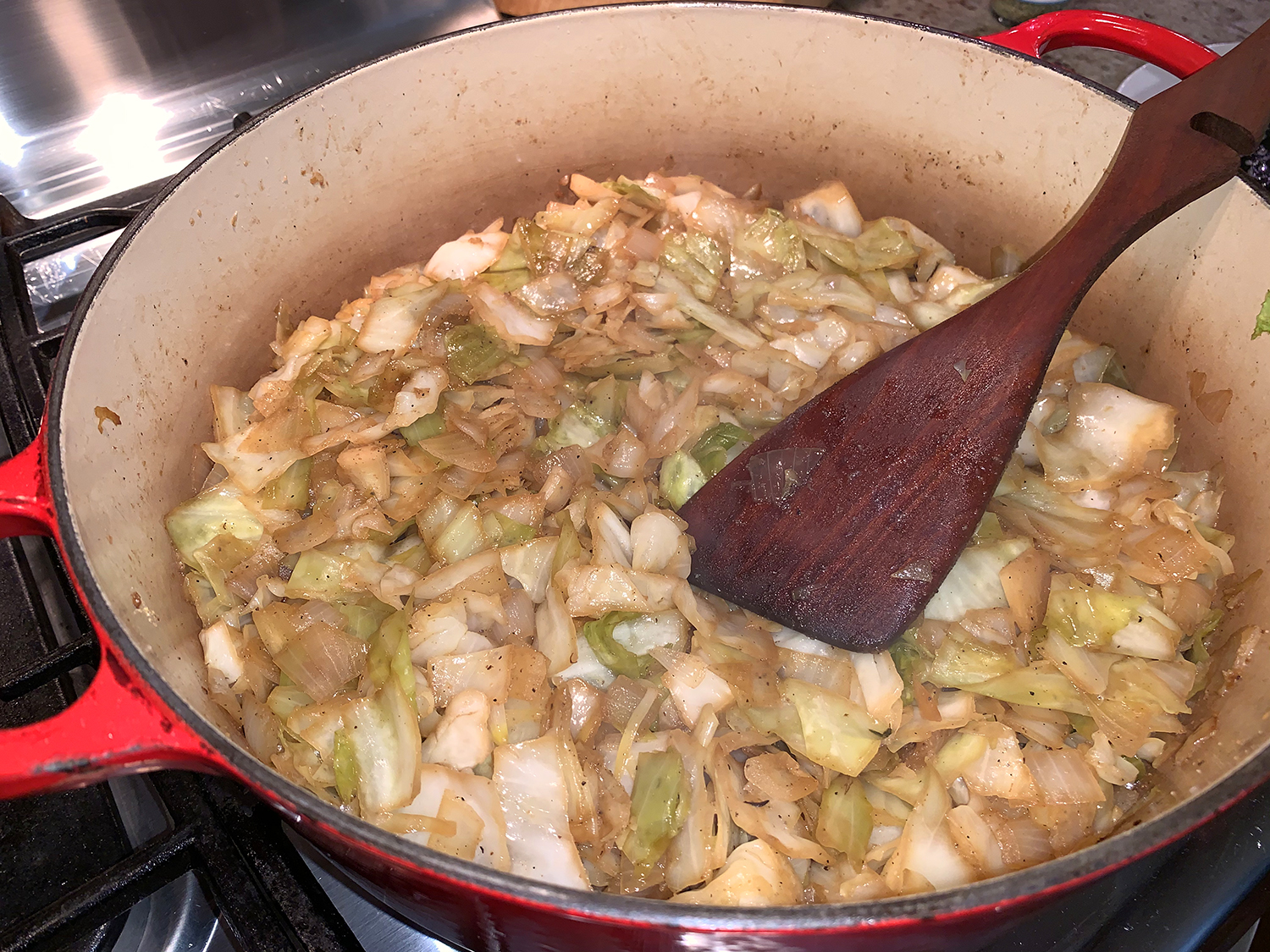
  4. Add cabbage to pot and cook over medium-high heat for 10 minutes, stirring every minute or so.
  5. Add chopped onion and continue cooking 5 more minutes, continue stirring every minute.
    IMG_4785
  6. Add Worcestershire, apple cider vinegar, garlic powder and brown sugar.
    IMG_4786
  7. Reduce heat to medium and continue cooking for 30 minutes, stirring occasionally, until cabbage is cooked through.
    IMG_4791
  8. Add cooked bacon to cabbage and taste to adjust seasonings and serve.
    IMG_4793
    IMG_4800

http://www.lynnandruss.com

Beef, Orange and Olive Stew (Boeuf À La Gardiane)

OK, now you don’t have the excuse of not enough time to make an hours-intensive recipe. As far as I know, pretty much the entire world is on lockdown due to the spread of the corona virus. And while this dish takes nearly five hours from start to finish, the pot sits in the oven for 3 1/2 of those hours, leaving you plenty of time to watch whatever show you’re currently bingeing on.

And while it’s getting all happy in the oven, the aromas will be wafting around the house teasing you into a frenzy, but be patient because the end game is truly memorable.

This hearty Beef, Orange and Olive Stew (Boeuf À La Gardiane) from Camargue, in the south of France, is traditionally made with taureau, or bull meat, but beef is a common substitute. Chuck roast is used instead because the fatty cut becomes tender and succulent with simmering.

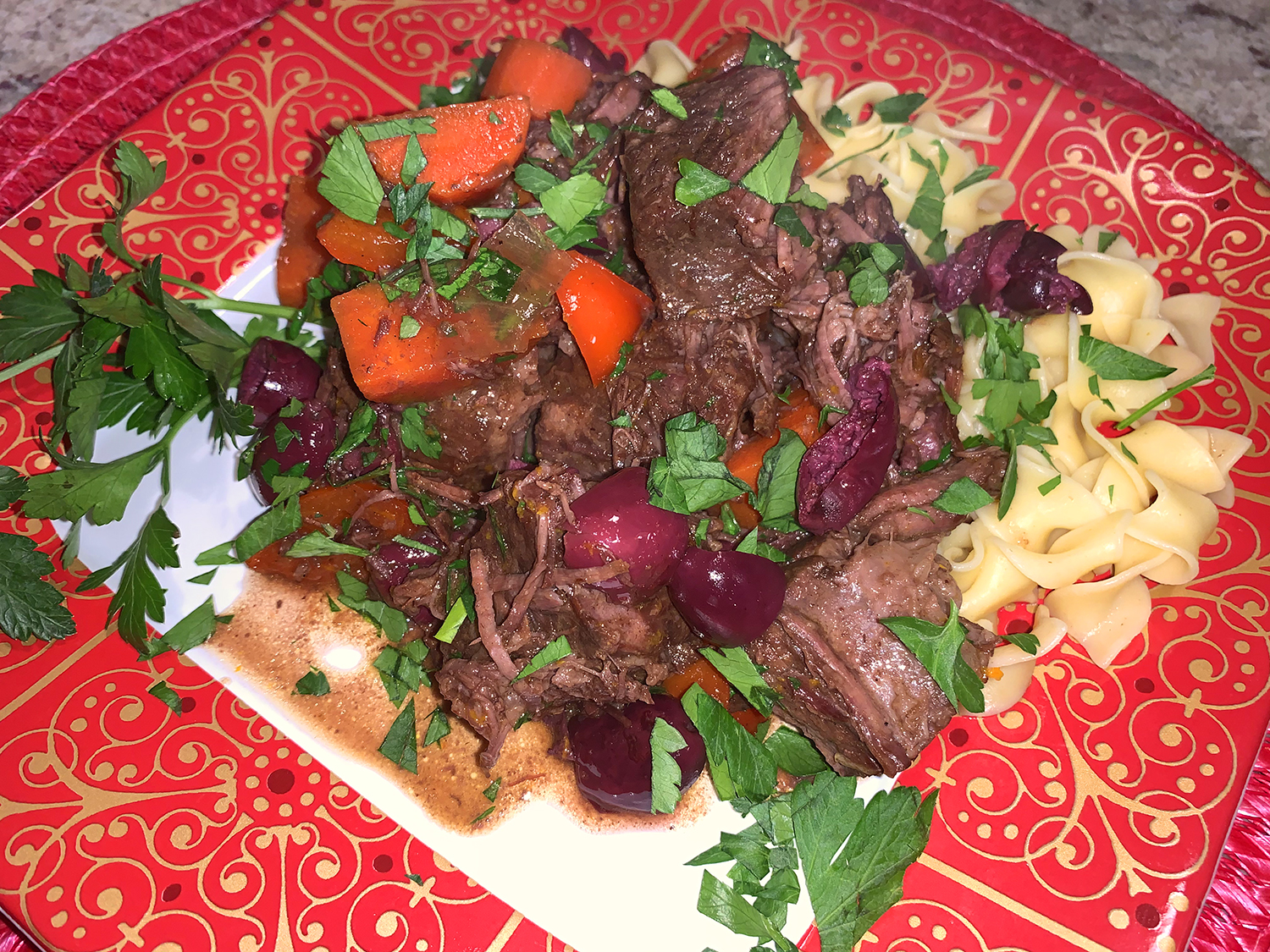
The stew gets robust flavor from classic Provençal ingredients—red wine, olives, anchovies and garlic. Orange is traditional, too; it lends the braise a brightness that balances its depth and richness. A bold, full-bodied dry red wine such as Côtes du Rhône or syrah is ideal, as it holds its own among the other big flavors. Serve with rice, egg noodles (our choice) or potatoes.

BTW, don’t pull a rookie move and forget to zest the orange before juicing it. It’s much easier to grate the zest from a whole orange than from one that’s been halved and squeezed.

Don’t add all of the carrots to the pot with the beef. Adding some at the beginning gives the stew a subtle sweetness, but after hours of braising, these carrots are spent. More carrots are added near the end of cooking so that they are tender but still flavorful.

NO. 67: Use Less Liquid for More Flavor

IMG_4517

Beef, Orange and Olive Stew

  • Servings: 6-8
  • Difficulty: easy
  • Print

Ingredients

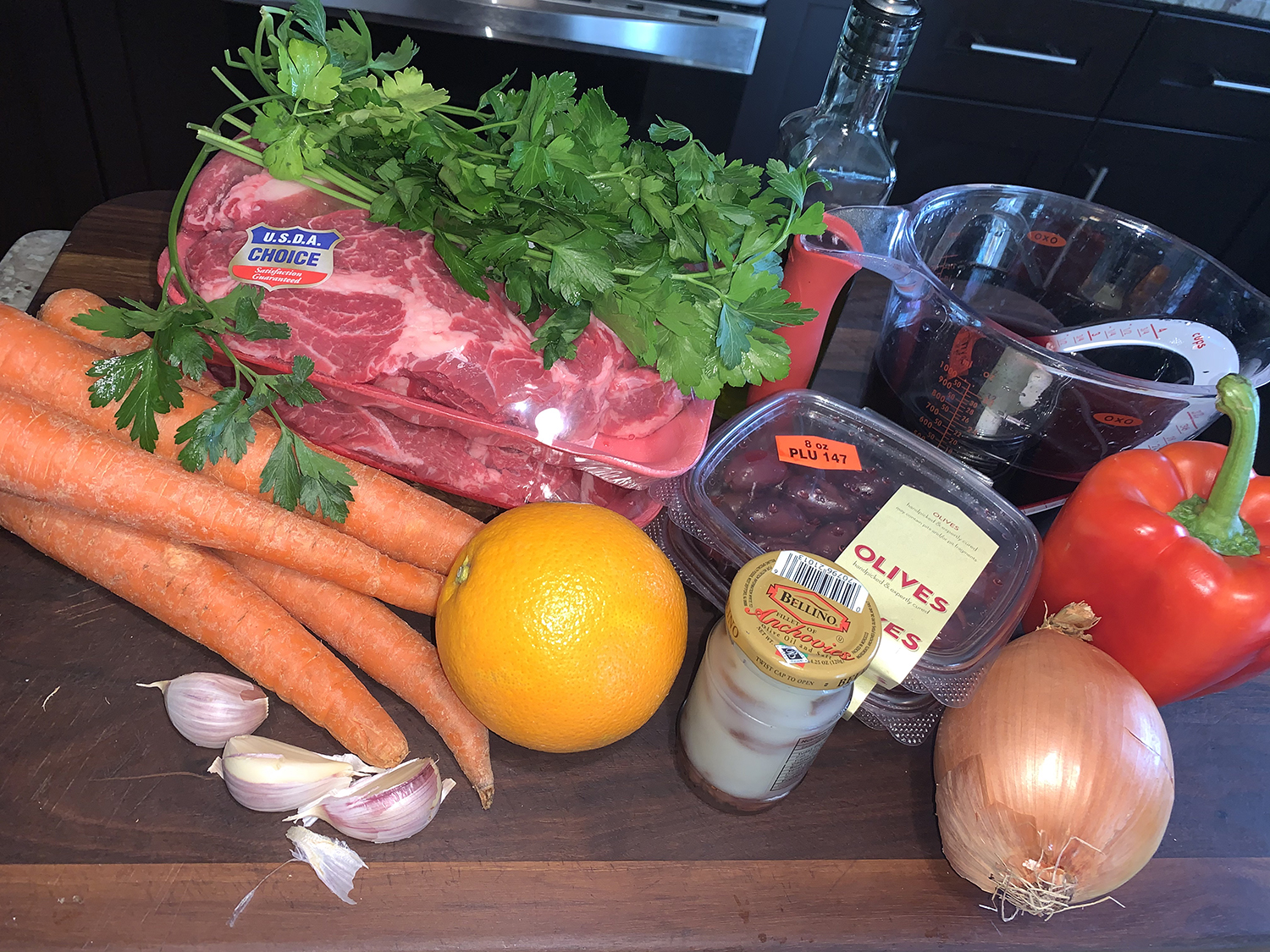
  • 6-7 lbs. boneless beef chuck roast, well trimmed and cut into 2-inch cubes
  • Kosher salt and ground black pepper
  • 4 Medium carrots, peeled and cut crosswise into ½-inch rounds, divided
  • 3 Anchovy fillets, patted dry
  • 2 Tbsp. extra-virgin olive oil
  • 2 Medium garlic cloves, thinly sliced
  • 1 Medium yellow onion, chopped
  • 1 Cup pitted kalamata olives, rinsed, patted dry and chopped, divided
  • 2½ Cups dry red wine
  • 1 Medium red bell pepper, stemmed, seeded and cut into 1-inch pieces
  • 1 Tbsp. grated orange zest, plus â…“ cup orange juice
  • 2 tsp. red wine vinegar
  • 1 Cup lightly packed fresh flat-leaf parsley, roughly chopped

Directions

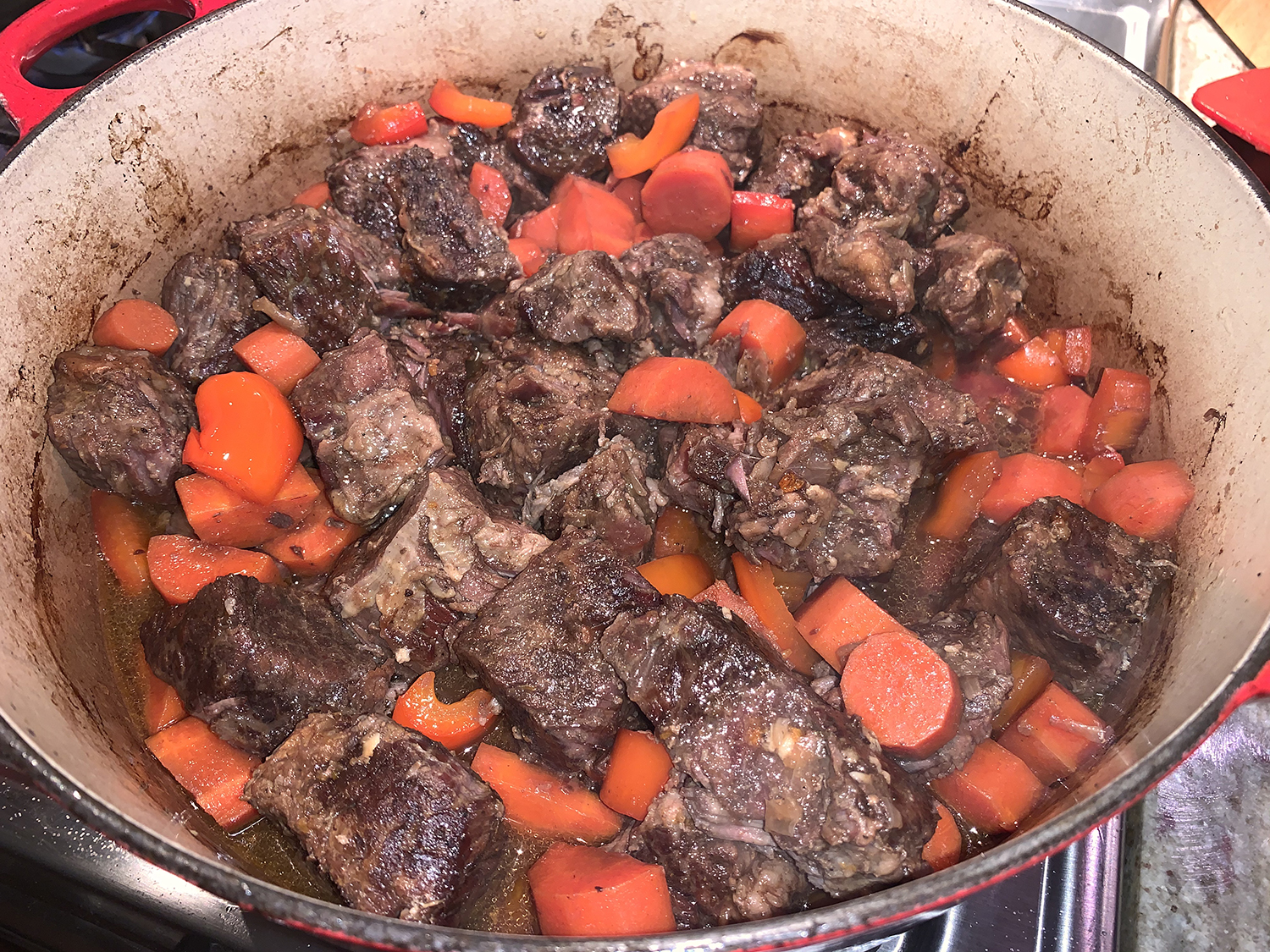
  1. Heat the oven to 325°F with a rack in the lower-middle position. In a large Dutch oven, toss the beef with 2 tablespoons salt and 2 teaspoons pepper. Add ½ the carrots, the anchovies, oil, garlic and onion, then toss. Cover, transfer to the oven and cook for 2 hours.
  2. Remove the pot from the oven and stir in ½ cup of the olives. Return to the oven uncovered and cook until a knife inserted into a piece of beef meets no resistance, 1 to 1½ hours.
    IMG_4524
  3. Using a slotted spoon, transfer the meat to a large bowl, leaving the vegetables in the pot. Set a fine mesh strainer over a fat separator or medium bowl. Pour the meat juices into the strainer, pressing on the solids to extract as much liquid as possible; discard the solids. You should have about 2½ cups liquid (we ended up with only 3/4 cup); if needed, add with water.
  4. Pour the wine into the now-empty pot and bring to a boil over medium-high, scraping up any browned bits. Reduce to medium and simmer, stirring occasionally, until the wine is reduced by half, about 8 minutes. Meanwhile, if you strained the meat juices into a bowl, use a spoon to skim off and discard the fat from the surface.
  5. Pour the defatted meat juices into the pot and add the remaining carrots and the bell pepper. Return to a simmer and cook, uncovered and stirring occasionally, until the vegetables are tender and the sauce is slightly thickened, 10. (After 10 minutes, cover the pot to maintain the juices and further soften the carrots, cooking for another 15 minutes.)
  6. Stir in the orange juice and beef. Continue to cook, stirring occasionally, until the sauce begins to cling to the meat, 3 to 6minutes.
    IMG_4546
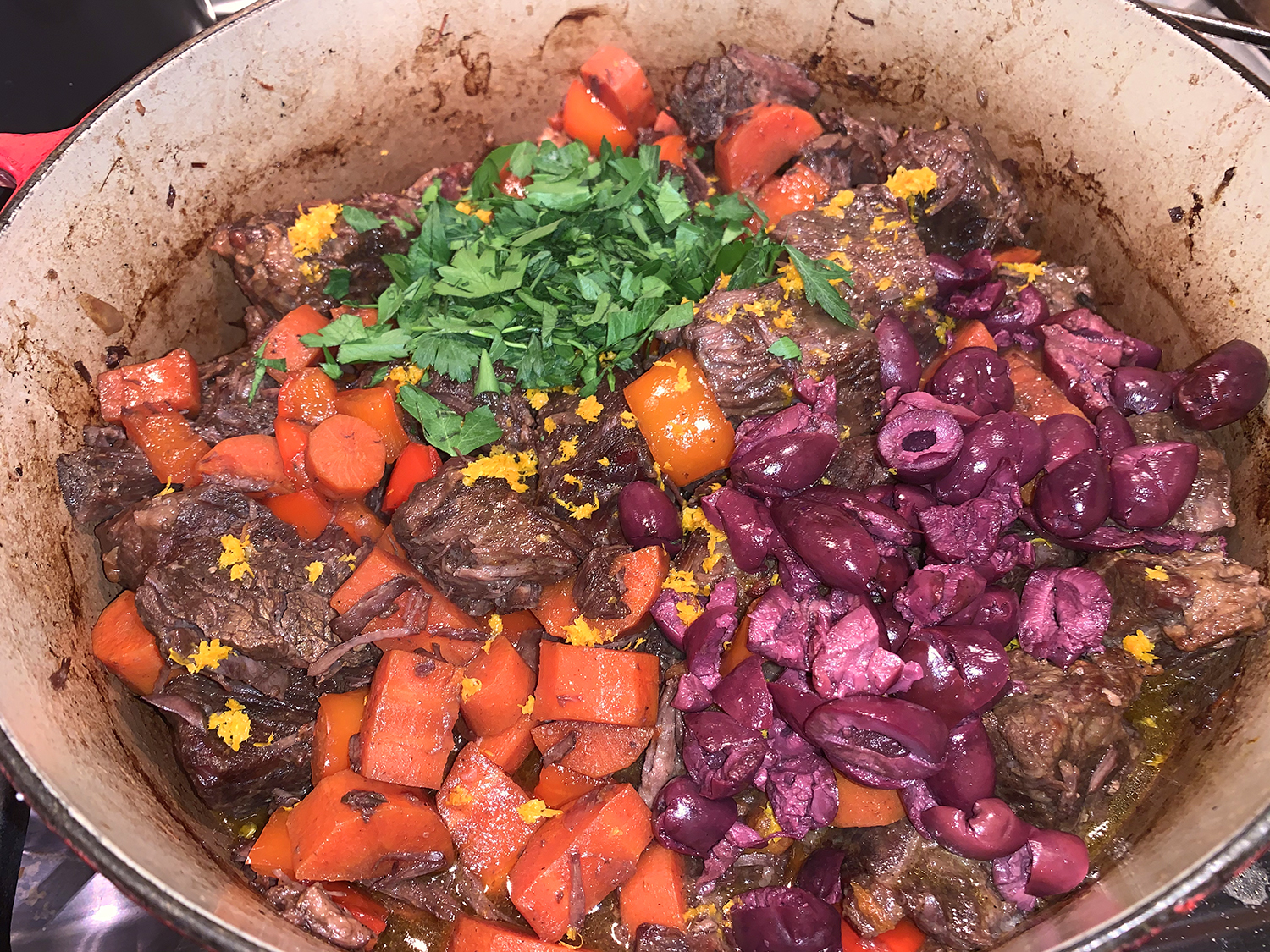
  7. Off heat, stir in the remaining ½ cup olives, the orange zest, vinegar and half of the parsley. Taste and season with salt and pepper. Sprinkle with the remaining parsley.
    IMG_4547
    IMG_4550

http://www.lynnandruss.com

Adapted from a recipe by Milk Street: The New Rules.

Broiled Flank Steak, Asparagus, Scallions, and Radishes

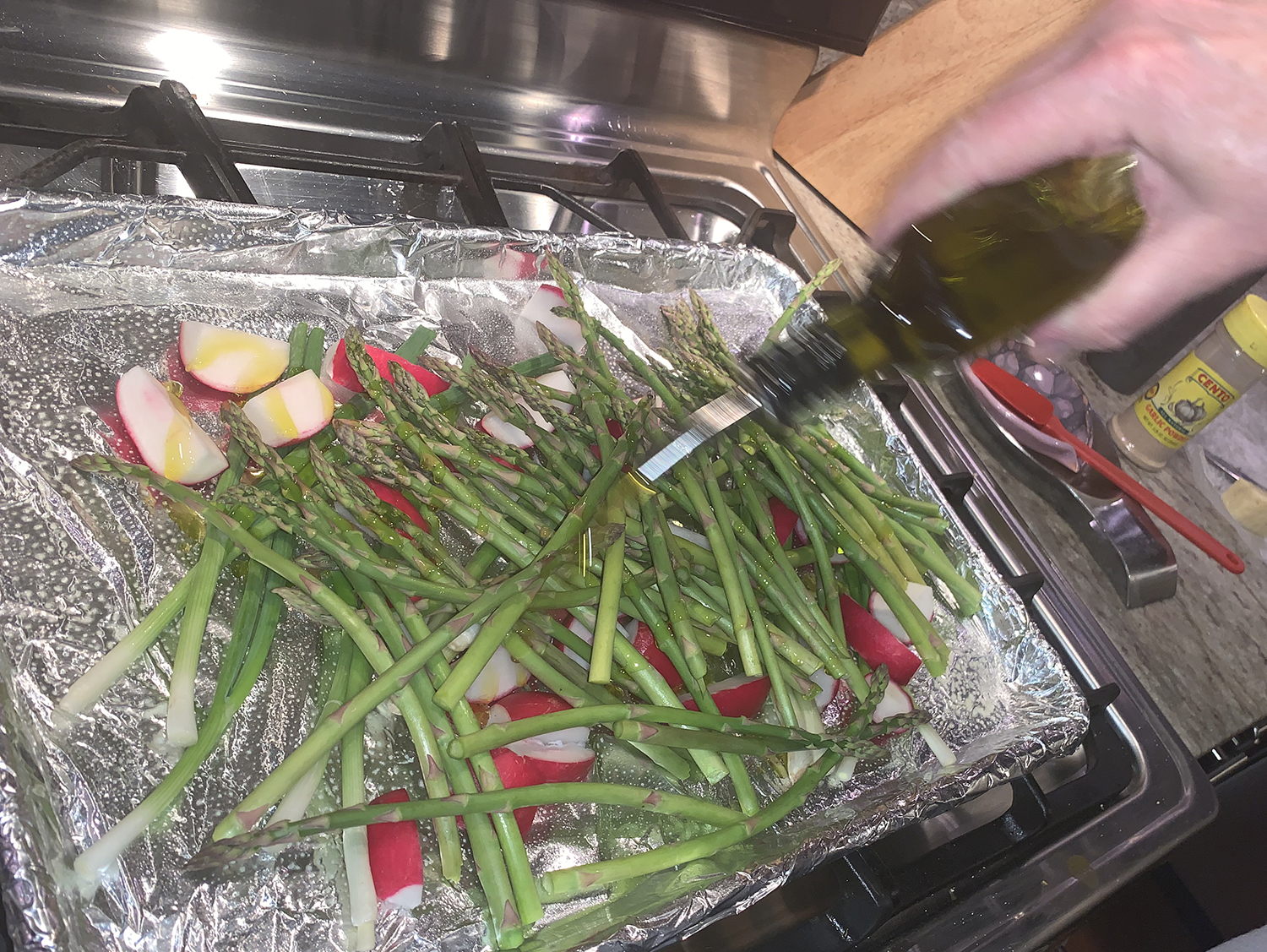
Broiled flank steak served with nutty asparagus, charred scallions, and caramelized radishes makes an easy sheet-pan dinner—with little clean up! We were a bit skeptical of the roasted radishes, but came away converts. They were so good, especially in tandem with the other charred veggies.

IMG_4681

Remember Green Goddess Sauce? It pulled the meal together with a bright herby note. This light, creamy version is also delicious with roasted potatoes and fish, or as a dip with vegetables.

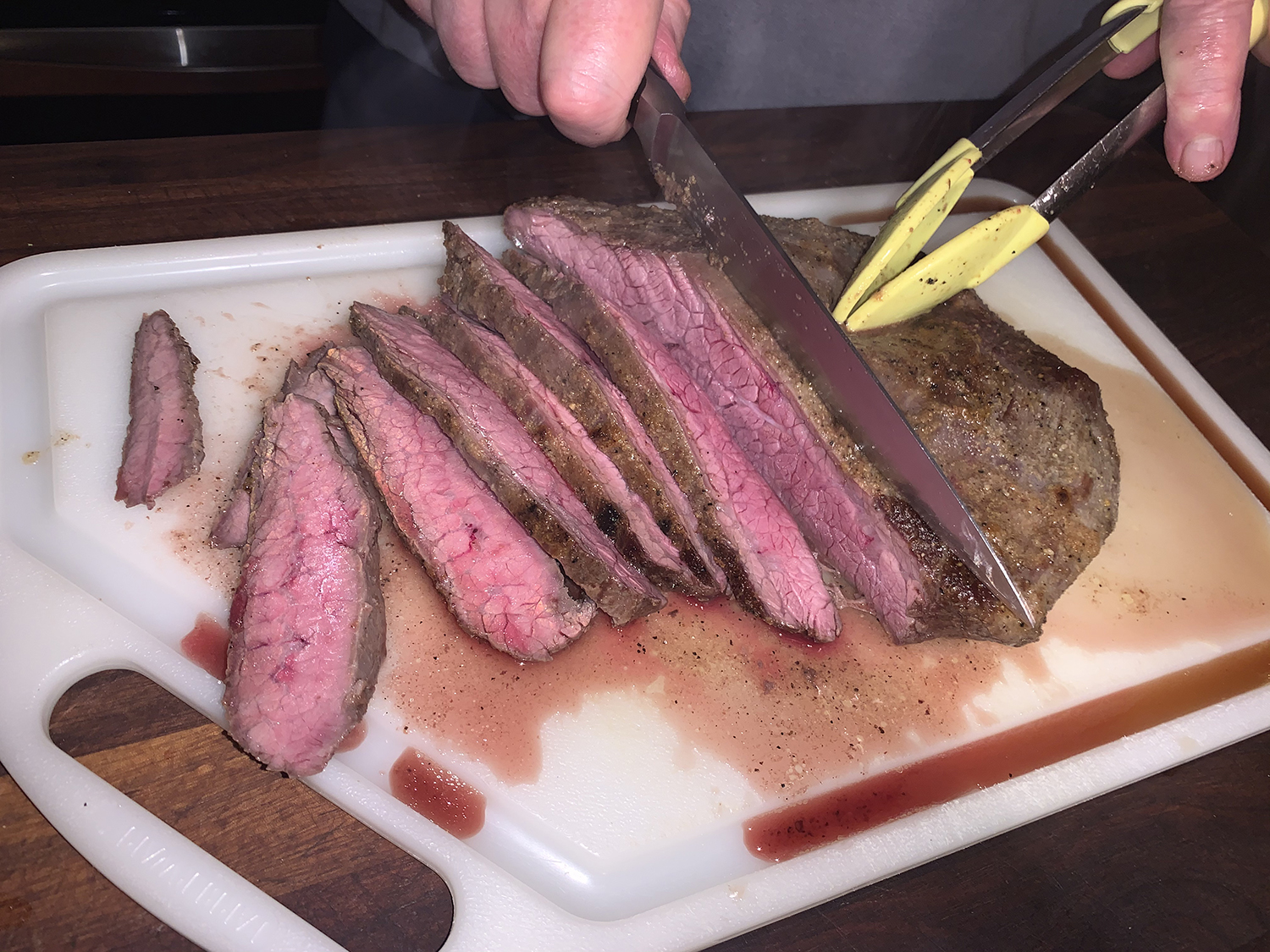
Our piece of steak weighed in a bit heavier at 2 pounds. One end was much thinner so we tucked it under the thicker portion. However, it still got done ahead of time, so we sliced the thin part off and tented with tinfoil on a cutting board with moat while the remaining ingredients continued broiling.

But then the veggies were done before the thick part of the steak, so those went under foil on a platter. Ideally everything would be a wrap at the same time, but you have to be ready to improvise if necessary.

As is, it’s a great low-carb dinner. For a heartier meal, serve with a cooked grain, such as quinoa or farro.

IMG_4656

Broiled Flank Steak, Asaparagus, Scallions and Radishes with Green Goddess Sauce

  • Servings: 4
  • Difficulty: easy
  • Print

Ingredients

For the green goddess sauce

IMG_4667

  • 2 anchovies, rinsed and patted dry
  • 1 medium clove garlic
  • 1/2 cup loosely packed fresh flat-leaf parsley leaves and tender stems
  • 2 Tbs. chopped scallions (from about 1 large scallion)
  • 1 Tbs. fresh tarragon leaves
  • 3/4 cup whole-milk yogurt
  • 3 Tbs. mayonnaise
  • 1 Tbs. fresh lemon juice
  • Kosher salt and freshly ground black pepper

For the steak and vegetables

  • 1-1/4-lb. flank steak
  • 1-1/2 tsp. granulated garlic
  • Kosher salt and freshly ground black pepper
  • Nonstick cooking spray
  • 1 lb. asparagus, trimmed
  • 1 bunch scallions, trimmed
  • 6 medium radishes, quartered
  • 2 Tbs. canola or vegetable oil

Directions

Make the green goddess sauce

  1. Put the anchovies and garlic in a mini food processor, and pulse until chopped.
  2. Add the parsley, scallions, and tarragon, and process until finely chopped.
    IMG_4658
  3. Add the yogurt, mayonnaise, lemon juice, 1 tsp. salt, and 1/2 tsp. pepper. Process until smooth. Season to taste with more salt and pepper.
    OR: To make the sauce by hand, mince the garlic, then mash with the anchovies. Put the mixture into a small bowl. Finely chop the herbs and scallions, and add to the garlic mixture. Stir in the yogurt, mayonnaise, lemon juice, salt, and pepper.
  4. The sauce can be made up to 1 day ahead. Store in the refrigerator in an airtight container.

Broil the steak and vegetables

  1. Season the steak with 1 tsp. of the granulated garlic, salt, and pepper, coating both sides. Let sit at room temperature for at least 30 minutes or up to 1 hour.
  2. Position an oven rack 4 inches from the broiler element, and heat the broiler on high. Line a large rimmed baking sheet with foil, and spray it lightly with cooking spray.
  3. Put the asparagus, scallions, and radishes on the baking sheet. Drizzle with 1 Tbs. of the oil and toss to coat. Sprinkle with the remaining 1/2 tsp. granulated garlic, and season with salt and pepper. Nudge the vegetables to the sides of the pan, keeping them in a single layer.
    IMG_4662
  4. Add the steak to the center of the pan, and drizzle with the remaining 1 Tbs. oil.
    IMG_4666
  5. Broil, flipping the steak once and stirring the vegetables, until the internal temperature of the steak is 125°F to 130°F for medium rare, about 5 to 6 minutes per side.
  6. Transfer the steak to a cutting board, and let rest for 5 to 10 minutes. Thinly slice the steak against the grain. Serve the steak and vegetables drizzled with the Green Goddess Sauce.
    IMG_4673
    IMG_4680

http://www.lynnandruss.com

Adapted from a recipe by Nicki Sizemore from Fine Cooking

Cardamom-Lime Chicken and White Beans

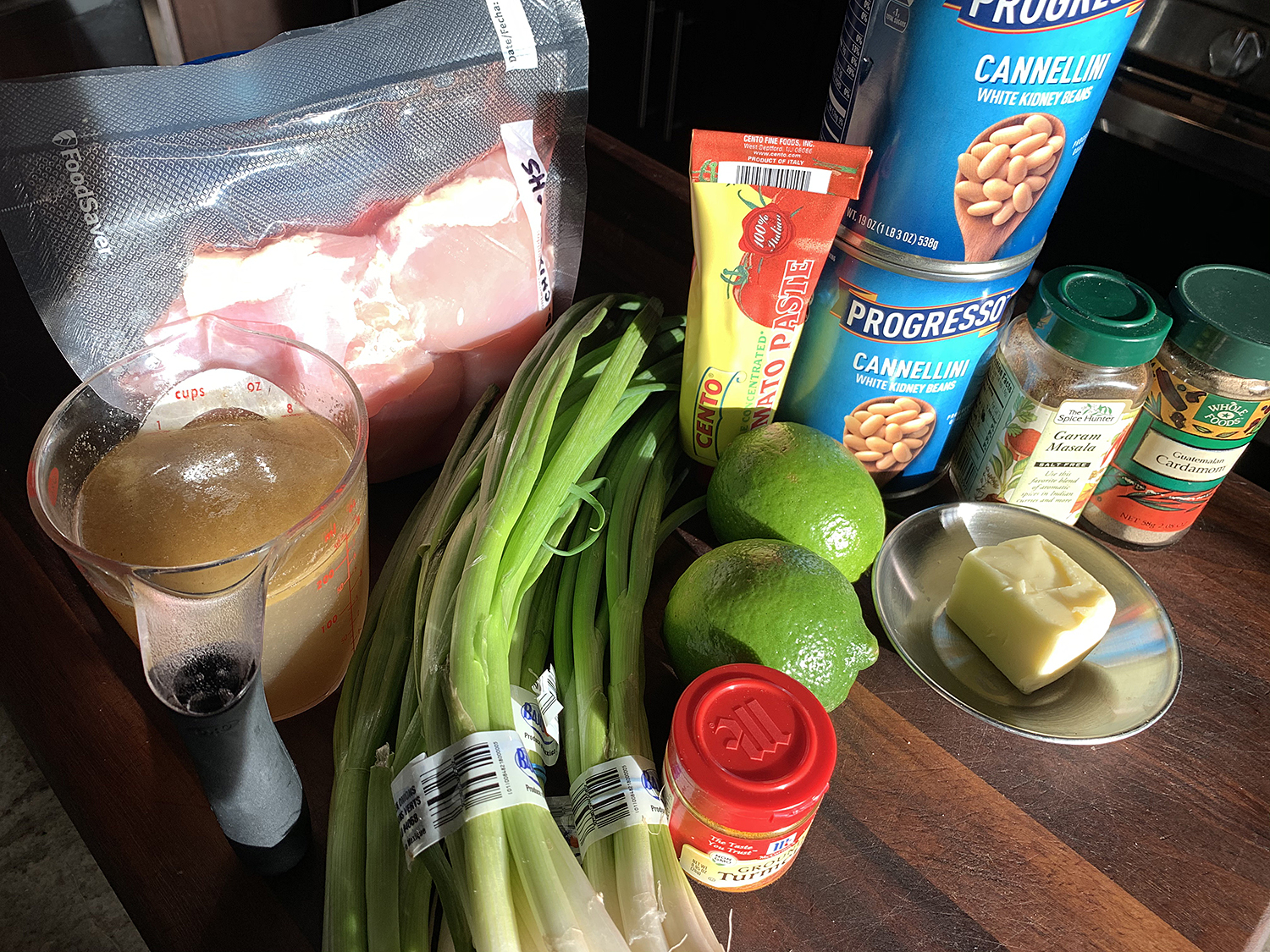
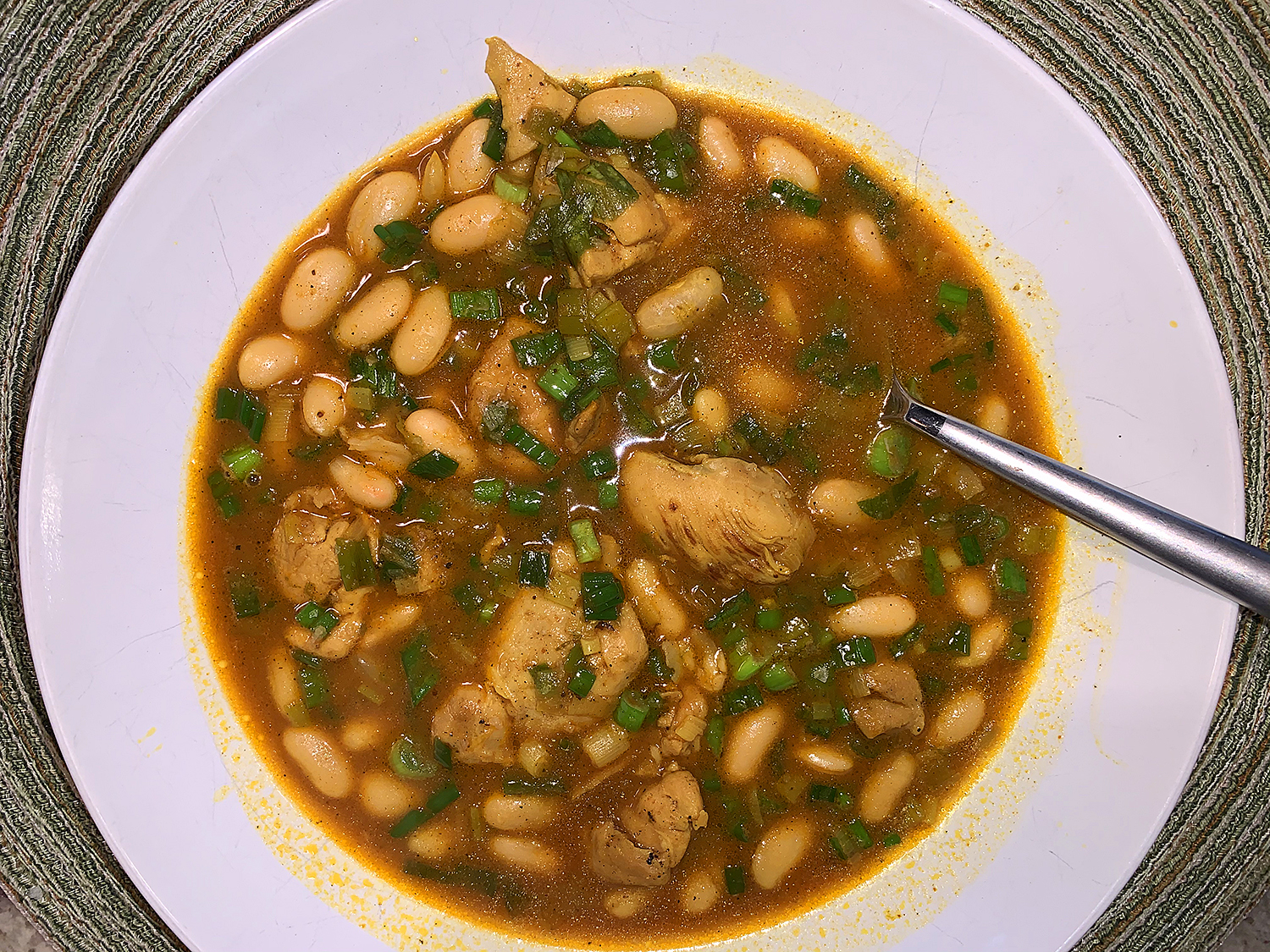
Another winner from Milk Street, Cardamom-Lime Chicken and White Beans. Their inspiration for this hearty braise was a chive and white bean soup from “Cooking In Iran” with some simplifications. They swapped canned white beans for the dried which saved tons of time. And substituting fresh lime zest in place of hard-to-find Persian limes saves your sanity.

Four bunches of scallions? I’m an allium lover and that even threw me for a loop. The scallions infuse every bit with pungency while also lending the recipe color. Not necessary to make them perfectly uniform in size, but they must be sliced thin. Remember to keep the white parts separate from the green as they are added at different times.

Don’t forget to save the liquid when draining the beans. It adds both body and flavor to the dish. If you do accidentally discard it, simply increase the chicken broth to 2⅓ cups. The braising liquid will be thinner, but the dish will still be tasty.

In many cases, I tend to increase the amount of meat/protein. Here, because our package of defrosting chicken thighs weighed only one pound, I decided to increase the white beans to two 19-once cans. If desired, you can serve the stew with rice, roasted potatoes or warmed flatbread. We enjoyed it without any accompaniments.

IMG_4588

Cardamom-Lime Chicken and White Beans

  • Servings: 4
  • Difficulty: easy
  • Print

Ingredients

  • 1½ lbs. boneless, skinless chicken thighs, trimmed and cut into 2-inch chunks
  • Kosher salt and ground black pepper
  • 3 Tbsp. salted butter
  • 4 bunches scallions, thinly sliced, white and green parts reserved separately
  • 2 Tbsp. tomato paste
  • 1 Tbsp. garam masala
  • 1½ tsp. ground cardamom
  • 1 tsp. ground turmeric
  • 2 15½-ounce cans cannellini beans, drained, liquid reserved
  • 1 cup low-sodium chicken broth
  • 2 tsp. grated lime zest
  • ¼ cup lime juice

Directions

  1. Season the chicken with 1 teaspoon salt and ¼ teaspoon pepper.
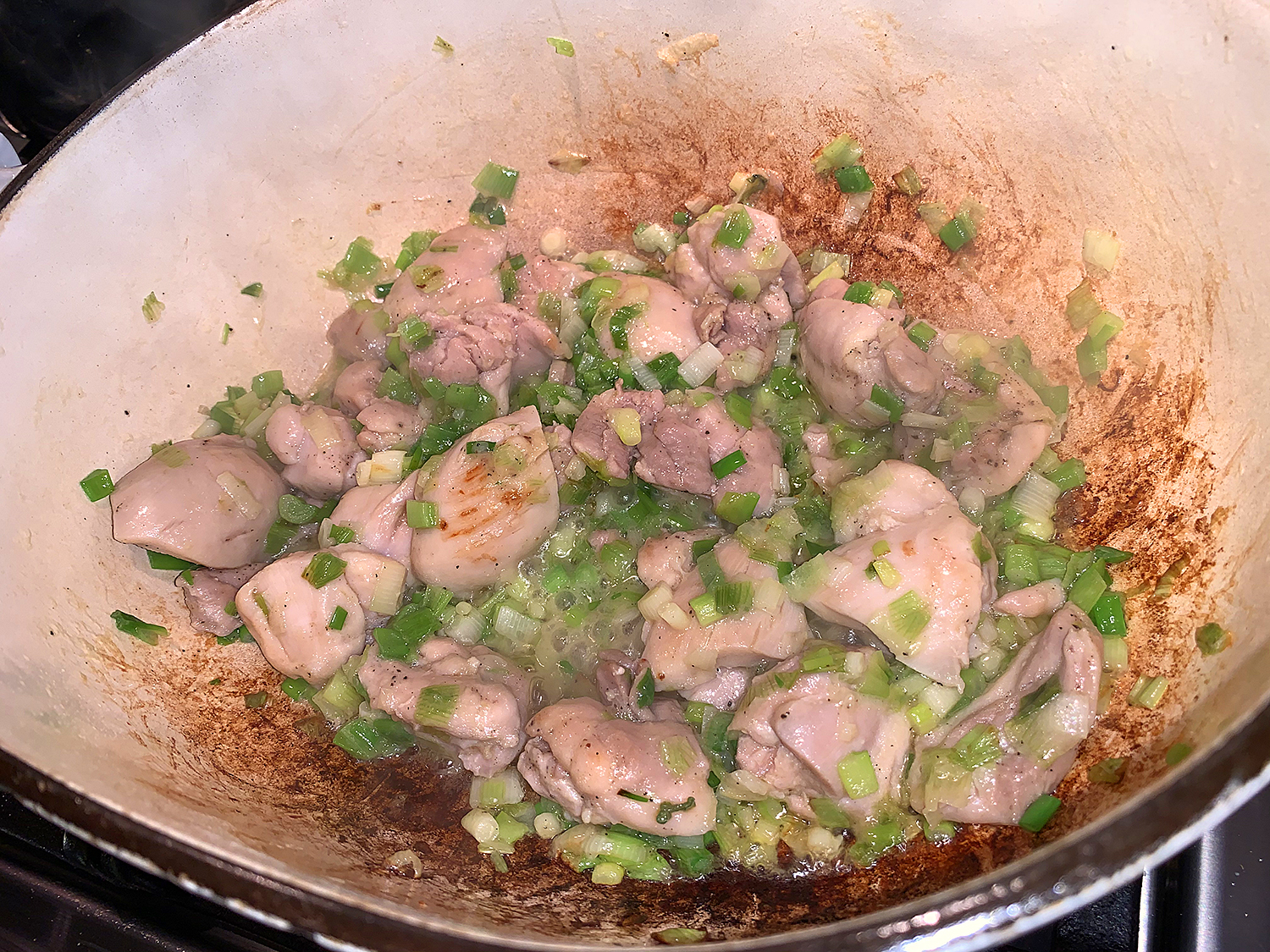
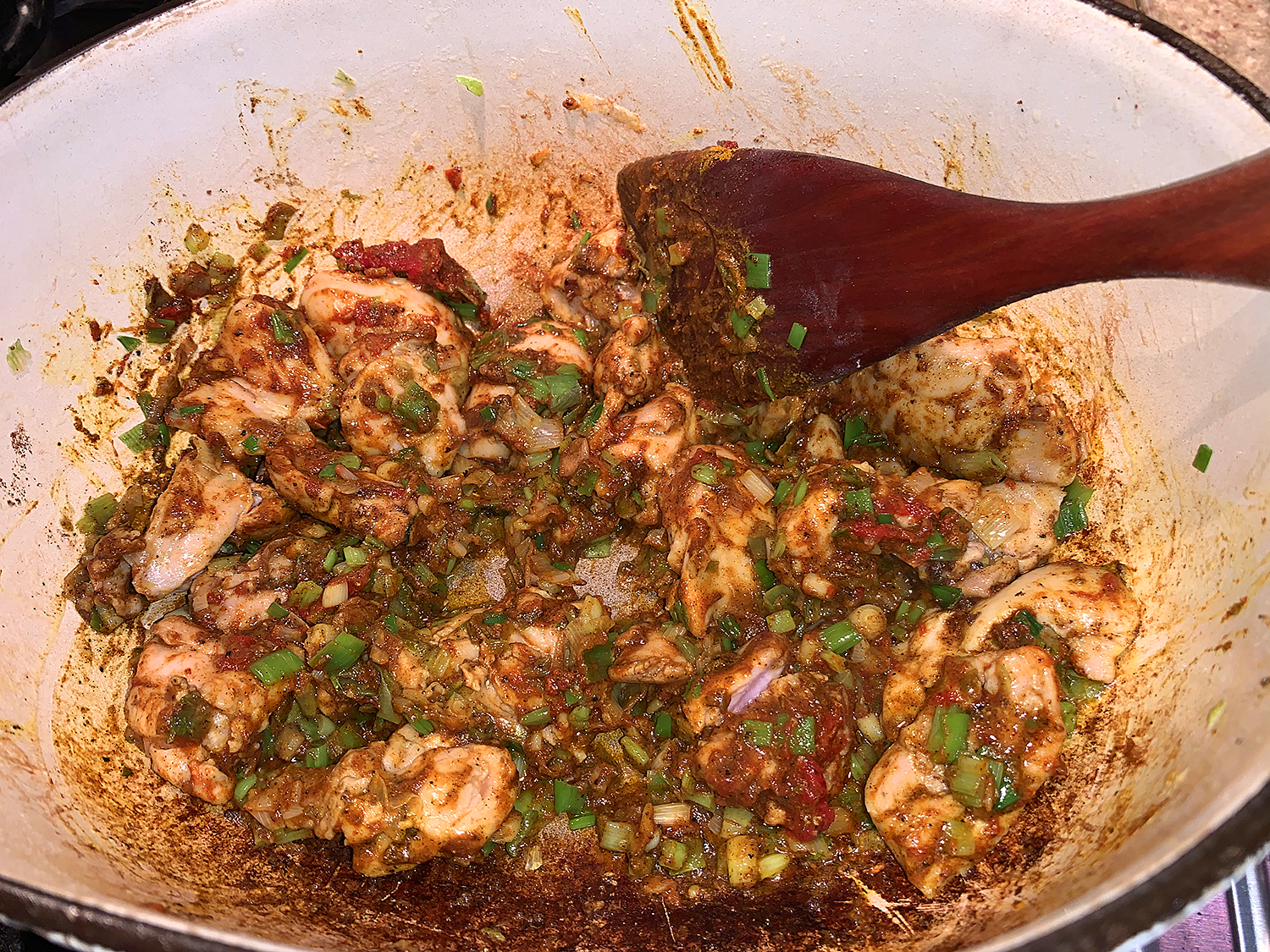
  2. In a large pot over medium-high, melt the butter. Add the chicken and scallion whites, then cook, stirring once or twice, until both the chicken and scallions begin to turn golden brown, 3 to 5 minutes.
    IMG_4593
  3. Add the tomato paste, garam masala, cardamom, turmeric, 1½ teaspoons salt and ½ teaspoon pepper.Cook, stirring constantly, until fragrant, 30 to 60 seconds.
    IMG_4594
  4. Add the bean liquid, broth, and lime zest and juice, then bring to a boil. Reduce to medium and cook, uncovered, stirring occasionally and adjusting the heat as needed to maintain a simmer, until the chicken is opaque when cut into, 5 to 7 minutes.
  5. Stir in the scallion greens and the beans, then cook until the beans are heated through, another 2 minutes.
    IMG_4598
  6. Taste and season with salt and pepper.
    IMG_4599

http://www.lynnandruss.com

Adapted from a recipe by Julia Krakow from Milk Street

Bake Well, Be Well with Mediterranean-Inspired Ingredients

Olive Oil Sugar Cookies with Pistachios and Lemon Glaze, now don’t they sound fantabulous? The Mr. found them during a favorite pastime of combing through online recipes, and thought it might be a great addition (or substitute) for my typical, but much-loved, Easter decorated sugar cookies. As soon as he told me about these, I knew immediately that I would double the amount (which made 62 cookies, to be exact, with a 2 1/4″ cookie cutter).

IMG_4654

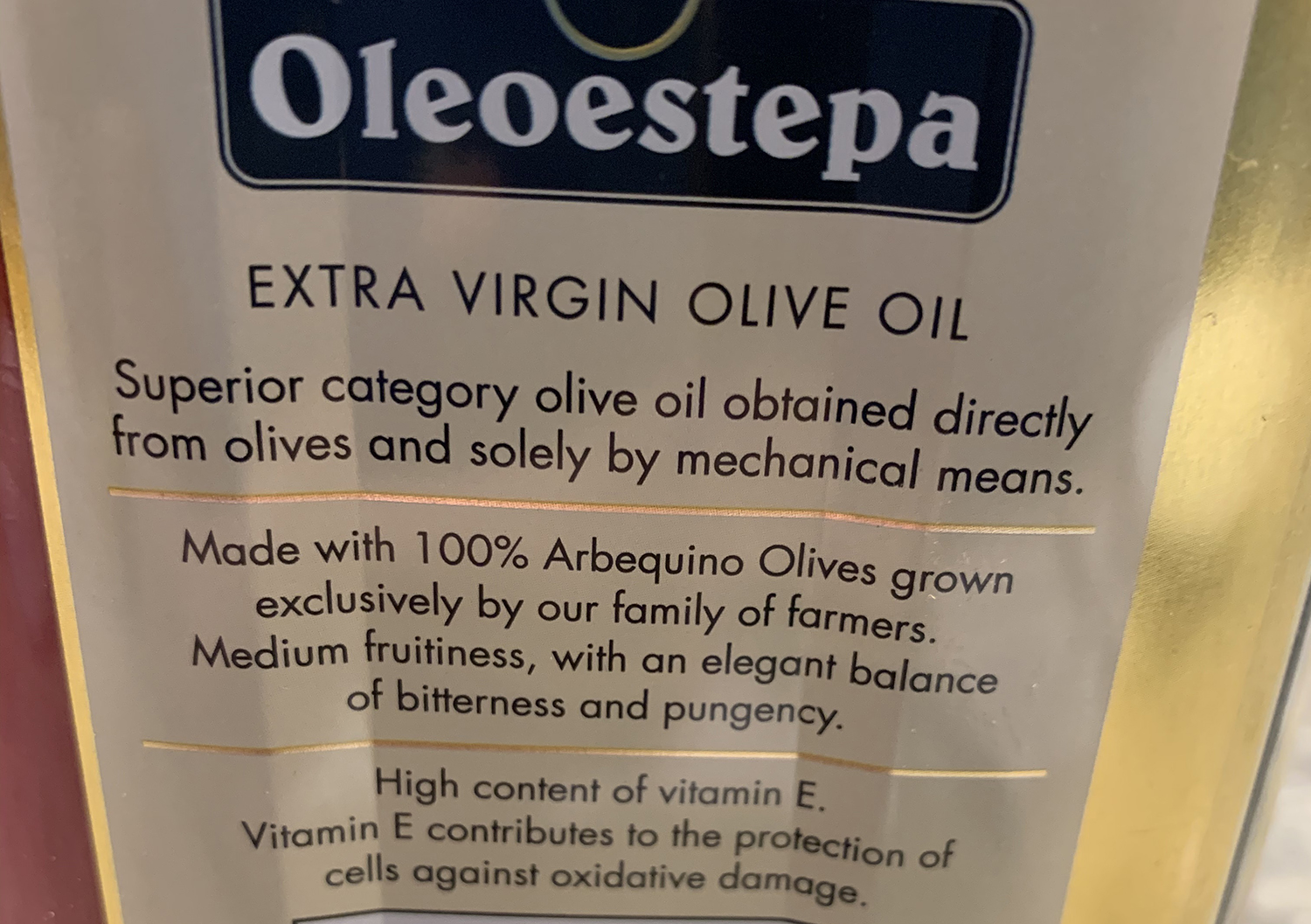
They taste even better than they look. With ingredients such as extra-virgin olive oil, pistachios and lemon, we dubbed them “Mediterranean-Inspired” which prompts a more pious attitude when eating cookies, no? To that end, be sure to use a high-end more neutral olive oil such as an Arbequino.

IMG_4641

To begin, it’s worth remembering that extra virgin olive oil is similar to wine in key ways. Like Cabernet Sauvignon or Chardonnay, which are named for their grape varietals, Arbequina and Arbosana extra virgin olive oils are named for the olives that are crushed to make the oils.

The Arbequina olive hails originally from Catalonia, in Spain. It produces more delicate, fruity oil—great for baking. Here’s a couple novel ideas: Sprinkle over meats to bring out their intense flavors. OR, for a really easy treat, drizzle it on good French vanilla ice cream along with a tinkle of flaky sea salt. But I digress…

Enter the “Shelter-in-Place” mandate and now I had plenty of time to bake. Thank goodness because the only pistachios available at the grocery store were still in their shells, increasing the time component. Speaking of time, there is a lot of refrigerating/freezing you need to take into account, so plan accordingly.

Son David was also going to be celebrating a birthday on Easter weekend, so we did a drive-by (admittedly 2 weeks early) to drop off his present along with a gift box of these fabulous cookies. David, girlfriend Vikki and dog Olive are shown below keeping their 6-foot distance….

IMG_4633

Olive Oil Sugar Cookies with Pistachios and Lemon Glaze

  • Servings: 2 1/2 doz. cookies
  • Difficulty: easy
  • Print

Ingredients (Single batch. This makes about 2 1/2 dozen cookies)

Cookies

  • 1/3 cup whole pistachios, plus 1/3 cup chopped for sprinkling
  • 2 cups all-purpose flour
  • 1/2 tsp. baking soda
  • 1/2 tsp. salt
  • 4 Tbsp. (1/2 stick) unsalted butter, at room temperature
  • 3/4 cup granulated sugar
  • 1/4 cup confectioners’ sugar
  • 1/2 cup high-quality extra virgin olive oil
  • 1 large egg
  • 1 tsp. pure vanilla extract

Lemon Glaze

  • 1 cup confectioners’ sugar
  • Grated zest of 1 lemon
  • 1 Tbsp. lemon juice
  • 2 to 4 Tbsp. heavy cream or whole milk

NOTES: For a double batch, I needed two lemons. However, my fruits were very large so I only used the zest from 1 1/2 lemons. As far as the milk, I used 4 Tbsp. for the double batch and the glaze was a perfect consistency.

Directions

Cookies

  1. Place the pistachios in a food processor fitted with a steel blade and pulse until finely ground. Add the flour, baking soda, and salt. Pulse to fully combine and set aside.
  2. In the bowl of a stand mixer fitted with a paddle, beat the butter on medium until creamy. Add the granulated and confectioners’ sugars and beat on medium until light and fluffy, 2 to 4 minutes.
  3. Add the olive oil and mix on low until combined. Scrape down the sides of the bowl and add the egg and vanilla, mixing on low until combined. Add the flour mixture and mix on low until combined.
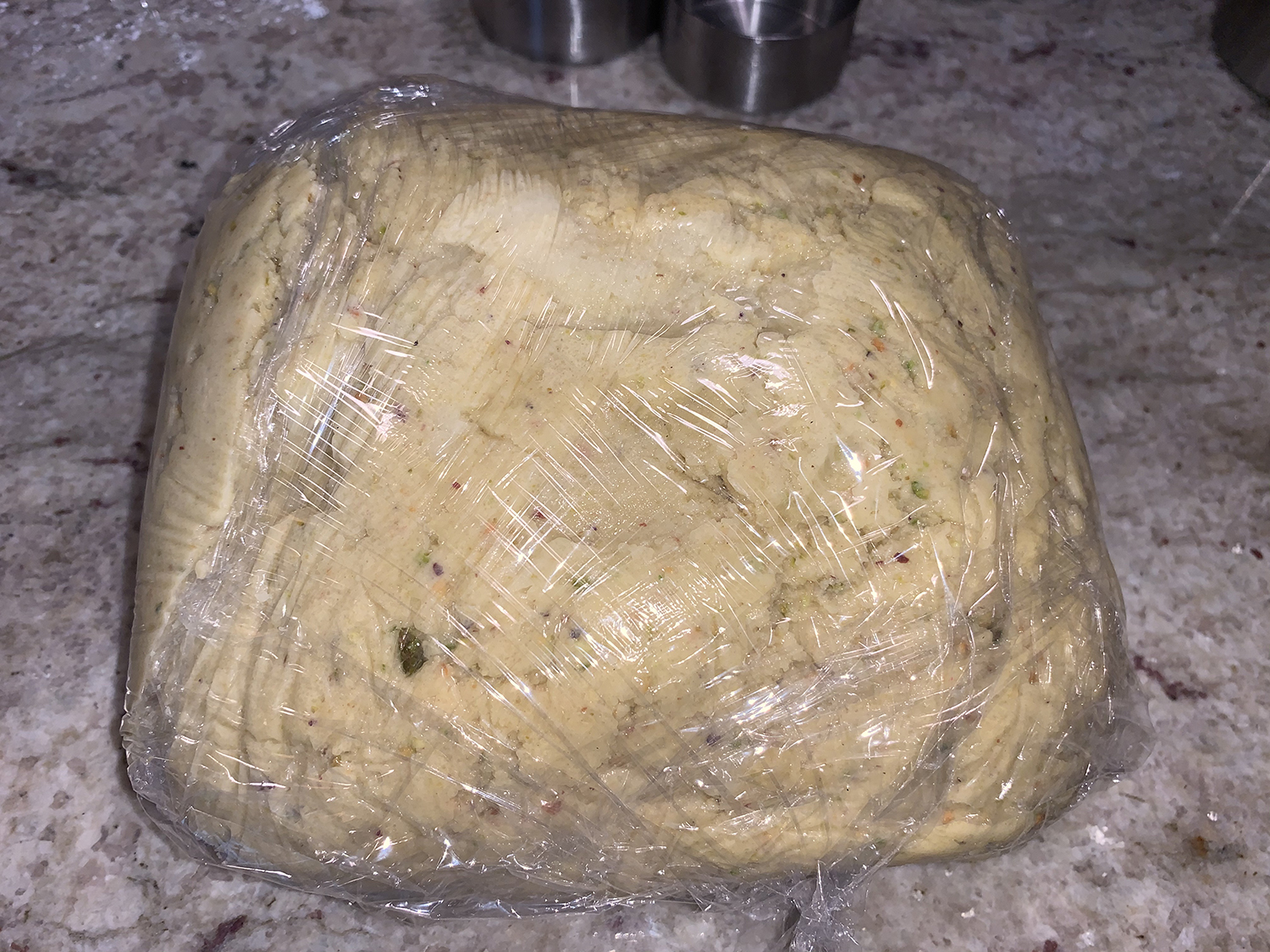
  4. Gather the dough, wrap with plastic wrap, and chill in the refrigerator for at least 2 hours and up to 1 day.
    IMG_4640
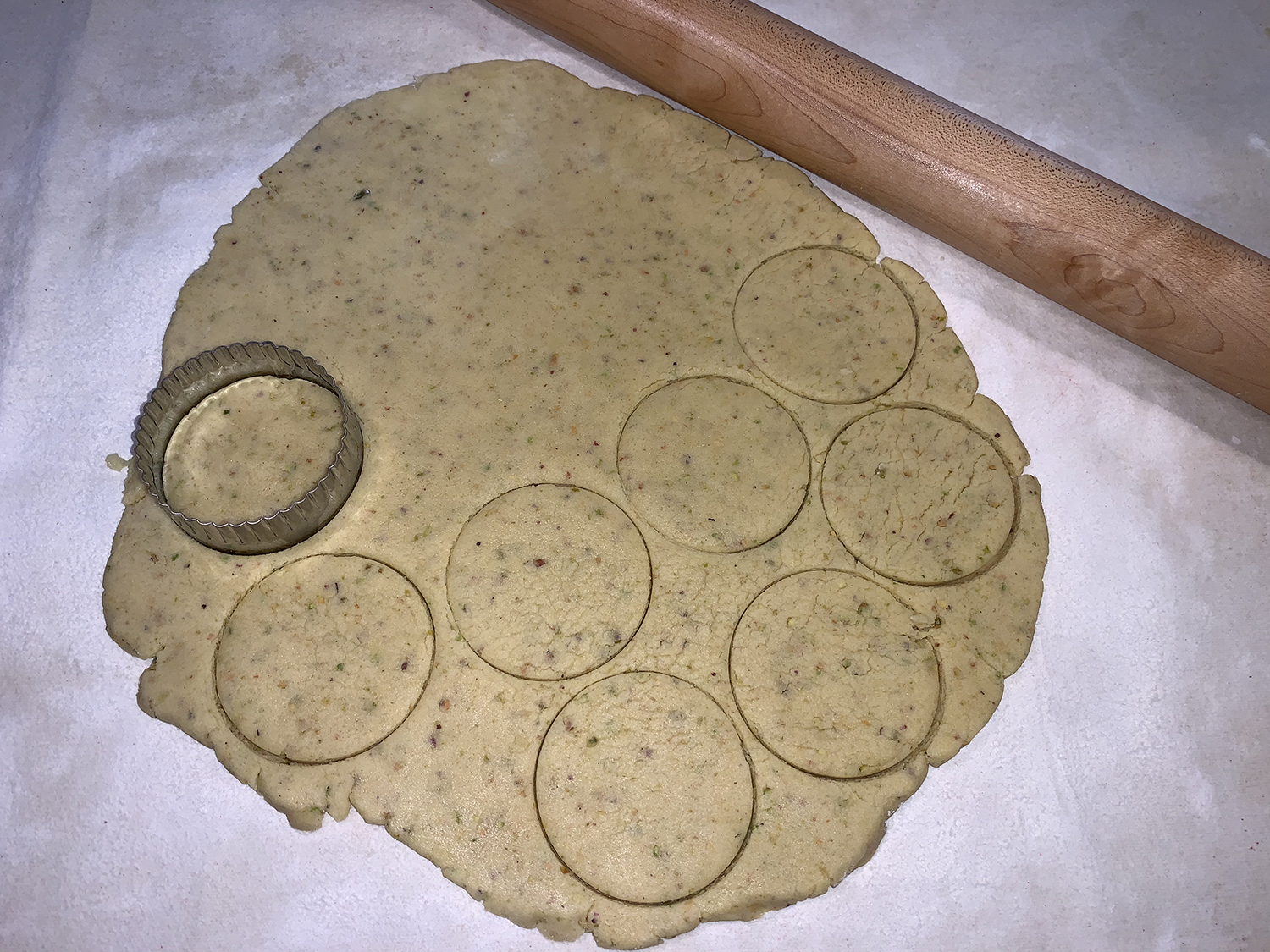
  5. Lightly flour a work surface and roll the dough to 1/4-inch thick. Using a 2-inch (or slightly bigger) biscuit or cookie cutter, cut out circles. (Any dough scraps can be rewrapped and chilled while the cookies are baking/freezing.)
    IMG_4643
  6. Adjust the oven rack to the middle position. Preheat the oven to 350°F. Line two baking sheets with parchment paper.
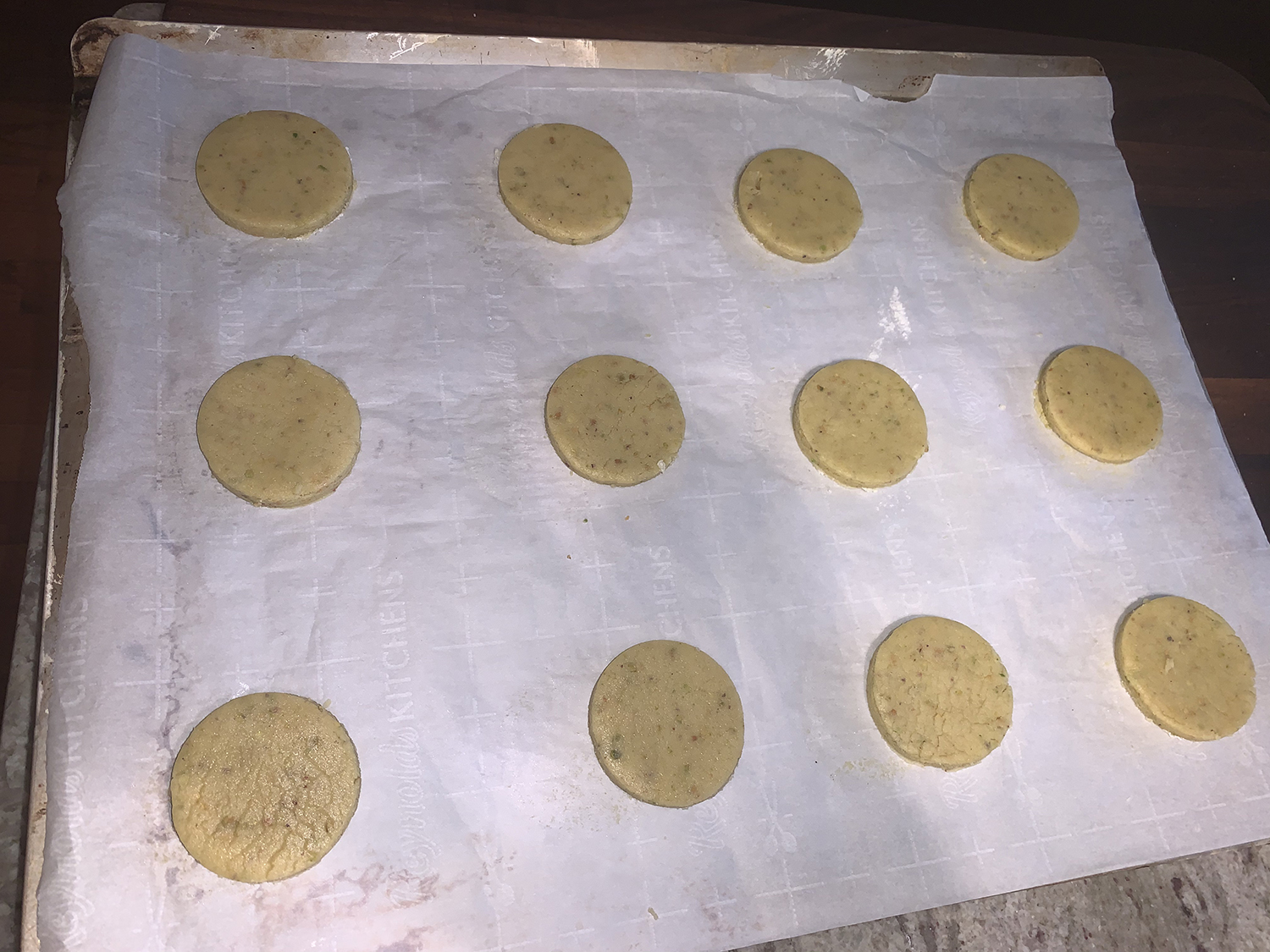
  7. Gently slide a metal spatula underneath each round and transfer it to the prepared baking sheet. Place 12 on each sheet.
    IMG_4645
  8. Put the first baking sheet in the freezer for 10 minutes. After the dough has chilled, put the first pan of cookies in the oven, and then put the second pan in the freezer. Repeat with the leftover dough.
  9. Bake 10 to 12 minutes one sheet at a time, until the cookies are just beginning to brown on the edges. Transfer the baking sheet to a wire rack and let the cookies cool completely on the pan.

Lemon Glaze

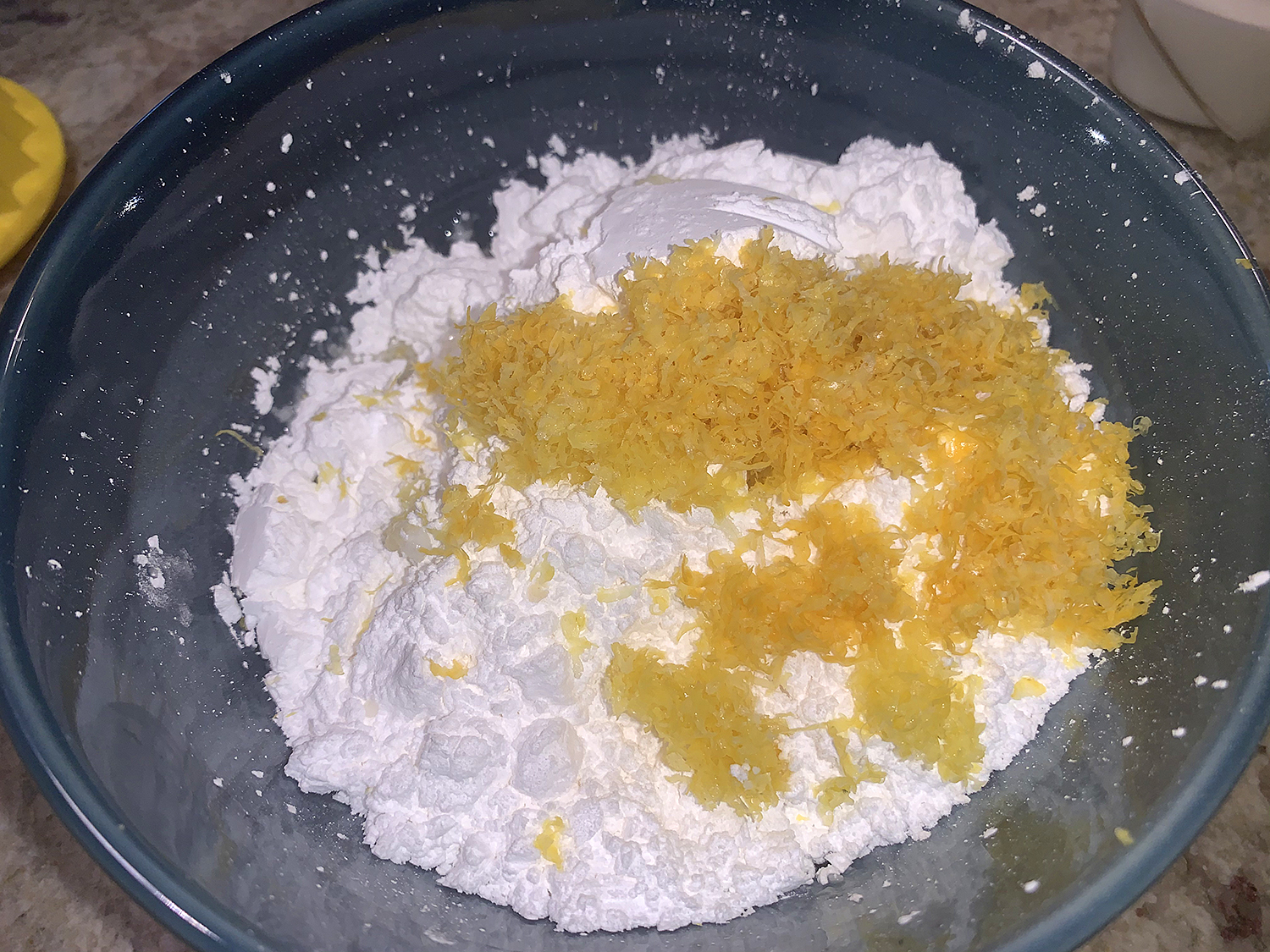
  1. In a small bowl, whisk the confectioners’ sugar and lemon zest. Whisk in the lemon juice.
    IMG_4646
  2. Whisk in the heavy cream (or whole milk), 1 tablespoon at a time. Add just enough cream to make a thin glaze.
  3. Using an offset spatula or kitchen knife, spread a thin layer of the glaze on each cooled cookie.
  4. Sprinkle with the chopped pistachios and let the glaze set a few minutes before serving.
    IMG_4650

http://www.lynnandruss.com

Recipe by Sarah Kieffer found on Food52.com

Herb-Roasted Garlic Parmesan Baby Potatoes

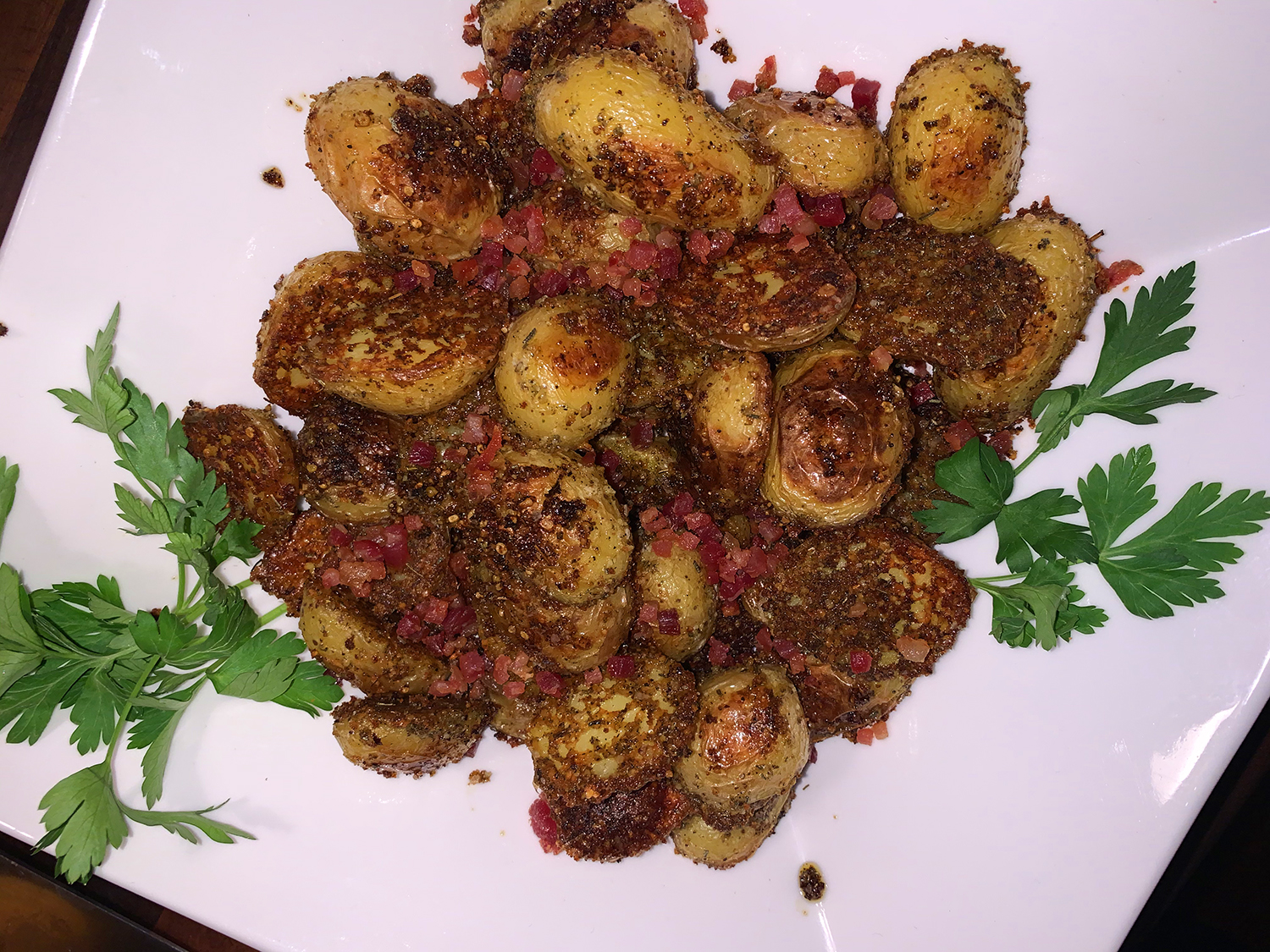
Crispy golden on the outside, light and creamy interiors—a potato lover’s dream! Yes, I admit, I do like my spuds. And these babies, bursting with flavor, rank among the best.

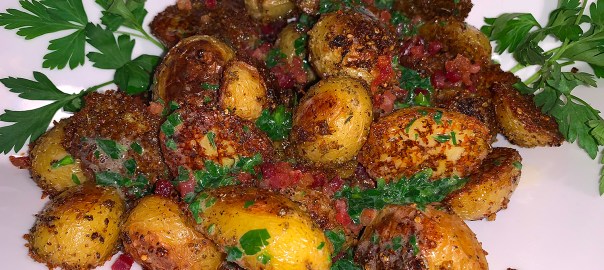
One ingredient is roasted garlic paste which I make homemade with EVOO and always keep on hand in the fridge. If you don’t have any, don’t sweat it, just finely mince or grate some garlic cloves. The addition of melted butter and pancetta at the end is purely over-the-top, but the pop of green from the parsley is refreshing.

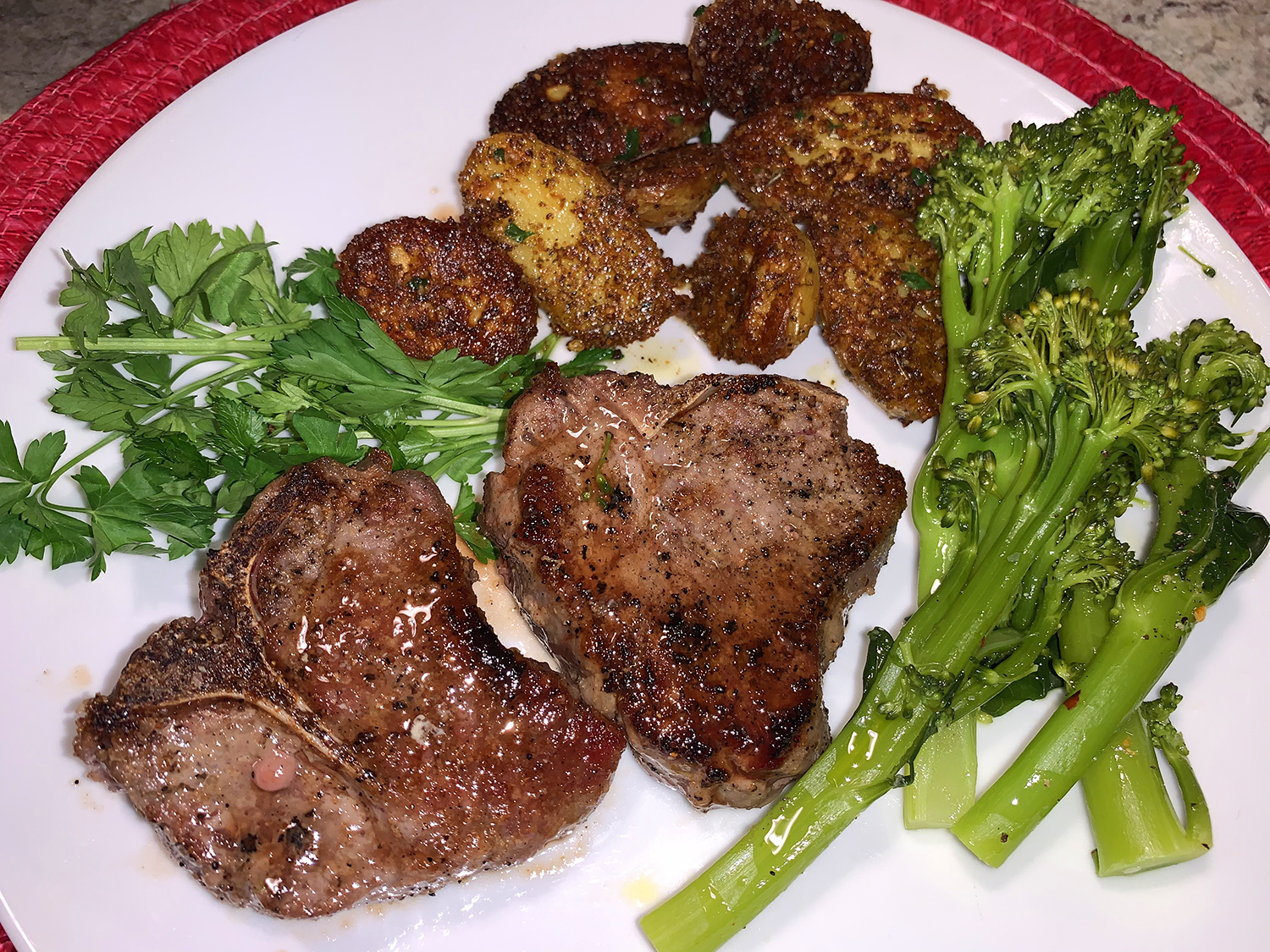
IMG_3635We served our potatoes with pan seared lamb loin chops and sautéed broccolini.

Herb-Roasted Garlic Parmesan Baby Potatoes

  • Servings: 4-6
  • Difficulty: easy
  • Print

Ingredients

  • 1.5 lbs. baby potatoes, such as Klondike Gourmet
  • 3 Tbsp. olive oil
  • 1 Tbsp. roasted garlic paste, or 4 cloves finely minced or grated
  • Salt and fresh cracked black pepper
  • 1 Tbsp. Italian seasoning*
  • 1/2 cup fresh grated Parmesan cheese
  • 1/2 cup unsalted butter (optional)
  • Fresh chopped parsley, for garnish
  • 2 oz. pancetta, small dice (optional)

*To make your own Italian seasoning: In a food processor, combine 2 Tbsp. each of basil, oregano, rosemary, marjoram, cilantro, thyme, savory and red pepper flakes. Blend for 1 minute, or until desired consistency is achieved.

Directions

  1. Preheat your oven to 400ºF. Grease a large rimmed baking sheet with non-stick spray or olive oil and set aside.
  2. If using pancetta, cook in a skillet over medium heat until crispy, move to a paper towel- lined plate and set aside.
  3. Parboil baby potatoes in boiling water for 5 to 8 minutes to precook them. They’ll be more tender on the inside when roasting. Cool slightly then cut in half.
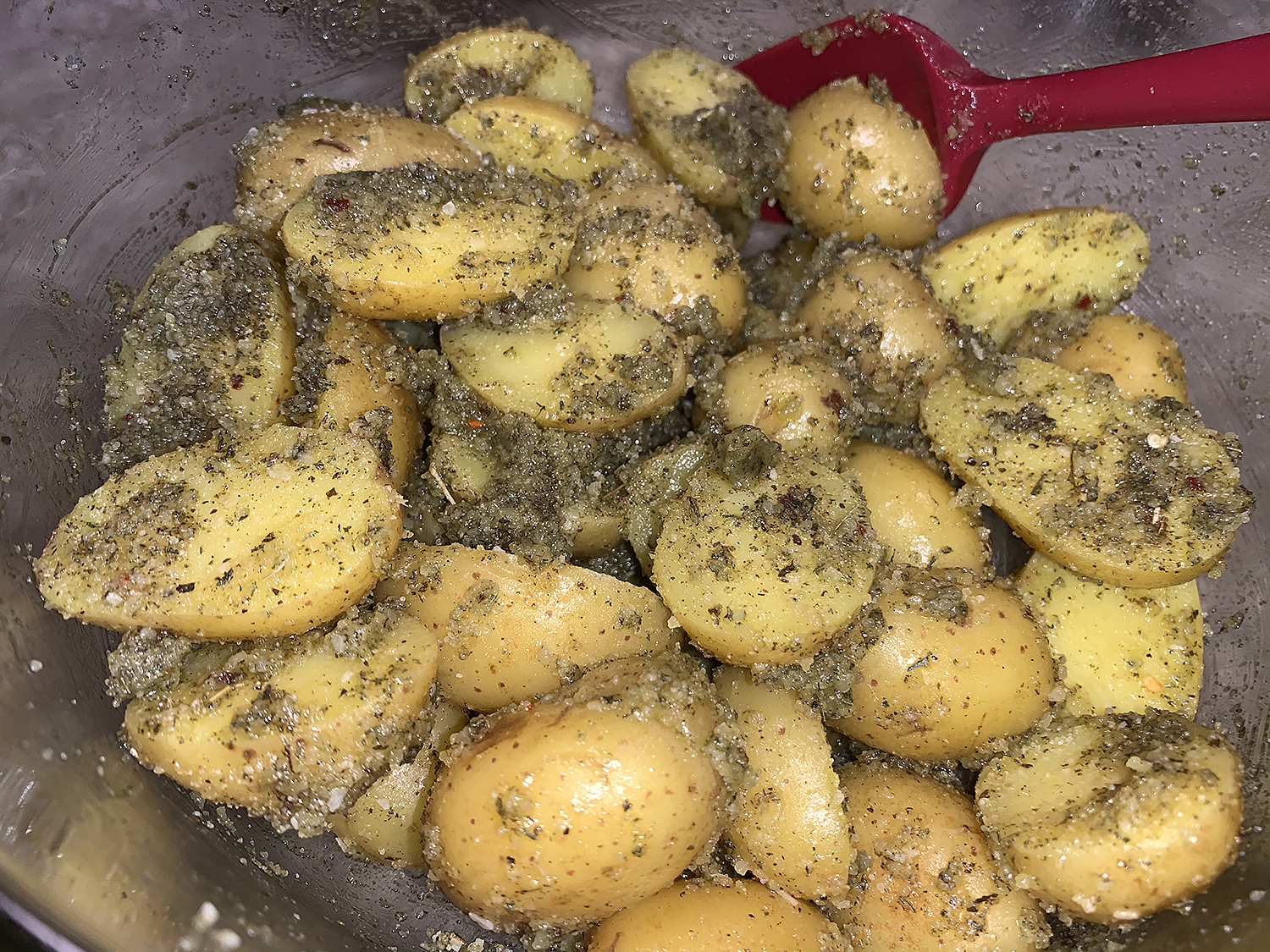
  4. In a large bowl, combine olive oil, garlic paste, salt, herbs, pepper, and parmesan cheese together, mixing to combine. Add a little more olive oil if the parmesan cheese has absorbed most of it.
    IMG_3622
  5. Toss parboiled potatoes halves with the garlic parmesan mixture to evenly coat.
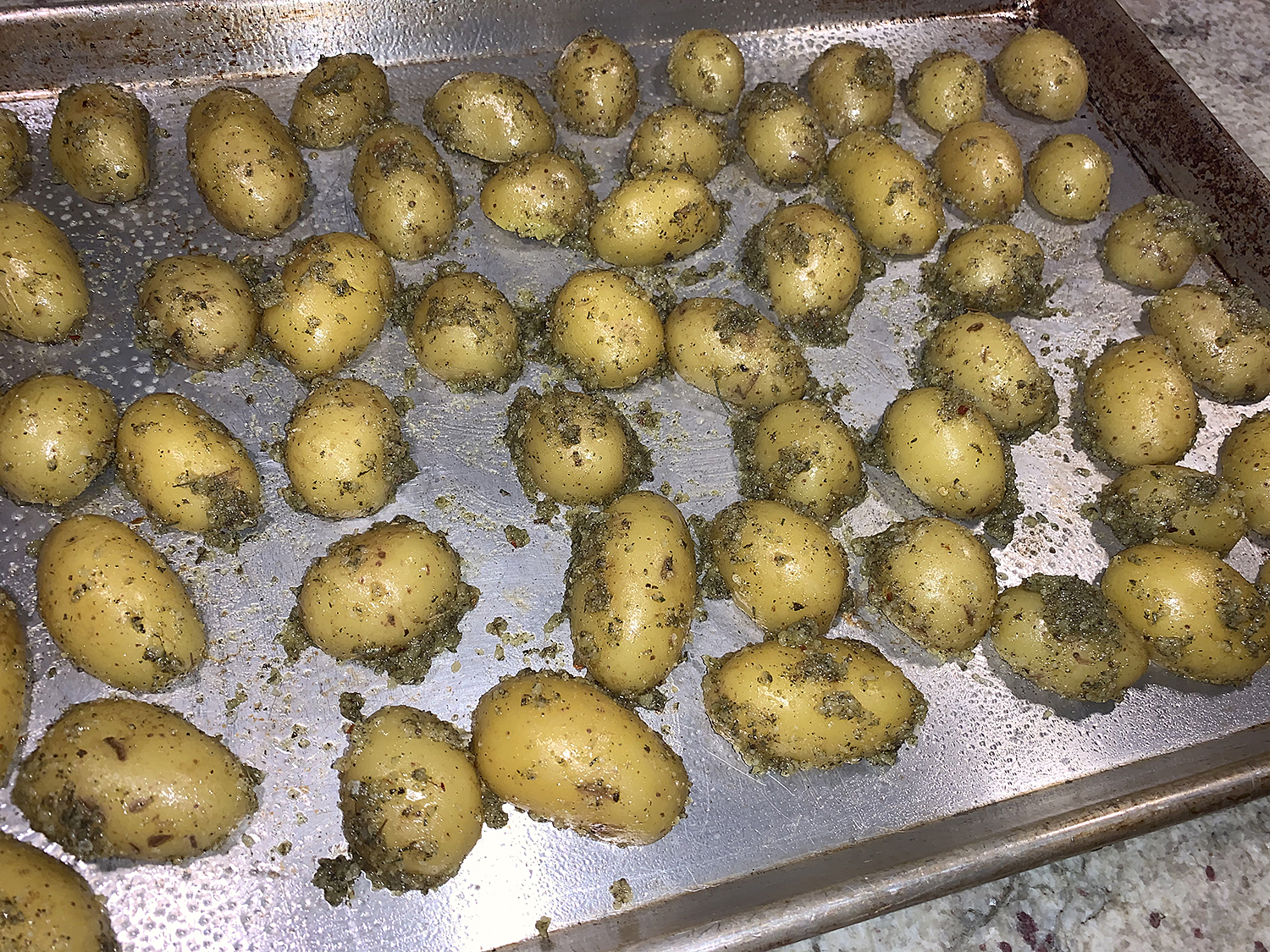
  6. Arrange the coated potatoes cut side down in a single layer onto the prepared baking sheet.
    IMG_3624
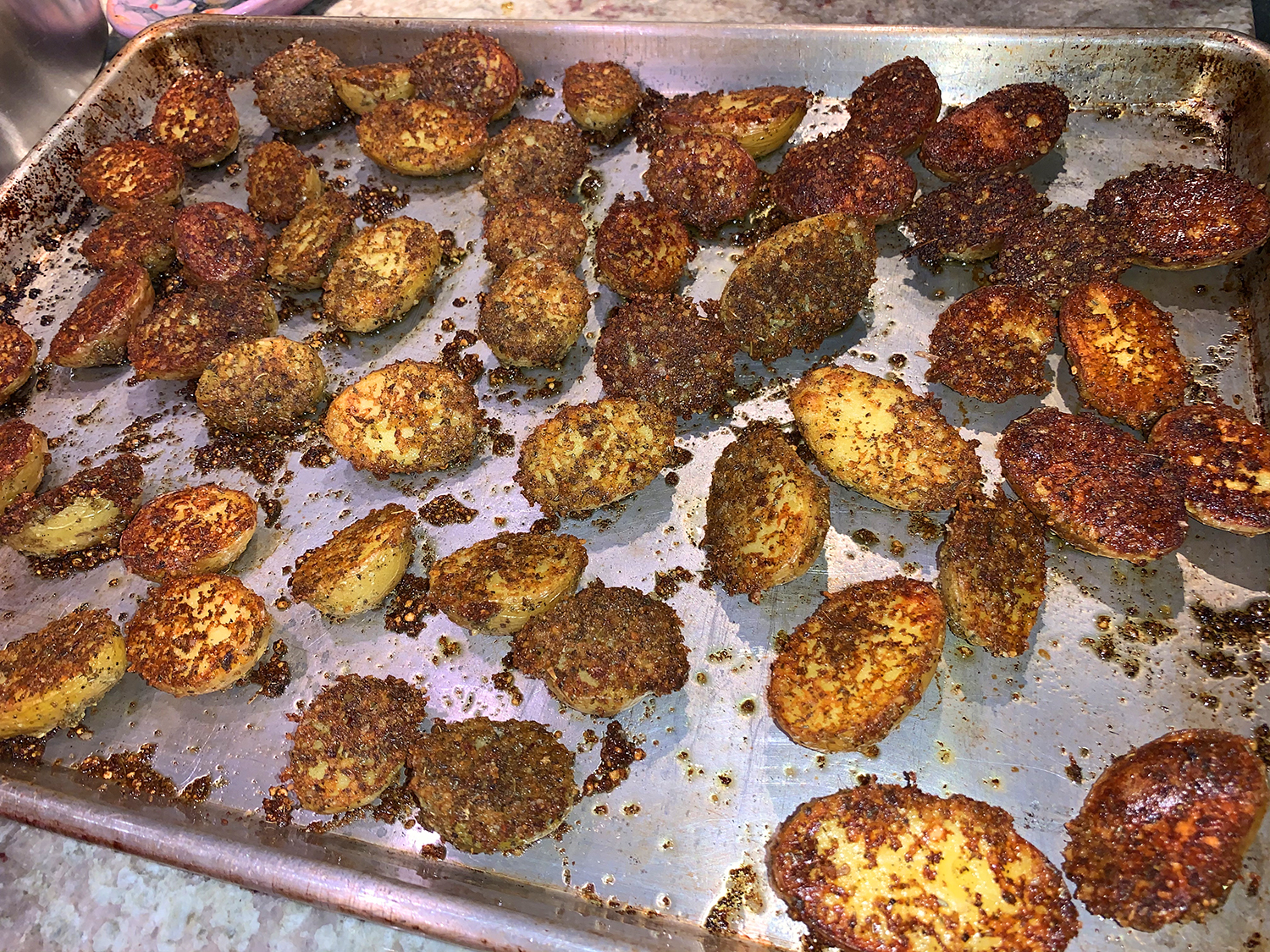
  7. Bake the potatoes, turning after 15 minutes with tongs or a spatula, until potatoes are browned and crisped at the edges, up to 10 minutes more.
    IMG_3627
  8. Allow the potatoes to cool down for a couple of minutes on the baking sheet before removing. This will ensure parmesan sticks to the potatoes, not on the baking sheet surface.
  9. In the meantime if desired, gently melt butter in the microwave and combine with fresh chopped parsley. Remove roasted potatoes for the oven, and drizzle with the butter parsley sauce. (Or just use the chopped parsley without butter.) Add pancetta bits, toss to coat well and serve immediately.
    IMG_3630

http://www.lynnandruss.com


Cavatelli with Shrimp and Asparagus

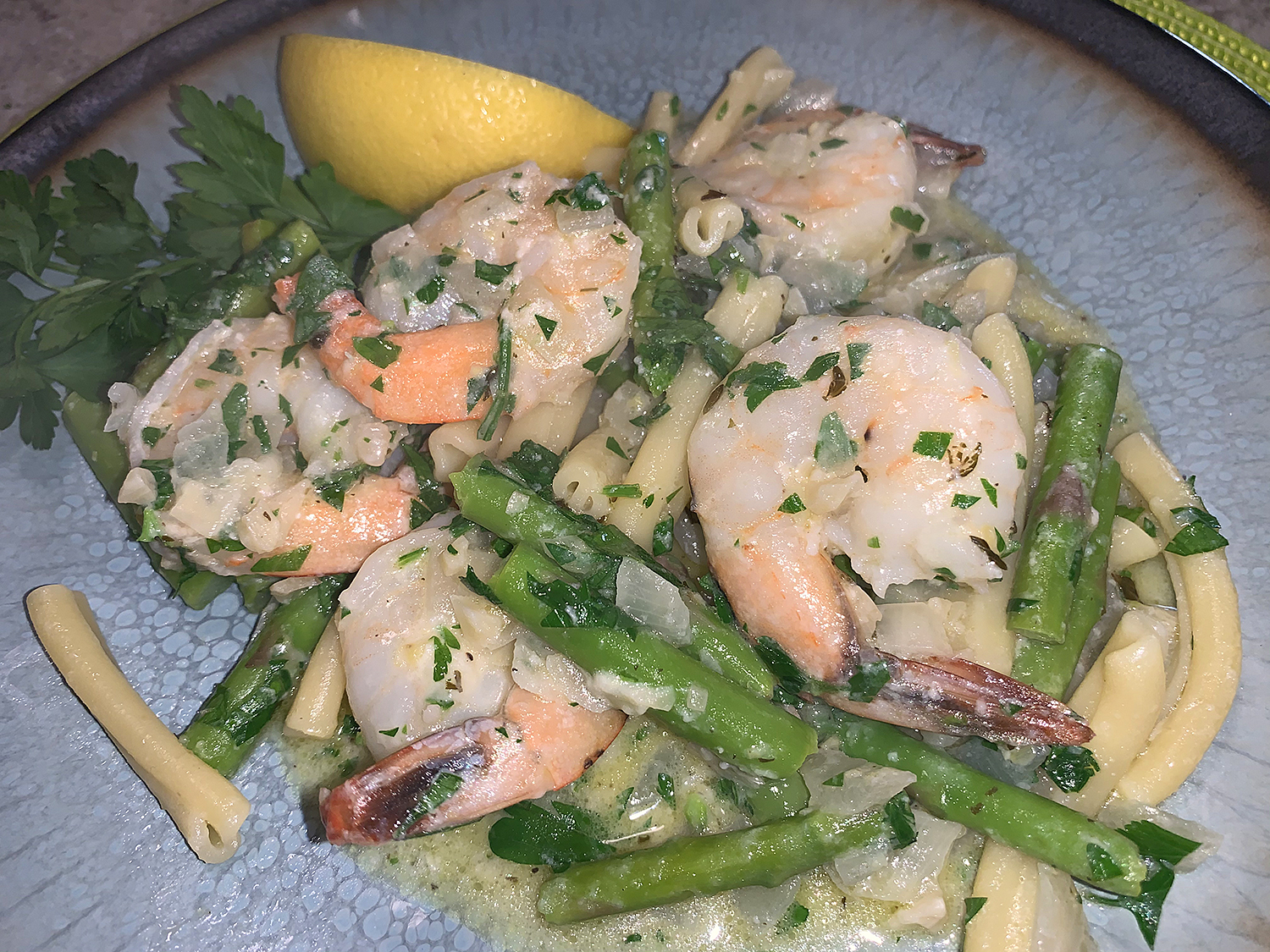
Perfectly succulent, extra-large shrimp always seems like a decadent choice either at home or when I’m out on the town. Unfortunately, as we continue this COVID-19 lockdown, there is no “night-on-the-town” so why not do something extra-special for your household of “sheltered-in-placers.”

Dressed with garlicky olive oil and lemon, shrimp and crisp-tender asparagus tossed with cavatelli make a delightful, fresh main course. It calls for a 1/2 cup of either dry white wine or vodka. Something tells me that a nice chilled glass of Sauvignon Blanc, with a plate of this pasta, is just the ticket to ward off some of those social isolation doldrums…

IMG_4554

Cavatelli with Shrimp and Asparagus

  • Servings: 6
  • Difficulty: easy
  • Print

Ingredients

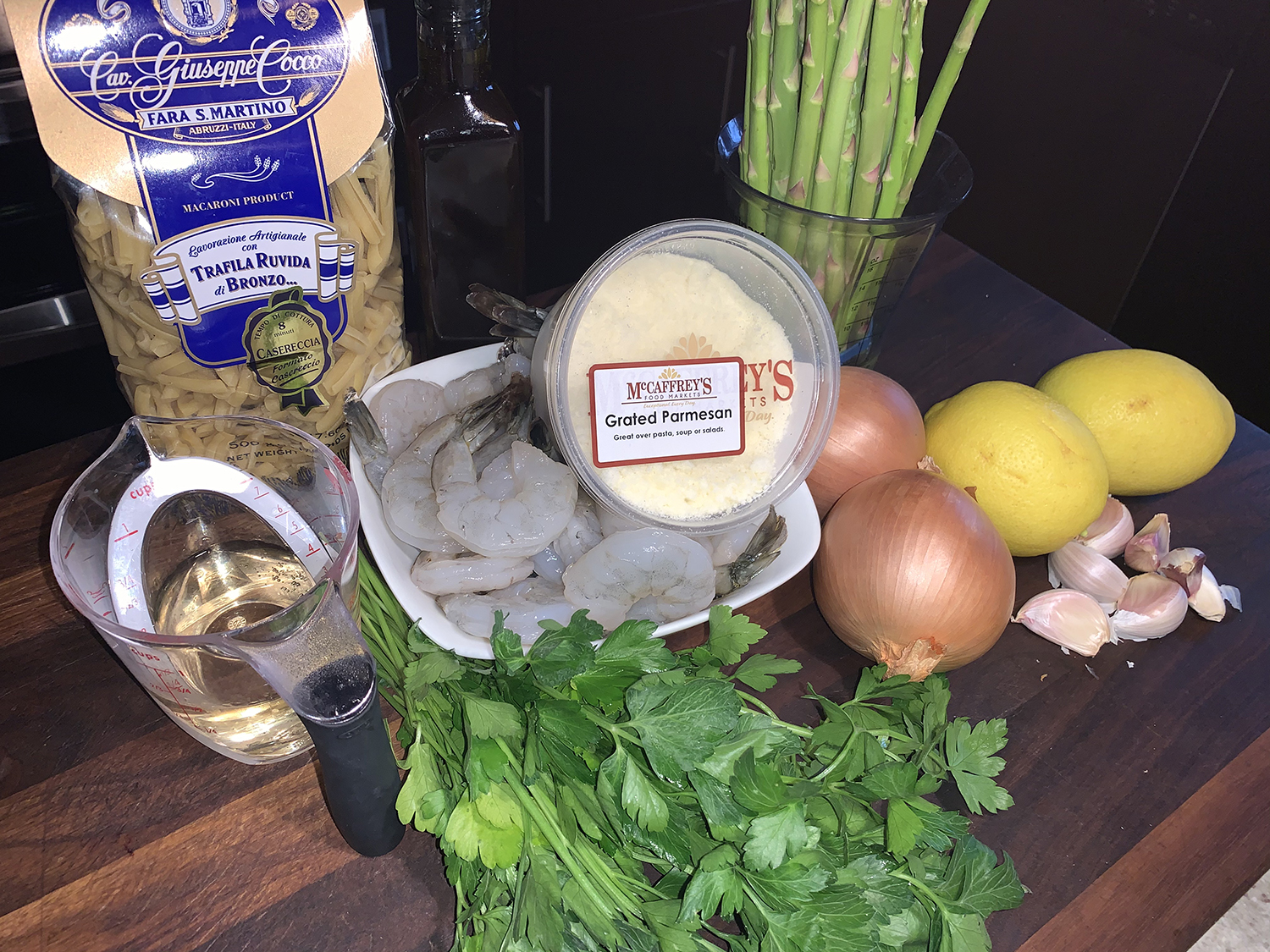
  • 5 large cloves garlic, coarsely chopped (about 1/4 cup)
  • 1 tsp. dried thyme
  • 1/3 cup extra-virgin olive oil; more as needed
  • Kosher salt
  • 12 oz. cavatelli or similar pasta
  • 1 lb. asparagus, cut into 1-1/2-inch pieces
  • 1 large onion, finely chopped (about 1-1/2 cups)
  • 1 lb. extra-large shrimp, shells removed
  • 2 medium lemons, 1 zested and juiced, 1 cut into wedges for serving
  • Freshly ground black pepper
  • 1/2 cup dry white wine or vodka
  • 1 cup finely grated Parmigiano-Reggiano or Grana Padano; more for serving
  • 1 cup chopped fresh flat-leaf parsley

Directions

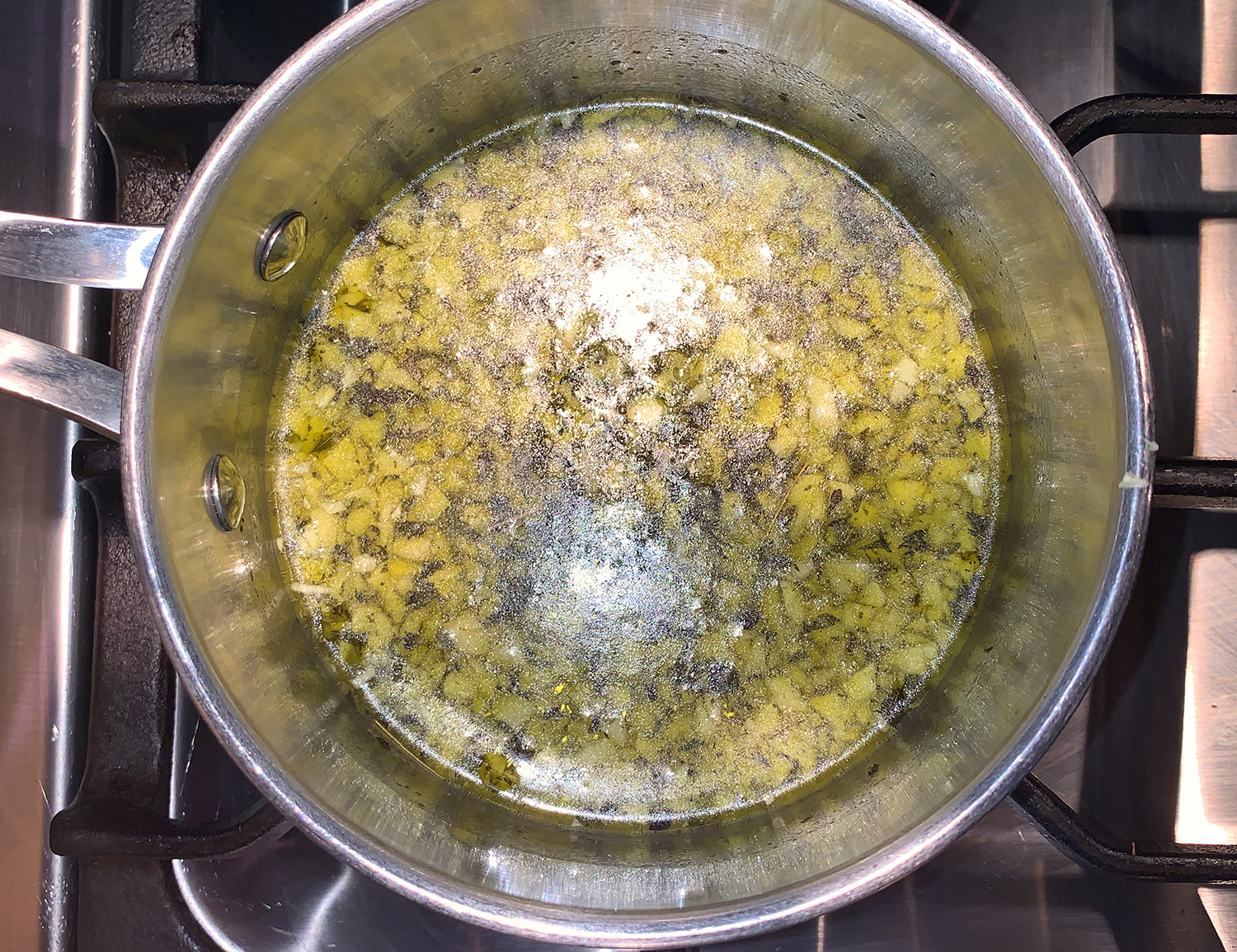
  1. Put the garlic and thyme in a small saucepan and add enough oil just to cover, about 1/3 cup. Warm the pan over very low heat so that the temperature of the oil is just below a simmer; you should see small bubbles rising from the oil at a slow, gentle rate. (If the oil begins to simmer, lower the heat. If you can’t reduce the heat any further, remove the pan from the heat to allow the oil to cool slightly, and then return it to the burner.)
    IMG_4557
  2. Continue to poach the garlic until it becomes slightly translucent (there should be no browning), about 20 minutes. Remove the pan from the heat and set aside.
  3. Meanwhile, bring a large pot of well-salted water to a boil. Cook the pasta according to package directions until al dente, adding the asparagus in the last 2 minutes of cooking. Reserve 1 cup of the cooking water, and then drain the pasta and asparagus.
  4. Heat 3 Tbs. of the garlic oil in a large skillet over medium-high heat. Add the onion and cook, stirring frequently, until translucent, about 2 minutes.
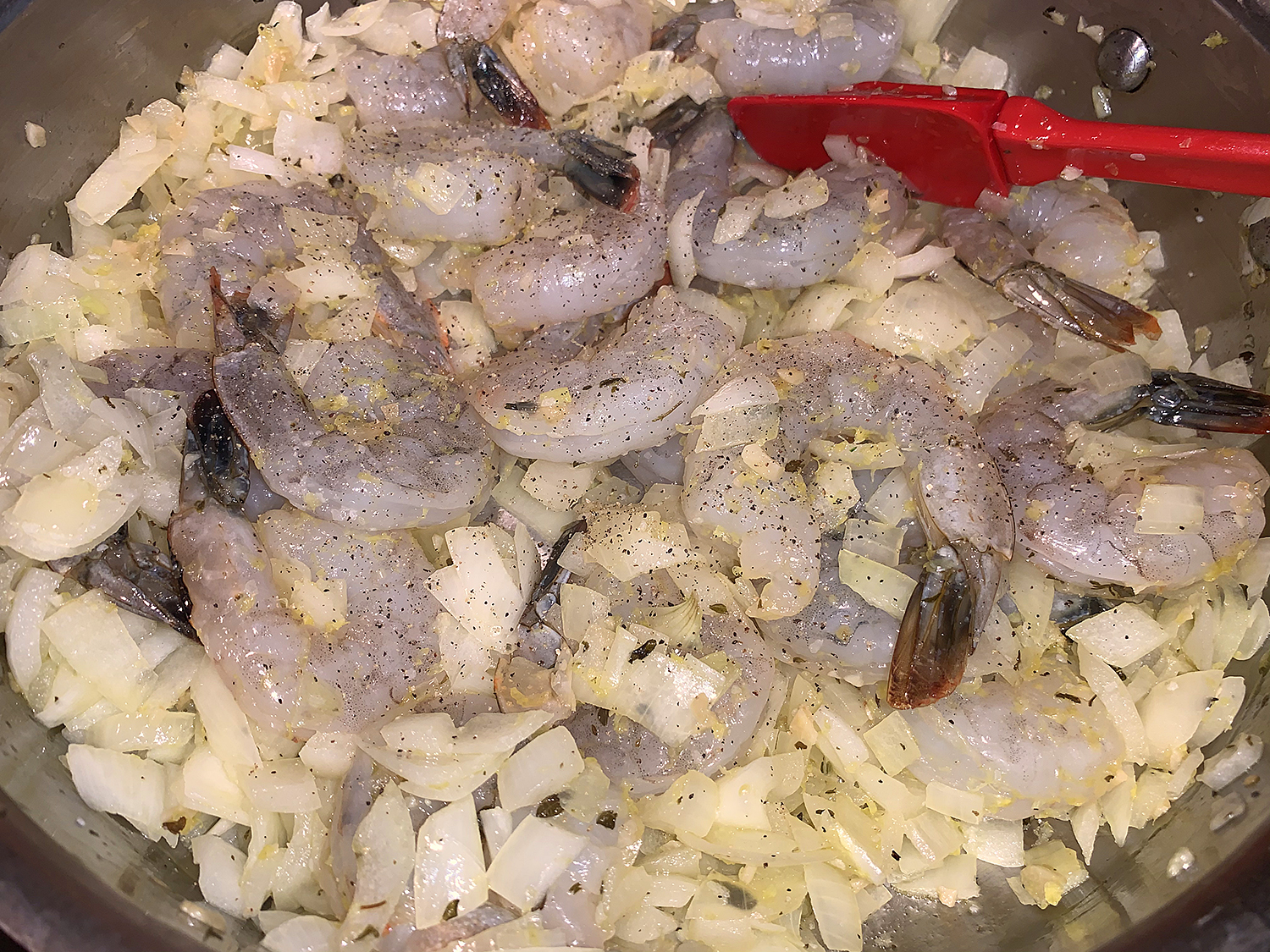
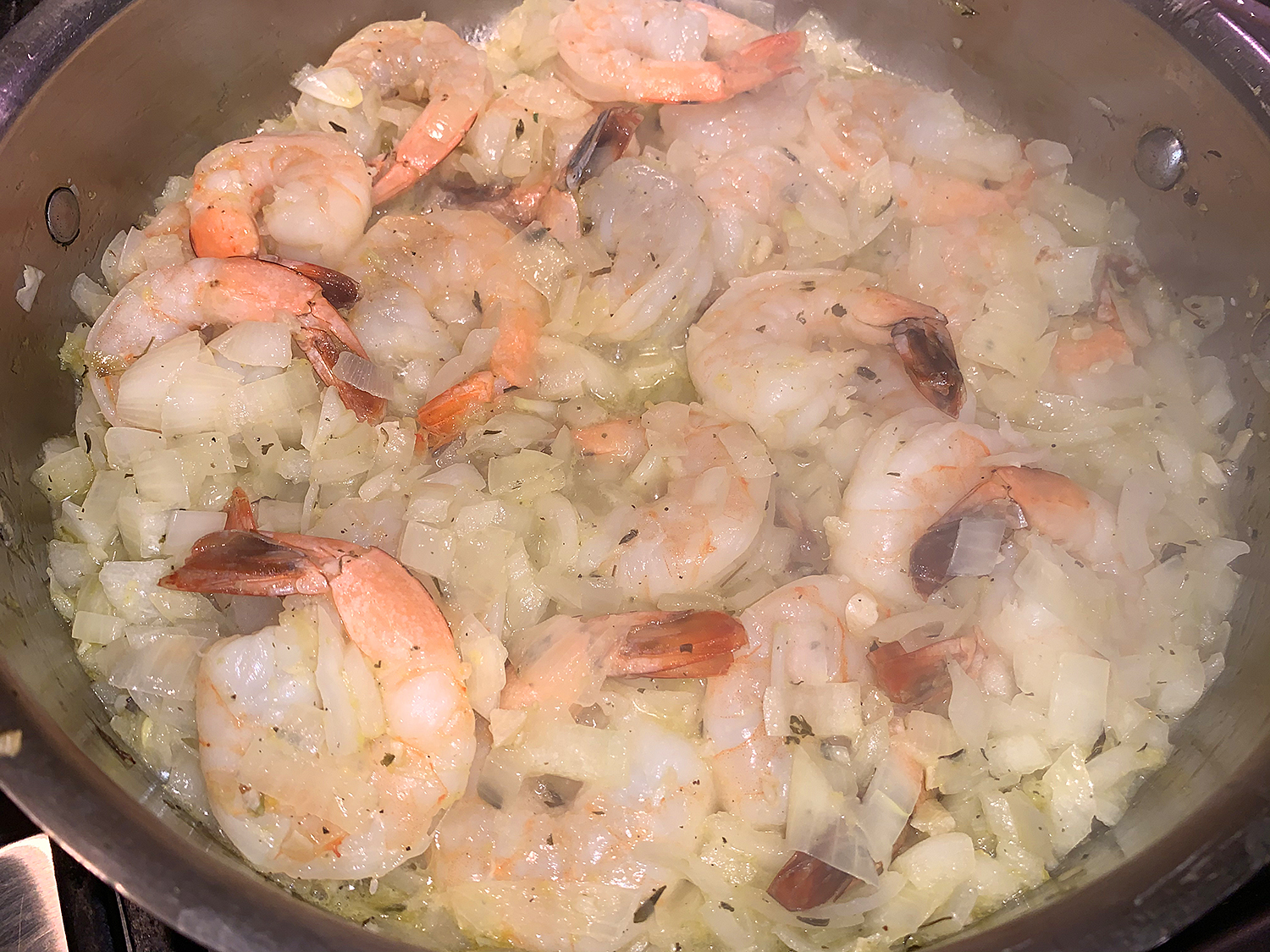
  5. Add the shrimp, lemon zest, 1/2 tsp. salt, and a few grinds of pepper, and cook, stirring frequently, until the shrimp begin to turn pink, about 1 1/2 minutes.
    IMG_4559
  6. Add the wine and cook, stirring occasionally, until the shrimp are pink and curled and most of the liquid has evaporated, about 3 minutes.
    IMG_4560
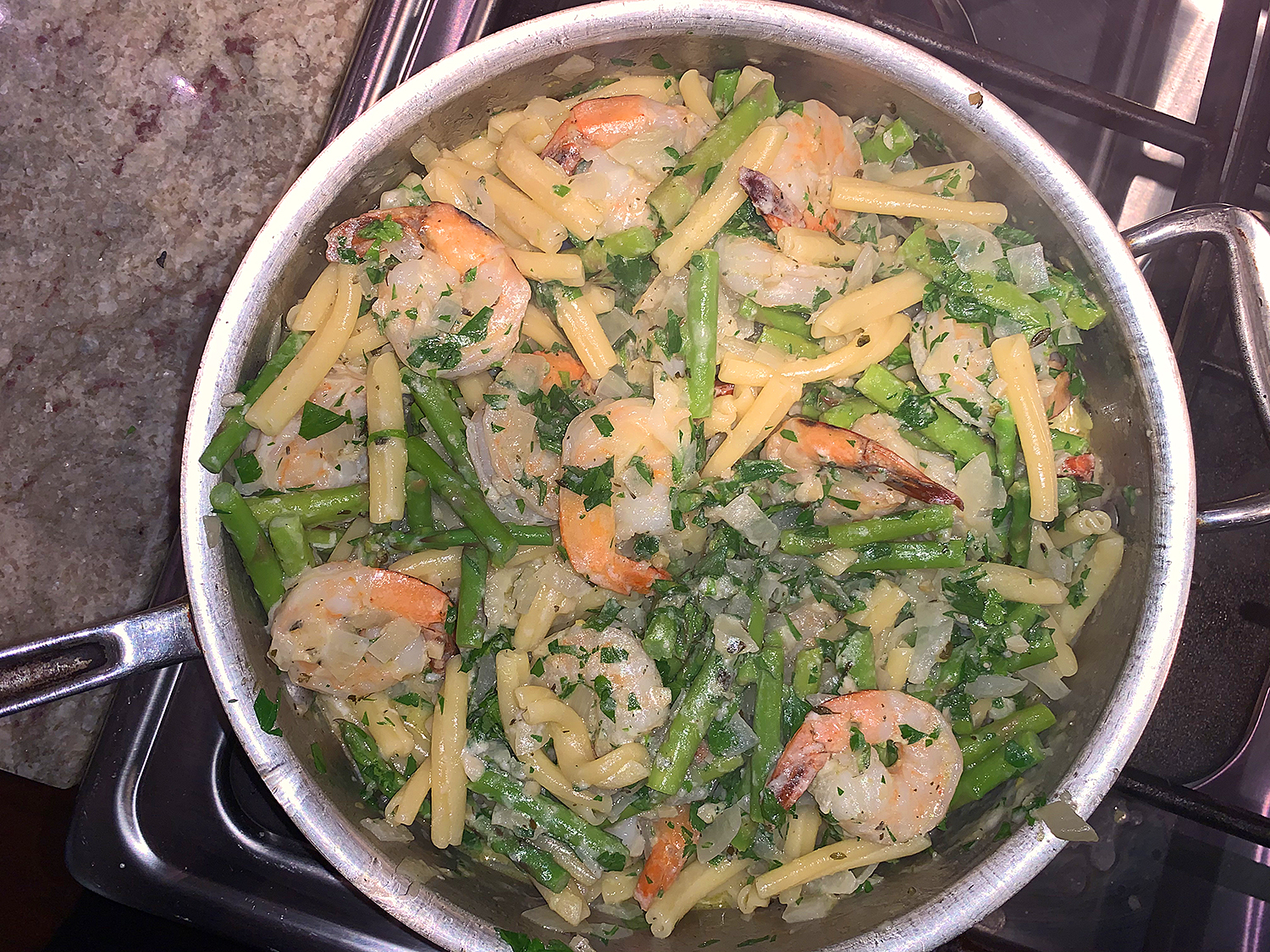
  7. Add the pasta, asparagus, cheese, poached garlic, and garlic oil to the pan, toss to combine, and heat through, about 2 minutes.
    IMG_4563
  8. Remove from the heat, add the lemon juice and parsley, and season to taste with salt and pepper. If necessary, add some of the reserved cooking water to loosen the sauce.
    IMG_4567

http://www.lynnandruss.com

Adapted from a recipe by Lisa Lahey from Fine Cooking

Dynamite Chicken Tenders; Portuguese Rice with Kale
These two dishes are fantastic, it’s that simple. The Central/South American based Mayo-Marinated Chicken with Chimichurri recipe came from J. Kenji Lopez-Alt from The Times Cooking website. Their version uses chicken cutlets pounded down to 1/4″ thickness. But because of the panic-buying during the COVID-19 Virus, chicken breasts of any kind were in very short supply, but one supermarket had the tenders, so I snapped them up.

IMG_4511

It actually saved me time because there was no cutting or pounding necessary. Due to thicker tenders, they’ll take a few more minutes to reach temperature of 160°. Now I know it may sound a little gross to slather mayo all over chicken that you are going to cook, but bear with me, the mayo-chimichurri marinade combo was out of this world.

According to Kenji, the magic of mayo is that it helps your other marinade ingredients spread evenly across the surface of the meat, delivering more consistent flavor, while improving browning. No argument from me! Then the deep chimichurri flavor enhances even more with a post-cooking drizzle of fresh sauce.

Using the mayo method, it could work with nearly any marinade using pesto, barbeque sauce, curry and teriyaki sauces, and so on, just use your noggin’ for inspiration…

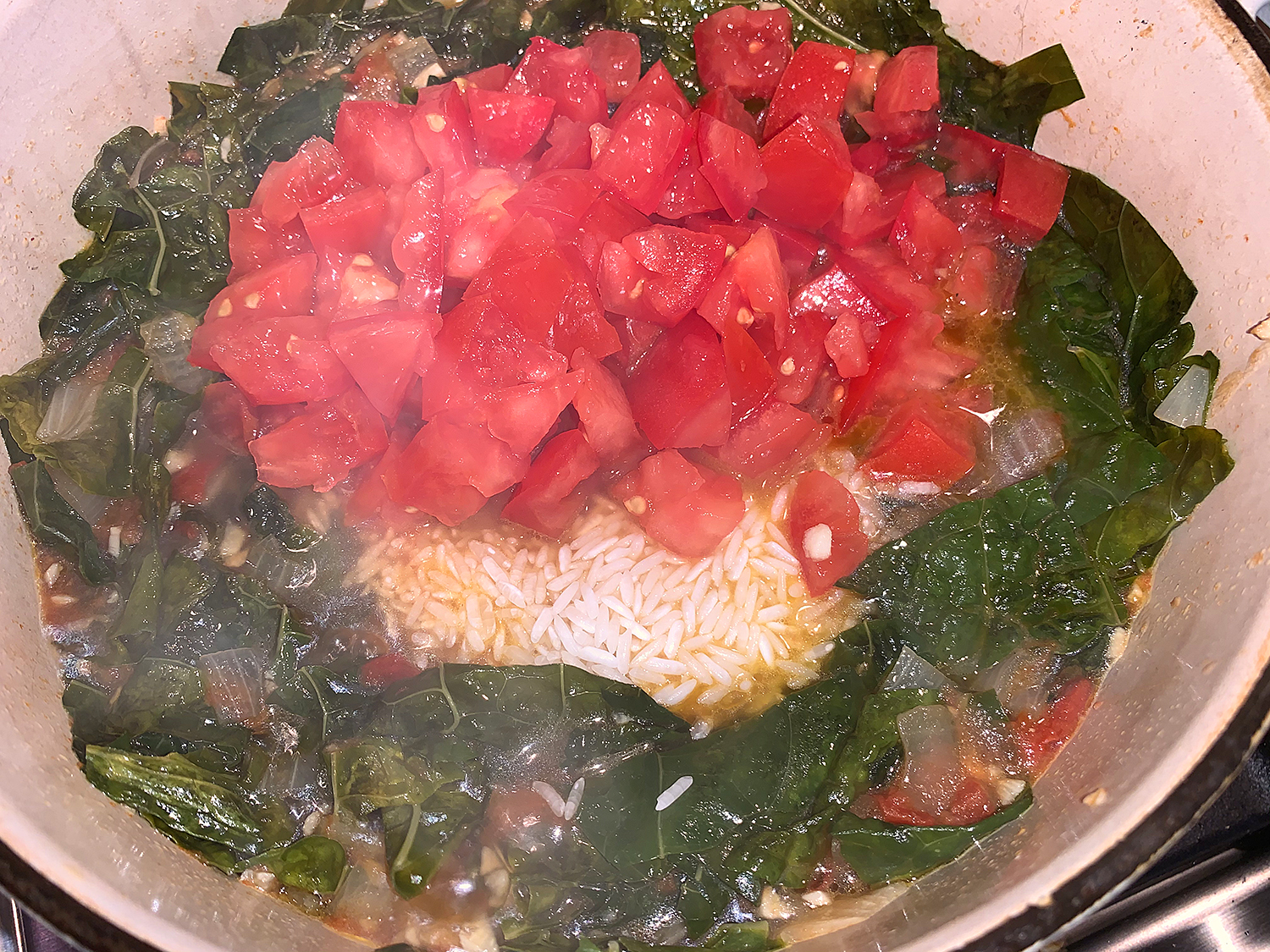
In the Portuguese Rice with Kale and Tomatoes recipe, I also had an issue in obtaining an ingredient—specifically, plum tomatoes. So I substituted two large beefy tomatoes and made sure to remove as much of the watery pulp/seeds as possible.

IMG_4516

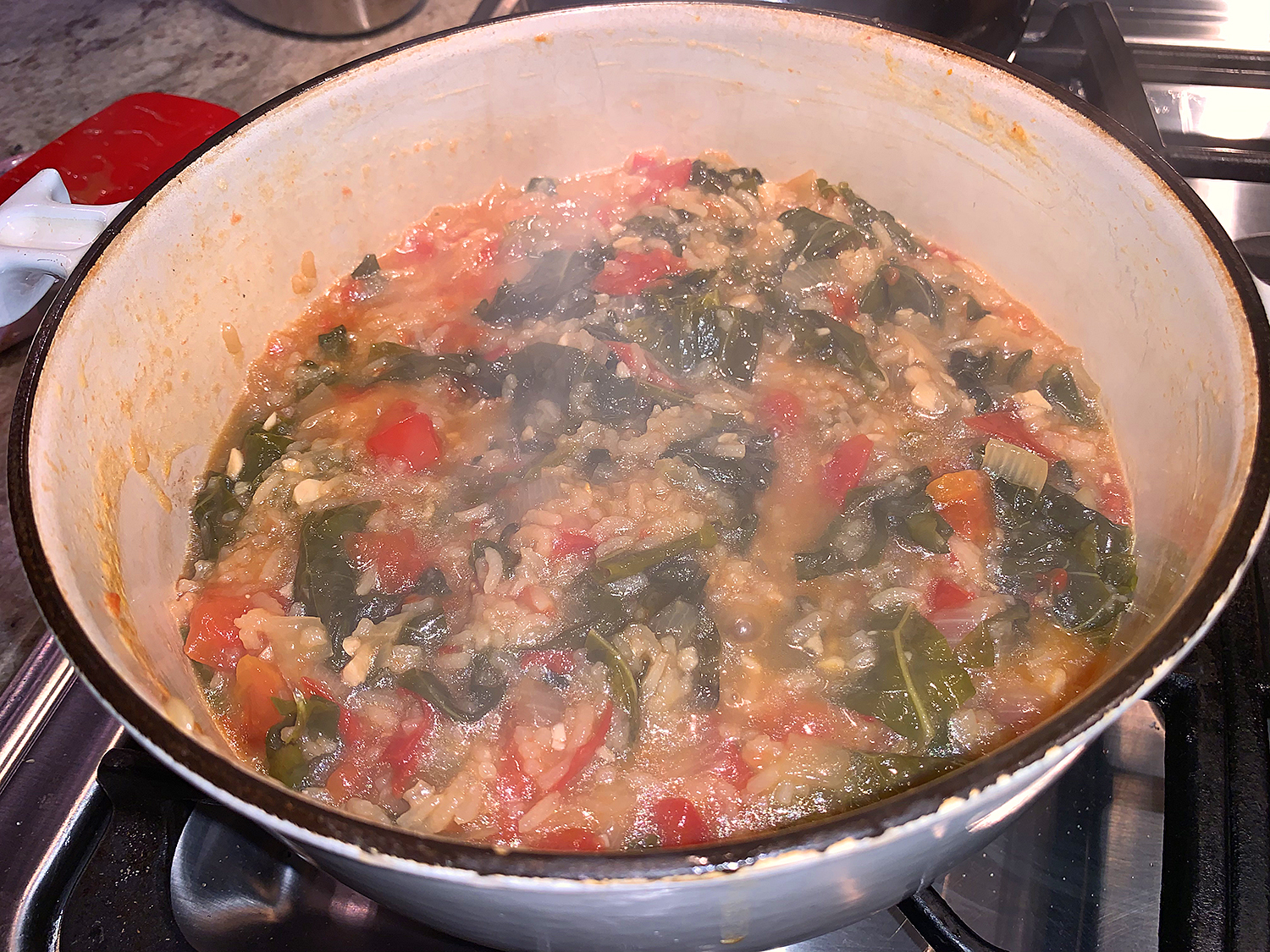
And instead of water, I incorporated our homemade chicken stock which of course added oodles of flavor. At the end, after 20 minutes simmering while covered, there was still too much liquid (probably due to those tomatoes), so I continued a rolling simmer without the lid for another 10-15 minutes while we seared the chicken tenders in a cast iron skillet.

Mayo-Marinated Chicken with Chimichurri

  • Servings: 3
  • Difficulty: super easy
  • Print

Mayo-Marinated Chicken with Chimichurri

Ingredients

  • 1 1/2 lbs. chicken tenders (about 9-10 tenders)
  • 1/3 cup store-bought or homemade mayonnaise
  • 1 cup chimichurri (see recipe below)

Directions

  1. Season chicken tenders on both sides with salt and pepper and set aside.
  2. Whisk together mayonnaise and 1/4 cup chimichurri in a large bowl. Reserve remaining chimichurri. Add chicken to the mixture and turn to coat. (Cook immediately, or for better flavor, transfer to a sealed container and refrigerate for 4 to 24 hours. Ours marinated for 4 hours.)
  3. Heat a large 12-inch” cast-iron or nonstick skillet over medium-high heat until a drop of water immediately balls up and dances across the surface.
  4. Add chicken tenders in a single layer and cook, flipping once until browned on both sides and just cooked through, about 6-8 minutes. You may have to cook them in two batches so as not to crowd the pan, which would steam the poultry instead of browning the pieces. (Test with an instant thermometer for the temperature to reach about 160°.)
  5. Transfer chicken to a serving platter. Spoon some of the remaining chimichurri over the chicken and serve the rest in a small bowl on the side.
    IMG_4506

http://www.lynnandruss.com

Chimicurri

There are countless variations of Chimichurri recipes out there, so if you have a fave, go ahead and use that. Basically, it is a loose, uncooked, oil-based condiment with dominant flavors of parsley and garlic. It is used to accompany grilled meat, or in the this case, chicken tenders seared in a skillet.

Chimichurri

  • Servings: about 1 cup
  • Difficulty: easy
  • Print

Ingredients

  • 1/2 cup olive oil
  • 2 Tbsp. red wine vinegar
  • 1/2 cup finely chopped parsley
  • 4 cloves garlic, minced
  • 2 small red chilies, deseeded and minced
  • 3/4 tsp. dried oregano
  • 1/2 tsp. salt, more to taste

Directions

Mix all ingredients in a bowl. Allow to sit for 5-10 minutes to release all of the flavors into the oil.
IMG_4487

http://www.lynnandruss.com

Portuguese Rice with Kale and Plum Tomatoes

A staple on the Portuguese table, arroz de grelos customarily is made with spicy turnip greens (grelos), but in Milk Street’s version, they opted to use easier-to-find lacinato kale. You can serve this simple yet remarkably flavorful one-pot dish as the center of a vegan or vegetarian meal, or offer it alongside almost any prepared seafood or meat, such as the chicken recipe above.

IMG_4513

RULE NO. 10: Braise Low and Slow to Tenderize Tough Greens

Portuguese Rice with Kale and Plum Tomatoes

  • Servings: 4
  • Difficulty: easy
  • Print

Ingredients

  • â…“ cup extra-virgin olive oil
  • 1 medium yellow onion, chopped
  • 4 medium garlic cloves, finely chopped
  • 3 medium plum tomatoes, cored and chopped
  • Kosher salt
  • 1 bunch lacinato kale (about 1 pound), stemmed, leaves torn into 1½-inch pieces
  • ½ cup long-grain white rice, rinsed and drained
  • 2 1/2 cups homemade chicken broth, or water
  • 1 Tbsp. lemon juice

Directions

  1. In a large pot over medium-high, heat the oil until shimmering. Add the onion, garlic, a third of the chopped tomatoes and 1 tablespoon salt. Cook, stirring occasionally, until the tomatoes have broken down and the bits stuck to the bottom of the pot are dark golden brown, 7 to 10 minutes.
  2. Add the kale and cook, stirring and scraping up any browned bits, until wilted, about 1 minute.
    IMG_4497
  3. Stir in 2½ cups water (or homemade chicken stock) and bring to a simmer, then cover and reduce to medium-low. Cook for 10 minutes, then stir in the rice and remaining chopped tomatoes.
    IMG_4498
  4. Return to a simmer, cover and reduce to low. Cook, without stirring or lifting the cover, until the rice is tender and only a little liquid pools at the bottom of the pot, 20 minutes.
  5. Stir in the lemon juice and 1 teaspoon salt. Taste and adjust the seasoning with salt.
    IMG_4503

Tip: Don’t uncover the pot while the rice is cooking; it will release too much steam and the end result will be too dry.

http://www.lynnandruss.com

Adapted from a recipe   Milk Street “The New Rules” cookbook

Classic Steakhouse Combo with a Twist

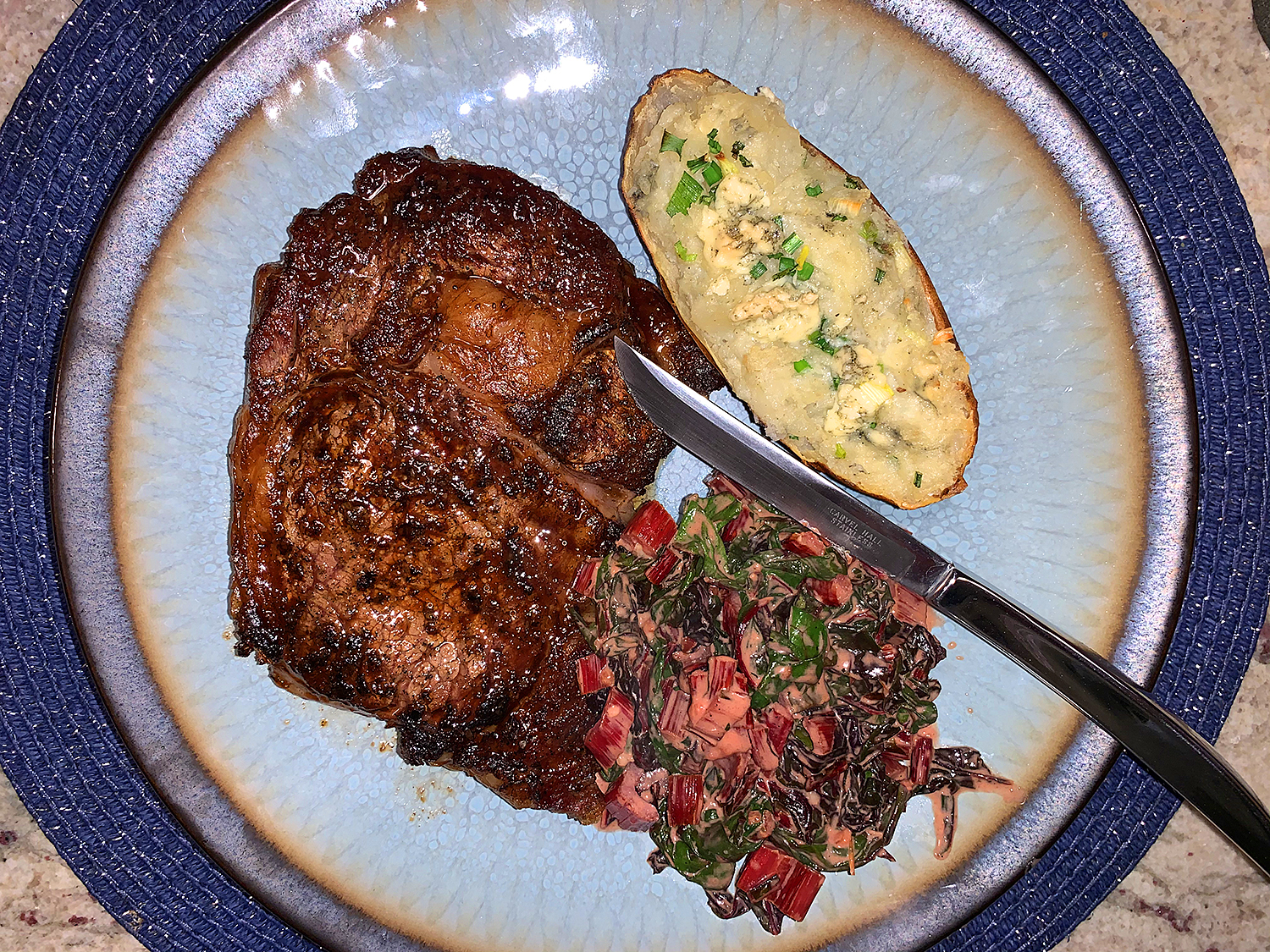
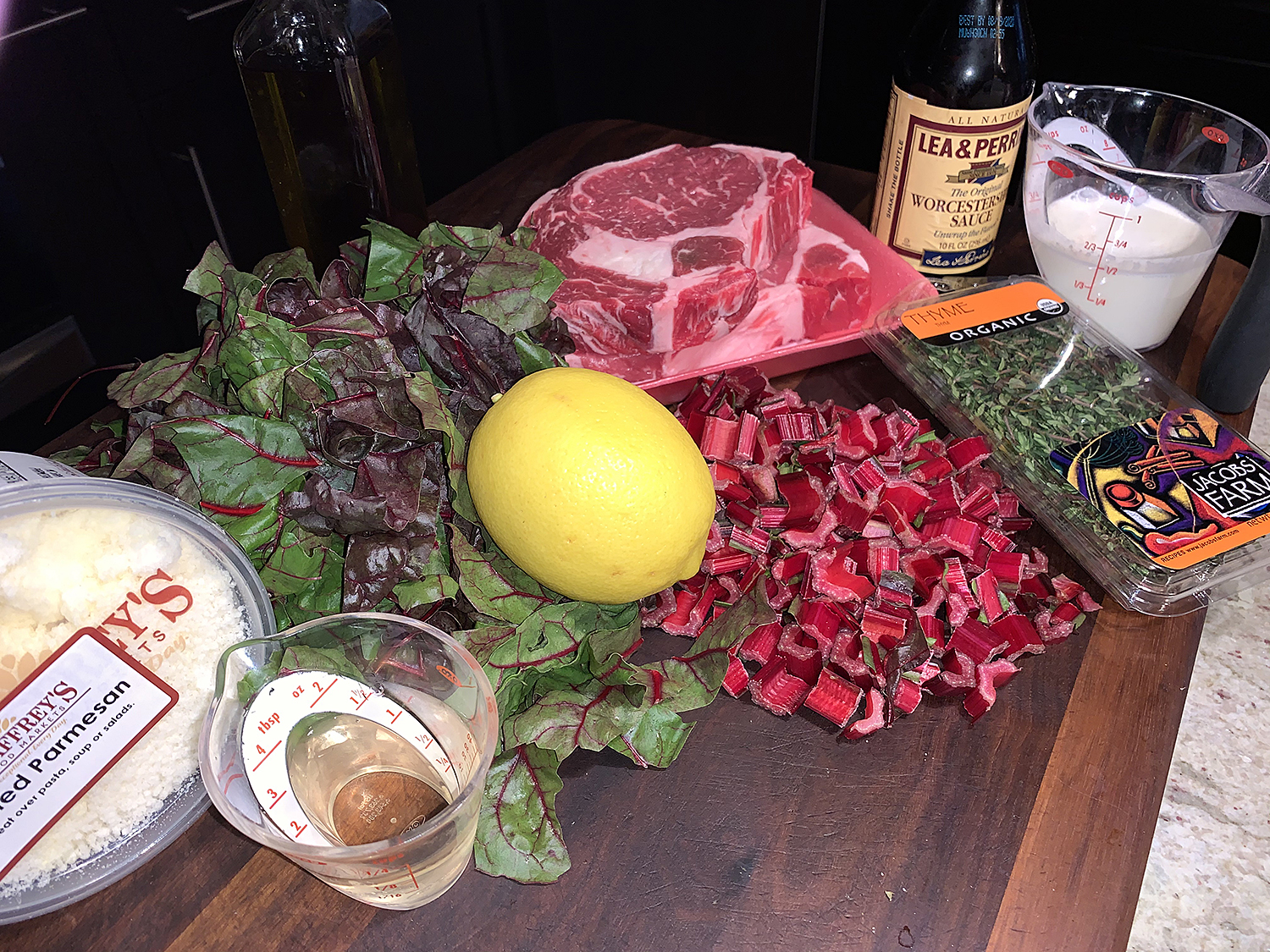
During these bleak times, you may want to treat yourself every now and again. How about this classic steakhouse combo? Chard takes the place of spinach in this Sear-Roasted Rib-Eye with Creamed Chard riff. Any kind of chard will work well, but rainbow/red chard adds a great pop of color. Just make sure to rinse your chard real well, as it often contains a lot of grit.

I did not halve the steaks (about 3/4 pound each), but we each ended up with half left over, which made for delicious lunches the next day. Be aware that the amount of grated parmesan in the chard, is only 3/4 of an ounce, about a 1/4 cup. If you grate it yourself on a rasp grater, the volume increases to nearly 3/4 cup—which would be way too much if you are using the powdery pre-grated store version.

IMG_4409We completed our meal with a side of twice baked potatoes.
IMG_4395

A lovely, decadent meal in no time at all! Indulge yourself…

Sear-Roasted Rib-Eye with Creamed Chard

  • Servings: 4
  • Difficulty: easy
  • Print

Ingredients

  • 1 tsp. Worcestershire sauce
  • Kosher salt and freshly ground black pepper
  • 2, 1-1/2-inch-thick boneless rib-eye steaks (about 2 lb. total), each cut into two equal pieces and patted dry
  • 2-1/2 Tbs. olive oil
  • 2 large cloves garlic, minced
  • 1-1/2 lb. chard, washed, stems halved lengthwise and thinly sliced crosswise, leaves sliced into ribbons about 1/2 inch thick
  • 1 tsp. chopped fresh thyme
  • 2 Tbs. dry white wine
  • 1/2 cup heavy cream
  • 1-1/2 tsp. fresh lemon juice; more to taste
  • 3/4 oz. finely grated Parmigiano-Reggiano (3/4 cup grated on a rasp)

Directions

  1. Position a rack in the center of the oven and heat the oven to 425°F. Set a wire rack over a rimmed baking sheet lined with foil.
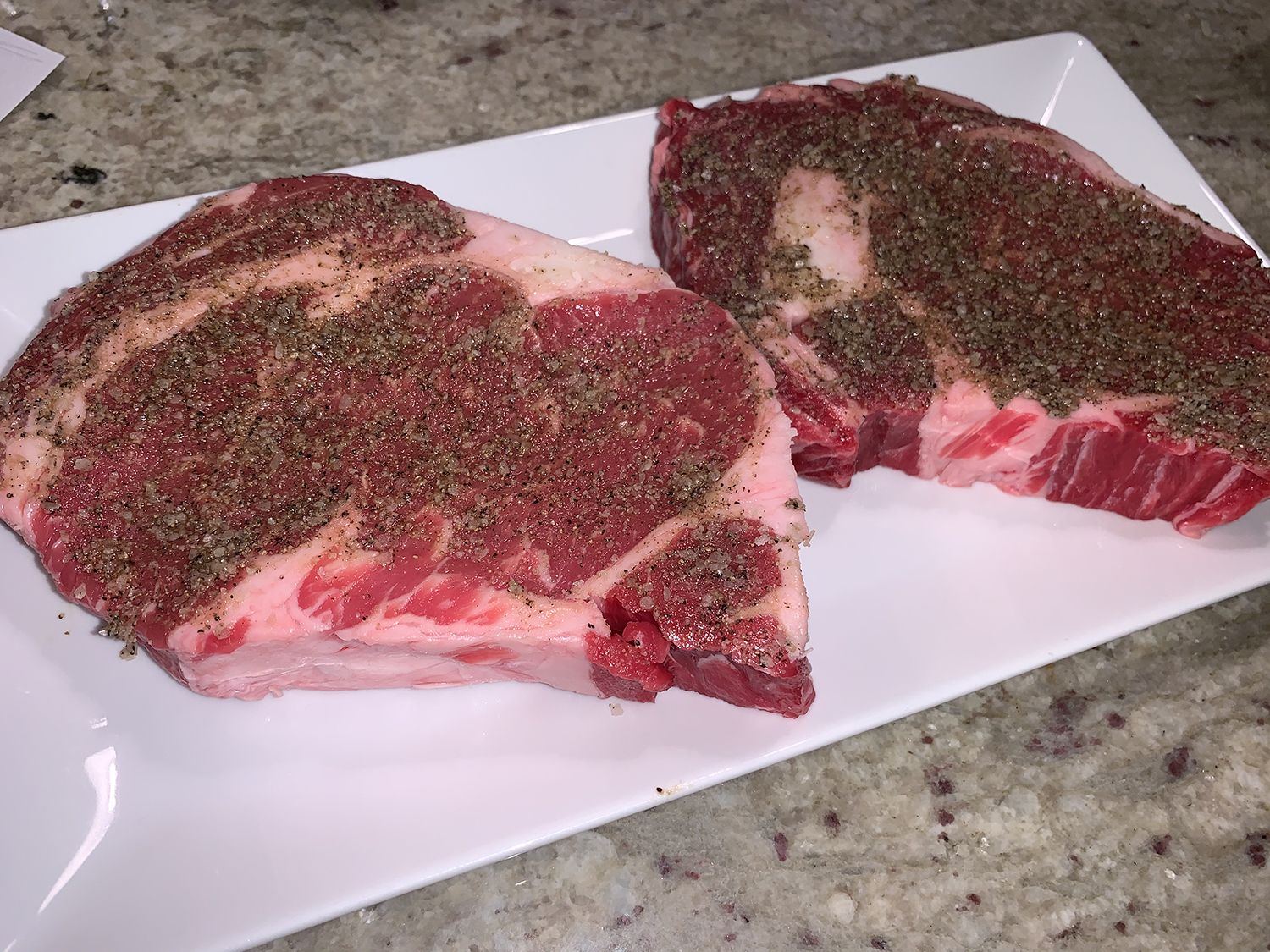
  2. In a small bowl, combine the Worcestershire sauce with 2 tsp. salt and 1/2 tsp. black pepper, and rub all over the steaks.
    IMG_4397
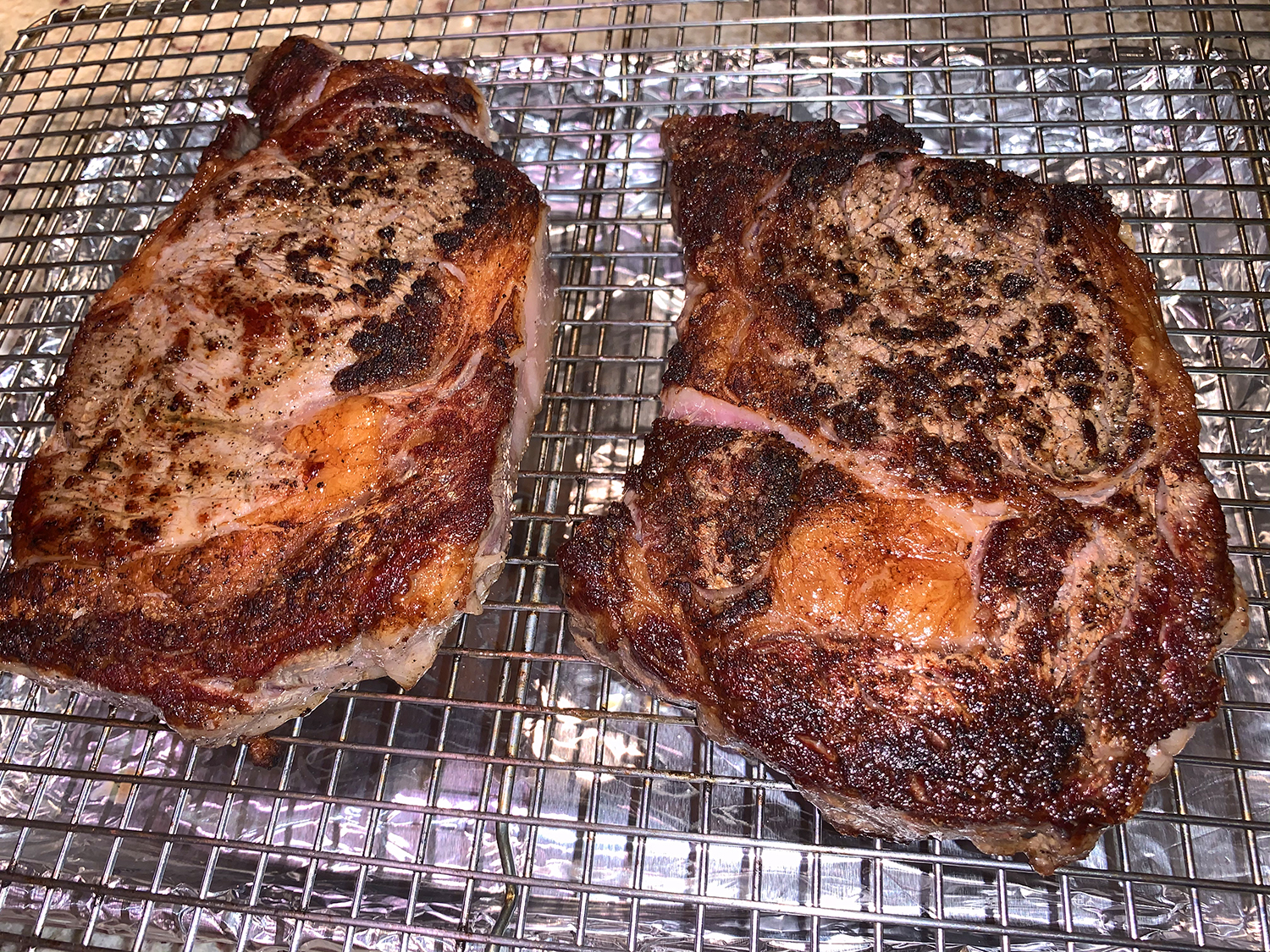
  3. Heat 1 Tbs. of the olive oil in a heavy-duty 12-inch skillet over medium-high heat until shimmering hot. Sear the steaks until well browned, about 3 minutes per side.
    IMG_4398
  4. Transfer to the rack and roast until medium rare (130°F), 8 to 10 minutes. Transfer to a platter, tent with foil, and let rest for at least 5 minutes.
    IMG_4401
  5. While the steaks are in the oven, return the skillet to medium heat, add the remaining 1-1/2 Tbs. oil and the garlic, and cook, stirring, until pale golden, about 1 minute.
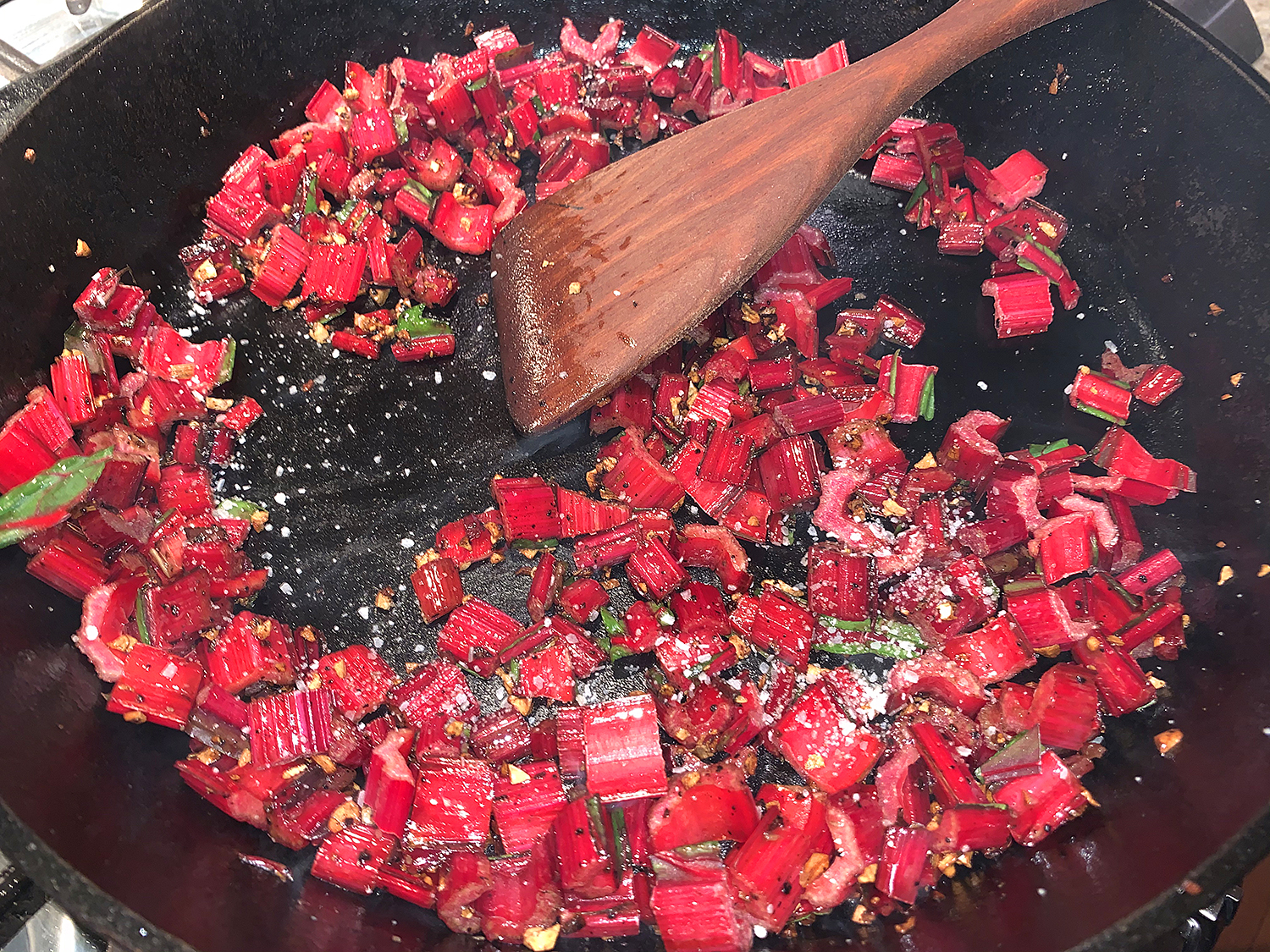
  6. Add the chard stems, thyme, and a pinch of salt; cook, stirring occasionally, until just tender, about 5 minutes.
    IMG_4403
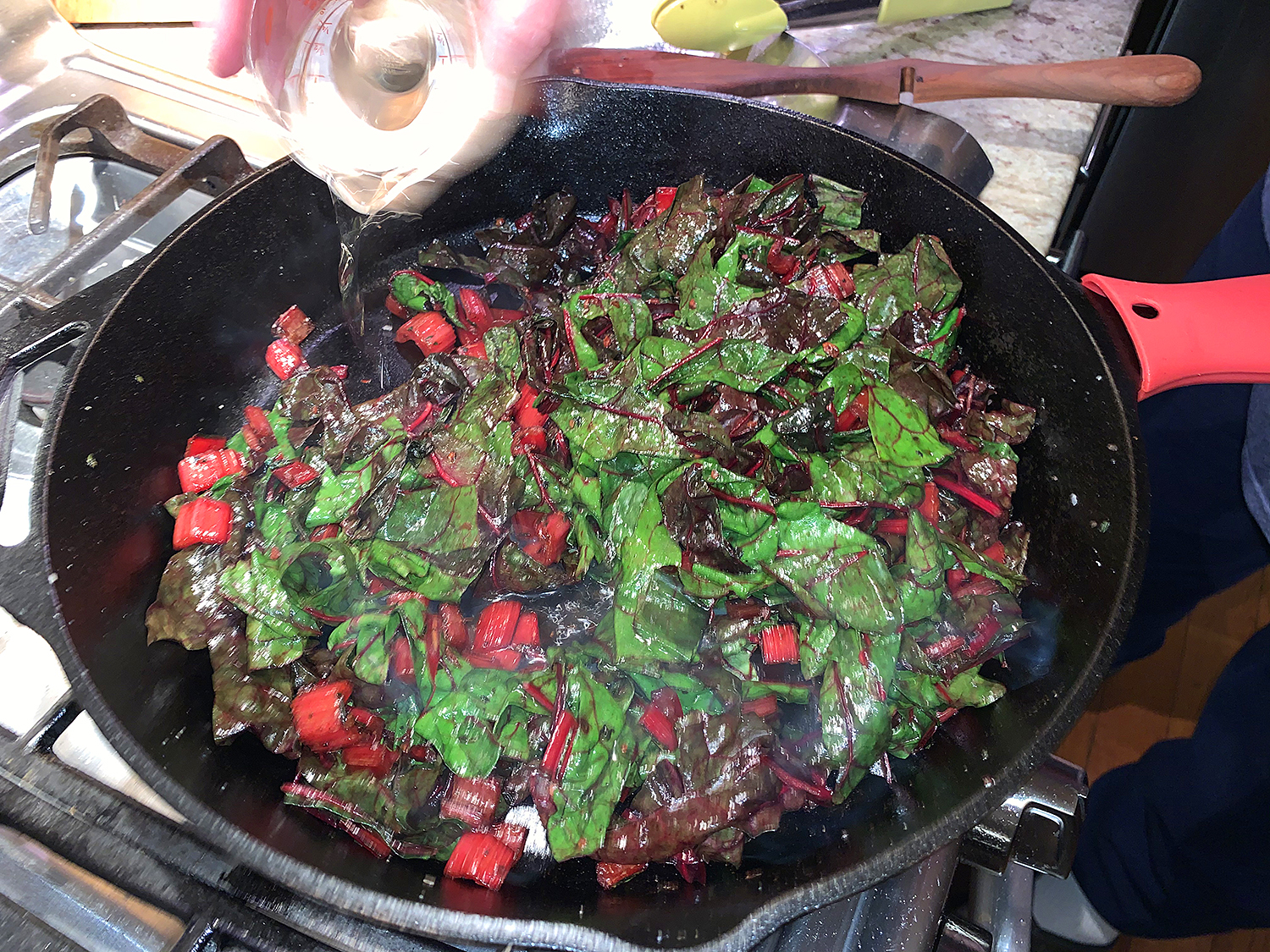
  7. In batches, add the chard leaves, tossing with tongs and 1/4 tsp. salt, until wilted, about 5 minutes. If necessary, transfer to a large sieve and press on the chard with the back of a spoon to drain as much liquid as possible. (We did not need to do this.)
  8. Return the chard to the skillet over medium heat and add the wine. Cook, stirring occasionally, until the wine is almost evaporated, about 2 minutes.
    IMG_4405
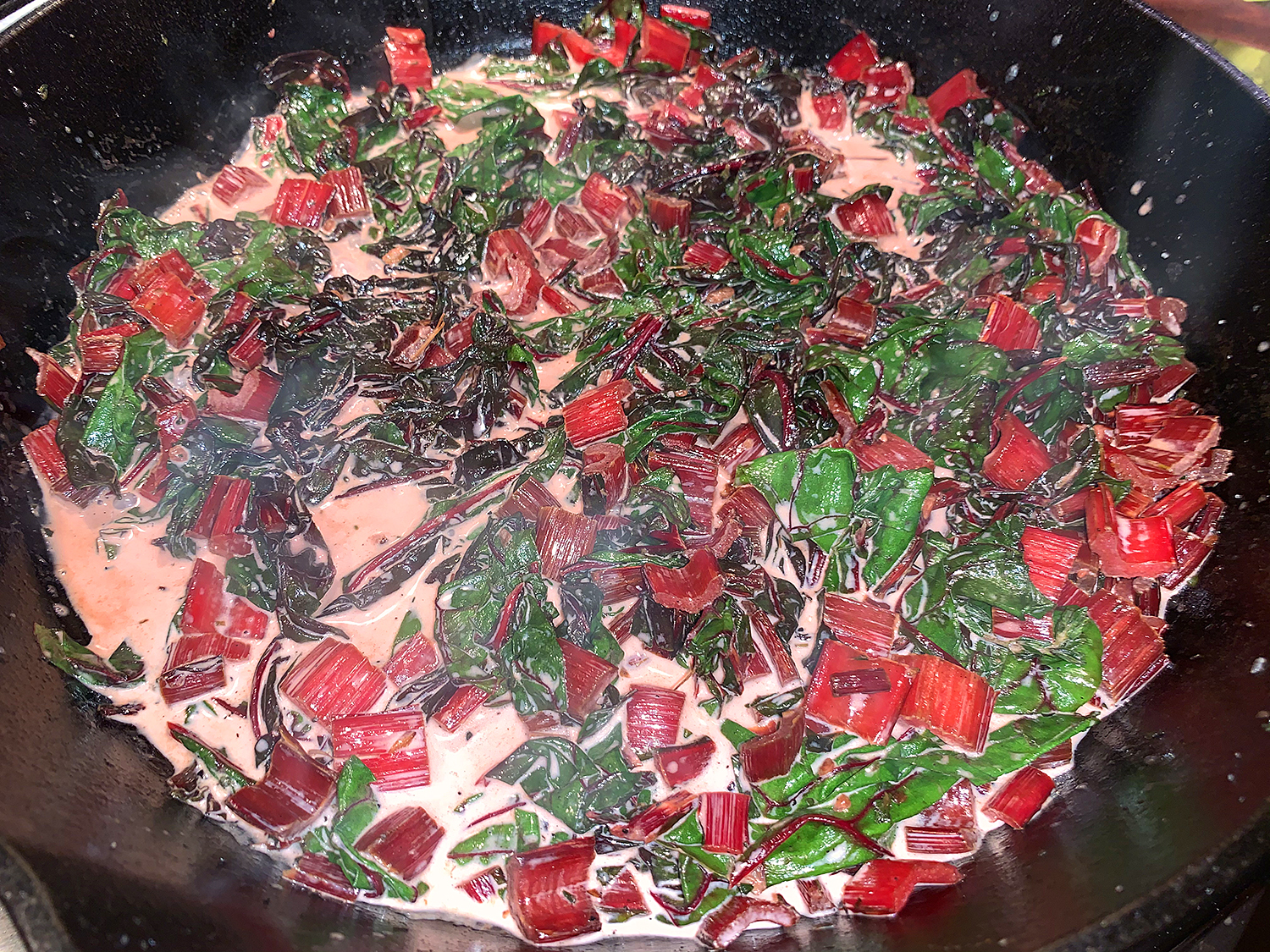
  9. Add the cream, bring to a boil, then adjust the heat to simmer until reduced by half, about 3 minutes.
    IMG_4406
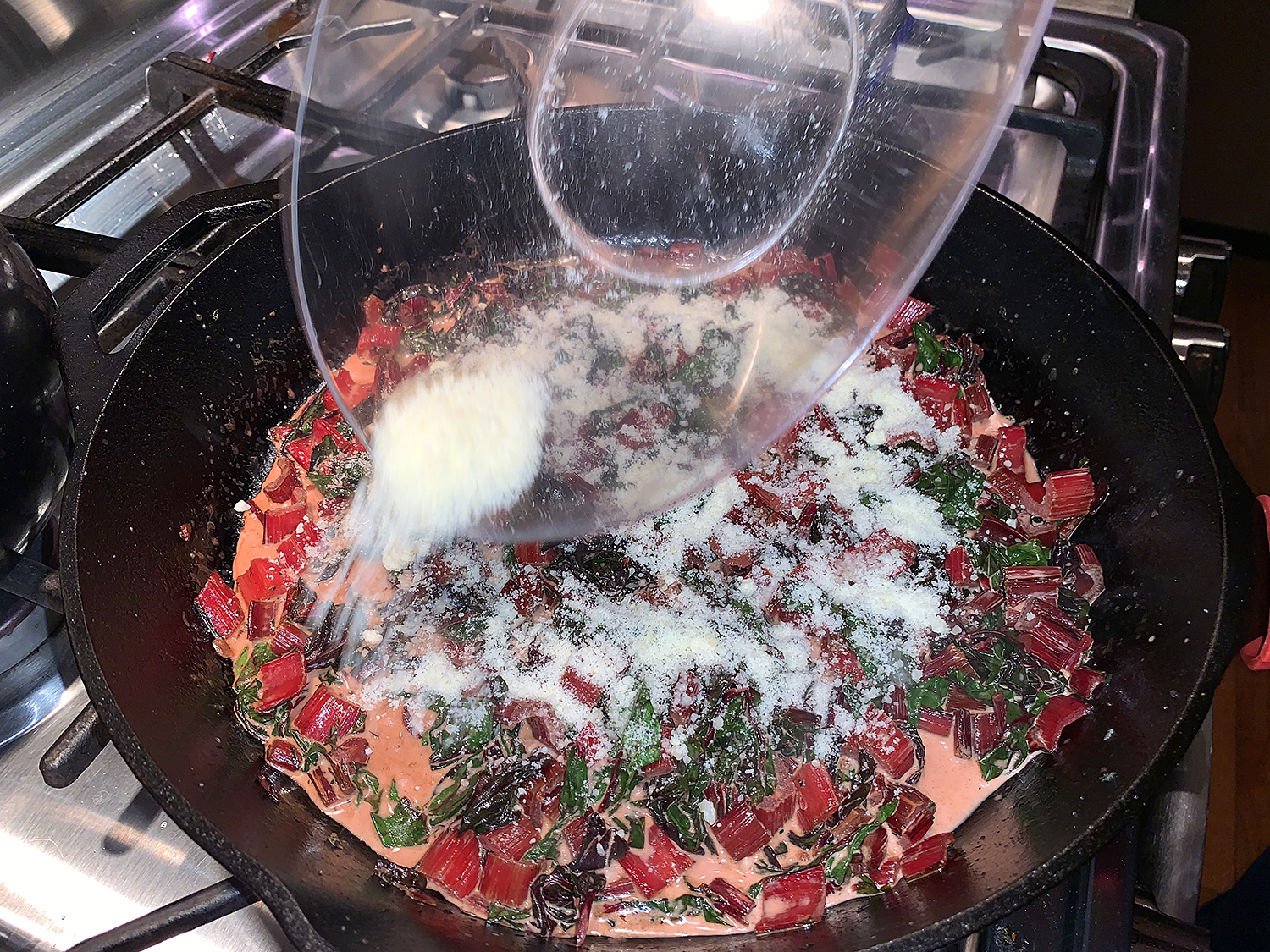
  10. Off the heat, stir in the lemon juice and Parmigiano. Season to taste with more lemon juice, salt, and pepper. Serve with the steaks.
    IMG_4407

http://www.lynnandruss.com

Adapted from a recipe by Nadia Arumugam